

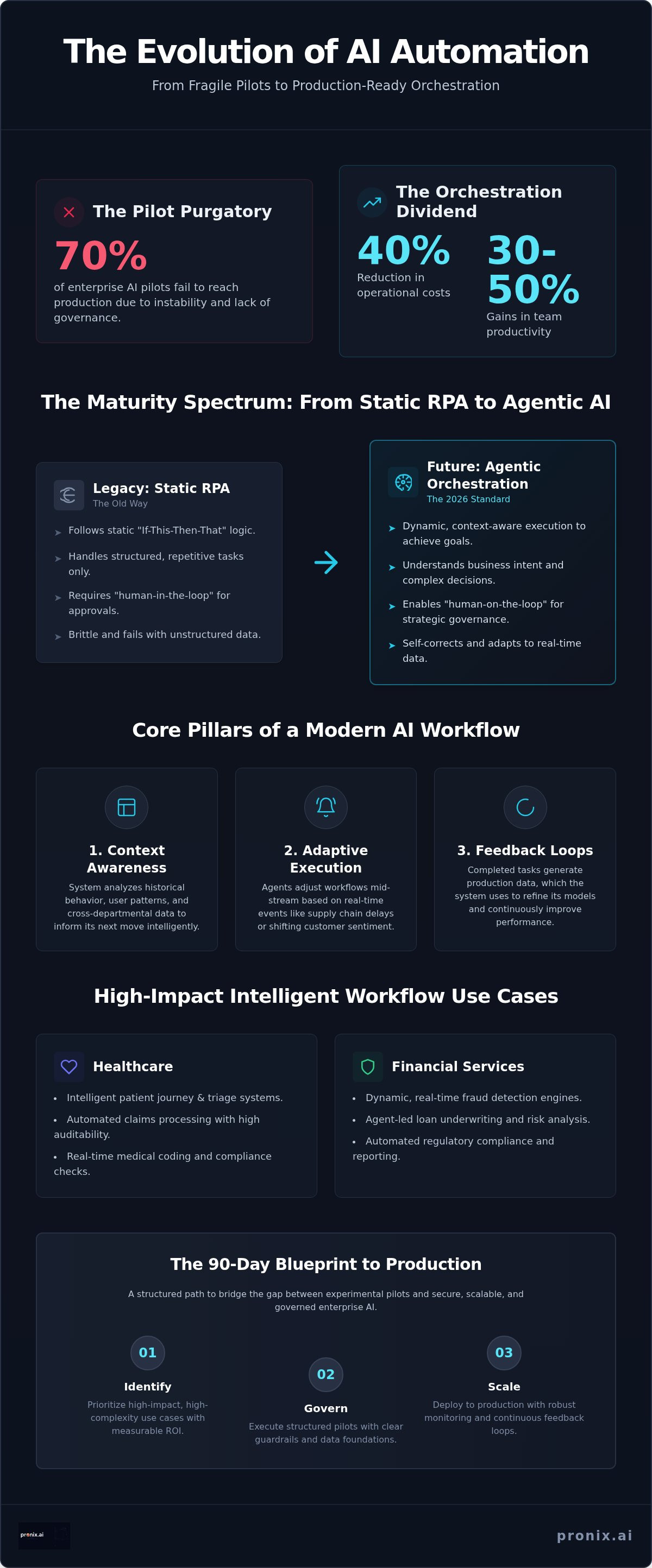
Nearly 70% of enterprise AI pilots fail to reach production, yet McKinsey research indicates that intelligent workflow automation use cases can reduce operational costs by up to 40%. You've likely seen the friction caused by legacy systems and the instability of ungoverned autonomous agents. Static RPA is no longer sufficient for the demands of 2026. It's time to move toward agentic orchestration that prioritizes stability, auditability, and risk mitigation.
This article examines high-impact strategies that deliver measurable ROI and production-ready outcomes. You'll discover how top-tier enterprises are transitioning from simple triggers to sophisticated, agent-led workflows that improve customer experience and employee productivity. We provide a clear roadmap for AI automation, ensuring your strategy aligns with the latest regulatory frameworks like the EU AI Act and California's transparency laws. By moving from experimental pilots to governed execution, your organization can capture the 30% to 50% productivity gains now possible through orchestration tools.
Key Takeaways
- Transition from static "if-this-then-that" logic to dynamic, context-aware agentic AI that adapts to real-time enterprise data.
- Identify and prioritize high-impact intelligent workflow automation use cases that deliver measurable ROI while maintaining strict operational governance.
- Modernize customer experience by deploying autonomous service agents capable of resolving complex, end-to-end issues without manual intervention.
- Execute a structured 90-day blueprint to bridge the gap between experimental AI pilots and secure, scalable production environments.
- Partner with specialized systems integrators to manage data foundations and ensure long-term stability in an evolving regulatory landscape.
What is Intelligent Workflow Automation in the Agentic Era?
2026 marks the end of the experimental AI pilot. Enterprises have moved past the novelty of generative chat and are now demanding production-ready systems that deliver measurable ROI. This evolution is driven by the convergence of Agentic AI, machine learning, and business process management (BPM). This synergy transforms traditional operations into self-correcting systems that don't just follow instructions but achieve objectives.
To understand What is Intelligent Workflow Automation in this context, you must look beyond simple task completion. It's no longer about static "If-This-Then-That" logic. Modern intelligent workflow automation use cases focus on dynamic, context-aware execution where the system understands the "why" behind a process, not just the "how."
Intelligent workflow automation is a self-optimizing framework that utilizes autonomous agents to orchestrate complex business functions by dynamically adjusting its logic based on real-time environmental data and enterprise goals.
From RPA to Agentic AI: The Maturity Spectrum
Traditional Robotic Process Automation (RPA) served its purpose for structured, repetitive tasks. It fails, however, when faced with unstructured data or complex decision-making. Agentic AI bridges this gap. By integrating Large Language Models (LLMs), these systems interpret business intent rather than just following a script. These advanced intelligent workflow automation use cases move the workforce from a "human-in-the-loop" model, where people must approve every step, to a "human-on-the-loop" governance structure. In this mature state, humans provide oversight and strategic guardrails while the AI handles the execution.
The Core Components of an Intelligent Workflow
Scaling these systems requires three fundamental architectural pillars that ensure stability and performance:
- Context Awareness: The system doesn't treat every request as a fresh start. It analyzes historical behavior, user patterns, and cross-departmental data to inform its next move.
- Adaptive Execution: Workflows aren't linear. If a supply chain delay occurs or a customer's sentiment shifts mid-interaction, the agent adjusts the workflow mid-stream to optimize the outcome.
- Feedback Loops: Every completed task generates production data. The system uses this data to refine its internal models, ensuring that performance improves with every transaction.
This structural maturity is why 2026 is the year of the production-ready workflow. Organizations are no longer testing if AI works. They're scaling how it works across the entire enterprise to drive efficiency.
High-Impact Intelligent Workflow Automation Use Cases by Industry
Identifying the right intelligent workflow automation use cases requires a focus on high-value, high-complexity tasks where human error or delay is most costly. While simple RPA handles repetitive entry, agentic AI thrives in the friction points between departments. Cross-departmental handoffs often create the biggest bottlenecks in large organizations. By deploying autonomous agents, enterprises can synchronize these handoffs without manual intervention. Industry-specific agents handle compliance-heavy tasks by mapping complex regulatory requirements directly into automated decision-making frameworks.
This strategic shift ensures that automation isn't just a cost-saving measure but a driver of operational maturity. Organizations that prioritize these high-impact areas see faster ROI because they solve the problems that actually stall growth.
Healthcare: Automating Patient Journeys and Compliance
In the healthcare sector, AI-driven CX modernization is transforming the patient journey. Intelligent triage systems now manage appointment scheduling by analyzing patient history and urgency in real-time. Beyond scheduling, agents automate claims processing and medical coding with high levels of auditability. These systems must operate within a secure enterprise data strategy for AI to protect sensitive patient information. This level of rigor is similar to the frameworks discussed in the report on Improving Government Outcomes with Intelligent Automation, which highlights how large-scale institutions manage complex public health data.
Financial Services: Fraud Detection and Loan Underwriting
Finance leaders use agentic orchestration to solve two primary challenges: fraud and underwriting. Real-time fraud pattern recognition now triggers automated mitigation workflows, freezing accounts or flagging transactions in milliseconds. For loan underwriting, agents navigate multiple legacy systems to aggregate data, assess risk, and generate a decision. This process ensures regulatory compliance through automated audit trails and risk reporting. If you're looking to build these capabilities, Agentic AI strategy and consulting can help bridge the gap between legacy friction and modern efficiency.
Manufacturing: Supply Chain and Predictive Maintenance
On the factory floor, autonomous agents manage inventory levels by interpreting predictive demand signals. This prevents overstocking while ensuring production never stalls. Procurement workflows, from initial request to final reconciliation, are streamlined to eliminate manual data entry. By integrating AI with IoT data, manufacturers can achieve proactive process adjustments, where the workflow itself changes based on equipment performance or supply chain shifts. This level of connectivity turns the factory into a self-optimizing environment that responds to market changes instantly.
Modernizing Customer Experience with Intelligent Workflows
Customer experience has emerged as the primary front line for intelligent workflow automation use cases in 2026. The shift is driven by a move away from basic, menu-driven chatbots toward autonomous service agents that resolve issues end-to-end. These agents don't just provide information; they execute actions across disparate systems to deliver immediate outcomes. This transition to AI-driven CX modernization directly addresses high operational friction and rising agent attrition by offloading complex, repetitive tasks to intelligent systems. When human agents are freed from mundane data entry, productivity increases and organizational morale improves.
Enterprises are integrating these modern workflows with established platforms like AWS Connect and Genesys Cloud. This integration allows for a seamless transition where AI agents handle initial interactions and only escalate the most nuanced cases to human representatives. This hybrid model ensures that the contact center remains a stable environment while benefiting from the speed of automation. It prioritizes safety and compliance, ensuring every automated response aligns with corporate policy and regulatory standards.
Hyper-Personalization at Scale
True personalization requires more than just using a customer's name. It involves using historical data to anticipate needs before the first contact occurs. Intelligent workflows analyze past behavior to offer proactive solutions, such as notifying a user of a resolved system issue before they call to report it. Dynamic routing now relies on real-time sentiment and intent analysis, ensuring customers reach the right resource instantly. After the interaction, the system automates post-call summaries and follow-up actions. This reduces the administrative burden on service agents, contributing to the 30% to 50% productivity gains observed in automated environments.
Orchestrating Complex Service Logic
The real power of agentic AI lies in its ability to handle multi-step resolutions involving external API integrations. For example, resolving a billing dispute often requires verifying payment history, checking service logs, and adjusting account balances across multiple legacy databases. In 2026, autonomous agents perform these steps without manual intervention, providing a resolution in seconds rather than days. By building enterprise AI agents specifically for these complex logic paths, organizations significantly reduce average handle time (AHT) and improve first-contact resolution rates. This level of orchestration ensures that every interaction is backed by a rigorous framework, moving the contact center from a cost center to a strategic value driver.
The Path to Production: Implementation and Governance
Transitioning from a conceptual pilot to a governed production environment is the most difficult hurdle in enterprise AI. While identifying intelligent workflow automation use cases is the first step, the real challenge lies in execution. Most firms stall because they lack a clear roadmap for scaling. A structured "90-Day Blueprint" provides the necessary milestones to move from a controlled experiment to a production-ready outcome. This process begins with a robust enterprise data strategy for AI to ensure that agents operate on accurate, real-time information. Accuracy is the foundation of trust.
To scale effectively, organizations should follow a disciplined, five-step sequence:
- Data Foundation Audit: Verify the quality, security, and accessibility of existing enterprise data.
- Governance Framework Design: Establish strict guardrails for agent behavior and bias mitigation.
- High-Impact Pilot Execution: Deploy a targeted automation in a high-value area to prove ROI.
- Agentic Orchestration Integration: Connect autonomous agents to cross-departmental legacy systems.
- Enterprise-Wide Scaling: Replicate success across business units while maintaining centralized oversight.
Enterprise-Grade Governance and Security
Governance remains the primary barrier to AI success in large firms. Implementing guardrails prevents agent hallucination and bias, ensuring every output remains within corporate standards. Auditability is mandatory. Every decision made by an autonomous agent must be tracked and logged for compliance reviews. Role-based access control (RBAC) ensures that AI agents only interact with data they're authorized to process. This level of discipline is essential for successful Agentic AI Implementation in regulated sectors.
Measuring ROI and Operational Maturity
Success in 2026 is measured by more than just "hours saved." Enterprises now focus on revenue acceleration and risk reduction. Use the enterprise AI maturity model to benchmark your progress against industry peers. Continuous optimization is the final stage of the journey. Managed services play a critical role here, maintaining workflow health and adjusting agents as production data reveals new patterns of behavior. This ensures that your automation strategy remains stable and scalable over the long term.
Scaling Success with [pronix.ai] Managed Services
Enterprises frequently underestimate the complexity of maintaining intelligent workflow automation use cases once they leave the pilot phase. Strategic success requires more than a software license; it demands a partner capable of navigating legacy friction and modern data architecture. Leading organizations choose pronix inc because they provide the specialized talent needed to bridge the gap between high-level strategy and technical execution. From initial design to long-term management, these end-to-end services ensure that AI foundations remain secure and scalable.
Bridging the talent gap is critical in 2026. Internal teams often lack the specialized AI and CX practitioners required to build and govern autonomous agents. By focusing on Agentic AI implementation services, we deliver outcomes that prioritize stability and risk mitigation. Our practitioners understand the nuances of regulated sectors like healthcare and finance, where data governance is non-negotiable. This expertise ensures that your automation strategy isn't just innovative but also audit-ready and compliant with global standards.
Expert Implementation Across Major Platforms
Deep technical expertise across major platforms is a prerequisite for modern automation. We specialize in AWS Connect, Microsoft Azure, and Salesforce Agentforce, ensuring that custom agents integrate seamlessly with your existing stack. Every business logic is unique; therefore, we design agents tailored to your specific operational requirements. Our rapid deployment frameworks minimize disruption to legacy systems, allowing for a swift transition to agentic orchestration without compromising the integrity of your current operations. This pragmatism allows for speed without the typical risks of large-scale transformation.
The Managed Services Advantage
The work doesn't end at deployment. Managed services provide the ongoing monitoring and tuning required to maintain workflow health as production data evolves. We provide continuous optimization, adjusting agent behavior based on real-time performance metrics and feedback loops. This ensures long-term stability and security in a shifting AI landscape. As regulatory requirements like the EU AI Act or California's transparency laws evolve, we ensure your intelligent workflow automation use cases remain compliant. This strategic partnership aligns AI outcomes with your evolving business goals, providing a disciplined path to long-term operational maturity and measurable ROI.
Moving Toward Governed Agentic Orchestration
The defining operational shift of 2026 is the transition from static automation to dynamic, governed agentic orchestration. Success requires moving beyond experimental pilots into scalable, production-ready environments that deliver measurable ROI. By prioritizing high-impact intelligent workflow automation use cases in high-friction areas, your organization can capture significant productivity gains while maintaining strict compliance and safety standards. Stability and auditability are no longer optional; they're the foundation of enterprise maturity.
Our team brings deep technical expertise in AWS, Salesforce, and Genesys to help you execute a 90-Day Production Blueprint backed by an Enterprise-Grade Governance Framework. We focus on bridging the gap between high-level strategy and "boots-on-the-ground" implementation. Schedule a Strategic AI Consultation with pronix.ai to transform your legacy operations into a self-optimizing system built for the future. The era of autonomous enterprise operations is here, and your organization is ready to lead the way.
Frequently Asked Questions
What is the difference between RPA and intelligent workflow automation?
RPA is built for repetitive, rule-based tasks with structured data. It lacks the ability to handle nuance or shift logic mid-stream. In contrast, intelligent workflow automation use cases utilize agentic AI to interpret business intent and manage unstructured information. These systems don't just follow a script; they orchestrate complex processes across multiple platforms, adapting to real-time data to achieve specific outcomes rather than just repeating clicks.
How do I choose the first use case for AI automation in my business?
Identify high-friction, high-value tasks where manual coordination creates bottlenecks. Focus on processes with clear success metrics and existing data foundations, such as claims processing in finance or patient triage in healthcare. Choosing intelligent workflow automation use cases that involve cross-departmental handoffs often yields the highest ROI. This approach solves immediate operational pain while providing a stable proof of concept for broader enterprise scaling.
Is intelligent workflow automation secure for highly regulated industries?
Yes, provided the implementation includes an enterprise-grade governance framework. Security in 2026 relies on role-based access control (RBAC), data encryption, and real-time auditability. Every decision an autonomous agent makes must be logged for compliance reviews. By establishing these guardrails early, organizations in healthcare and finance can safely automate complex service logic while meeting strict regulatory requirements like the EU AI Act or TRAIGA.
What are the common challenges when moving AI agents from pilot to production?
Many organizations fail because they treat AI as a software purchase rather than an operational shift. Common barriers include fragmented data architecture, a lack of clear governance, and the absence of a production roadmap. Moving agents from a controlled pilot to a live environment requires more than technical skill; it demands a disciplined framework that handles edge cases and ensures agent behavior remains predictable and secure at scale.
How long does it take to deploy a governed intelligent workflow?
A governed deployment typically follows a 90-day production blueprint. This timeline allows for a structured progression from data foundation auditing and governance design to pilot execution and enterprise-wide scaling. While simple triggers take less time, production-ready agentic workflows require this window to ensure stability, security, and full integration with legacy systems. This methodical approach prioritizes long-term operational maturity over speculative, unmanaged speed.
What platforms does pronix.ai support for AI automation implementation?
We support a broad ecosystem of enterprise-grade platforms to ensure flexibility and scalability. Our technical expertise covers AWS Connect, Microsoft Azure, and Salesforce Agentforce. Additionally, we implement solutions using Kore.ai, Genesys, and NICE. This multi-platform capability allows us to design custom agentic workflows that integrate directly with your existing infrastructure, ensuring minimal disruption to your legacy systems while modernizing your customer and employee experiences.
How do I measure the ROI of intelligent workflow automation?
Measure success by tracking productivity gains, operational cost reductions, and revenue acceleration. McKinsey research indicates that intelligent automation can reduce costs by 30% to 40% in targeted areas. Beyond financial metrics, evaluate improvements in customer satisfaction (CSAT) and employee retention. A mature ROI analysis also accounts for risk mitigation, as automated audit trails and governed agents reduce the likelihood of compliance failures and manual errors.