

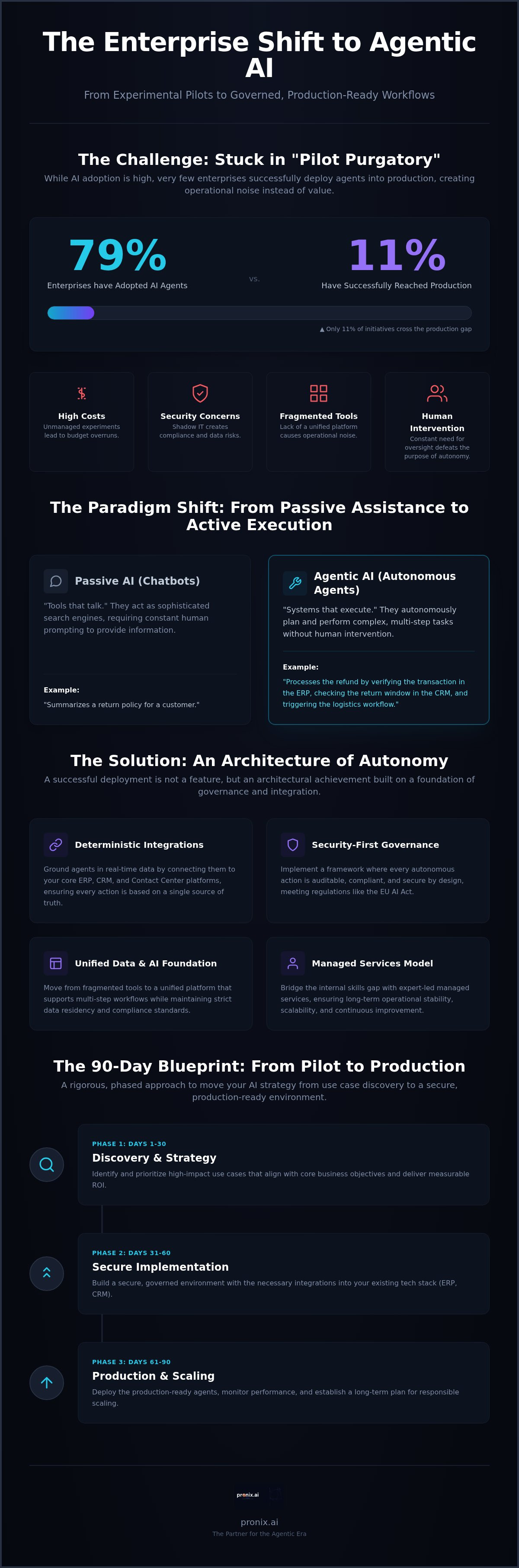
While 79% of enterprises have adopted AI agents in some form, only 11% have successfully moved them into production as of 2026. Most organizations find their AI initiatives stuck in a pilot purgatory where fragmented tools create more operational noise than measurable value. You likely recognize the friction: high costs, security concerns, and the constant need for human intervention. To bridge this gap, leadership teams are shifting their focus toward professional Agentic AI implementation services that prioritize governance over experimentation. It's no longer about whether the technology works; it's about whether it can be trusted to execute autonomously within a regulated environment.
You need a framework that moves beyond "tools that talk" to "systems that execute." This guide outlines how to transition from isolated pilots to secure, scalable workflows that drive enterprise ROI. We'll explore the path to operational maturity, including the 2026 transparency requirements under the EU AI Act and the structural shifts required for multi-agent collaboration. From initial strategy to long-term managed services, you'll learn how to build a governed environment where AI agents operate with precision and accountability. Here is your roadmap for turning autonomous potential into production reality.
Key Takeaways
- Identify why the transition from passive chatbots to active, autonomous agents is the primary driver of enterprise ROI in 2026.
- Understand the architectural requirements for Agentic AI implementation services, including the integration of autonomous workflows with your existing ERP and CRM systems.
- Adopt a rigorous 90-day blueprint that moves your AI strategy from high-impact use case discovery to a secure, production-ready environment.
- Establish an enterprise-grade governance framework to manage the security and compliance risks of autonomous agents in regulated markets.
- Learn how to bridge the internal skills gap by leveraging a managed services model for long-term operational stability and scalability.
Beyond Chatbots: Why Enterprises Require Agentic AI Implementation Services Now
Agentic AI represents a fundamental shift in enterprise technology. It's the transition from systems that generate text to systems that execute actions. Unlike traditional chatbots that require constant prompting to be useful, agentic systems are autonomous. They plan their own steps; they select the appropriate digital tools; and they navigate complex, multi-step workflows without human intervention. This shift marks the move from "Passive AI," which acts as a sophisticated search engine, to "Active AI," which functions as a digital workforce.
In 2026, the market has reached a point of operational maturity. The novelty of large language models has faded, replaced by a demand for measurable ROI and structural stability. Enterprises are realizing that standard internal IT cycles are often insufficient for this level of complexity. Orchestrating autonomous agents requires a specialized layer of governance and integration that goes beyond simple API calls. This is why professional Agentic AI implementation services have become a requirement for organizations looking to move past experimental phases and into full-scale production.
The Shift from Passive Assistance to Autonomous Execution
Passive AI summarizes a return policy. Active AI processes the refund. This distinction is the core of the agentic revolution. Modern AI Agents utilize reasoning loops to evaluate their own progress and adjust their actions in real time. For example, a customer service agent in a production environment doesn't just explain how to return a product. It verifies the transaction in the ERP; checks the return window in the CRM; and triggers the logistics workflow via API. It's a closed-loop system that moves beyond assistance into the realm of true execution. These systems don't just talk about work; they do it.
The High Cost of Pilot Purgatory
The gap between adoption and production remains the primary challenge for leadership teams. While 79% of enterprises have adopted AI agents in some capacity, only 11% have successfully deployed them into production as of 2026. This "pilot purgatory" creates significant hidden costs. Fragmented, unmanaged AI projects lead to shadow IT environments that lack proper oversight. Without professional Agentic AI implementation services, these initiatives often fail due to security risks or a lack of alignment with legacy infrastructure. Professional implementation mitigates these risks by establishing a governed framework from day one. It ensures that every autonomous action is auditable, compliant with the August 2026 EU AI Act transparency rules, and aligned with core business objectives. Moving to production isn't just about the technology; it's about the discipline of the deployment.
The Architecture of Autonomy: Core Pillars of Enterprise-Grade AI Agent Deployment
Autonomy in the enterprise isn't a feature; it's an architectural achievement. Moving beyond simple prompts requires a rigid structural foundation that connects reasoning models to operational data. While Stanford HAI defines Agentic AI as systems capable of pursuing complex goals with limited supervision, achieving this in a corporate environment requires deterministic integrations. These integrations ensure that agents stay grounded in real-time data from your ERP, CRM, and Contact Center platforms. Without this grounding, autonomous systems become liabilities rather than assets. High-quality Agentic AI implementation services prioritize this connectivity, ensuring that every action an agent takes is based on a single, verified source of truth.
For regulated industries like finance and healthcare, the architecture must be security-first by design. It's not enough for an agent to be "smart." It must be auditable. This requires a transition from fragmented AI tools to a unified Data & AI Foundation that supports multi-step workflows while maintaining strict data residency and compliance standards. Building these foundations is the only way to ensure that your autonomous systems are ready for the rigors of production.
Data Foundations and RAG Orchestration
An agent's reasoning is only as good as the data architecture supporting it. Most organizations struggle with "dark data"-unstructured information siloed across legacy systems that agents cannot access or interpret. Professional Agentic AI implementation services address this by implementing advanced Retrieval-Augmented Generation (RAG) pipelines. This orchestration layer cleans and indexes enterprise data, allowing agents to pull factual, real-time context before executing a task. This process eliminates the "knowledge gap" that often leads to errors in unmanaged AI pilots. You can stabilize your internal infrastructure and prepare for autonomy by establishing a robust Data & AI Foundation tailored to your specific operational needs.
Governance Guardrails and Responsible AI
As of August 2, 2026, the EU AI Act mandates strict transparency for any AI system interacting with humans. This makes governance a technical requirement, not just a policy preference. Enterprise-grade deployment includes autonomous verification gates that evaluate an agent's output before it reaches a customer or a database. For high-stakes actions, such as processing medical records or approving financial transactions, we implement "Human-in-the-loop" (HITL) triggers. These triggers ensure that agents handle the heavy lifting while humans retain control over final decisions. This dual-layer approach provides the auditability required for modern compliance while reducing the operational costs of manual oversight.
Evaluating Implementation Partners: Strategy, Governance, and Managed Outcomes
Selecting a partner for autonomous transformation is a decision about operational stability. Many firms can write code, but few can operationalize autonomy within a complex legacy architecture. You must distinguish between "AI Development" and "AI Implementation." Development is often a project-based effort to build a specific tool. In contrast, Agentic AI implementation services focus on the entire lifecycle of the system. They ensure that an agent doesn't just exist in a vacuum but interacts correctly with your mainframe, cloud infrastructure, and security protocols. Performance is the only metric that matters.
Platform-agnostic expertise is a non-negotiable requirement in 2026. Your organization likely utilizes a mix of AWS, Salesforce, Microsoft, and Genesys. A partner tied to a single ecosystem will create silos. You need a practitioner who understands how to orchestrate agents across these diverse environments. Furthermore, industry-specific knowledge in sectors like Healthcare and Finance is critical. These fields carry unique compliance burdens that a generalist will overlook. Expertise in regulated markets ensures that your agents are built with the auditability required to survive a 2026 regulatory review.
Technical Integration vs. Strategic Transformation
"Bolting on" AI to existing systems is a recipe for technical debt. It creates fragmented workflows that are difficult to maintain and impossible to scale. When evaluating a partner, ask direct questions about their governance framework. How do they handle model drift? What is their process for securing the data layer? Strategic transformation starts with CX modernization. By focusing on customer experience first, you can prove the value of agentic reasoning in a high-impact, measurable environment. This approach allows you to build a foundation for broader Agentic AI implementation services across the rest of the enterprise.
The Managed Services Advantage
Agentic AI is not a "set it and forget it" technology. These systems require 24/7 monitoring to ensure they remain within their operational guardrails. This is why a "Talent as a Service" model is often more effective than building an entire internal team from scratch. Managed services provide continuous optimization. Agents must learn from edge cases and improve their reasoning post-deployment. A dedicated partner manages the security layer, protecting your agents from prompt injection and unauthorized data access. This ongoing management ensures that your autonomous workflows remain secure, compliant, and aligned with your shifting business objectives. Implementation is a lifecycle, not a launch.
The 90-Day Blueprint: Moving Your Agentic AI Strategy from Pilot to Production
Execution requires a timeline, not just a vision. Most AI initiatives stall because they lack a clear path from a successful proof-of-concept to a live, governed environment. A structured 90-day blueprint eliminates this inertia by breaking the transition into three distinct, goal-oriented phases. This methodical approach ensures that Agentic AI implementation services deliver measurable results rather than perpetual experimentation. Speed is essential, but it must be balanced with the operational maturity required for enterprise-scale deployment.
- Phase 1: Strategy & Discovery (Days 1-30). We identify high-impact use cases and audit existing data foundations. This phase defines the success metrics and governance guardrails.
- Phase 2: Technical Foundation & Pilot (Days 31-60). We build the secure staging environment and configure the reasoning loops. This is where we stress-test the agent’s ability to use enterprise tools safely.
- Phase 3: Integration & Production Launch (Days 61-90). We connect the agents to live workflows in your CRM or ERP. The focus shifts to real-time monitoring and managed optimization.
Identifying High-ROI Use Cases
Success starts with the "Agentic Matrix." We map potential use cases by weighing technical complexity against immediate business value. The Contact Center is often the ideal starting point. It offers a high-volume environment where agents can process routine transactions, such as scheduling or basic troubleshooting, with low risk and high reward. Transitioning these tasks to autonomous agents yields immediate operational savings. We define "Production-Ready" metrics not just by the accuracy of the agent's response, but by its ability to resolve a ticket without human intervention. To begin your journey, you can schedule an Agentic AI Strategy & Consulting session to identify your most impactful entry points.
Technical Staging and Stress Testing
Production readiness requires rigorous validation. Before an agent interacts with live customer data, it must undergo extensive simulation of edge cases. We push the system to its limits to see how it handles ambiguous requests or conflicting data. Load testing is equally critical. An autonomous workflow that works for ten users must remain stable for ten thousand. During this phase, we finalize the governance and auditability dashboard. This provides leadership with a real-time view of every decision the agent makes. By the end of Day 60, the system is no longer a pilot. It's a hardened, enterprise-grade asset ready for the final launch phase. Professional Agentic AI implementation services ensure that this transition is seamless and secure.
Scaling Responsibly: Why pronix.ai is the Partner for the Agentic Era
Transitioning to an autonomous enterprise is a structural evolution. It requires a partner who understands the friction points of legacy infrastructure and the precision of modern reasoning models. At pronix.ai, we position ourselves as the bridge between your existing systems and intelligent, autonomous workflows. Our focus isn't just on the initial build; we prioritize production outcomes that drive measurable ROI. By choosing expert Agentic AI implementation services, you ensure that your transition is grounded in stability rather than speculation.
Success in 2026 depends on moving beyond the pilot phase. While many firms focus on the "what" of AI, we focus on the "how" of execution. We combine deep CX modernization expertise with a rigorous implementation framework to ensure your agents are ready for the high stakes of the real world. Our methodology prioritizes risk mitigation and operational readiness, allowing your organization to scale with confidence.
The pronix.ai Production Framework
Speed to market is a competitive advantage. We leverage our strategic partnerships with AWS, Salesforce, and Genesys to accelerate the deployment of your autonomous agents. These integrations allow us to build on established foundations while customizing the reasoning loops for your specific business needs. Governance is built into every layer of our framework. We ensure full compliance with the August 2026 EU AI Act transparency requirements, providing the auditability needed for regulated industries like healthcare and finance. Our framework accelerates productivity by aligning technical execution with enterprise-grade security standards.
Bridging the Talent Gap with Managed AI Services
The global enterprise agentic AI market is valued at approximately $3.9 billion in 2026, yet the internal skills gap remains the largest barrier to production. Enterprises often find that their internal teams are overwhelmed by the complexities of agent orchestration and security. Our Enterprise AI Managed Services solve this problem by providing specialized talent as a service. We handle the continuous monitoring, software updates, and security patches required to keep your agents performing at peak efficiency. This model protects your systems from prompt injection and data leakage while ensuring they adapt to new operational challenges. You don't need to build a new department to achieve autonomy; you need a partner who can manage the lifecycle for you. If you're ready to move from pilot to production, schedule your Agentic AI Strategy Consultation with pronix.ai today to begin your transformation.
Operationalizing the Future of Enterprise Autonomy
The transition to agentic AI is no longer a technical experiment; it is a structural necessity for 2026. Success requires moving beyond isolated pilots to build a deterministic architecture that connects reasoning to execution. Organizations must prioritize an enterprise-grade governance framework that satisfies global transparency standards while driving measurable ROI. By aligning your strategy with professional Agentic AI implementation services, you can bridge the internal talent gap and ensure your autonomous workflows remain secure, auditable, and scalable.
At pronix.ai, we specialize in navigating these complexities for high-stakes industries. We provide specialized talent for healthcare and finance alongside a proven track record with partners like AWS, Salesforce, and Genesys. Our methodology moves your organization from strategy to production in 90 days, ensuring your digital workforce is ready for the rigors of the modern market. It’s time to stop experimenting and start executing.
Move your AI agents to production with pronix.ai and lead your industry into the era of intelligent automation with confidence.
Frequently Asked Questions
What is the difference between an AI chatbot and an AI agent?
A chatbot is a passive system designed to generate text or answer questions based on user prompts. An AI agent is an active system capable of autonomous execution. Agents utilize reasoning loops to plan multi-step workflows, interact with APIs, and use enterprise tools to complete tasks. While a chatbot explains a policy, an agent executes the transaction within your ERP or CRM.
How much do agentic AI implementation services typically cost?
The investment depends on the complexity of the reasoning loops and the number of deterministic integrations required. Factors such as data architecture readiness, the scale of multi-agent orchestration, and specific regulatory requirements in healthcare or finance influence the total scope. Most enterprises find that professional Agentic AI implementation services provide a more predictable path to ROI by avoiding the hidden costs of failed pilots.
How do you ensure agentic AI stays compliant in healthcare and finance?
Compliance is maintained through a security-first architecture and autonomous verification gates. We implement Human-in-the-loop triggers for high-stakes decisions to ensure oversight in regulated markets. Every action taken by the agent is logged in a detailed audit trail, meeting the August 2026 transparency obligations of the EU AI Act and industry-specific requirements like HIPAA or SOC2.
What platforms do you support for agentic AI implementation?
We provide platform-agnostic Agentic AI implementation services across major enterprise ecosystems. Our expertise includes AWS, Microsoft Azure, Salesforce, and Genesys. This allows us to orchestrate agents that navigate across your existing cloud infrastructure and contact center platforms without creating new data silos or technical debt. This flexibility is essential for maintaining a unified data foundation.
How long does it take to move an AI agent from pilot to production?
Our structured blueprint moves an agent from strategy to production in 90 days. This timeline includes 30 days for discovery and use case mapping, 30 days for technical staging and stress testing, and a final 30 days for integration into live workflows. This methodical pace ensures that the system is hardened against edge cases and fully compliant with governance standards.
Can agentic AI work with our legacy contact center software?
Yes, agentic AI is designed to bridge the gap between modern reasoning models and legacy infrastructure. We use deterministic integrations to connect agents to your existing contact center software and databases. This enables autonomous workflows to pull real-time data and execute actions without requiring a complete overhaul of your current technology stack or disrupting existing customer service operations.
What are the biggest risks of implementing autonomous AI agents?
The primary risks include model hallucinations, security vulnerabilities like prompt injection, and a lack of auditability. Without a robust governance framework, autonomous agents can execute incorrect actions or expose sensitive data. We mitigate these risks by building verification gates and strict guardrails that keep the agent's reasoning grounded in your verified enterprise data and existing business rules.
Do we need to hire our own AI engineers if we use a managed service provider?
You don't need to build a full internal team if you leverage a managed service model. Our Talent as a Service approach provides the specialized expertise needed to monitor, secure, and optimize your agents 24/7. This allows your internal IT staff to focus on core business objectives while we handle the technical orchestration and continuous updates required for production stability.