

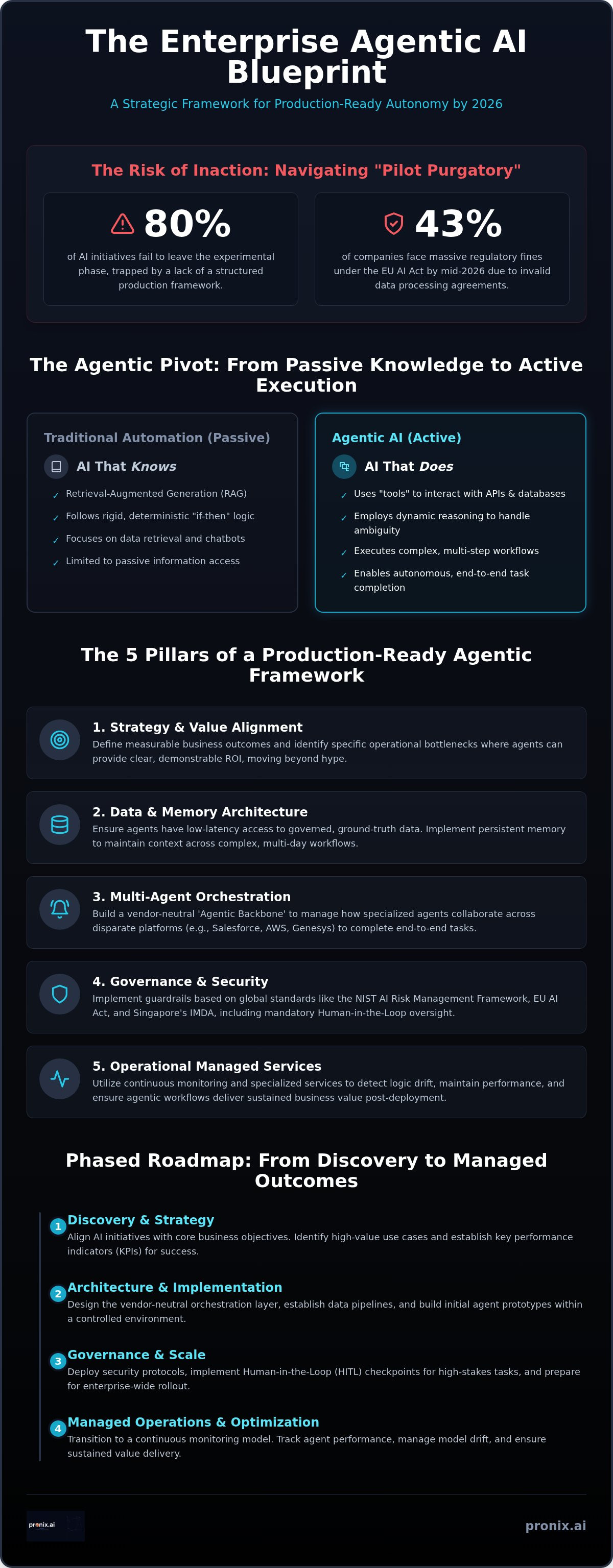
By mid-2026, 43% of companies deploying customer-facing AI still lack valid data processing agreements, exposing them to massive regulatory fines under the now fully enforceable EU AI Act. Most leadership teams realize that isolated pilots have reached their limit. You've likely felt the frustration of experimentation purgatory, where promising agents stall because they lack a clear agentic AI adoption framework for production. The risk of unmanaged autonomous agents causing reputational damage is no longer a theoretical concern; it's a board-level liability.
We agree that the shift to autonomous agents requires more than just better prompts. It demands a rigorous strategy that prioritizes stability, auditability, and measurable ROI. This blueprint provides the strategic roadmap you need to transition from fragmented tests to a governed, high-scale enterprise. You'll learn how to build a vendor-neutral orchestration layer and implement a governance model that satisfies global compliance standards like Singapore’s IMDA framework. We're moving past the hype to deliver a practitioner-led strategy that bridges the gap between initial strategy and long-term production management.
Key Takeaways
- Replace rigid automation with dynamic reasoning by implementing a structured agentic AI adoption framework designed for high-scale enterprise production.
- Secure your deployment by mastering the five pillars of operational maturity, specifically memory architecture and governed data access.
- Establish a governance model that satisfies 2026 compliance requirements. This includes mandatory Human-in-the-Loop oversight for high-stakes API interactions.
- Transition from isolated experiments to a governed enterprise using a phased roadmap focused on vendor-neutral orchestration.
- Leverage specialized managed services to prevent post-deployment drift and ensure your agentic workflows deliver sustained business value.
The Agentic Pivot: Why Standard AI Frameworks Fail at Scale
Enterprise technology has reached a critical inflection point. Standard AI implementations, once focused on simple chatbots and data retrieval, no longer meet the demands of a high-velocity market. Success in 2026 requires a formal agentic AI adoption framework. This structured methodology moves beyond experimental scripts. It establishes the architectural and governance standards necessary for deploying autonomous agents that can reason, plan, and execute complex workflows without constant human intervention.
Traditional automation is deterministic. It follows rigid "if-then" logic. Agentic workflows are dynamic. They use generative reasoning to navigate ambiguity and adjust their path based on real-time feedback. This shift is why legacy Cloud Adoption Frameworks (CAF) often fail. A standard CAF prioritizes infrastructure uptime and data storage. It lacks the nuance required for autonomous decision-making, identity management for non-human actors, and the containment of logic loops. Without a specialized framework, 80% of AI initiatives remain trapped in "pilot purgatory," failing to ever reach a stable production environment.
From Passive RAG to Active Agents
The first stage of enterprise AI focused on Retrieval-Augmented Generation (RAG). It allowed systems to "know" things by searching internal documents. This was passive. The 2026 production blueprint moves toward active agents. These systems don't just find information; they use "tools" and "actions" to interact with CRM systems, ERP databases, and external APIs. They execute the task they researched. Scaling these operations often involves complex multi-agent systems where specialized entities collaborate to solve multifaceted business problems. Agentic AI marks the fundamental shift from "AI that knows" to "AI that does."
The Enterprise Maturity Gap
Legacy data architectures often collapse under agentic demands. Agents require low-latency access to governed, ground-truth data to make accurate decisions. When data is siloed or inconsistent, agents produce unreliable outcomes. This technical friction creates a "trust deficit" among executive leadership. Decision-makers hesitate to authorize autonomous actions without clear guardrails and audit trails. Bridging this gap requires a disciplined approach to data foundations and a clear strategy for human-in-the-loop oversight. For those requiring specific technical benchmarks, our Enterprise Agentic AI: 2026 Production Guide details the necessary infrastructure standards to overcome these maturity hurdles. Operational maturity isn't about the model you choose; it's about the framework that manages it.
The 5 Pillars of a Production-Ready Agentic AI Framework
Moving from an experimental pilot to a stable production environment requires a multidimensional agentic AI adoption framework. It isn't enough to simply deploy a model. You must architect an ecosystem where autonomy is balanced with rigorous oversight. This blueprint identifies five core pillars that sustain high-scale agentic operations in 2026.
- Strategy and Value Alignment: Define measurable business outcomes. Move beyond the hype cycle to identify where agents solve specific operational bottlenecks.
- Data and Memory Architecture: Ensure agents access governed, ground-truth data. Persistent memory enables agents to maintain context across complex, multi-day workflows.
- Multi-Agent Orchestration: Manage how distinct agents collaborate across disparate platforms to complete end-to-end tasks.
- Governance and Security: Implement guardrails based on the NIST AI Risk Management Framework to ensure safety without stifling innovation.
- Operational Managed Services: Utilize continuous monitoring to detect logic drift and maintain performance in a live environment.
Orchestration: The Multi-Platform Reality
Most enterprises don't operate on a single stack. Your 2026 strategy must manage agents across Salesforce Agentforce, AWS, and Genesys simultaneously. A centralized Agentic Backbone is essential for global operations. This backbone ensures that a customer service agent on one platform can hand off tasks to a logistics agent on another without losing critical context. Prioritizing a vendor-neutral implementation prevents platform lock-in. It gives your organization the flexibility to swap underlying models as technology evolves. Our team at Pronix specializes in building these vendor-agnostic orchestration layers to ensure long-term agility.
Data Foundations for Autonomous Reasoning
Agents are only as effective as the data they consume. They require real-time, high-fidelity data streams to perform dynamic reasoning. Static databases and batch processing no longer suffice for agents that must make split-second decisions. Establishing robust Enterprise AI Data Strategy: 2026 Production Foundations is the non-negotiable prerequisite for any agentic deployment. This foundation ensures that agents don't just act quickly; they act accurately based on the most current enterprise truth. High-fidelity data minimizes hallucination and builds the executive trust necessary for scaling full autonomy across the business.
Governing Autonomy: Risk Mitigation in Regulated Industries
Regulated industries face a unique paradox. The efficiency of autonomous agents is attractive, but the liability of an unmanaged action is catastrophic. A robust agentic AI adoption framework must prioritize risk mitigation over pure speed. Unlike static AI, agentic systems introduce dynamic vulnerabilities like prompt injection, infinite logic loops, and unauthorized API calls. These aren't just technical glitches. They are compliance failures that can trigger million-dollar mistakes. Success in 2026 requires a "safety-first" architecture that treats every autonomous action as a potential audit event.
To prevent catastrophic errors, enterprises must implement a "Human-in-the-Loop" (HITL) requirement for all high-stakes decision-making. If an agent triggers a financial transaction above a defined threshold or modifies a sensitive healthcare record, a human must provide final authorization. This isn't a bottleneck; it's a necessary safety valve. It ensures that while the agent does the heavy lifting of reasoning and preparation, the final accountability remains with a qualified professional. We mitigate the "million-dollar mistake" by ensuring agents suggest actions while humans authorize them.
The Auditability Mandate
Compliance in 2026 requires more than just a log of the final output. Regulators now demand a reconstruction of the "reasoning chain" behind every autonomous decision. This is where Explainable AI (XAI) becomes essential. Every step an agent takes, from the initial data retrieval to the final recommendation, must be logged in a tamper-proof format. In finance and healthcare, these logs must be granular enough to prove the agent followed specific regulatory guardrails. Real-time monitoring of agent behavior allows teams to intervene before a logic loop escalates into an operational crisis. You don't just need to know what the agent did. You must be able to prove why it did it.
Security Guardrails for Agentic Workflows
Securing agentic workflows starts with the "Least Privilege" principle. An AI agent should only have access to the specific data and APIs required for its immediate task. Broad, administrative access is a significant liability. Advanced architectures now employ "Supervisor Agents" to monitor worker agent outputs. These supervisors act as a secondary layer of validation, checking for hallucinations or logic errors before any action is finalized. Implementing Enterprise AI Automation Managed Services provides the continuous oversight necessary to manage these risks at scale. This proactive approach transforms security from a reactive barrier into a strategic enabler of autonomous operations.
The Phased Roadmap: From Discovery to Managed Outcomes
Execution in 2026 requires moving beyond linear project management. A high-scale agentic AI adoption framework follows an iterative lifecycle. This ensures that agents don't just launch; they evolve alongside your business data. Transitioning from a theoretical use case to a managed production outcome involves five distinct phases of maturity. This roadmap prioritizes stability and measurable ROI at every milestone.
- Phase 1: Opportunity Assessment. Identify high-impact, low-risk agentic use cases.
- Phase 2: Architectural Design. Select the orchestration layer and secure data connectors.
- Phase 3: Pilot and Logic Tuning. Test agent reasoning in sandboxed environments.
- Phase 4: Production Integration. Embed agents into existing CX and business workflows.
- Phase 5: Managed Optimization. Refine performance via specialized AI talent.
Phase 1: Identifying the "Agentic Sweet Spot"
Don't fall into the trap of "Agent Overkill." If a task is deterministic and follows a fixed script, standard RPA or simple automation is more cost-effective. Agents excel where reasoning is required to bridge silos. Use this checklist to select your first pilot project:
- Does the workflow involve three or more disparate software platforms?
- Is there a need for dynamic planning based on unstructured input?
- Is high-fidelity, real-time data available for the agent to consume?
- Does the task require multi-step logic that changes based on intermediate results?
Architectural design starts once you've identified a suitable use case. You must select an orchestration backbone that supports your multi-platform reality. Before full integration, conduct logic tuning in a sandboxed environment. This allows your team to observe agent reasoning chains without impacting live customer interactions or financial workflows.
Phase 5: The Managed Services Imperative
Deployment is the beginning, not the end. Agents require more post-launch "care and feeding" than traditional software. They are prone to logic drift as underlying data models and business rules change. Managing this complexity requires specialized AI talent capable of tuning agent memory and refining prompt logic. Partnering with a vetted Enterprise AI Managed Service Provider ensures your systems maintain operational maturity long after the initial go-live. This continuous refinement is what separates a successful enterprise transformation from a stalled experiment. If you're ready to build a scalable, production-ready environment, consult with the implementation experts at Pronix to accelerate your roadmap.
Operationalizing the Framework with Pronix.ai
Successful implementation of a high-scale agentic enterprise requires more than a software license. It requires a partner who understands the friction points of modernizing legacy systems while maintaining operational maturity. At Pronix.ai, we operationalize the agentic AI adoption framework by bridging the gap between high-level strategic vision and secure production outcomes. We don't deal in speculative hype. We focus on evidence-based success and auditability for national, large-scale organizations.
Our approach prioritizes the transition from isolated pilots to governed, high-scale environments. We recognize that the most significant challenge isn't the initial build; it's the long-term management of autonomous entities. Through our Enterprise AI Managed Services, we provide the continuous oversight necessary to prevent logic drift and ensure every action remains within defined regulatory guardrails. This managed lifecycle ensures that your investment delivers sustained ROI without compromising security or reputational stability.
CX Modernization via Agentic AI
The contact center is the primary battlefield for enterprise AI. Standard automation often fails here due to the complexity of human interaction and the dynamic nature of customer needs. By leveraging our AI-Driven CX Modernization: The 2026 Enterprise Guide, we deploy agents that enhance both customer satisfaction and employee experience. These systems integrate directly with your existing stack, including platforms like Genesys, Salesforce, and AWS Connect. This ensures a seamless handoff between human agents and autonomous assistants, reducing resolution times while maintaining a high standard of care.
The Pronix Inc Advantage
Strategic success depends on access to elite technical talent that understands regulated environments. As a seasoned systems integrator founded in 2010, Pronix Inc provides the global scale and specialized expertise required for industries like healthcare and finance. We offer flexible engagement models, including Talent as a Service, to ensure your internal teams have the support they need to maintain complex agentic workflows and multi-agent orchestration layers.
We prioritize transparency and evidence over marketing promises. Our practitioners have navigated the complexities of large-scale organizational change, ensuring that every deployment is backed by a rigorous agentic AI adoption framework and a clear path to production. If you're ready to master the strategic framework required for a governed, high-scale agentic enterprise, the next step is a direct engagement with our strategy team. Schedule an Agentic AI Strategy Consultation today to secure your 2026 production roadmap.
Securing Your Agentic Future
The transition from experimental pilots to a high-scale agentic enterprise is an operational necessity in 2026. Success depends on moving beyond deterministic automation toward a disciplined agentic AI adoption framework. This framework ensures that your autonomous agents operate within strict governance guardrails while delivering measurable ROI across multi-platform environments like AWS, Microsoft, and Salesforce. We've established that the "trust deficit" in leadership is bridged not by the models themselves, but by the rigor of your data foundations and the auditability of your reasoning chains.
Scaling autonomy requires a partner who prioritizes safety and operational maturity. Pronix.ai delivers production-ready outcomes by combining strategic vision with comprehensive managed services designed to eliminate post-deployment drift. Don't let your transformation stall in experimentation purgatory. It's time to move your AI agents from pilot to production with Pronix.ai and secure your competitive advantage in a results-driven market. Your organization is ready for the next phase of intelligent automation.
Frequently Asked Questions
What is the difference between an AI agent and a chatbot?
A chatbot primarily retrieves information or follows predefined scripts, while an AI agent possesses the reasoning capability to execute complex tasks. Chatbots are passive tools for information retrieval; agents are active participants in your workflows. An agent uses tools to interact with your CRM, ERP, or external APIs to complete multi-step processes autonomously. This shift from "knowing" to "doing" allows agents to manage operations that once required manual human intervention.
How does an agentic AI adoption framework improve ROI?
An agentic AI adoption framework improves ROI by reducing the high failure rate associated with unmanaged pilots. It establishes clear architectural standards that prevent technical debt and logic drift over time. By prioritizing high-impact use cases and vendor-neutral orchestration, the framework ensures that your AI investment scales across the entire enterprise. This disciplined approach converts speculative experimentation into predictable, high-margin operational efficiency for national organizations.
Is agentic AI safe for highly regulated industries like healthcare?
Yes, provided the implementation includes rigorous governance and "Least Privilege" security protocols. In healthcare, agents operate within strict compliance guardrails, utilizing Explainable AI (XAI) to reconstruct reasoning chains for every decision. Implementing a "Human-in-the-Loop" requirement for clinical or financial actions ensures that autonomy never bypasses professional accountability. These safeguards protect patient data while accelerating administrative productivity and care coordination across the care lifecycle.
What are the core components of an enterprise agent architecture?
Enterprise agent architecture consists of four primary layers: the reasoning engine, persistent memory, tool integration, and the orchestration backbone. The reasoning engine processes unstructured data, while memory provides the long-term context needed for complex workflows. Tools allow the agent to take action within your software stack. Finally, the orchestration layer manages collaboration between multiple agents, ensuring stable performance across platforms like AWS, Microsoft, and Salesforce.
How do I move an AI agent from a pilot environment to full production?
Transitioning to production requires a phased approach that starts with logic tuning in a sandboxed environment. You must validate the agent's reasoning chains against real-world edge cases before embedding it into live business workflows. This process includes establishing secure data connectors and a managed services layer for continuous monitoring. Production readiness is achieved only when the agent satisfies all governance, auditability, and performance benchmarks defined in your strategy.
What role does "Human-in-the-Loop" play in an agentic framework?
"Human-in-the-Loop" (HITL) serves as the ultimate safety valve for autonomous systems. In an agentic framework, HITL is used to authorize high-stakes actions, such as financial transactions or sensitive data modifications. The agent performs the complex reasoning and preparation, but a human professional provides the final approval. This model mitigates the risk of catastrophic mistakes while still capturing the speed and efficiency of autonomous processing at scale.
Why do enterprises need managed services for AI agents?
Enterprises require managed services because AI agents are dynamic entities that experience logic drift as business rules and data models evolve. Unlike traditional software, agents need continuous refinement to maintain accuracy and compliance. A managed service provider offers the specialized AI talent and monitoring tools necessary to optimize performance post-launch. This ongoing oversight ensures your autonomous workflows remain secure, auditable, and aligned with your long-term business goals.
How do I choose between building custom agents or using platform-specific ones?
The choice depends on your need for cross-platform flexibility versus immediate speed to market. Platform-specific agents, like those in Salesforce Agentforce, offer rapid deployment within a single ecosystem. However, custom agents built on a vendor-neutral orchestration layer provide the agility to manage workflows across disparate systems. Most global enterprises benefit from a hybrid approach that leverages platform strengths while maintaining a centralized, vendor-agnostic backbone for long-term scalability.