

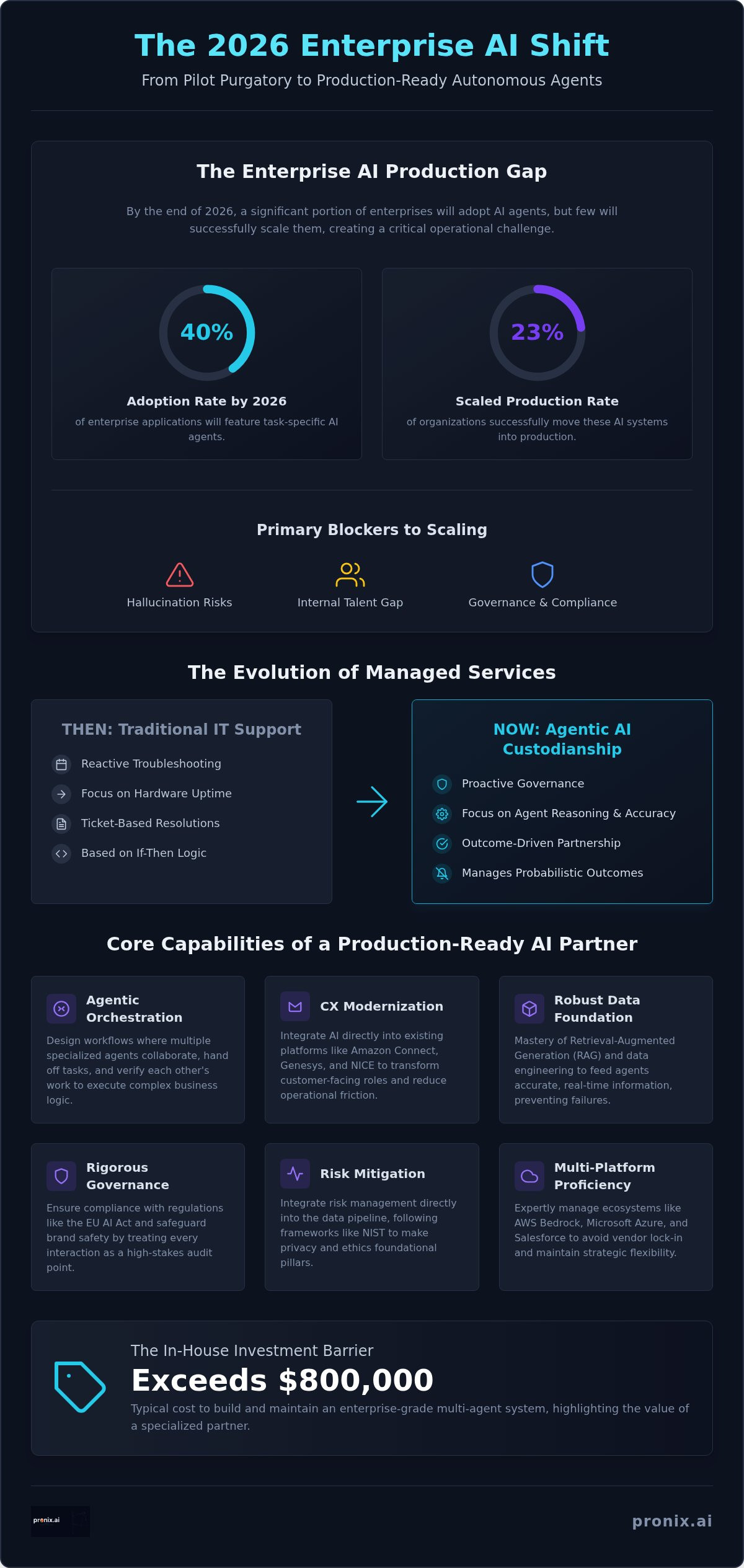
By the end of 2026, 40% of enterprise applications will feature task-specific agents, yet only 23% of organizations have successfully moved these systems into a scaled production environment. Most leaders are currently trapped in pilot purgatory. They watch promising experiments stall due to hallucination risks and a massive internal talent gap. Scaling autonomous workflows requires more than just a software license. It demands specialized managed services for agentic AI that prioritize governance and operational maturity over mere technical uptime.
You likely feel the pressure to deliver measurable ROI while keeping your brand safe from unmonitored agent behavior. We agree that the move from reactive copilots to proactive agents is the most significant shift in a decade. This guide provides the 2026 Selection Framework to help you identify a partner capable of managing complex agentic reasoning. You will learn how to evaluate providers based on their ability to bridge the gap between experimental code and a stable, governed production environment that reduces operational friction in your customer experience.
Key Takeaways
- Transition from reactive IT ticketing to a proactive AI custodianship model focused on agent reasoning and operational stability.
- Audit technical depth in orchestration and data architecture to prevent the common pitfalls that stall AI projects in the pilot phase.
- Implement a rigorous governance framework to ensure compliance with the EU AI Act and specific regulations in Finance and Healthcare.
- Select managed services for agentic AI that prioritize measurable business outcomes and brand safety over simple infrastructure maintenance.
- Leverage CX modernization to transform customer-facing roles with production-ready agents that reduce operational friction.
The Evolution of Managed Services: From IT Support to Agentic AI Custodianship
Traditional IT support models are breaking under the weight of non-deterministic technology. For decades, the industry focused on reactive troubleshooting and hardware uptime. The Evolution of Managed Services has reached a critical pivot point in 2026. Yesterday's providers managed servers; today's partners must manage agent reasoning. This shift represents the move toward Outcome Custodianship. It's no longer enough to keep the lights on. A provider must now ensure that an autonomous agent makes the right decision at the right time.
The core difference lies in predictability. Traditional IT relies on if-then logic and ticket-based resolutions. Managed services for agentic AI deal with probabilistic outcomes. When an agent hallucinates in a customer-facing role, there's no server alert to trigger. Traditional MSPs often fail here because they lack the frameworks to monitor model drift or audit multi-step reasoning chains. They're equipped for stability, but they're blind to the nuances of agentic behavior. True custodianship requires a practitioner-led approach that prioritizes the integrity of the process over simple connectivity.
Why 2026 Demands a New Managed Service Model
The enterprise landscape has shifted. By the end of 2026, 40% of enterprise applications will incorporate task-specific agents. This explosion of autonomous workflows has effectively collapsed the traditional pilot phase. Organizations can't afford to let projects sit in experimental stages for months. They need production-ready outcomes immediately. Maintaining this talent in-house is increasingly unsustainable. With the cost of building an enterprise-grade multi-agent system often exceeding $800,000, the operational burden of managing these complex workflows requires a specialized, elite partner who can scale without the friction of a talent gap.
Uptime vs. Accuracy: The New SLA Standard
Standard Service Level Agreements (SLAs) are becoming obsolete. A 99.9% server availability rating means nothing if the agent's reasoning accuracy drops to 70%. In 2026, the new standard is Accuracy over Uptime. Partners must monitor for model drift and ensure agents remain within governed guardrails. This is particularly vital as the EU AI Act and California AI Transparency Act now enforce strict transparency for generative systems. Governance is the new security layer for agentic production. You need a partner who treats every interaction as a high-stakes audit point, ensuring compliance while driving measurable ROI through automated workflows.
Core Capabilities of a Production-Ready AI MSP
Selecting a partner for managed services for agentic AI requires a focus on practitioners who can handle the complexity of production outcomes. Software alone doesn't solve for model drift, data leakage, or integration friction. For enterprises to scale, they must secure managed services for agentic AI that provide technical depth across diverse ecosystems. A production-ready provider manages AWS Bedrock, Microsoft Azure, and Salesforce Agentforce with equal proficiency, ensuring that your AI strategy remains flexible and avoids restrictive vendor lock-in.
Effective AI management starts with a robust data foundation. Your provider must be expert in Retrieval-Augmented Generation (RAG) and the underlying data engineering required to feed agents accurate, real-time information. Without this, even the most sophisticated agents will fail. Following the NIST AI Risk Management Framework, an elite MSP integrates risk mitigation directly into the data pipeline. This proactive approach ensures that data privacy, auditability, and ethical reasoning are foundational pillars, not afterthoughts added during a crisis.
Agentic AI and Workflow Orchestration
True value emerges when agents move from answering questions to executing multi-step business logic. This requires sophisticated orchestration. An MSP must design workflows where multiple specialized agents collaborate, hand off tasks, and verify each other's work. Agentic Orchestration is the core of 2026 automation, serving as the connective tissue that turns isolated tools into a cohesive digital workforce. If your partner can't manage the orchestration layer, your agents will remain siloed and ineffective.
Modernizing CX with Managed AI
Customer experience is the primary battleground for agentic outcomes in 2026. A top-tier MSP integrates AI directly into existing platforms like Amazon Connect, Genesys, and NICE. This isn't just about replacing a legacy IVR with a chatbot. It's about a complete AI-driven CX modernization that moves toward intelligent, agent-led interactions. These production-ready agents handle complex, multi-step queries autonomously, reducing operational friction while providing a seamless transition to human staff for high-empathy scenarios.
Achieving this level of maturity requires a partner who understands the friction points of legacy systems. Transitioning to production is a high-stakes endeavor that demands a disciplined framework. If you are ready to move beyond experimental pilots, exploring Agentic AI Strategy & Consulting can provide the roadmap necessary for scalable success.
Vetting Technical Depth: Orchestration, CX, and Data Foundations
Traditional managed services often confuse AIOps with Agentic AI. AIOps focuses on IT infrastructure health, using machine learning to parse logs and predict server failures. Agentic AI, however, is built for business process automation. It targets the execution of complex workflows that impact the bottom line. Many infrastructure-centric MSPs struggle here. They attempt to apply ticket-based logic to non-deterministic agent reasoning. This is a significant red flag. If a provider discusses hardware availability more than agent decision accuracy, they are likely masking traditional IT support as a modern AI offering.
A true partner for managed services for agentic AI prioritizes process outcomes over hardware pings. Strategic process automation requires understanding the intent behind a customer interaction, not just the bandwidth it consumes. Traditional models fail because they lack the practitioner experience needed to manage the friction points of legacy system modernization. Tool-led automation often results in rigid workflows that break when faced with real-world variability. In contrast, a practitioner-led approach ensures that the technology adapts to the business logic, not the other way around.
The Practitioner-Led Advantage
Brand safety in 2026 depends on human-in-the-loop governance. A practitioner-led model ensures that AI engineers and data scientists, not just helpdesk generalists, oversee your agentic workflows. Strategy-first implementation is mandatory. Plug-and-play tools often ignore the specific regulatory needs of Finance or Healthcare. By vetting for specialized talent, you ensure your agents operate within strict ethical guardrails. This human oversight prevents the hallucination cycles that can devastate customer trust. You need experts who can audit the reasoning chain of an agent, ensuring it aligns with corporate policy before it ever touches a customer.
Multi-Platform Governance Frameworks
Enterprise ecosystems are rarely homogenous. You likely manage Salesforce Agentforce alongside AWS Connect or Genesys Cloud. A production-ready MSP provides a unified governance framework across this fragmented landscape. They ensure that an agent reasoning logic remains consistent, whether it is operating in a CRM or a contact center platform. This level of cross-platform discipline is what separates elite providers from those offering basic Agentic AI implementation services. Consistency in governance is the only way to maintain a scalable, auditable AI production environment that meets 2026 compliance standards across your entire stack.
The Governance Roadmap: Vetting for Compliance in Regulated Markets
In 2026, compliance is no longer a peripheral concern. It's the literal gatekeeper of production viability. For leaders in Finance and Healthcare, the stakes are exceptionally high. A hallucinating agent isn't just a customer service failure. It's a regulatory liability. Vetting a partner for managed services for agentic AI requires a disciplined, five-step audit of their governance frameworks. This process ensures that your autonomous agents operate within the strict boundaries of the EU AI Act and the California AI Transparency Act.
- Step 1: Audit Governance Frameworks. Examine their ethical reasoning guardrails. You must verify how they prevent bias and ensure transparency in agent decision-making.
- Step 2: Verify Industry Experience. Generalist MSPs often stumble over sector-specific nuances. Look for a track record in regulated environments where HIPAA or financial audit standards are the baseline.
- Step 3: Evaluate Deployment Ratios. Only 23% of organizations have a scaled agentic system in production. Ask for their specific pilot-to-production ratio to ensure they can actually cross the finish line.
- Step 4: Assess Pipeline Maturity. Review their Data-to-Outcome pipeline. A mature MSP manages the entire lifecycle, from data ingestion to measurable business results.
- Step 5: Review Audit Protocols. Demand real-time auditability. You need to see exactly how an agent reached a specific conclusion at any given moment.
AI Governance for Regulated Sectors
Regulated industries require more than just functional agents. They demand agents that are compliant by design. Your provider must ensure adherence to HIPAA, SOC2, and evolving financial standards. Explainable AI (XAI) is essential here. Without it, your reporting remains a "black box" that won't survive a regulatory audit. Auditability is the primary barrier to enterprise AI scale in 2026. If a provider cannot offer a clear, documented reasoning chain for every autonomous action, they aren't ready for enterprise-grade managed services for agentic AI.
Scaling from Pilot to Production
The transition from a controlled pilot to a live environment is where most projects fail. You must ask potential partners about their specific stress-testing methodologies. How do they handle edge cases? What happens when an agent encounters a scenario it wasn't trained for? A production-ready partner manages these failures in real-time through continuous model and prompt optimization. They don't just set up the agent and walk away. They provide the ongoing custodianship required to maintain accuracy as data and market conditions shift.
Moving from a risky experiment to a governed outcome requires a partner who understands these complexities. If you're ready to secure your production environment, explore how Enterprise AI Managed Services can provide the stability and compliance your brand requires.
Partnering with pronix.ai for Scalable AI Outcomes
Scaling beyond the experimental stage requires more than just code. It demands a practitioner-led approach that understands the friction of legacy modernization. pronix.ai serves as the strategic bridge for organizations currently stalled in pilot purgatory. By integrating strategy, implementation, and managed services for agentic AI, we ensure that autonomous workflows deliver measurable ROI without compromising the stability of your production environment. Our methodology is designed to move your enterprise from speculative prototypes to secure, scalable results.
We focus on the high-impact intersection of Agentic AI and CX modernization. This isn't just about tool deployment. It is about building the architectural foundations that allow agents to execute complex business logic within your existing ecosystem. pronix.ai provides the discipline and framework necessary to turn isolated tools into a cohesive digital workforce. This integrated approach ensures that every innovation is backed by a rigorous path to production and long-term operational maturity.
Why Enterprises Trust pronix.ai
Enterprise leaders choose pronix.ai because of our global technology heritage and operational stability. We maintain specialized talent for AWS Connect, Salesforce Agentforce, and Genesys. This deep platform expertise allows us to manage fragmented stacks without the risks of vendor lock-in. Our focus remains on high-stakes sectors like Healthcare and Finance, where we prioritize evidence-based success over speculative hype. By focusing on auditability and reasoning accuracy, we ensure your AI initiatives are both productive and compliant with 2026 standards.
Next Steps: Moving Beyond the Pilot
Stalling at the pilot phase is a choice that limits your competitive advantage. Engaging with pronix.ai begins with a rigorous AI maturity and readiness assessment to identify friction points in your data architecture. Following this assessment, we execute a 90-day blueprint for governed deployment. This structured path moves your enterprise from a concept to a production-ready agentic outcome in approximately 12 weeks. Explore our enterprise AI automation managed services to secure your 2026 strategy and scale your agentic goals today.
Transitioning to Governed Agentic Production
The shift from experimental pilots to production-ready outcomes is the definitive enterprise challenge of 2026. Success requires moving beyond traditional IT support toward a model of Outcome Custodianship. You must prioritize agent reasoning accuracy and strict regulatory compliance over simple server uptime. By vetting for technical depth in orchestration and a robust data-to-outcome pipeline, you ensure your brand remains safe while capturing the efficiency of autonomous workflows.
Specialized managed services for agentic AI provide the essential governance layer required for high-stakes industries like Finance and Healthcare. pronix.ai offers the specialized talent for AWS Connect, Genesys, and Salesforce Agentforce needed to modernize your CX and automate complex business logic. With decades of technology implementation excellence, we provide the stability and elite expertise your organization demands.
It's time to stop stalled experiments and start delivering measurable ROI through a disciplined, governed framework. Move your AI agents from pilot to production with pronix.ai and lead your industry into the autonomous era with confidence.
Frequently Asked Questions
What is the difference between an AI MSP and a traditional IT MSP?
Traditional MSPs manage infrastructure uptime and ticket-based hardware issues. An AI MSP manages non-deterministic agentic reasoning and model accuracy. While a traditional provider focuses on server availability, an AI partner ensures that your agents correctly execute business logic. This shift moves the focus from technical connectivity to outcome custodianship. Success is measured by the agent's ability to solve complex problems without human intervention, rather than just keeping systems online.
How do AI managed services handle data privacy and SOC2 compliance?
AI managed services integrate governance directly into the data pipeline to ensure SOC2 and HIPAA compliance. They utilize Retrieval-Augmented Generation (RAG) frameworks that keep sensitive enterprise data within secure boundaries. Your provider should implement real-time monitoring to prevent data leakage during agent interactions. By following the NIST AI Risk Management Framework, these services provide the auditability required for high-stakes environments, ensuring that every agent response remains within governed ethical and legal guardrails.
What platforms should an enterprise AI MSP support in 2026?
In 2026, an enterprise provider must support a multi-platform ecosystem including AWS Bedrock, Microsoft Azure AI, and Salesforce Agentforce. They should also manage specialized CX platforms like Genesys Cloud and Amazon Connect. Platform neutrality is critical to prevent vendor lock-in and ensure your agents can access data across fragmented environments. A robust partner orchestrates these disparate systems into a unified digital workforce, maintaining consistent governance and reasoning accuracy across your entire technology stack.
How does an MSP help scale AI from pilot to production?
An MSP bridges the gap by implementing a disciplined deployment framework that moves beyond experimental code. They handle the complex orchestration, data engineering, and prompt optimization required for real-world reliability. By managing edge cases and agent failures in real-time, they ensure your system remains stable at scale. This transition involves rigorous stress-testing and the implementation of human-in-the-loop protocols, allowing your organization to move from risky pilots to governed, production-ready agentic outcomes.
What are the typical pricing models for enterprise AI managed services?
Enterprise AI managed services typically utilize outcome-based or usage-based pricing models rather than traditional flat-fee per-user licenses. Many providers are moving toward risk-share models where compensation is tied to specific business results, such as cost savings or productivity gains. Others use a unified usage pool for agentic tasks, allowing for flexible scaling as your interaction volume grows. You should evaluate your provider based on their ability to deliver a measurable return on investment through automated workflows.
Can an AI MSP manage my existing Salesforce Agentforce or AWS Connect setup?
Yes, elite providers for managed services for agentic AI are specifically designed to manage and optimize existing setups like Salesforce Agentforce and AWS Connect. They integrate autonomous agents into these platforms to modernize your customer experience. This includes managing the orchestration layer between your CRM data and your contact center's communication channels. Their role is to ensure these systems work in synergy, providing intelligent, agent-led interactions that reduce operational friction and improve resolution rates.
Why is Agentic AI governance important for regulated industries like healthcare?
Governance is vital in healthcare because agent hallucinations can lead to significant regulatory liabilities and patient safety risks. managed services for agentic AI provide the Explainable AI (XAI) needed for medical audits and HIPAA compliance. These services ensure that agents follow strict reasoning chains and remain within ethical guardrails. By providing real-time auditability, they allow healthcare organizations to scale automation while maintaining the high standards of accuracy required for clinical and administrative workflows.
What specialized talent should I look for in an AI managed service provider?
Look for a provider with a practitioner-led team that includes AI engineers, data scientists, and specialized orchestration experts. You need talent that understands both the technical architecture of Large Language Models and the practical nuances of business process automation. Avoid generalist MSPs that lack deep experience in model drift management or RAG implementation. The right partner brings a blend of strategic vision and boots-on-the-ground pragmatism, ensuring that your AI initiatives are backed by rigorous engineering and clear governance.