

AI implementations rarely stall because the model isn’t capable. They stall because the operating conditions around it aren’t ready. The common pitfalls of AI implementation often begin with unclear ownership, fragmented data, legacy integration, and security concerns, not a lack of experimentation. A successful pilot can help establish a business case, but a controlled demo doesn’t show whether a system can perform reliably in day-to-day operations or deliver measurable value at scale.
This article offers a practical framework for diagnosing why enterprise AI initiatives lose momentum and what to address before investing further. You’ll learn how to define accountable ownership and success measures, assess data and integration readiness, and map a realistic route from pilot to production. You’ll also see how governance, security, and ongoing operational controls help turn promising experiments into auditable, measurable business outcomes. The goal is to move beyond pilot purgatory with a disciplined approach that connects strategy, implementation, and managed operations.
Key Takeaways
- Distinguish a disappointing demo from an implementation failure by assessing whether AI can perform reliably in real business workflows.
- Diagnose the common pitfalls of AI implementation by tracing symptoms such as low adoption or unreliable outputs to root causes, evidence, and accountable owners.
- Assess data fitness, legacy integration, exception handling, and user adoption before expanding a pilot.
- Use a staged framework to define outcomes, assess readiness, design controls, validate workflows, and scale deliberately.
- Set proceed, revise, or stop criteria at each stage so investment decisions are grounded in evidence and operational readiness.
Common Pitfalls of AI Implementation: Where Enterprise Initiatives Go Off Track
A disappointing AI demo isn’t automatically an implementation failure. A demo can miss the mark without affecting business operations. An implementation failure is more consequential: the system can’t perform reliably in its intended workflow, users can’t depend on it, or the expected business value remains unproven.
An AI implementation pitfall is a preventable gap between the value an organization intends to achieve and its readiness to deliver that value in day-to-day operations. Weak business fit, poor data readiness, unclear ownership, and unmanaged change are common sources of that gap. These issues can compound. A data problem may appear as unreliable outputs, erode user trust, and then be misdiagnosed as a model issue. A technical fix alone won’t resolve a process or accountability gap.
Look beyond whether a model works in isolation. A more useful test is whether the organization has defined the workflow, prepared the data, assigned decision rights, and planned for changes to how people work. Broader discussions of advanced AI risks, including AI Takeover and Risks, also underscore why capability needs appropriate oversight.
When AI ambition outruns the business problem
“Use AI” is a technology ambition, not an operating objective. Without a defined business problem, teams can’t agree on what to build, which workflow to change, or what evidence would justify further investment. Compare “apply AI to customer service” with “reduce the time agents spend retrieving answers to routine account questions while preserving human review for sensitive cases.” The second statement identifies a workflow and a result the team can evaluate.
Novelty can also drive scope. A team may select an advanced capability before establishing whether it addresses a meaningful bottleneck. Set decision rights early: business leaders own the outcome and workflow priorities, while technical teams assess feasibility and controls. Without those boundaries, priorities drift, requirements keep changing, and no one is accountable for deciding whether the initiative is delivering value.
When a successful pilot creates false confidence
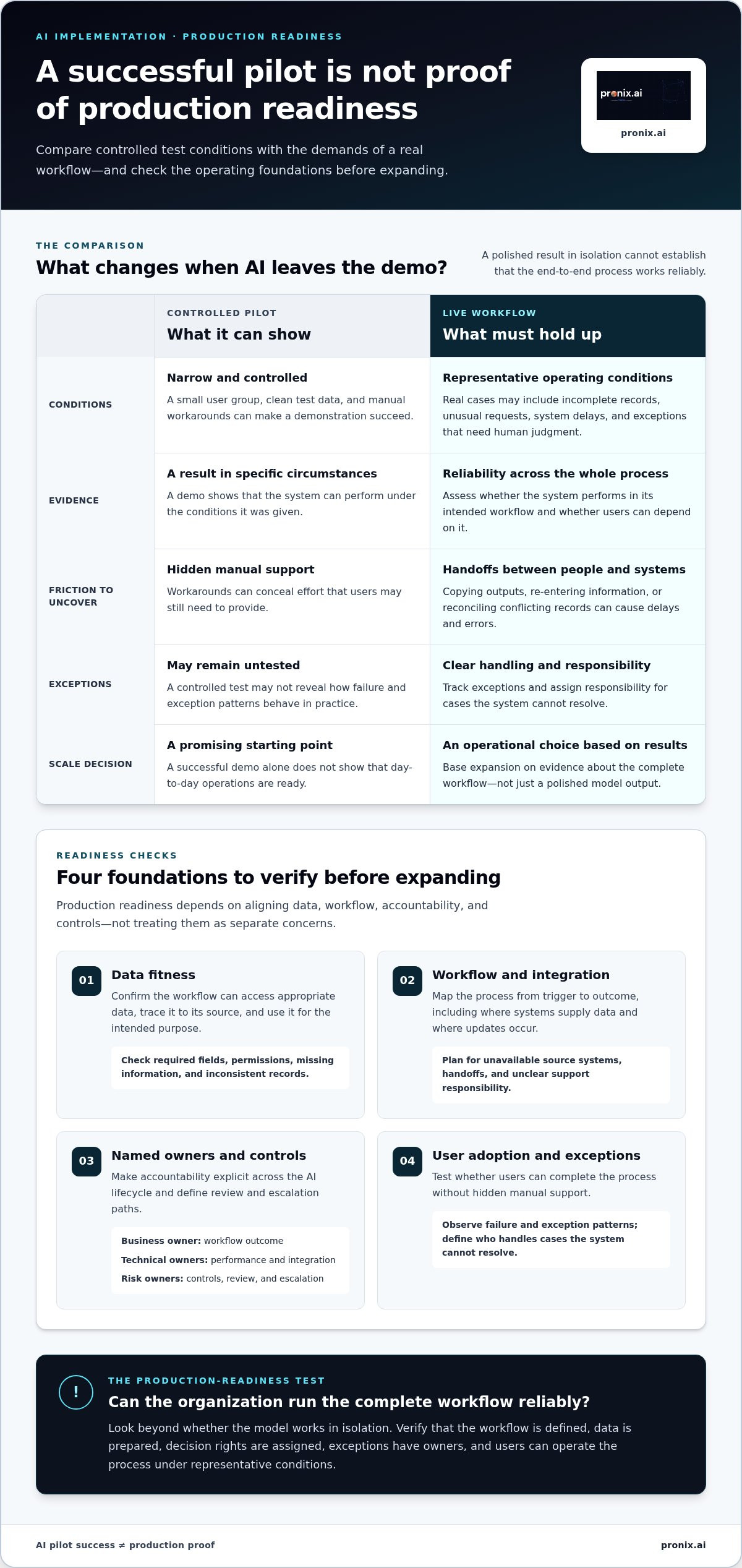
A controlled demonstration proves that a system can perform under specific conditions. It doesn’t prove that it can support a live workflow reliably. A pilot with a small user group, clean test data, and manual workarounds may not expose the production cases that matter, such as incomplete records, unusual requests, system delays, or exceptions that require human judgment.
Before expanding a pilot, test the workflow under representative conditions. Track failure and exception patterns, assign responsibility for cases the system can’t resolve, and assess whether users can complete the process without hidden manual support. Moving from pilot to production requires evidence about the whole workflow, not just a polished demo. Treat the decision to scale as an operational choice based on results.
Why AI Implementations Stall: Data, Integration, Governance, and Adoption
A system can produce accurate results in a test and still fail in production. The difference often lies in dependencies around the model: whether the right data is accessible at the right time, whether connected systems can support the workflow, and whether people know how to manage exceptions. These dependencies become more visible when an AI workflow moves beyond a controlled pilot and encounters real operating conditions.
Production readiness depends on the alignment of data, workflow, accountability, and controls. Treating these as separate workstreams can leave gaps between a technically functional component and a process employees can reliably use. That’s why the common pitfalls of AI implementation often appear at handoffs: between systems, teams, or automated and human decisions.
Data and integration gaps that surface at scale
Data quality is broader than accuracy. A record may be correct but inaccessible to the system, difficult to trace to its source, outdated for the task, or irrelevant to the decision. Readiness means confirming that the workflow can access appropriate data, establish its lineage, and use it for the intended purpose. Define the workflow’s inputs and permissions, too. Without them, it may receive incomplete context or access information beyond what the task requires.
Map the workflow from trigger to outcome. Identify which systems provide data, where updates occur, and what happens when a required field is missing or a source system is unavailable. Legacy platforms and disconnected processes can make these transitions difficult. Even when APIs connect systems successfully, staff may still need to copy outputs, re-enter information, or reconcile conflicting records. That handoff can introduce delays and errors, while leaving responsibility for support unclear.
When assessing data readiness, document the sources each step relies on, the fields required to complete the task, and what the process should do when information is missing or inconsistent.
Governance and adoption gaps that block operations
Governance must work in the operating model, not just exist as a policy document. Assign named business, technical, and risk owners across the AI lifecycle. The business owner is accountable for the workflow outcome; technical owners manage system performance and integration; risk owners help define controls, review, and escalation paths. Teams should also be able to trace key decisions and changes so the organization can understand how the system is used and managed.
Human oversight needs practical instructions. Staff should know which outputs require review, when they can override a recommendation, and how to escalate an uncertain or harmful result. Otherwise, some may over-rely on outputs while others bypass the system entirely. Define those rules in the workflow, train users against realistic cases, and gather feedback as operations evolve.
Enterprises can connect these data, integration, and governance needs through AI strategy and implementation support, with controls designed around the workflow rather than added after deployment.
How to Diagnose AI Implementation Failures Without Chasing Symptoms
A warning sign is a reason to investigate, not proof of a particular cause. Low adoption, rising exceptions, unreliable outputs, and unproven ROI can point to different problems across the model, data, workflow, integration, or change management. Treating every symptom as a model defect can lead to costly technical changes while the real barrier remains untouched.
Use a diagnostic matrix to connect what teams observe with testable explanations, evidence, and an accountable owner. Treat the causes below as hypotheses to examine, not conclusions. A correlation, such as lower usage after a system update, doesn’t establish that the update caused the decline.
| Observed symptom | Likely root cause | Evidence to gather | Accountable owner |
|---|---|---|---|
| Low adoption | Poor workflow fit, limited trust, usability friction, or insufficient training | Usage by task and team, user feedback, workflow observations, training records | Business process owner |
| Escalating exception rates | Unclear task boundaries, changing inputs, weak exception paths, or integration failures | Exception categories, input patterns, system logs, handoff records | Workflow and technical leads |
| Unreliable outputs | Input quality, evaluation gaps, overly broad tasks, or unclear escalation rules | Representative output samples, evaluation criteria, source-data checks, review outcomes | AI product or model owner |
| Unproven ROI | Weak baseline, mismatched success measures, low workflow usage, or untracked operating effort | Baseline and current performance, adoption, rework, ongoing process costs | Business sponsor |
| Delayed deployment | Unresolved security review, integration dependencies, or missing decision ownership | Open review items, dependency map, decision log, assigned owners | Program sponsor with security and technology leads |
Map visible symptoms to testable causes
Start with the workflow and compare what should happen with what actually happens. For low adoption, examine whether the AI step fits the user’s routine, whether outputs are trusted, and where usability or training gaps appear. For inconsistent outputs, check task boundaries, input quality, evaluation design, and escalation paths before assuming model performance is the only issue. For delayed deployment, review security decisions, integration dependencies, and unresolved ownership. Record evidence that could disprove each suspected cause as well as evidence that supports it.
Prioritize failures by business impact and exposure
Once causes are better understood, rank issues using organization-defined criteria for potential impact, likelihood, affected workflows, and urgency. Prioritize barriers to safe, reliable operation, such as missing oversight or an exception path that leaves cases unhandled. Defer enhancements that improve convenience but don’t address a material operating risk.
For each priority, document the finding, evidence, owner, and next decision. This turns a list of complaints into a remediation plan and keeps the common pitfalls of AI implementation distinct from symptoms that still need investigation.
A Practical Framework to Prevent AI Implementation Pitfalls
Move from experimentation to production through explicit decision gates. Each stage should have a named owner, evidence to support the next decision, and a clear choice to proceed, revise, or stop. This keeps enthusiasm from substituting for readiness and makes it easier to address the common pitfalls of AI implementation before they become embedded in operations.
Set scope, ownership, and evidence before building
Start with a bounded workflow, not a broad mandate to “apply AI.” Name the user, the decision or task being supported, and the intended operational outcome. Assign a business owner alongside technical, data, security, and risk responsibilities. Before building, document the current process and select measures that reflect the goal, such as completion time, rework, service quality, or exception handling. Choose evaluation criteria in advance; universal benchmarks won’t reflect every workflow’s needs.
Validate controls and operational readiness before scaling
Test with representative inputs and realistic workflow conditions, including edge cases, system failures, and tasks that require human judgment. Define access boundaries, review responsibilities, monitoring, and incident response appropriate to the use case. Confirm that operational teams can support the workflow, not just that the system can run. Scale only when evidence supports the intended outcome and people know how to manage exceptions.
- Define the outcome. The accountable owner is the business sponsor. Evidence includes a documented workflow, baseline measures, target outcome, and agreed evaluation criteria. Proceed when the problem and value are clear; revise if scope or measures are vague; stop if no material business need is established.
- Assess readiness. The business and technical leads share accountability, with data owners identifying dependencies. Gather evidence on data access and fitness, system integration, process exceptions, user needs, and support capacity. Proceed when critical dependencies are understood; revise to close readiness gaps; stop if the workflow cannot be supported safely or reliably.
- Design controls. The risk owner coordinates with security, technical, and business leads. Document permissions, human review, escalation, monitoring, and incident handling. Proceed when responsibilities and controls are operationally defined; revise where ownership or safeguards are incomplete; stop if material risks lack a workable control.
- Validate in workflow. The product or workflow owner leads testing with representative users. Compare results against the predefined business and operational measures, and record failures, exceptions, and manual effort. Proceed when evidence meets the agreed criteria; revise if gaps are fixable; stop if the use case fails its evaluation.
- Scale deliberately. The business owner and operations lead confirm the service can be sustained. Review performance, adoption, support processes, and control monitoring. Proceed when teams and evidence support expansion; revise the rollout if capacity or performance needs work; stop expansion if outcomes or controls deteriorate.
For enterprise teams moving through these gates, explore pronix.ai enterprise AI implementation services to connect strategy, implementation, and ongoing operations.
Move from AI Implementation Pitfalls to Governed Production Outcomes
The central lesson is straightforward: production outcomes depend on business fit, reliable foundations, accountable ownership, and controls that work in real operations. Addressing the common pitfalls of AI implementation isn’t a one-time technical exercise. Choose the next step based on the constraint the evidence reveals, then maintain responsibility for how the system performs as workflows and business needs change.
Choose the next step based on the diagnosed constraint
Use the diagnosis to determine what should happen next, rather than expanding a pilot by default. If the use case remains unclear, return to business outcomes and workflow selection. If readiness is weak, strengthen the relevant data, integration, ownership, or governance foundation before broadening deployment. If a pilot has been validated, move into production planning: assign operational responsibilities, establish monitoring, and define how exceptions will be handled.
Different stages call for different support. Strategy helps align the opportunity with business priorities and operating needs. Technical implementation connects AI capabilities to the data, platforms, workflows, and controls required for use. Managed services can support ongoing operations after deployment, including attention to system performance, governance, and workflow requirements. These stages are connected, but they solve distinct needs. An enterprise exploring agentic AI, business automation, CX modernization, or stronger data and AI foundations should match the work to its current constraint.
Treat production as an operating capability, not a launch date
Deployment is a milestone, not the finish line. Teams need clear responsibility for monitoring performance, maintaining controls, reviewing exceptions, and responding when a workflow or its inputs change. Without those operating practices, a system can drift away from its intended purpose even if it performed well during initial validation.
Set a review rhythm that connects operational signals to the original business measures. Examine whether the workflow is delivering the expected outcome, where people still intervene, whether exception patterns are changing, and whether support teams can sustain the process. Use that evidence to decide whether to maintain, adjust, expand, or pause the deployment.
pronix.ai connects enterprise AI strategy, implementation, and managed services across agentic AI, business automation, CX modernization, and data and AI foundations. This end-to-end approach helps align business goals with technical delivery and operational accountability, rather than treating each as a separate initiative.
Discuss your enterprise AI implementation with pronix.ai to explore a practical path from diagnosed constraints to governed production operations.
Make Your Next AI Decision Production-Ready
The next step isn’t necessarily to launch another pilot. Decide what evidence, ownership, or operational capability your organization needs before making the next commitment. That discipline turns the common pitfalls of AI implementation into decision points and helps teams direct investment toward opportunities that are ready to deliver value.
For enterprises operating in healthcare, finance, and manufacturing, readiness must account for the realities of each business environment. pronix.ai connects AI strategy, implementation, and managed services, with a focus on enterprise security, governance, and auditability. The aim is to build a sustainable path from the business decision to an AI capability that can be operated and assessed over time.
If your team is weighing a use case, preparing to scale a validated pilot, or strengthening the foundations around an existing deployment, start by defining the constraint and intended outcome. Plan your enterprise AI implementation with pronix.ai and move forward with focus, accountability, and confidence.
Frequently Asked Questions
What are the most common pitfalls of AI implementation?
The most common pitfalls of AI implementation include weak business alignment, unready data, unclear accountability, difficult integration, insufficient governance, and unmanaged adoption. These issues can compound: poor source data may reduce trust, lower usage, and obscure the workflow’s actual value. First establish whether the problem is confined to a pilot test or affects a live operational process. Then trace the evidence to the underlying cause before choosing a remedy.
Why do AI implementation projects fail?
AI implementation projects often fail when teams choose a technology before agreeing on the business outcome, underestimate the effort to connect data and systems, or leave no one accountable for daily operations. For example, an AI assistant might generate useful answers but still slow a service process if staff must transfer every response manually. Review intended value, readiness, controls, and adoption together. A capable model can’t compensate for a workflow that doesn’t work.
How can a business avoid AI implementation mistakes?
Define a contained use case, name the owners, check data and system readiness, set evaluation criteria, and test the workflow under realistic conditions before expanding it. For a document-review task, include incomplete files and define who handles uncertain cases. Add human review and exception handling where the use case needs them. At each stage, record the evidence behind a proceed, revise, or stop decision instead of treating a strong demo as proof.
What happens when an AI pilot does not move into production?
A stalled pilot may reveal a mismatch between the workflow and the use case, or unresolved data, integration, governance, adoption, or operating-ownership issues. It doesn’t automatically mean the model performs poorly. Revisit the original objective and the assumptions tested in the pilot, then gather evidence about what blocked progress. The right next step may be redesigning the workflow, narrowing its scope, pausing for foundational work, or stopping the initiative.
How should enterprises measure AI implementation success?
Choose measures that reflect the use case and agree on them before deployment. A claims-support workflow might track processing quality, completion time, staff rework, and appropriate human review, while a customer-facing workflow may need different indicators. Compare results with a relevant baseline and document what the measure excludes. Avoid universal ROI promises. Leaders should use evidence from their own operating context to decide whether the system is delivering value, needs refinement, or is ready to expand.
Is AI implementation only a technology project?
No. Enterprise AI implementation is also a business and operating-model initiative. Teams need to decide how work changes, who owns the outcome, what data and systems the process depends on, and how users get support. For example, a model may work well in testing but add little value if employees don’t know when to use its output or how to report a problem. Coordinate business and technical responsibilities through deployment and ongoing operations.