

What if the biggest risk in scaling an AI pilot isn’t the model, but expanding before the evidence is strong enough? If you’re asking how to scale an AI pilot program, promising test results aren’t enough. You need a fair comparison with business as usual, confidence that the workflow can meet production requirements, and clear ownership of risks and outcomes.
That’s a demanding standard, but it’s the right one. Data gaps, fragile integrations, security requirements, and employee concerns can surface as soon as a pilot moves beyond a controlled test. Scaling without addressing them can multiply operational risk instead of business value.
This guide shows you how to make a defensible go, iterate, or stop decision, then build a phased path from validated use case to enterprise operations. You’ll learn how to define measurable success, test production readiness, assign owners and controls, and track performance as adoption grows. The goal is a repeatable approach that connects strategy, implementation, and ongoing operations, so evidence and accountability travel with the use case.
Key Takeaways
- Learn how to scale an AI pilot program by tying expansion to evidence, production controls, and accountable ownership.
- Use a readiness gate to compare pilot results with a documented baseline and decide whether to proceed, iterate, or stop.
- Choose whether to extend a workflow, replicate it across teams, or redesign it before expanding.
- Plan phased rollout waves around workflow risk, user readiness, and operational capacity.
- Establish production owners and review business outcomes, quality, adoption, costs, and risks on a regular cadence.
How to Scale an AI Pilot Program Without Scaling Uncertainty
A successful demonstration proves that a system can perform under test conditions. It doesn’t prove the workflow is valuable, safe, supportable, or repeatable across the enterprise. To understand how to scale an AI pilot program, define scaling as expanding a validated business workflow with measurable outcomes, production controls, and accountable owners.
Expansion can mean handling more transactions, adding teams, serving new use cases, or transferring day-to-day responsibility to operations. Each change introduces dependencies. More users can mean different access needs; higher volume can expose latency or data-quality issues; a new team may follow a different process. Scaling means testing these changes deliberately, not simply widening access.
Model performance is only one input to the decision. A model may produce accurate outputs in a controlled test while the surrounding process lacks reliable data access, system integrations, security controls, escalation paths, or a clear business owner. Strong technical results also don’t establish business value unless they’re compared with a documented baseline and tied to an intended outcome, such as reduced handling time or fewer manual steps.
What does it mean to scale an AI pilot?
It means moving from limited testing to a supported workflow that people can use in real operations. The workflow needs defined inputs and outputs, access controls, human review where appropriate, performance monitoring, and an owner responsible for what happens when the system produces an unexpected result. Build governance and auditability into the design from the start.
For example, an AI assistant that summarizes service requests for one small test group may need to connect to approved business systems, respect role-based access, and fit established review practices before another team can use it. The model may be unchanged, but the operating environment is not.
Why do AI pilots stall before production?
Pilots often lose momentum when the original goal is too vague to measure, the business-as-usual baseline was never recorded, or no one owns the result after the test ends. Technical gaps can add friction: data may be incomplete or inaccessible, integrations may not support the workflow, and security or compliance requirements may need further design. These are readiness issues to resolve, not reasons to assume every pilot will fail.
People can also resist a workflow that adds review steps, changes established responsibilities, or leaves them unsure who is accountable for an AI-assisted decision. Training may help, but it won’t fix a poor process fit. Gather user feedback, clarify decision rights, and adjust the workflow before expanding exposure. Broader debate about advanced AI, including the concept of AI takeover, is distinct from operational readiness. Enterprise governance should address concrete system boundaries, oversight, and escalation.
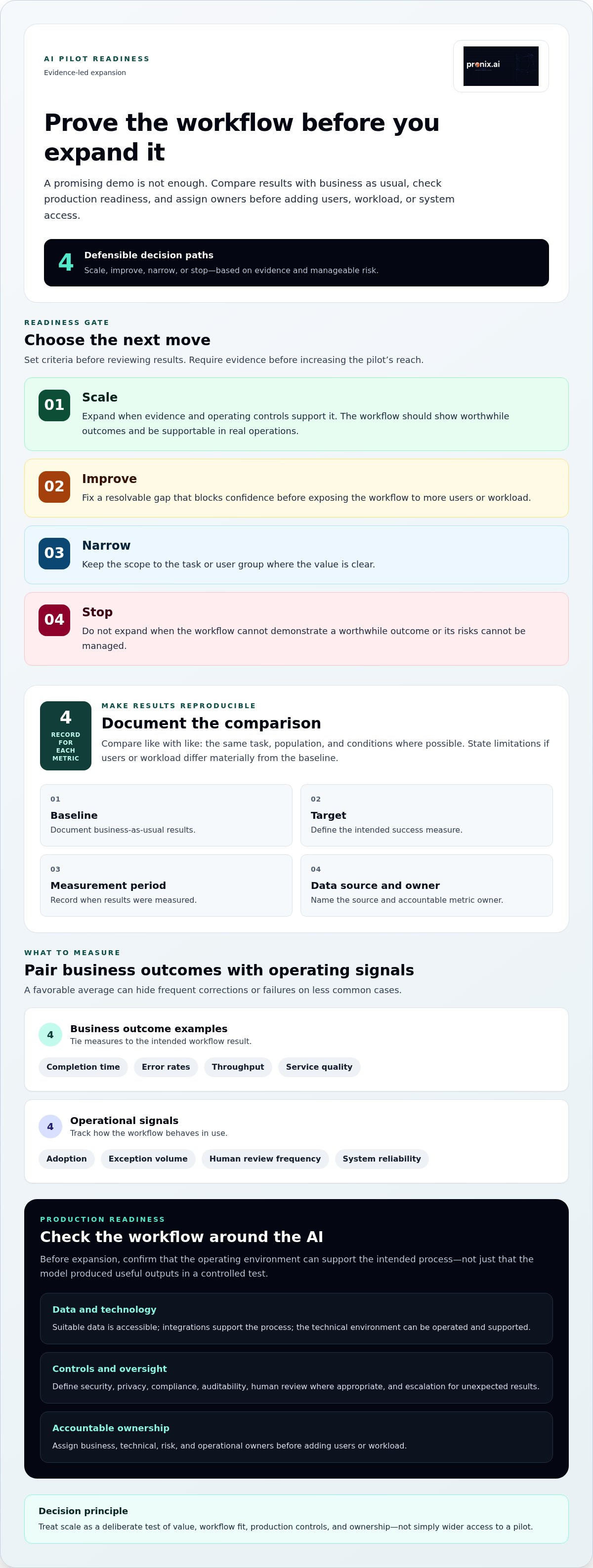
The decision isn’t simply “scale or fail.” Scale when evidence and operating controls support expansion. Improve the pilot when a fixable gap blocks confidence. Narrow its scope when value is clear only for a specific task or user group. Stop when the workflow can’t demonstrate a worthwhile outcome or its risks can’t be managed. A clear decision protects resources and gives the next stage a sound basis.
Use an AI Pilot Readiness Gate to Decide What Scales
A readiness gate turns “the pilot looks promising” into a decision leaders can defend. Set the criteria before reviewing results, then require evidence at each step before increasing users, workload, or system access. This keeps a strong demo from being mistaken for a production-ready business capability.
Start with the business outcome, not a model score. If the pilot is intended to reduce case-handling time, compare the measured time for the AI-supported workflow with a documented business-as-usual baseline. If the goal is better service quality, define how quality will be evaluated and who can judge whether the change matters. Record the measurement period, data source, and accountable metric owner so results can be reproduced and challenged.
Which measures show whether an AI pilot is working?
Choose a small set of measures tied to the workflow. Depending on the use case, these could include completion time, error rates, throughput, or service quality. Pair business outcomes with operational signals such as adoption, exception volume, human review frequency, and system reliability. A favorable average can hide frequent corrections or failures on less common cases.
For each metric, document the baseline, target, measurement period, data source, and owner. Compare like with like: the same task, population, and conditions where possible. If the pilot’s users or workload differ materially from the baseline, state that limitation rather than treating the comparison as conclusive.
What must be ready before a pilot expands?
Readiness covers the workflow around the AI, not only its outputs. Confirm that suitable data is accessible, integrations support the intended process, and the technical environment can be operated and supported. Define security, privacy, compliance, auditability, and human escalation requirements for the expanded scope. Assign business, technical, risk, and operational owners before adding users or workload.
Use this sequence to make the evidence review consistent:
- Validate the outcome. Confirm that the pilot addresses a defined business need and that the baseline and success measures are documented.
- Review output quality. Assess results against workflow-specific criteria, including error patterns and cases that require correction.
- Test exceptions and oversight. Identify what happens when inputs are incomplete, outputs are uncertain, or a human must review or take over.
- Confirm control and operating readiness. Verify data access, integrations, security and privacy controls, audit records, support ownership, and escalation paths for the proposed scope.
- Make and record the decision. Scale when evidence supports the outcome and controls; iterate when a specific gap can be addressed; stop when value or manageable operation isn’t demonstrated. Capture the rationale and lessons either way.
This gate is a practical answer to how to scale an AI pilot program without relying on enthusiasm or a single performance score. If the evidence is mixed, narrow the next test to the unresolved question and define what result would change the decision. For complex workflows, enterprise AI implementation and operations can connect readiness criteria with the technical and operational work required for production.
Choose a Scaling Path: Extend, Replicate, or Redesign the Pilot
Once a pilot has evidence behind it, decide what to expand. Increasing use of the same workflow, applying it in another team, and redesigning the process are different moves. Each introduces distinct dependencies and risks. Choosing deliberately helps preserve what worked without assuming that every team, data source, or operating condition is interchangeable.
Use the readiness evidence to match the path to the use case. Reuse is appropriate only where the process, data, controls, and user needs align. A similar task name isn’t enough. For example, two departments may both summarize customer requests but differ in data access, approval steps, or the consequences of an incorrect summary. Those differences shape whether to extend, replicate, or redesign.
When should you extend the same AI workflow?
Extend when the workflow is stable and repeatable under known operating conditions. Increase volume or access in controlled steps, then watch for changes in latency, exception rates, output quality, and the amount of human oversight required. A workflow that performs well with a small, consistent queue may behave differently under peak demand or a wider mix of inputs.
Before broadening access, confirm capacity across connected systems, data sources, and support teams. Set a threshold for pausing expansion if service quality falls or exceptions rise. Extension is the most direct path, but it can expose bottlenecks that a limited pilot never stressed.
When should you replicate or redesign instead?
Replicate when another team follows a comparable process, uses appropriately accessible data, and can operate under equivalent controls. Treat replication as a new validation, not a copy-and-paste rollout. Map local variations first. Redesign when steps, risk profiles, user roles, or system dependencies differ materially. Keep reusable components, but retest assumptions that were specific to the original pilot.
Extension: Best when the same workflow has repeatable outcomes. Main trade-off: higher volume can strain integrations, capacity, or oversight. Next step: expand in controlled increments and monitor operating signals.
Replication: Best when another team has closely aligned processes, data, controls, and users. Main trade-off: local variations can undermine transferability. Next step: map differences and validate the workflow with the receiving team.
Redesign: Best when the current process or risk profile differs enough that reuse would carry unsafe assumptions. Main trade-off: more workflow and implementation work before expansion. Next step: revise the process and success measures, then test the redesigned workflow.
This comparison makes the choice practical: follow the path whose assumptions you can support with evidence. To determine how to scale an AI pilot program, separate reusable assets, such as evaluation methods or integration patterns, from context-specific elements, such as approval rules and data permissions. That distinction enables repeatability without forcing uniformity where the business needs a different design.
Roll Out AI in Phases With Clear Owners and Feedback Loops
A phased rollout limits exposure while revealing what changes under real operating conditions. Set each wave by workflow risk, readiness, user group, and the capacity of the teams supporting it. Begin with a defined group and scope, gather operational feedback, then expand only when agreed checkpoints are met. Higher-risk workflows or teams with different processes may need additional validation before they enter a rollout wave.
Before launch, name the people accountable for four distinct areas: business outcomes, system operation, risk decisions, and user support. One person may hold more than one role, but the responsibilities still need to be explicit. If output quality falls, for example, the team should know who assesses the business impact, who investigates system behavior, and who can pause use or approve a change.
How should teams prepare users for broader adoption?
Explain how the AI-enabled workflow changes tasks, decisions, and escalation paths. Train users to understand appropriate reliance, recognize limitations, review outputs, and handle exceptions. Give them a practical way to report inaccurate results, extra work, or points where the workflow no longer fits the job. Cross-functional champions can surface recurring barriers and share practices grounded in actual use, not assumptions about adoption.
Feedback needs a route to action. Establish a channel for issues and suggestions, a triage owner, and a process for deciding whether feedback requires a workflow adjustment, technical fix, additional guidance, or no change. Close the loop with users by communicating what was addressed and what remains under review. This helps distinguish isolated frustration from a pattern that should pause expansion.
How do you govern phased deployment?
Connect rollout decisions to the organization’s existing AI governance framework rather than creating a parallel process. Document who can approve access, changes, and exceptions; where users escalate concerns; and which records must be retained. Keep traceable records of releases, incidents, reviews, and material workflow changes so decision-makers can understand what changed, when, and under whose authority.
Use go/no-go checkpoints between waves. Review whether quality and risk remain within agreed limits, support capacity is sufficient, and unresolved issues have clear owners. Pause expansion if a threshold is breached or a control fails. Resume only after the issue is addressed and the decision is recorded. Checkpoints make scaling controlled, not automatic.
- Before a wave: Confirm scope, user group, accountable owners, access, training, and escalation routes.
- During a wave: Capture user feedback, incidents, exceptions, and workflow changes through assigned channels.
- At the checkpoint: Review evidence against predefined criteria, then approve expansion, require changes, or pause.
This operating model helps leaders see how to scale an AI pilot program while keeping decision rights and feedback connected to day-to-day use. Pronix.ai’s enterprise AI rollout services bring implementation, governance, and ongoing operations together.
Move the Scaled AI Pilot Into Production Operations
Expansion isn’t complete when more people can use the AI workflow. It’s complete when the organization can operate, monitor, and improve it as part of normal business activity. That requires a shift from pilot-team support to defined business and technical responsibilities, with processes for handling incidents, maintaining integrations, and approving workflow changes.
What changes when an AI pilot becomes a production service?
Production ownership should cover the full operating lifecycle. Name who monitors system behavior, who responds to incidents, who maintains the technical environment, and who approves material changes to the workflow. For a customer service assistant, for example, the business owner may assess effects on service quality, while the technical owner investigates system issues and the operations team manages escalation into the existing support process.
Set monitoring and escalation practices in proportion to the workflow’s impact and risk. Document how users report unexpected outputs, what conditions require human intervention, and who can pause or roll back a change. Keep a record of releases, incidents, reviews, and workflow updates. These records support auditability and help teams distinguish a one-off issue from a recurring operational pattern. For additional production considerations, see this enterprise agentic AI production guide.
How can an enterprise sustain and improve scaled AI?
Review the system on a defined cadence. Compare business outcomes with the original baseline and objectives, then examine output quality, user adoption, exception patterns, cost drivers, and risk indicators. Assign owners to investigate material changes and track agreed actions to completion. If performance declines after a data source or workflow changes, the review should identify the cause and determine whether to adjust, restrict, or pause the affected use.
Operational learning should inform more than the model or application. Repeated data issues can point to a need for stronger data ownership, access practices, or quality controls. Feed those findings into an enterprise AI data strategy and use them to refine the workflow. Improvements should follow change controls, with appropriate review before they reach users.
As the number of scaled workflows grows, internal teams may need a more sustained operating model. Enterprise AI managed services can support ongoing management and strategic consulting for data and AI foundations, including enterprise-grade security and auditability. This can help integrate specialist support with enterprise operations.
Knowing how to scale an AI pilot program includes planning for the work after launch. Pronix.ai supports enterprises with AI strategy, implementation, and managed services, connecting production requirements with ongoing operations.
Turn Your Next AI Decision Into Measurable Progress
The next step isn’t to scale for its own sake. Choose an enterprise workflow where evidence, accountable ownership, and a clear business outcome can move together. That discipline gives leaders a practical way to decide how to scale an AI pilot program while building the conditions for broader adoption.
Pronix.ai brings enterprise strategy, implementation, and managed services to production transitions, with support for organizations across healthcare, finance, and manufacturing. Its work spans AWS, Microsoft, Salesforce, Kore.ai, and Genesys platforms, supporting complex enterprise environments.
Ready to define your path from pilot to production? Discuss your enterprise AI path from pilot to production with Pronix.ai. A focused next step can turn early learning into a durable capability, built to deliver value responsibly as your needs evolve.
Frequently Asked Questions
How do you scale an AI pilot program?
Scale an AI pilot program by expanding in controlled stages, using evidence from real workflow conditions to guide each move. Start with a clearly defined use case and a limited expansion, such as one additional team or a broader but bounded set of tasks. Check whether the process still works with different inputs and user habits. Keep a pause or rollback option available so an issue doesn’t become an enterprise-wide disruption.
When is an AI pilot ready to scale?
An AI pilot is ready to scale when its performance is repeatable across relevant cases and the business can support the workflow beyond the test team. Look for consistent results across routine and less common inputs, a workable human review process, and a response plan for errors. For example, a document-processing pilot should be tested on varied document formats before staff rely on it for a wider range of submissions.
Why do AI pilots fail to reach production?
AI pilots often stall because the test environment doesn’t reflect the demands of day-to-day operations. A prototype may rely on manual data uploads, informal approvals, or a small group of highly engaged users. Those shortcuts can conceal integration work and ownership gaps. A pilot may also lack a clear route from user-reported problems to fixes, leaving operational friction unresolved even when the technology appears promising.
What metrics should you use to evaluate an AI pilot?
Use measures that reflect the specific task, then pair them with signals that show how the workflow behaves in practice. A drafting assistant, for instance, could be evaluated on review time and the share of drafts accepted with limited edits, alongside correction patterns and user adoption. Define how each measure is collected and what conditions could affect it. This makes results easier to interpret when the pilot’s workload changes.
How long should an AI pilot run before scaling?
There’s no universal duration. Run the pilot long enough to observe representative work, including normal variations in demand and less frequent but important exceptions. A short test may miss end-of-cycle tasks, peak periods, or uncommon input types. Set the evaluation point around the evidence needed for the decision, not an arbitrary calendar deadline. If the sample is still too narrow, extend testing or limit the proposed expansion.
Can an AI pilot scale without changing the underlying workflow?
Yes, if the workflow already fits the new volume and users, and the controls remain effective. But increasing access can reveal handoffs or approval steps that weren’t visible in a small trial. For example, a team may need a shared queue or clearer escalation ownership once several departments use the same AI-assisted process. Preserve the workflow where it works, and adjust only the steps that create bottlenecks or unmanaged risk.
What governance is needed when moving an AI pilot into production?
Production governance should make clear who can use the system, who reviews its outputs, and who can approve changes or suspend use. Define how incidents are reported, assessed, and documented. Keep records of significant workflow changes and review decisions so the organization can trace how the system is being used. Governance should also assign an owner to assess whether changes in data, users, or business purpose require a fresh review.