

The safest AI bet for 2026 isn’t choosing the model everyone is watching. It’s building the capacity to adapt when models, platforms, and business requirements change. That’s the real work of future-proofing your AI strategy: creating a path from promising pilots to measurable production value without locking the enterprise into brittle technology choices.
It’s reasonable to worry that today’s platform could become tomorrow’s constraint. But isolated experiments, fragmented governance, and unclear operational ownership can stall progress before AI reaches core workflows. A durable strategy addresses these challenges before deployment, with practical ways to assess readiness, assign responsibility, and revisit decisions.
This guide explains how to prioritize AI use cases by lasting business value, make architecture and vendor decisions that preserve flexibility, and establish governance and operating practices that can evolve. You’ll learn how to connect integration, risk management, and measurable outcomes across the AI lifecycle, so your organization can respond to change without losing sight of what the technology needs to deliver.
Key Takeaways
- Anchor AI use cases to business outcomes, process owners, and measurable baselines before selecting technology.
- For future-proofing your AI strategy, compare architecture options by interoperability, data control, deployment fit, and operational effort.
- Build data quality, access, lineage, and integration requirements into planning instead of treating them as later fixes.
- Use clear decision gates for data readiness, risk, architecture, ownership, and evidence of outcomes.
- Evaluate partners on enterprise delivery experience, security practices, platform fit, and accountability from strategy through operations.
Future-proofing your AI strategy starts with adaptability, not prediction
No enterprise can reliably predict which AI models, vendors, or technical approaches will lead several years from now. A strategy built around one expected winner is exposed to change. A stronger approach sets clear business goals and creates the conditions to adjust capabilities, controls, and priorities as needs evolve.
This is a practical discipline, not a reason to wait for certainty. Leaders still need to make decisions about investment, data, architecture, and ownership. The difference is that those choices include review points and alternatives, rather than being treated as permanent commitments.
What does future-proofing an AI strategy actually mean?
Future-proofing an AI strategy means building the ability to adapt AI capabilities, architecture, governance, and operations as business needs and technology change, while continuing to measure outcomes. It doesn’t promise that a particular model or platform will remain dominant. It makes strategic choices reviewable, with clear reasons to continue, adjust, or replace them.
AI strategy is one part of a broader technology strategy: it connects technical choices to organizational priorities. In practice, adaptability is about more than model selection. Consider whether teams can access and use the required data, whether integrations can change without disrupting core workflows, and whether governance and operational responsibilities can keep pace.
Why enterprise AI plans become outdated
Plans can lose relevance when they assume a business process, customer need, or success measure will stay fixed. A use case that once reduced manual work may need reassessment if the workflow changes or business priorities shift. Regular reviews help leaders spot those changes and redirect effort before outdated assumptions become embedded in production.
Technical coupling can create another constraint. If an AI capability is closely tied to one application, data structure, or vendor-specific interface, changing a component may require broader integration work. That doesn’t make a single-platform approach inherently wrong. It means the trade-offs should be visible before they limit future choices.
Pilots can also stall when there’s no clear route to operational ownership. Separate teams may create overlapping experiments with different controls, success measures, and support responsibilities. The result can be activity without a coherent enterprise capability. Give each initiative an owner, an outcome measure, and a review path so it can advance, change direction, or stop based on evidence.
Durable value is the anchor. A feature may attract attention today, but an AI initiative earns a place in the strategy by addressing a defined business need. That distinction lets leaders move with urgency while retaining flexibility in how the outcome is achieved.
Build an AI strategy around durable value, flexible architecture, and governance
Adaptability needs practical foundations. Start with business outcomes, then connect each priority use case to a process owner, a baseline, and an accountable measure. For example, a service workflow might track resolution time and escalation rates. Its owner should validate that changes improve the process, rather than simply increase automation.
The IBM CFO study on AI value discusses strategic flexibility, preserving options, and governance as elements of AI strategy. These principles belong in planning from the outset. If future-proofing your AI strategy is the goal, build data quality, access, lineage, and integration into the plan instead of leaving them for a later implementation phase.
Choose use cases that can survive changing technology
Prioritize recurring problems with clear ownership and outcomes that matter even if the underlying model changes. Before committing, check whether the process is stable enough to support automation, whether the required data is accessible and fit for purpose, who will be affected, and what happens if the system fails or produces an incorrect result.
Separate the business need from the technical assumption. “Reduce time spent classifying incoming requests” describes an enduring objective. “Use this model’s specific feature” is a solution choice that may need review. This distinction keeps evaluation focused on business impact while leaving room to change the method.
Design foundations that support controlled change
Map the data sources, applications, access controls, and integrations an AI workflow depends on. Record who owns each dependency and how a change could affect downstream processes. Where practical, use modular components and well-defined interfaces to make updates more manageable. Portability has limits: data formats, security requirements, and platform capabilities can make some components costly or complex to replace.
- Measure value: Record a baseline and define how the process owner will assess results.
- Control risk: Set security, privacy, auditability, and human-review requirements according to the use case and its potential impact.
- Review the framework fit: Assess whether the NIST AI Risk Management Framework and ISO/IEC 42001 suit your organization’s risk profile, governance needs, and operating context. Verify the current versions and applicability before relying on either.
Make oversight operational. Assign responsibility for reviewing outputs, handling exceptions, and responding when data, performance, or business conditions change. Governance should clarify who can make decisions and take action, not just document principles.
Organizations connecting strategy to implementation and ongoing operations can learn about enterprise AI strategy and implementation.
Compare AI platforms and approaches by flexibility, control, and operational fit
There’s no universally best architecture. Compare platform-led, custom-integrated, and hybrid approaches against the same business requirements, not vendor claims or feature counts. For each option, assess interoperability, data controls, deployment constraints, observability, security review, and the effort required to operate and update it.
Separate capabilities available now from roadmap commitments. Ask for demonstrations, technical documentation, and evidence in a relevant environment. Record assumptions and dependencies, including how platform updates will be evaluated, who supports integrations, and what an exit or migration would involve. This makes trade-offs visible before they become production constraints.
When does a platform-led approach fit?
A platform-led approach may fit when its supported functions match the workflow and its controls meet organizational requirements. Validate integration fit, configuration limits, data handling, and observability against the intended use case. Define how updates will be assessed and tested, and document practical exit options. Don’t treat roadmap features as available until they’re demonstrated and verified.
When should an enterprise consider a hybrid or custom approach?
Consider a hybrid or custom pattern when existing systems or differentiated processes require tailored integration. Weigh that flexibility against supportability, security review, and your team’s ability to own the solution over time. Evaluate AWS, Microsoft, Salesforce, Genesys, and Kore.ai against the same confirmed requirements. Verify current platform capabilities and availability before making selection decisions.
For future-proofing your AI strategy, choose the approach that meets today’s needs while keeping dependencies understood and manageable. Revisit the comparison when business requirements, platform capabilities, or operating conditions change.
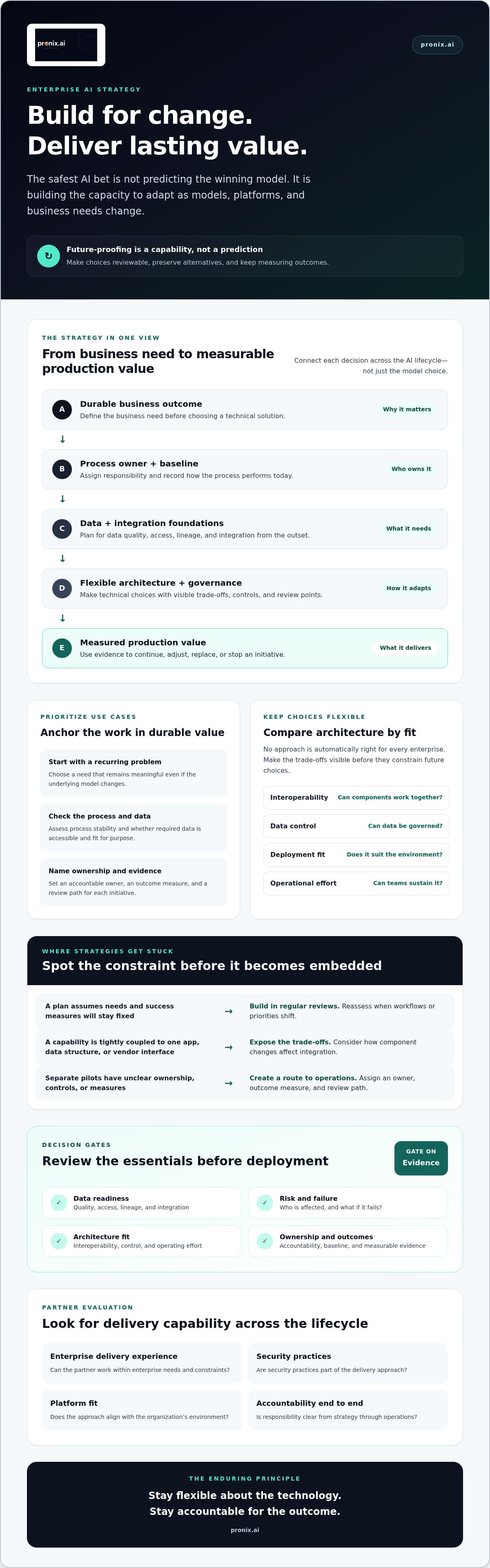
Use a repeatable roadmap to keep your AI strategy current
A strategy stays useful when teams turn it into a sequence of decisions, evidence, and scheduled reviews. Start with business objectives, then assess current initiatives and their dependencies. Use clear decision gates before an AI use case advances, expands, or moves into production. This makes future-proofing your AI strategy an ongoing management discipline, not a document that sits unchanged after approval.
How do you turn AI priorities into a sequenced roadmap?
First, inventory initiatives, accountable owners, supporting systems, data dependencies, and evidence of business value. Then rank opportunities using transparent criteria such as expected value, feasibility, risk, and readiness. A promising use case may need to wait if its data is inaccessible or critical integrations lack an owner.
Sequence foundational work before expanding initiatives with unresolved dependencies. Set decision gates that require teams to confirm:
- Data readiness: Required data is accessible, sufficiently reliable, and governed for the intended use.
- Risk and controls: Security, human oversight, and exception handling are defined for the workflow.
- Architecture and ownership: Dependencies are understood, and accountable teams can support the solution.
- Outcome evidence: Baselines and measures are in place to judge whether the initiative is delivering value.
After deployment, track agreed measures for business value, reliability, adoption, exceptions, and control effectiveness. These indicators help leaders distinguish a system that is merely active from one that continues to perform as intended.
How often should enterprise teams review their AI strategy?
Set a regular review cadence that aligns with existing governance and planning cycles. There’s no single schedule that suits every organization. Define the cadence, assign participants, and ensure reviews consider performance evidence, changes in business priorities, and outstanding risks.
Don’t wait for the next scheduled meeting if a material change occurs. A shift in business objectives, data availability, platform capabilities, or risk conditions may warrant an out-of-cycle review. Reassess affected assumptions and decide whether to continue, adjust, pause, or retire an initiative.
Keep an auditable record of each review: decisions made, assumptions tested, accountable owners, and follow-up actions. That record gives future reviewers context and makes it easier to understand why the roadmap changed. For support connecting AI priorities to implementation and ongoing operations, learn about pronix.ai’s enterprise AI services.
Move from AI strategy to durable enterprise operations with the right partner
A strategy creates lasting value only when it can move into delivery and remain operational after launch. That calls for continuity across prioritization, technical implementation, integration, governance, and ongoing support. If these stages are disconnected, teams can be left with a sound plan but no production path, or a deployed system without clear ownership and oversight.
Partner selection should test delivery capability, not just strategic fluency. Look for experience with complex enterprise environments, practical security and governance practices, and a credible fit with your existing platforms and operating model. Ask who is accountable at each stage, how internal teams will participate, and what the partner needs from your organization. Future-proofing your AI strategy depends in part on making those responsibilities explicit before work begins.
What should an enterprise expect from an AI implementation partner?
Expect a clear route from discovery and prioritization through integration, production readiness, and operational handover. The partner should explain how its proposed work connects to your business goals and existing constraints, rather than assuming that a promising use case is ready to deploy.
Before engagement, clarify the scope and evidence you’ll use to evaluate progress. Ask how the delivery team will address:
- Governance and security: Who reviews risk, access, and control requirements?
- Testing and monitoring: How will teams validate behavior and identify issues after release?
- Integration and dependencies: Which systems, data, and internal owners are required?
- Handover and accountability: Who supports ongoing operations, and what responsibilities remain with your teams?
- Success measures: Which agreed outcomes will show whether the work is delivering value?
Specific answers make assumptions visible and help leaders judge whether the proposed delivery model fits their organization.
How can pronix.ai support an adaptable enterprise AI strategy?
pronix.ai, Pronix Inc.’s AI and customer experience solutions division, provides enterprise AI strategy, technical implementation, and managed services. Its capabilities span Agentic AI, AI-driven CX modernization, business automation, and data foundations. These services are relevant when they align with a defined business need, existing systems, and operational readiness. They don’t replace the need to confirm scope, platform fit, governance responsibilities, or measurable success criteria.
Leaders assessing a path from priorities to delivery can discuss their enterprise AI strategy with pronix.ai. Bring your objectives, current constraints, and ownership questions to the conversation. This provides a practical starting point for assessing whether strategy, implementation, and the ongoing operating approach fit together.
Turn adaptability into lasting enterprise value
Future-proofing your AI strategy isn’t about predicting which model or vendor will lead next. It’s about anchoring decisions in durable business outcomes, choosing architecture with understood dependencies, and building governance and operational ownership into delivery. A repeatable roadmap keeps priorities connected to evidence and makes it easier to reassess when business needs or technology change.
The right partner can help connect strategy to implementation and ongoing operations. pronix.ai provides enterprise AI strategy, implementation, and managed services across Agentic AI, business automation, and AI-driven CX modernization. Its work includes platforms such as AWS, Microsoft, Salesforce, Kore.ai, and Genesys, considered in relation to enterprise needs.
Ready to turn priorities into a practical delivery path? Discuss your enterprise AI strategy with pronix.ai and explore how your objectives, governance requirements, and delivery constraints can guide the next steps. With clear measures and accountable ownership, your organization can adapt with confidence and keep AI focused on lasting value.
Frequently Asked Questions
What does future-proofing your AI strategy mean?
Future-proofing your AI strategy means building the ability to adapt AI capabilities, architecture, governance, and priorities as business needs and technology change. It doesn’t mean predicting which model or vendor will remain dominant. Instead, define measurable business outcomes, make dependencies visible, and set review points so your organization can adjust its approach without losing sight of the value it needs to deliver.
How can a business future-proof its AI strategy?
Start with recurring business problems, clear process owners, and measurable outcomes. Assess data readiness, integration needs, security, and the consequences of errors before selecting a technical approach. Document ownership and dependencies, then use decision gates to guide deployment and expansion. Track results and schedule strategy reviews, with additional reviews when business priorities, technology, or risk conditions materially change.
Which AI platform is best for a future-proof enterprise strategy?
No single AI platform is best for every enterprise. Test each option against the same requirements: workflow fit, data controls, interoperability, deployment constraints, observability, security, and operating effort. Verify current capabilities rather than relying on roadmap promises. A platform-led, custom-integrated, or hybrid approach may fit, depending on existing systems, process needs, and the organization’s ability to support the resulting dependencies.
Can an enterprise avoid vendor lock-in when adopting AI?
An enterprise can reduce, but may not be able to eliminate, vendor dependency. Review data portability, interfaces, integration design, update processes, and the practical effort required to migrate or exit. Modular components and documented dependencies can preserve options where feasible. However, platform capabilities, security controls, and data formats may make some elements difficult to replace, so assess those trade-offs before committing.
How often should an organization update its AI strategy?
Set a regular review cadence that aligns with governance and business planning cycles, then revisit the strategy sooner if material changes occur. Triggers might include a shift in business priorities, data availability, platform capabilities, or risk conditions. At each review, assess performance measures and assumptions, record decisions, and assign owners to follow-up actions. The cadence should support timely decisions without creating unnecessary review overhead.
What should an enterprise AI strategy include?
An enterprise AI strategy should connect business objectives to prioritized use cases, accountable owners, and measurable outcomes. It should also address data readiness, architecture, integration dependencies, security, governance, human oversight, and operational ownership. Define how initiatives will be assessed, tested, monitored, and reviewed over time. Include decision gates for advancing or changing work so investment follows evidence, readiness, and business value.
When should a company work with an AI strategy and implementation partner?
Consider a partner when internal teams need support connecting AI priorities to technical implementation, enterprise integration, governance, or ongoing operations. Assess the partner’s enterprise delivery experience, security practices, platform fit, and clarity on scope, responsibilities, dependencies, and success measures. Pronix.ai provides enterprise AI strategy, implementation, and managed services across Agentic AI, AI-driven CX modernization, and business automation, aligned to organizational needs.