













NewNew: The enterprise guide to Agentic AI — 24 min read.

Read →
Slide 1 of 3
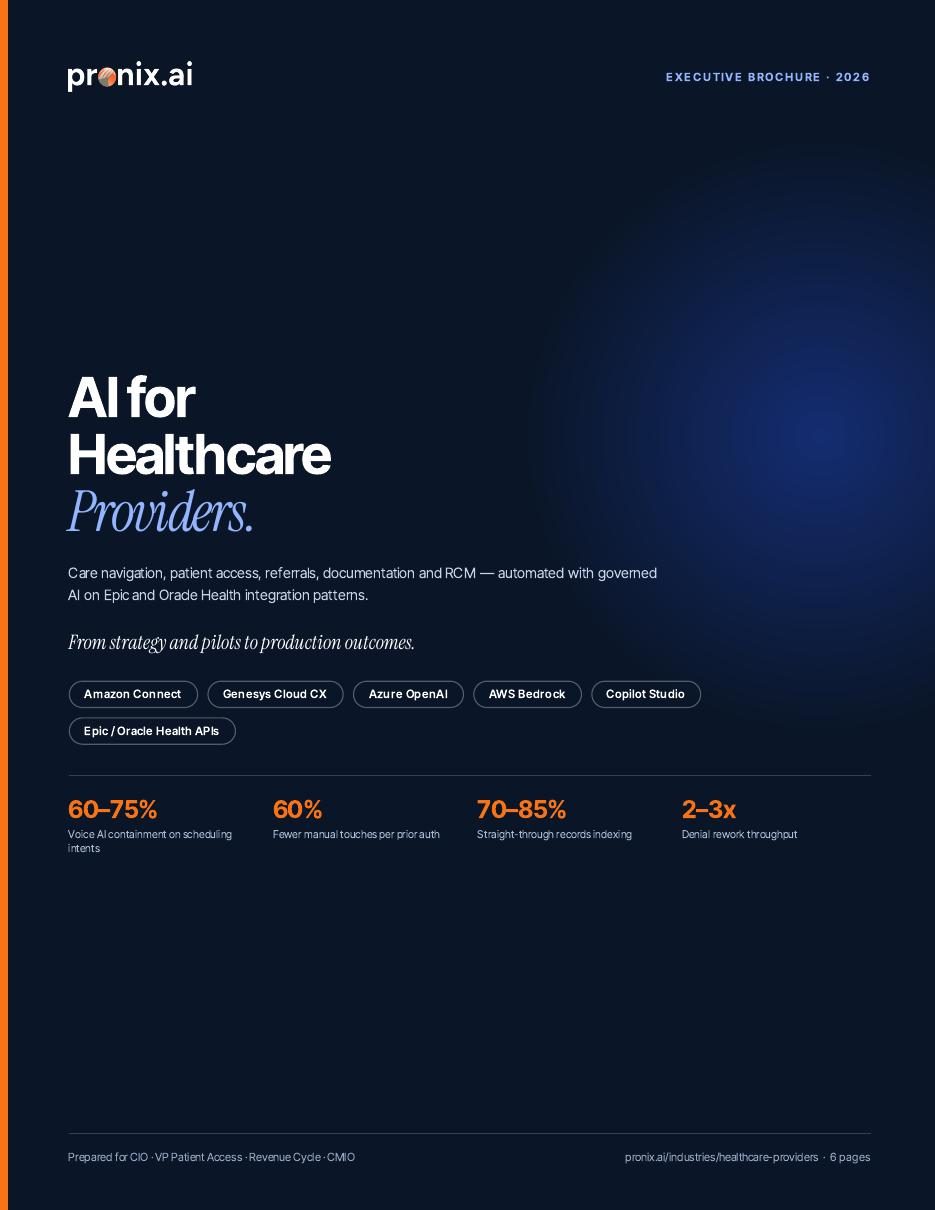
60–75%
Voice AI containment on scheduling intents
60%
Fewer manual touches per prior auth
70–85%
Straight-through medical-records indexing
2–3x
Denial rework throughput

Ranges reflect outcomes observed across Pronix healthcare-provider engagements; results vary by EHR, payer mix and service line. Documentation-burden figure per Sinsky et al., Annals of Internal Medicine, 165(11):753–760 (2016).

Certified partner platforms
  • Amazon Connect logo
  • Genesys Cloud CX logo
  • NICE CXone logo
  • Salesforce Agentforce logo
  • Google CCAI Platform logo
  • Kore.ai logo
The enterprise challenge

Patient access and revenue cycle are the biggest AI opportunities in healthcare.

Patients can't reach the right care fast enough. Clinicians drown in documentation. Revenue cycle leaks at every touchpoint. AI applied well — with PHI-safe governance — changes all three.

  • Access friction
    Long hold times, dropped calls and referral leakage lose patients before care ever starts.
  • Clinical documentation burden
    Physicians spend nearly two hours on documentation for every hour of patient care (Sinsky et al., Annals of Internal Medicine, 2016) — a major driver of burnout.
  • Revenue cycle complexity
    Prior auth, eligibility, claims and denials — every step is a hand-off that leaks revenue.
Capabilities

Care-first AI and CX capabilities.

01
Patient access voice AI

Amazon Connect + Lex voice bot integrated with EHR scheduling APIs — healthcare-grade auth and warm transfer on clinical questions.

02
Care navigation & agent assist

Genesys + Azure OpenAI copilot for patient financial services — balance, plan eligibility, script-safe payment options in real time.

03
Clinical documentation copilots

Ambient documentation, coding assistance and encounter summarization (Azure OpenAI) with clinician-in-the-loop.

04
Prior-authorization agents

Multi-agent system on Azure OpenAI + Copilot Studio — intake, payer-rules, submission and follow-up agents; humans review exceptions only.

05
Denials, appeals & rework

Denial classification, root-cause tagging and drafted appeal packets — 2–3x rework throughput.

06
PHI-safe enterprise search

Semantic search across clinical, policy and coding content on AWS Bedrock with PHI-aware access controls.

How we deliver

A six-step model, from assessment to managed operations.

Every engagement follows the same rhythm — so business, IT and delivery stay aligned from opportunity to outcome.

01
Assess

Patient access, RCM and clinical workflow audit.

02
Design

Care journey, AI architecture and PHI model.

03
Pilot

One service line with measurable KPIs.

04
Implement

EHR integration, CCaaS build, evals.

05
Scale

Service lines, regions, languages.

06
Operate

Managed operations with clinical oversight.

Where it lands

Use cases already in production with enterprise clients.

Voice AI for scheduling & reschedules (Amazon Connect + Lex)

Natural-language voice bot integrated with EHR scheduling APIs and healthcare-grade auth — 60–75% containment on scheduling intents.

Agent assist for patient financial services (Genesys +

Grounded copilot surfaces balance, plan eligibility and script-safe payment options — 25% AHT reduction, higher FCR.

Prior-authorization agent (Azure OpenAI + Copilot Studio)

Multi-agent intake, payer-rules, submission and follow-up — humans review exceptions only, 60% fewer manual touches.

Enterprise clinical search (AWS Bedrock)

Unified semantic search over clinical, policy and coding content with PHI-aware access controls and evaluation guardrails.

Medical-records intake & indexing (Bedrock IDP)

Fax/PDF/portal records classified, extracted and indexed to the EHR — 70–85% straight-through processing.

Denials & appeals rework (Azure OpenAI)

Classification, root-cause tagging and appeal-packet drafting with reviewer approval — 2–3x throughput.

Advisory brief

Patient Access Maturity Model

A staged model — reactive call center → self-service IVA → predictive navigation → closed-loop RCM — with EHR (Epic App Orchard, Oracle Health/Cerner) integration patterns, PHI controls and the KPIs that move at each stage.

Delivered by

Pronix service lines aligned to healthcare providers outcomes.

Strategy, implementation and operating support are combined around the service motions most relevant to this industry.

Runs on

Grounded on your data. Governed on day one.

Every platform we implement is only as good as the retrieval, connectors and controls behind it. These are the horizontal solutions we ship with every engagement.

Not sure where to start? Score your organization in 10 minutes.Take the AI Readiness Assessment →
Explore next
Frequently asked

Questions buyers ask us first.

Is your AI healthcare-ready?
Yes — PHI-safe retrieval, BAAs with underlying providers, PHI redaction and audit trails are standard.
Do you integrate with Epic and Oracle Health (Cerner)?
Yes — Epic (App Orchard, Vendor Services, MyChart) and Oracle Health (Cerner) integrations are core patterns; see the Patient Access reference architecture linked above.
How do ambient clinical documentation copilots stay clinician-safe?
Clinician-in-the-loop by design: the LLM drafts note sections and coding suggestions; the clinician reviews, edits and signs. Prompts, models and outputs are logged and evaluated against a governance harness.
Can you support ambulatory as well as inpatient?
Yes — the patterns span ambulatory, ED, inpatient and post-acute settings.
Next step

Book a working session with our healthcare providers team.

30 minutes. Your architecture, your data, your KPIs. You leave with a concrete pilot outline and a business case worth defending.