














NewNew: The enterprise guide to Agentic AI — 24 min read.

Read →
Slide 1 of 3
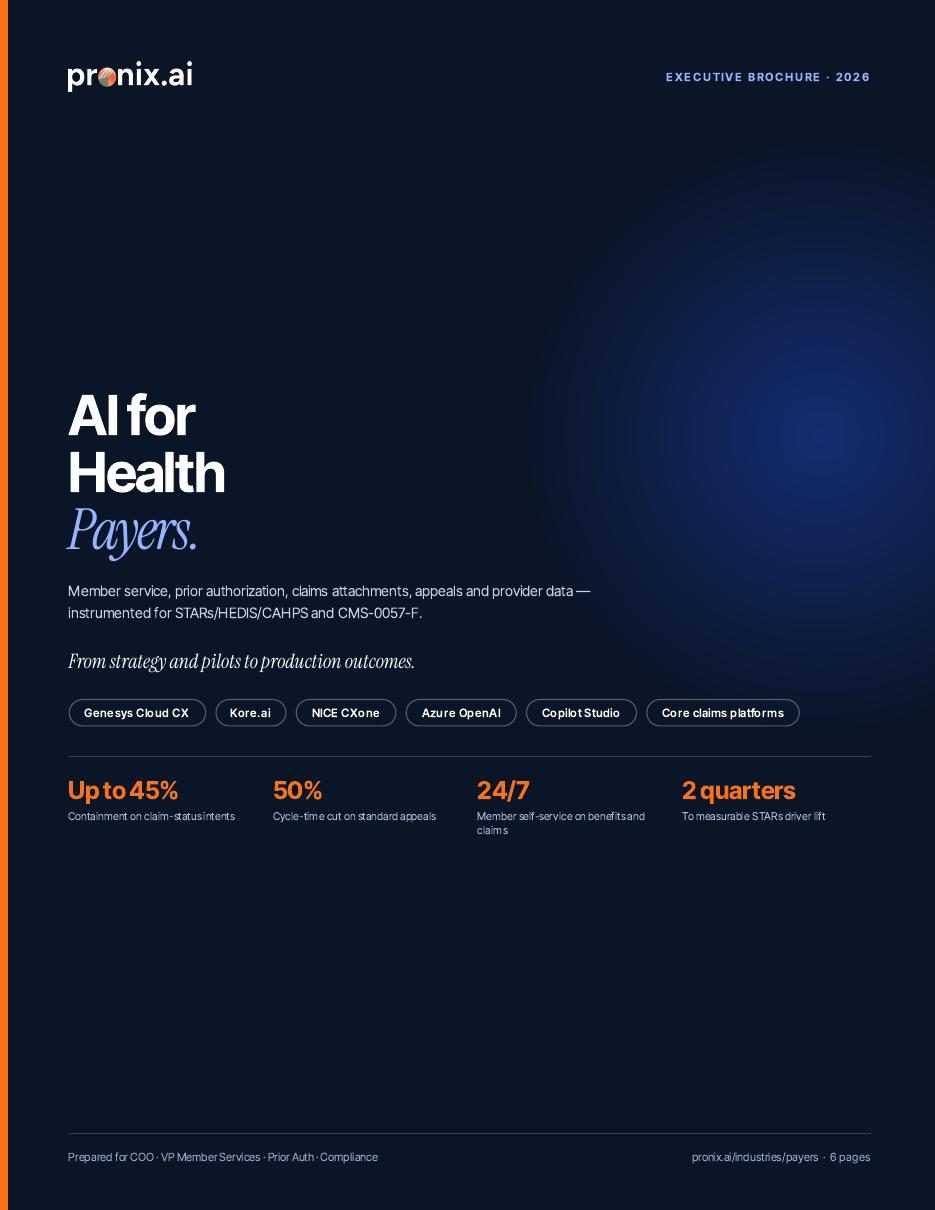
Up to 45%
Member-services containment on claim-status intents
50%
Cycle-time reduction on standard appeals
Measurable
STARs driver lift within two quarters
24/7
Member self-service on benefits and claims

Ranges reflect outcomes observed across Pronix payer engagements; results vary by line of business (Commercial, Medicare Advantage, Medicaid), core admin system and starting service baseline.

Certified partner platforms
  • Amazon Connect logo
  • NICE CXone logo
  • Salesforce Agentforce logo
  • Microsoft Dynamics 365 Contact Center logo
  • Google CCAI Platform logo
  • Kore.ai logo
The enterprise challenge

Payer operations are the single most under-automated area in healthcare — and the most regulated.

Members struggle to reach anyone. Providers wait days for authorizations. Claims processing depends on manual review at every exception. CMS's 2024 Interoperability and Prior Authorization Final Rule (CMS-0057-F) resets the clock on API-based prior auth and provider access — with 2026/2027 deadlines already on payer roadmaps.

  • Member service under pressure
    STARs, HEDIS and CAHPS ratings all reflect service quality — and legacy contact centers are the bottleneck.
  • Prior auth is the top provider abrasion point
    CMS-0057-F requires a Prior Authorization API, decision timelines and public reporting. Days-long turnarounds cost members care, burn provider relationships and now fail compliance.
  • Provider data drift
    Directory accuracy is a compliance risk and a service failure — automation is finally viable.
Capabilities

Payer-tailored AI and CX capabilities.

01
Member service IVA (Genesys + Kore.ai)

Claims-status IVA with member auth, knowledge-grounded responses on benefits, EOB and denial reasons — up to 45% containment.

02
Prior authorization automation

End-to-end automation with clinical review and human-in-the-loop for edge cases, aligned to CMS-0057-F API and timeline requirements.

03
Claims attachment intake (Azure OpenAI IDP)

IDP extracts key fields from op notes, EOBs and itemized bills, aligns to the claim and flags missing data before adjudication.

04
Appeals & grievances drafting agent

Azure OpenAI agent assembles case timeline, cites policy and drafts decision letter for reviewer — 50% cycle-time reduction on standard appeals.

05
Provider-data maintenance automation

Ongoing directory validation, roster automation and network adequacy checks with governed AI.

06
AI governance & evaluation platform

Central eval harness, model registry, red-teaming and PHI-aware guardrails across payer AI use cases.

How we deliver

A six-step model, from assessment to managed operations.

Every engagement follows the same rhythm — so business, IT and delivery stay aligned from opportunity to outcome.

01
Assess

Member journey and ops baseline.

02
Design

AI architecture, PHI model, evals.

03
Pilot

One line of business, measurable KPIs.

04
Implement

Core systems integration and rollout.

05
Scale

Lines of business, regions, languages.

06
Operate

Managed operations with clinical oversight.

Where it lands

Use cases already in production with enterprise clients.

Claims-status IVA with member auth (Genesys + Kore.ai)

IVA fronts the claims platform with knowledge-grounded responses and secure auth — 45% containment, 25% AHT reduction on transferred calls.

Conversation analytics for STARs & CAHPS (NICE Enlighten)

Enlighten + custom topic models surface Stars/CAHPS drivers and coaching moments — measurable driver lift within two quarters.

Appeals & grievances drafting agent (Azure OpenAI)

Agent assembles case timeline, cites policy and drafts decision letter — reviewers edit and approve rather than draft from scratch.

Attachment intake for claims adjudication (Azure OpenAI IDP)

IDP extracts key fields, aligns to the claim and flags missing data — cycle-time reduction on attachment-blocked claims.

Provider-data maintenance automation (Azure OpenAI)

Continuous directory validation, roster automation and network adequacy — compliance risk reduced, provider abrasion down.

AI governance & evaluation platform (Azure OpenAI)

Central eval harness, model registry and red-teaming across payer AI — defensible audit trail per model version.

Advisory brief

CMS-0057-F Prior Authorization Readiness POV

What the 2024 CMS Interoperability and Prior Authorization Final Rule actually requires — Prior Authorization API, Provider Access API, decision-timeline and reporting mandates — and a working reference for meeting the 2026/2027 deadlines with agentic prior-auth and IDP.

Delivered by

Pronix service lines aligned to health payers outcomes.

Strategy, implementation and operating support are combined around the service motions most relevant to this industry.

Runs on

Grounded on your data. Governed on day one.

Every platform we implement is only as good as the retrieval, connectors and controls behind it. These are the horizontal solutions we ship with every engagement.

Not sure where to start? Score your organization in 10 minutes.Take the AI Readiness Assessment →
Frequently asked

Questions buyers ask us first.

How does this align with CMS-0057-F?
Our prior-auth automation is designed to meet the Prior Authorization API, Provider Access API, decision-timeline and public reporting requirements of the CMS Interoperability and Prior Authorization Final Rule (2024), with agentic workflows for clinical review and human-in-the-loop where regulation requires it.
Do you integrate with core payer platforms?
Yes — HealthEdge, Facets, QNXT and custom cores via standard APIs and message-bus patterns.
Can you improve our STARs / CAHPS?
Yes — service redesign, care-gap outreach, member communication and conversation analytics (NICE Enlighten) surface Stars/CAHPS drivers with measurable lift within two quarters.
Next step

Book a working session with our health payers team.

30 minutes. Your architecture, your data, your KPIs. You leave with a concrete pilot outline and a business case worth defending.