

Building an internal AI team may look like the safest way to control costs and protect data. But if that team can’t move pilots into production or establish governance at scale, control alone won’t deliver business value. The in-house AI team vs managed services decision is really about who can bridge that production gap with the right speed, expertise, and safeguards.
The pressure is real. AI talent can be difficult to hire and retain, promising pilots can stall before reaching production, and regulated enterprises must account for security, compliance, and oversight from the start. Choosing a model based on headcount alone can leave these risks unresolved.
This 2026 framework compares the total cost of ownership, time to production, and governance demands of building internally and partnering with managed services. You’ll learn how to assess your organization’s readiness, decide where internal ownership matters most, and determine when a managed model can support production-ready Agentic AI and ongoing operations.
Key Takeaways
- The AI production gap often comes from challenges that emerge after a pilot, including scaling agentic workflows, infrastructure, and governance.
- Compare the full costs of internal AI development, including ongoing operations and the risk of technical debt, not just hiring expenses.
- Use the in-house AI team vs managed services decision matrix to weigh strategic ownership, delivery urgency, and scaling needs.
- Managed services can help address AI talent constraints and provide specialized platform expertise for production-focused work.
- A strategy-led approach can connect AI foundations, implementation, and managed services to support secure, scalable outcomes.
The 2026 AI Production Gap: Why In-House Teams Struggle to Scale
The AI production gap is the distance between a promising pilot and an AI capability that performs reliably within enterprise operations. Production readiness means more than a working model. Systems must connect to business processes and existing platforms, operate within security and governance controls, and deliver measurable value as demand grows.
The technical challenge is also changing. Early generative AI projects often added a conversational interface to a model. Agentic AI workflows go further: they can plan steps, use tools, and take actions across systems. That increases the need for orchestration, testing, monitoring, and clear boundaries on what agents can do. A pilot can demonstrate potential without proving that these capabilities are ready for production.
The Reality of the AI Talent War
Recruiting and retaining the mix of people needed to build enterprise AI can be difficult. A production team may need expertise across AI and data engineering, platform integration, operations, security, and user experience. Before deciding to hire, map the roles required for the whole lifecycle, then compare that list with your current team’s skills and available capacity. A few specialists may be enough for a contained use case, but they may not be able to design, deploy, govern, and maintain several workflows at once.
AI talent decay is the loss of relevance in a team’s skills as AI platforms, architectures, and practices evolve faster than employees can keep pace.
Experimentation vs. Production Readiness
A prototype can prove a concept, but it represents only the start of enterprise delivery. The “last mile” includes identity and access controls, security reviews, auditability, operational monitoring, and integration with legacy systems. Without systems integration, an internal team may build an agent that works in isolation but cannot safely exchange data or trigger actions across business workflows.
That gap can also create technical debt. Teams that build agents independently may use inconsistent patterns for permissions, logging, or evaluation. As the number of workflows grows, those differences make maintenance and oversight harder. A cross-platform systems integrator can help align implementation with the enterprise’s existing environment. Pronix.ai works with platforms including AWS, Microsoft, and Salesforce.
The managed services model provides an alternative to relying solely on internal capacity: an external provider takes responsibility for agreed services and ongoing operations. For leaders weighing the in-house AI team vs managed services trade-off, the key question is whether internal teams can sustain both innovation and production operations as technology changes.
For a closer look at the operational requirements, see the Enterprise Agentic AI 2026 Production Guide.
Hidden Costs and Risks of Internal AI Development
Building AI internally can appear to offer direct control over architecture and spending. But the budget extends well beyond model development. Leaders need to account for infrastructure, platform management, security, governance, and the work required to maintain systems after launch. The right comparison isn’t simply whether internal or external delivery costs less. It’s whether the organization can fund and operate the full lifecycle.
Capital expenditure (CapEx) may include dedicated compute and data infrastructure purchased or reserved for AI workloads. Operational expenditure (OpEx) covers recurring usage, storage, platform access, maintenance, and specialist labor. Cloud services can shift some infrastructure costs toward usage-based spending, but they don’t remove the need to monitor consumption or manage data movement, integrations, and performance. A pilot that works at low volume may have a different cost profile once usage expands.
Infrastructure and Tooling Overhead
Enterprise environments often span platforms such as AWS, Azure, and Salesforce. Each can bring different data connections, permissions, monitoring practices, and commercial arrangements. Managing these components separately can create duplicated effort and fragmented oversight. Before committing to a build, map the full lifecycle: compute, storage, data access, platform management, integration, and ongoing support. A sound enterprise AI data strategy can help clarify the foundations required to scale without multiplying complexity.
Non-standardized agents add another layer of cost. If teams implement permissions, logging, evaluation, or error handling differently for each workflow, future updates become harder to test and maintain. That technical debt can slow deployment and limit reuse. It can also force teams to revisit earlier design choices as systems expand.
Governance and Compliance Burdens
In regulated industries, governance requires more than adding a final review before launch. Teams need defined ownership, documented system behavior, review processes, and evidence that controls are working. Building and maintaining those practices internally takes coordination across technical, security, risk, and business functions. Responsible AI isn’t solely a technical task; it also involves organizational accountability and decision-making. Harvard Law Review examines related corporate governance and AI risks.
Customer-facing agents raise the stakes. An agent that gives inaccurate information or takes an unintended action can damage trust and create operational or liability concerns. Human escalation paths, clear action limits, testing, and monitoring help reduce exposure, but they require deliberate design and ongoing ownership.
Slow internal deployment has an opportunity cost, too. While a team works through infrastructure decisions and governance gaps, other organizations may put useful workflows into operation sooner. For organizations assessing the in-house AI team vs managed services trade-off, Pronix.ai’s enterprise AI managed services are one option to evaluate alongside the internal cost of building and maintaining these capabilities.
Managed AI Services: Accelerating Production-Ready Outcomes
Managed AI services give enterprises a way to add specialized delivery capacity without recruiting every skill set internally. A provider can bring together expertise in AI implementation, data, platform integration, and ongoing operations, while the organization retains ownership of business priorities and decision rights. This can help close capability gaps without making a permanent hiring plan the prerequisite for every initiative.
The systems integrator advantage is practical: AI must work across the enterprise’s existing technology, not in isolation. An implementation may need to connect cloud AI capabilities with customer data, business applications, and established workflows. Pronix.ai works with AWS, Microsoft, and Salesforce platforms. Cross-platform experience can help teams plan those connections and address integration requirements earlier in delivery.
A managed model can support time to value by reusing delivery experience and established implementation practices. It doesn’t guarantee that a project will move from months to weeks. Scope, data readiness, approvals, and integration complexity still shape timelines. But organizations can avoid treating every production challenge as a first-time problem and set milestones around a usable workflow rather than a demo alone.
Managed CX Modernization and Automation
Managed AI can help enterprises scale intelligent workflows without adding equivalent internal headcount for every new use case. In customer experience, an agent might support routine requests, retrieve relevant information, or route complex cases to a human. The goal is not automation for its own sake. It’s to improve consistency and reduce friction while preserving clear escalation paths and human oversight where needed. Explore the AI-driven CX modernization guide for a deeper look at production-ready outcomes.
Enterprise-Grade Security and Auditability
Governance is most effective when considered during architecture and implementation, rather than added after an agent is built. A managed provider can work with the enterprise to define access boundaries, approval points, logging needs, and monitoring responsibilities. The organization should confirm how responsibilities are divided, what evidence is retained, and how changes are reviewed. No provider removes the enterprise’s need to understand and oversee its own risk.
Managed AI governance is the ongoing application of defined controls, oversight, and accountability to AI systems, giving organizations a way to scale innovation while maintaining trust and operational discipline.
Agents also need care after launch. Models, connected systems, business rules, and user needs can change, so teams should review performance, address failures, and refine workflows over time. This continuous optimization is central to the in-house AI team vs managed services decision: evaluate not only who can build the first version, but who can sustain it securely as the business evolves.
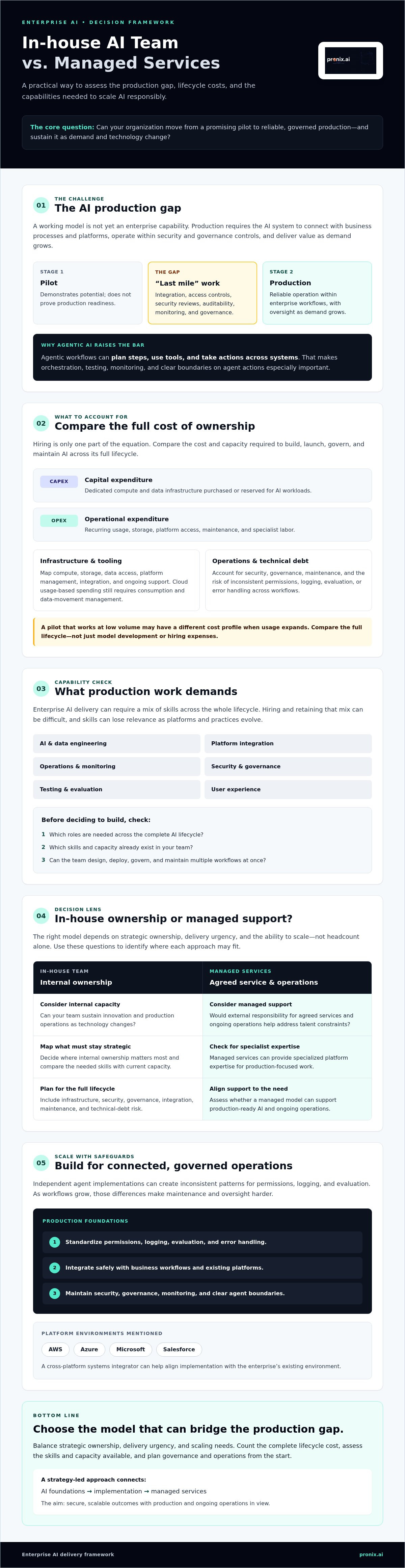
In-House AI Team vs Managed Services: Decision Matrix
The in-house AI team vs managed services decision depends on what the business needs to own, which capabilities it can sustain, and how quickly it needs production outcomes. Assess each initiative against these criteria before choosing a delivery model:
- Strategic importance: Is AI central to the business’s differentiation, or does it support an existing operation?
- Operational scope: Is the goal a contained departmental pilot or a capability intended to serve multiple business units?
- Internal readiness: Can current teams support the initiative’s delivery and ongoing requirements? Identify missing skills, competing priorities, and who will own operations after launch.
- Cost predictability: Can the organization absorb fluctuations in recruitment and R&D, or does it need a clearly defined service scope and commercial model?
Monthly fees may make some operating costs easier to forecast, but only when scope, usage assumptions, responsibilities, and change processes are clear. Internal investment can vary with hiring needs and research priorities. Compare total cost of ownership rather than weighing a provider’s fee against salaries alone. Include implementation, infrastructure, platform usage, integration, governance, and ongoing support in the comparison.
When to Keep AI In-House
Internal ownership may fit when AI capabilities or proprietary methods are central to the business’s differentiation. It can also suit organizations with established data science teams and sustained R&D capacity. The trade-off is greater direct control over priorities and knowledge, balanced against the effort required to build and retain the capabilities needed to execute. Before choosing this route, identify who will handle security reviews, platform changes, monitoring, and maintenance once the initial build is complete.
When Managed Services Make a Strong Case
External support may be valuable when modernizing legacy CX or contact center environments, or deploying Agentic AI across multiple business units. These initiatives can require expertise and delivery capacity beyond a team assembled for a single pilot. Review the enterprise AI managed service provider selection framework to assess partner fit and responsibilities. Ask how the provider will work with existing systems, document decisions, and support operations after implementation.
Consider a Hybrid Model
Build versus buy isn’t always an all-or-nothing choice. In a co-managed environment, internal leaders can retain ownership of business priorities and risk decisions, while a managed-services partner contributes implementation or operational expertise. Define decision rights, escalation paths, documentation, and knowledge transfer in advance. This model can support a focused initiative while leaving room to adjust the balance of internal and external responsibility as organizational needs evolve.
To apply the framework, map a priority use case against these criteria, then review Pronix.ai’s enterprise AI managed services as a potential fit for moving it toward production.
Transitioning to a Production-Ready Future with Pronix.ai
Choosing a delivery model is only the first decision. Enterprises also need a path from strategy to implementation and sustained operation. Pronix.ai helps organizations move AI initiatives beyond pilots toward secure, scalable production outcomes, with services spanning Agentic AI, CX modernization, business automation, and managed services.
This model can help address two common constraints at once: limited access to specialized AI talent and the technical work required to connect AI with enterprise platforms and processes. Pronix.ai works with AWS, Microsoft, Salesforce, Kore.ai, and Genesys. The objective is to align implementation with business priorities while accounting for integration, security, governance, and ongoing management.
For leaders weighing the in-house AI team vs managed services decision, the useful question is not simply who builds an agent. It’s how the organization will define success, measure results, manage risk, and keep the system useful as needs change. Business automation and CX modernization initiatives should start with measurable outcomes, such as reduced manual effort, improved workflow completion, or more consistent customer support. Establish a baseline before deployment, then track performance against it. Don’t assume ROI; validate it.
From Pilot to Production
Moving an Agentic AI workflow into production requires more than expanding a successful demo. Teams need to confirm data readiness, system integrations, access controls, human oversight, and monitoring responsibilities. A disciplined strategy-to-implementation process can surface operational dependencies early and define how the solution will be evaluated after launch. For more context on Pronix.ai’s approach, read Pronix.ai’s production-ready AI approach.
When assessing a provider’s results, ask for evidence tied to the use case: what baseline was used, which cost or productivity measures changed, and how those outcomes were monitored. This keeps case-study claims grounded in business impact rather than technical activity alone.
Starting Your AI Journey
A specialized AI strategy and consulting partner can help leaders prioritize use cases before committing to a broad rollout. Start by identifying one business problem, the systems and data it depends on, the risks that require oversight, and the measures that will determine success. Then clarify which capabilities should remain internal and where external implementation or managed services could fill a gap.
Pronix.ai connects strategy, implementation, and managed services so enterprises can plan for both deployment and continued operation. Discuss your priorities with Pronix.ai’s enterprise AI team to evaluate a production-focused path forward.
Turn Your AI Roadmap Into Production Results
The right in-house AI team vs managed services choice depends on what your organization must own, what it can sustain, and how quickly it needs to deliver. Internal teams can preserve control over core capabilities. Managed services can add specialized expertise and operational capacity. A hybrid model can combine both, provided ownership, governance, and success measures are clear.
Whatever path you choose, evaluate more than the initial build. Account for integration, security, ongoing optimization, and measurable business impact. Production-ready AI requires a disciplined approach from strategy through implementation and operations.
Pronix.ai focuses on Agentic AI and CX modernization, helping enterprises pursue secure, scalable production outcomes with expertise across AWS, Microsoft, Salesforce, Kore.ai, and Genesys platforms.
Set a clear objective, choose a delivery model that fits your capabilities, and contact Pronix.ai to discuss moving your AI initiative from pilot to production.
Frequently Asked Questions
What are the primary differences between an in-house AI team and managed AI services?
An in-house team is employed by your organization and develops expertise within its business, systems, and priorities. Managed AI services provide external strategy, implementation, or ongoing operational support under an agreed scope. Internal ownership can offer close day-to-day alignment, while a provider can add specialized skills without requiring every role to be hired internally. Some enterprises combine both, keeping strategic decisions in-house and using a partner to support delivery or operations.
How do managed AI services handle data security and enterprise governance?
Managed services should address security and governance as part of the delivery model, not as a final check. Before engagement, clarify data access, system permissions, ownership, logging, audit evidence, incident processes, and who approves changes. Responsibilities vary by provider and contract, so verify them directly. Your organization remains accountable for its own risk decisions. For regulated workflows, involve security, legal, compliance, and business owners early in design and review.
Is it more expensive to hire an internal AI team or use a managed service provider?
There’s no universal lower-cost option. Compare total cost of ownership across hiring and retention, infrastructure, platform usage, integration, governance, maintenance, and management. An internal team may suit sustained work that requires deep organizational knowledge, while managed services may reduce the need to recruit every specialty for a defined initiative. Request a clear scope and cost model, then compare it with the full internal resources needed to reach and maintain production.
Can a managed service provider work alongside my existing internal IT team?
Yes. A co-managed arrangement can pair your IT team’s knowledge of internal systems and policies with a provider’s AI implementation or managed-services expertise. Define responsibilities before work begins: who owns architecture decisions, approves data access, handles escalations, documents changes, and supports the system after deployment. This clarity helps prevent duplicated effort and keeps your internal team involved in decisions that affect enterprise operations.
What specific AI platforms does Pronix.ai support for enterprise managed services?
Pronix.ai works with major platforms including AWS, Microsoft, Salesforce, Kore.ai, and Genesys. The relevant technologies depend on the use case and the enterprise’s existing environment. For example, a customer experience modernization initiative may involve contact center platforms, while an agentic workflow may require connections to business systems and data. Confirm the platforms, integrations, and responsibilities included in the proposed scope before selecting an approach.
How long does it typically take to see ROI from managed AI implementation?
There isn’t a reliable universal timeline for ROI. Results depend on the use case, data readiness, integration needs, adoption, operating costs, and how success is measured. Set a baseline before implementation, define measurable outcomes such as reduced manual work or improved workflow completion, and review them at agreed milestones. A deployment date alone doesn’t establish business value; track performance and costs after launch to determine whether the initiative is delivering a return.
What happens to the AI agents if we decide to bring management back in-house later?
That depends on the agreement, the technical environment, and how knowledge transfer is handled. Before starting, clarify access to configurations, documentation, evaluation records, operating procedures, and relevant system credentials. Agree on transition responsibilities and timing, including how internal staff will learn to maintain and update the agents. A planned handover can reduce dependency on a provider, but the specific transition rights and deliverables should be documented in the contract.
How do managed services stay current with the rapid changes in AI technology?
Managed services can provide access to specialists who work across AI platforms and implementation contexts, but the provider’s review and update practices should be verified. Ask how it evaluates new capabilities, assesses security and operational impact, tests changes, and communicates recommendations. Updates should be driven by business value and risk, not novelty alone. Your organization should approve changes that affect data, workflows, user experience, or governance controls.