

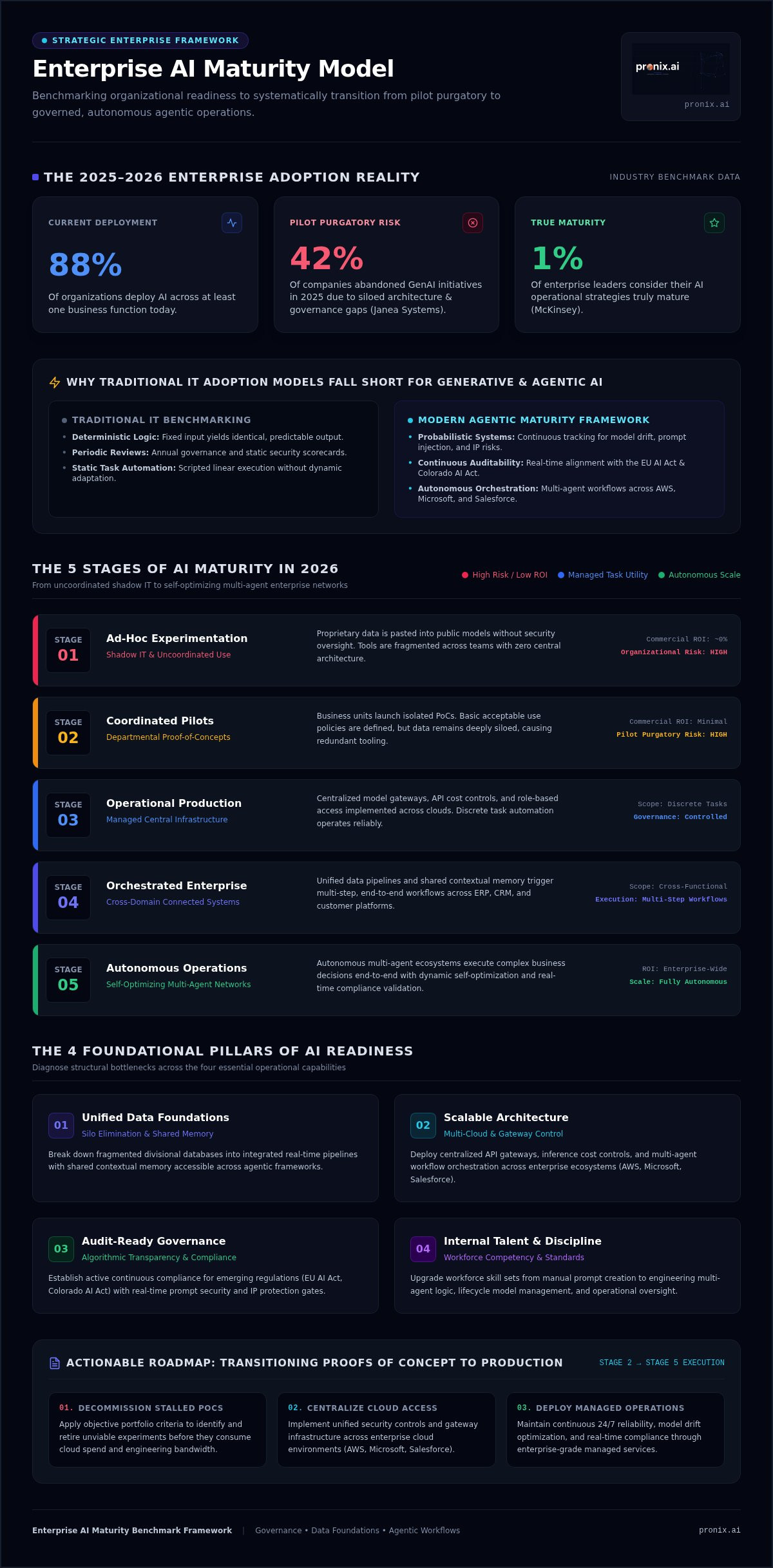
While 88% of organizations deploy AI across at least one business function, McKinsey reports that a mere 1% consider their strategies truly mature. The operational reality is unforgiving. Research from Janea Systems revealed that nearly 42% of companies abandoned generative AI initiatives in 2025, stranding high-potential concepts in perpetual pilot purgatory. Escaping this cycle requires an actionable enterprise AI maturity model that moves past ad hoc experimentation and anchors your technical roadmap in audit-ready governance, unified data, and autonomous workflows.
You already recognize the frustration of watching promising proofs of concept stall against disjointed data architecture, siloed teams, and emerging regulatory mandates. Achieving durable ROI demands operational discipline, not another isolated sandbox. In this strategic guide, you'll benchmark your enterprise AI capabilities across governance, data foundations, and agentic workflows to accelerate production-scale value. Below, we break down each maturity tier and map the exact transition milestones required to advance toward governed, autonomous production.
Key Takeaways
- Benchmark your operational readiness using a 2026 enterprise AI maturity model built specifically for agentic workflows, complex cloud environments, and rigorous compliance standards.
- Map organizational progress across five discrete stages, moving systematically from fragmented task automation to fully autonomous enterprise operations.
- Diagnose and resolve structural bottlenecks across the four foundational pillars: unified data, scalable architecture, audit-ready governance, and internal talent.
- Establish objective portfolio criteria to decommission stalled experiments and rapidly transition high-value proofs of concept into reliable production assets.
- Leverage enterprise managed services to secure continuous model optimization, round-the-clock reliability, and evolving regulatory alignment across your entire ecosystem.
What Is an Enterprise AI Maturity Model?
An enterprise AI maturity model operates as a diagnostic framework. It measures an organization's readiness, technical execution, and commercial value creation across every business unit. Rooted in the structural disciplines of the software Capability Maturity Model, modern enterprise frameworks evaluate artificial intelligence not as an isolated software tool, but as an interconnected organizational competency. This spans workforce skills, operational workflows, underlying data foundations, and governance. Without formal benchmarking, companies routinely fall victim to uncoordinated shadow AI investments, redundant tooling, and compounding security exposures. A structured model replaces disconnected departmental experimentation with a disciplined technical roadmap.
The Evolution of Enterprise AI Benchmarking
Enterprise benchmarking has fundamentally transformed. Early frameworks evaluated static statistical models built for descriptive reporting and predictive scoring. Modern enterprise architectures demand evaluation criteria built specifically for generative foundations and autonomous agentic systems. The goal is no longer basic task automation. It's multi-agent workflow orchestration across enterprise ecosystems like AWS, Microsoft, and Salesforce. Modern frameworks also prioritize regulatory posture. With state frameworks like the Colorado AI Act taking effect and the phased rollout of the EU AI Act, maturity requires algorithmic transparency, continuous auditability, and immediate risk mitigation rather than periodic retrospective reviews.
Why Traditional IT Adoption Models Fall Short
Standard IT rollout models assume deterministic software logic: a fixed input yields an identical, predictable output. Generative models and autonomous agents shatter that assumption. Because foundation models behave probabilistically, traditional gating fails to catch drift, prompt injection vulnerabilities, or intellectual property leakage. Static scorecards also fail because model capabilities advance every quarter. An enterprise can't rely on annual governance audits to monitor non-deterministic agents that make independent operational decisions. Managing modern AI requires continuous, dynamic capability tracking built for autonomous execution.
The 5 Stages of Enterprise AI Maturity in 2026
Advancing through an modern enterprise AI maturity model isn't an accidental outcome. It requires deliberate architectural shifts, evolving governance gates, and strategic engineering investments. Frameworks like the Carnegie Mellon University AI Adoption Maturity Model show that scaling software systems requires clear stage gates to escape pilot fragmentation. Today, maturity hinges on moving from reactive prompt generation to proactive, autonomous agent orchestration.
Stage 1 to Stage 3: From Discovery to Operational Deployment
Most enterprises begin with grassroots exploration before establishing formal engineering guardrails:
- Stage 1: Ad-Hoc Experimentation. Characterized by uncoordinated individual tools and shadow IT. Teams paste proprietary data into public models without security oversight. Organizational risk remains high, while measurable commercial return is virtually zero.
- Stage 2: Coordinated Pilots. Business units launch departmental proof-of-concept tests. Teams establish basic acceptable use policies, but data remains siloed, leading to redundant tooling across divisions.
- Stage 3: Operational Production. AI transitions into managed enterprise infrastructure. IT implements centralized model access gateways, API cost controls, and role-based access across core clouds. Solutions automate discrete tasks reliably within production environments.
Stage 4 to Stage 5: Scaling to Autonomous Agentic Ecosystems
The boundary between moderate utility and market leadership sits between Stage 3 and Stage 4. Crossing this threshold shifts the focus from simple task automation to autonomous business process execution.
Stage 4: Orchestrated Enterprise. Systems connect across functional domains using unified data pipelines and shared contextual memory. Rather than simply answering queries, models trigger multi-step workflows across ERP, CRM, and customer engagement platforms.
Stage 5: Autonomous Operations. Organizations deploy dynamic, self-optimizing multi-agent networks that execute end-to-end decisions with real-time compliance validation. Gartner predicts 40% of enterprise applications will feature task-specific AI agents by late 2026, up from under 5% in 2025. Achieving this level requires rigorous technical execution; enterprise teams mastering this shift prioritize disciplined playbooks for building enterprise AI agents that operate within strict governance boundaries.
Ascending these stages demands clear technical alignment. Engaging dedicated Agentic AI Strategy & Consulting provides the architectural roadmap required to transition from isolated task tooling to full enterprise autonomy.
The 4 Core Pillars of AI Readiness and Governance
A functional enterprise AI maturity model rests on four operational pillars: Data Foundations, Cloud Architecture, Governance, and Workforce Talent. A deficiency in any single domain stalls the entire enterprise pipeline. Advanced reasoning models paired with fragmented data pipelines produce severe hallucinations. Reliable data coupled with weak governance invites regulatory penalties and security breaches. Enterprise leaders must evaluate each pillar systematically to sustain operational integrity and velocity.
Data Engineering and Scalable Cloud Infrastructure
Autonomous agentic systems require low-latency pipelines and unified semantic context. Engineering teams must audit vector database throughput, ingestion latency, and retrieval accuracy across AWS, Microsoft Azure, and hybrid cloud footprints. Modernizing legacy pipelines ensures models retrieve authoritative, real-time enterprise records rather than stale operational caches. Reviewing your foundational enterprise data strategy for AI guarantees that hybrid data fabrics can support dynamic agentic read-write actions without exposing sensitive tenant data.
Enterprise AI Governance, Security, and Compliance
Governance can't remain a static legal checklist. As of May 2026, research shows that only 38% of organizations maintain a formal AI governance policy. This oversight gap proves costly under mandates like the Texas Responsible AI Governance Act (TRAIGA) and the Colorado AI Act. Operationalizing governance demands concrete safeguards:
- Continuous runtime telemetry to monitor autonomous agent drift, system anomalies, and prompt injection risks.
- Automated compliance audit trails that capture token-level model inputs, system prompts, and tool execution logs.
- Deterministic human-in-the-loop triggers for high-consequence decisions across financial services, healthcare, and supply chain operations.
Workforce Enablement and Organizational Operating Models
Technological capability means nothing if operational teams can't execute. Kyndryl's 2026 People Readiness Report revealed that only 23% of business leaders believe their workforce is fully prepared for AI. High-maturity organizations replace isolated technical research units with embedded, cross-functional AI pods. These teams combine domain operators, systems engineers, and compliance officers. They align incentives directly around production uptime, cost per successful task completion, and measurable commercial yield.
Moving from Pilot Purgatory to Production Maturity
Janea Systems reported that organizations discard 46% of AI concepts before they ever reach production. Escalating beyond this ceiling requires an actionable enterprise AI maturity model that treats transition not as an experiment, but as a disciplined systems engineering project. Moving from pilot purgatory to operational production demands rigorous portfolio rationalization, structured execution timelines, and targeted cross-platform integration.
Conducting an Enterprise AI Audit and Gap Analysis
Every successful transition starts with an unvarnished technical assessment. Engineering leaders must catalog active proofs of concept, redundant commercial API subscriptions, and disconnected cloud instances across departments. This audit contrasts current data pipelines and system latency against production criteria. It flags unmanaged dependencies, unmonitored model drift, and regulatory vulnerabilities under statutes like the Illinois Artificial Intelligence Safety Measures Act, establishing a clear baseline for remediation.
Architecting a Scalable 90-Day Execution Roadmap
Escaping sandbox inertia requires a structured, phased methodology:
- Days 1-30: Platform Standardization. Consolidate redundant API gateways. Unify data ingestion layers, establish strict token cost ceilings, and implement baseline role-based access controls across cloud environments.
- Days 31-60: High-Impact Deployment. Decommission non-viable proofs of concept. Migrate high-performing prototypes into production environments with deterministic human-in-the-loop controls and real-time guardrails.
- Days 61-90: Automated Telemetry. Operationalize continuous CI/CD pipelines for prompt versioning and retrieval validation. Implement automated audit logging to capture end-to-end task execution metrics.
Aligning Business Automation and CX Modernization
The highest commercial returns emerge when organizations connect autonomous agents directly into customer-facing and back-office transactional engines. Embedding governed workflows across Genesys contact centers and Salesforce CRM environments eliminates operational drag, enabling agents to resolve complex customer inquiries, update records, and trigger fulfillment actions dynamically. Technical teams executing this transition rely on battle-tested frameworks for Agentic AI implementation services to scale autonomous systems safely across heterogeneous platforms.
Moving from fragmented pilots to sustained commercial value requires experienced technical execution. Partner with pronix.ai for enterprise AI business automation to accelerate your deployment roadmap and operationalize production-grade workflows.
Accelerating AI Maturity with Enterprise Managed Services
Assessing gaps through an enterprise AI maturity model provides a clear diagnostic, but internal execution constraints often stall the cure. In-house engineering teams frequently hit operational roadblocks when maintaining production pipelines, updating foundational context, and managing non-deterministic workflows. Bridging this operational gap requires specialized systems integration. Enterprise managed services supply the specialized engineering muscle, operational playbooks, and continuous platform oversight required to ascend maturity tiers without overburdening core internal teams.
Solving the Enterprise AI Talent and Capability Deficit
Recruiting senior agentic systems architects, vector database engineers, and governance specialists remains a massive bottleneck for enterprise HR departments. Market demand heavily outstrips the supply of experienced practitioners who understand enterprise-scale orchestration. Partnering with a dedicated managed services provider grants instant access to production-tested architectures and cross-industry deployment experience. Rather than spending three quarters attempting to recruit and onboard scarce talent, enterprises instantly deploy mature operating models backed by proven implementation playbooks.
Continuous Governance, Observability, and Operational Excellence
Production environments demand vigilant operational management. Multi-agent systems interact dynamically, creating real-time challenges around prompt drift, tool failure, and context corruption. Specialized managed services provide structured infrastructure support:
- Continuous telemetry monitoring that tracks latency, token expenditures, agentic action paths, and model accuracy.
- Active governance audits to maintain full compliance with state mandates and changing privacy regulations.
- Systematic regression testing and continuous model fine-tuning to protect production uptime across complex tool chains.
Engineering leaders evaluating these operational requirements should review our strategic criteria for managed services for agentic AI to benchmark prospective operational partners effectively.
Partnering with pronix.ai for Enterprise Transformation
A specialized business unit of pronix.ai, founded in 2010, pronix.ai serves as an elite modernization partner that bridges the gap between maturity diagnostic assessments and production-scale execution. We deliver end-to-end capabilities across AWS, Microsoft, Salesforce, and Genesys ecosystems. Our production-tested frameworks transition organizations from disconnected proofs of concept to robust, governed agentic operations. Ready to baseline your capabilities and accelerate your roadmap? Schedule an enterprise AI maturity assessment with pronix.ai to benchmark your operations and engineer your path toward autonomous production.
Executing the Shift to Governed Enterprise Autonomy
Scaling artificial intelligence successfully requires escaping fragmented departmental sandboxes and anchoring your roadmap in unified data, proactive risk controls, and agentic workflows. The ultimate value of an modern enterprise AI maturity model lies in converting speculative technology investments into measurable, auditable commercial outcomes that stand up to evolving regulatory scrutiny.
Building that operational maturity doesn't happen in isolation. As a specialized business unit backed by Pronix Inc.'s enterprise integration experience since 2010, pronix.ai bridges the critical gap between readiness diagnostics and production execution. With deep engineering capabilities spanning AWS, Microsoft Azure, Salesforce, and Genesys environments, we deliver proven methodologies that transition high-potential concepts into resilient, automated production assets.
Take the definitive step toward sustainable technical leadership. Schedule an Enterprise AI Maturity Assessment with pronix.ai to benchmark your organization's capabilities and engineer a high-velocity path to autonomous scale.
Frequently Asked Questions
What is an enterprise AI maturity model, and why is it essential for organizations?
An enterprise AI maturity model is a diagnostic framework that evaluates an organization's capacity to build, deploy, and govern intelligent systems at scale. It's essential because it unifies executive leadership, engineering, and legal teams around an objective operational roadmap. Without it, companies suffer from fragmented tooling, redundant platform spending, and compliance blind spots. Benchmarking clarifies current capabilities and establishes the technical milestones needed to generate measurable commercial return.
How do we assess where our organization currently sits on the maturity curve?
You assess maturity by auditing technical infrastructure, data architecture, governance policies, and deployment velocity against standardized stage criteria. Start by cataloging all active proofs of concept, API integrations, and cloud configurations across business units. Evaluate whether your models operate in isolated sandboxes or execute multi-step workflows across systems like Salesforce or AWS. True assessment measures whether automated systems run reliably with runtime telemetry or rely on unmonitored manual handoffs.
What are the most significant roadblocks preventing enterprises from advancing past Stage 2?
Disjointed data architecture and a lack of audit-ready governance frameworks form the primary roadblocks stalling progress beyond departmental pilots. Many teams launch successful proof-of-concept tests in isolated departmental siloes. However, expanding these initiatives exposes unstructured data silos, inconsistent data pipelines, and security risks. Without centralized orchestration, engineering resources get trapped reconciling legacy tech debt instead of standardizing deployment infrastructure for production scale.
How does agentic AI alter traditional enterprise maturity frameworks in 2026?
Agentic AI transforms maturity models from measuring prompt-response efficiency to evaluating autonomous decision-making and tool execution across enterprise ecosystems. Legacy frameworks evaluated static models delivering passive insights or conversational summaries. Modern frameworks demand criteria for autonomous orchestration, memory persistence, and dynamic multi-agent collaboration. Organizations must now benchmark how safely agents call external APIs, query relational data, and execute transactions without requiring step-by-step human intervention.
What role does data governance play in determining overall AI organizational readiness?
Data governance serves as the bedrock of readiness, dictating whether models access trustworthy context or generate catastrophic compliance violations. Without unified semantic indexing and stringent access controls, autonomous workflows risk leaking intellectual property or hallucinating critical transactions. A mature governance posture enforces continuous audit logging, schema validation, and role-based data permissions. This ensures systems comply with evolving state and federal risk frameworks while maintaining operational integrity.
How long does it typically take for an enterprise to advance across maturity levels?
Transitioning between individual maturity stages typically requires six to twelve months of coordinated engineering, governance, and operational execution. Moving from ad-hoc discovery to managed operational production involves substantial modernization across data pipelines and cloud infrastructure. Organizations that partner with specialized managed services often accelerate this timeline significantly. They achieve production milestones in ninety-day structured sprints by leveraging production-tested architectures rather than building custom orchestration frameworks from scratch.
Can an enterprise leapfrog maturity stages by deploying third-party agentic platforms?
No organization can leapfrog maturity stages simply by purchasing third-party software licenses. While pre-built platforms accelerate tooling availability, maturity reflects organizational capability across data engineering, security guardrails, and workforce alignment. Deploying advanced autonomous agents onto fragmented data foundations or unmonitored networks creates severe operational risk rather than genuine capability. Advancing through an enterprise AI maturity model requires systematic execution across architecture, governance, and operating workflows.