

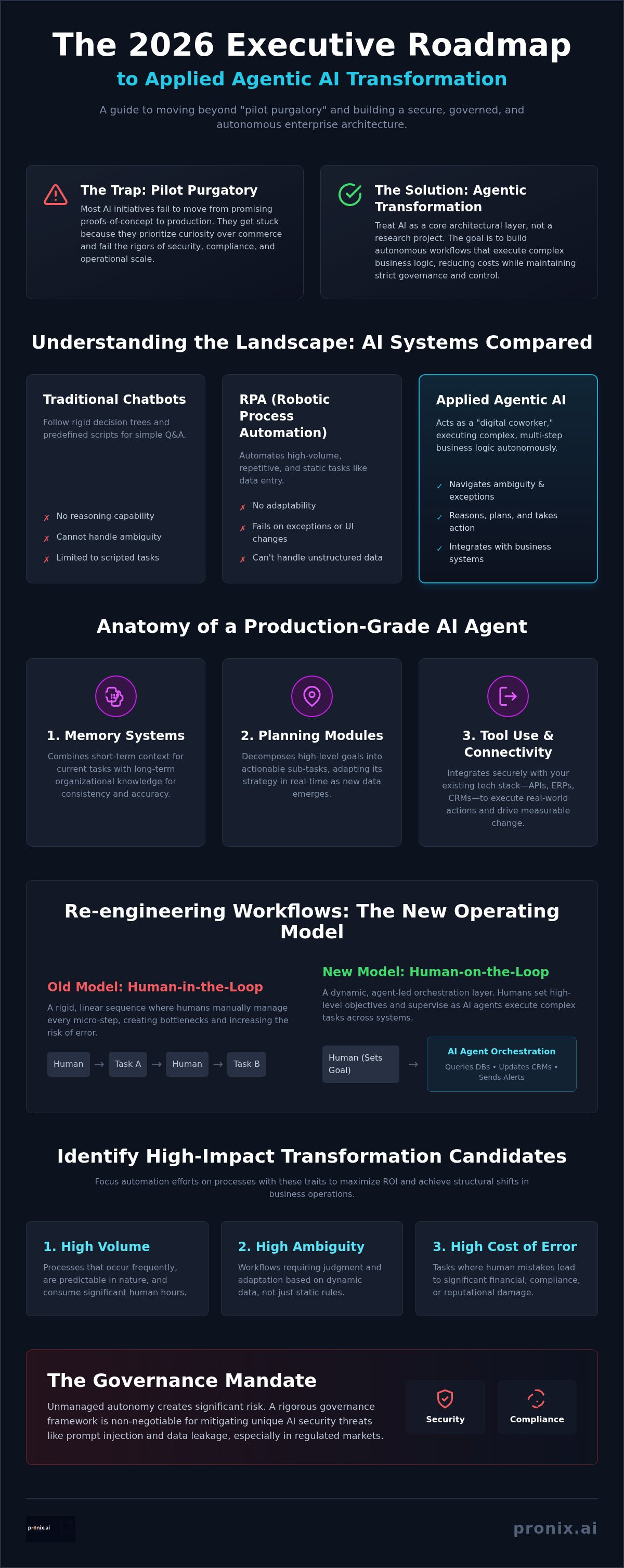
Most enterprise AI initiatives die in "pilot purgatory" because they prioritize curiosity over commerce. You've likely seen the cycle. A promising proof-of-concept is built, but it fails to survive the rigors of security, compliance, or actual operational scale. Realizing applied agentic ai for organizational transformation requires moving beyond simple chatbots toward autonomous workflows that execute complex business logic. It's time to stop treating AI as a research project and start treating it as a core architectural layer.
You understand that the pressure to modernize is real, yet the risks of unmanaged autonomy are even greater. This guide provides the 2026 Executive Roadmap to bridge the gap between theoretical potential and production reality. You'll learn how to architect secure, agentic workflows that reduce operational costs while maintaining strict governance. We will outline the transition from experimental models to a fully transformed, governed enterprise environment.
Key Takeaways
- Shift from passive generative tools to goal-oriented digital coworkers that execute complex business logic autonomously.
- Identify high-impact candidates for applied agentic ai for organizational transformation to replace linear workflows with dynamic, agent-led orchestration.
- Avoid the common pitfalls of "pilot purgatory" by utilizing a structured 90-Day Blueprint for secure, production-ready deployment.
- Establish a rigorous governance framework to mitigate unique security risks like prompt injection and data leakage in regulated markets.
- Bridge the gap between AI theory and production reality through a practitioner-led approach that focuses on operational maturity.
Defining Applied Agentic AI: The Shift from Tools to Autonomous Coworkers
Generative AI changed how we create content; it didn't change how we work. The real shift happens when we move from passive tools to active participants. Applied agentic ai for organizational transformation represents this transition. It's the difference between a tool that waits for a prompt and a system that pursues a goal. In an enterprise context, this means moving beyond simple text generation to systems that can plan, reason, and execute tasks across your existing business environment.
Unlike traditional chatbots that follow decision trees or RPA that repeats rigid tasks, intelligent agents possess reasoning capabilities. They don't just follow a script. They navigate ambiguity. While RPA is ideal for high-volume, static data entry, agentic systems handle dynamic exceptions and multi-departmental logic. They act as digital coworkers rather than simple software scripts, allowing your human talent to focus on higher-order strategy.
The economic imperative is clear. By 2026, the "Agentic Enterprise" will be the benchmark for operational maturity. We are moving away from speculative AI experiments toward evidence-based success. Organizations that successfully implement applied agentic ai for organizational transformation will see a fundamental shift in their cost structures. Those who remain stuck in the pilot phase will struggle with mounting technical debt and slower market response times.
From Prompting to Orchestration
The workflow model is evolving from human-in-the-loop to human-on-the-loop. In the old model, humans managed every micro-step of a process. Now, humans set the high-level objective and supervise the autonomous execution. Agency is defined by three pillars: perception of the environment, reasoning over data, and the ability to take action. Agentic AI is a system that uses LLMs to execute multi-step business logic autonomously. This orchestration allows for a level of scale that manual oversight cannot match.
The Core Components of an AI Agent
Building an agent requires more than just a large language model. It requires a structured architecture that supports production-grade reliability. A functional agent consists of three main systems:
- Memory systems: Agents need short-term context to handle current tasks and long-term organizational knowledge to maintain consistency across different sessions.
- Planning modules: These allow agents to decompose a high-level transformation goal into actionable sub-tasks, adjusting their path as new data emerges.
- Tool use: An agent is only as effective as its access. It must connect to your existing tech stack, including APIs, ERPs, and CRMs, to execute real-world changes.
This connectivity turns a static model into a functional coworker capable of driving measurable change. By integrating these components, enterprises move from theory to a stable, scalable reality.
Architecting the Agentic Enterprise: Re-engineering Workflows for Transformation
Transformation fails when leaders attempt to automate broken processes. Realizing applied agentic ai for organizational transformation requires a fundamental re-engineering of how work flows through the enterprise. We are moving away from rigid, linear sequences where a human must hand off a ticket to another human. Instead, we are building dynamic, agent-led orchestration layers that can query databases, update CRMs, and communicate across departments simultaneously. This shift creates a responsive architecture that adapts to real-time data inputs.
Most legacy systems aren't ready for a full replacement. The pragmatic path involves building robust Data & AI Foundations that allow agents to interface with existing ERPs via API layers. This approach preserves your existing capital investments while layering on the intelligence needed for modern competition. By creating these connective tissues, you enable agents to act on data that was previously trapped in silos. It's about augmenting your current infrastructure, not discarding it.
High-impact candidates for this transformation typically share three traits: high volume, high ambiguity, and high cost of human error. In finance, this looks like automated reconciliation across global entities. In supply chain, it's agents predicting disruptions and re-routing shipments without manual intervention. These aren't just incremental improvements. They are structural shifts in how the business operates.
CX Modernization: The First Frontier of Transformation
Customer experience is the most immediate proving ground. Agents no longer just provide answers; they resolve issues. By integrating with platforms like Salesforce Agentforce or Genesys Cloud, agents can process refunds, update shipping details, and escalate complex cases with full context. This turns the contact center from a cost-heavy operation into a high-efficiency value driver. It reduces operational friction for both the customer and the support staff who no longer handle repetitive, low-value queries.
Intelligent Business Automation
In industries like healthcare and manufacturing, the value isn't in simple task completion. It's in managing multi-departmental workflows that involve high volumes of unstructured data. Agents can cross-reference patient records with billing codes or synchronize supply chain logistics with real-time demand shifts. Success is measured by productivity acceleration rather than simple headcount reduction. This allows organizations to scale their output without a linear increase in operational overhead, providing a sustainable path for applied agentic ai for organizational transformation.
Overcoming the Pilot Paradox: Transitioning to Scalable Production Outcomes
Pilot purgatory is the graveyard of enterprise innovation. While many organizations launch AI experiments, industry observations show that 90% of these pilots never reach production-scale deployment. This failure isn't usually a failure of the technology itself. It's a failure of the implementation framework. Realizing applied agentic ai for organizational transformation requires moving beyond the "chat with a PDF" stage toward building robust, multi-agent systems that can handle real-world business complexity. You need a path to production that's baked into the project from day one.
Scaling requires a shift from curiosity to production-grade architecture. Most pilots fail because they're built in silos without considering security, data latency, or cross-platform orchestration. To bridge this gap, you must treat AI as a core operational layer rather than a peripheral tool. This involves moving from a single agent to an "Agentic Workforce" where multiple agents collaborate across departments. This orchestration requires infrastructure that supports 24/7 reliability and full auditability of every autonomous decision.
The 90-Day Blueprint for Production
To solve the pilot paradox, we utilize a structured, risk-mitigated approach. This blueprint ensures that every project has a clear path to production from its inception. It's designed to deliver measurable results quickly while maintaining high standards of governance.
- Phase 1: Strategy and governed use-case selection (Days 1-30). We identify high-impact processes and establish the security guardrails necessary for autonomous execution.
- Phase 2: Technical integration and RAG optimization (Days 31-60). This involves connecting agents to your tech stack and optimizing Retrieval-Augmented Generation for high-accuracy outcomes.
- Phase 3: Secure deployment and performance monitoring (Days 61-90). We move the system into production with active monitoring to ensure it meets performance and compliance benchmarks.
Data Foundations for Agentic Success
Your agents are only as effective as the data they can access. Applied agentic ai for organizational transformation relies on a modern data architecture that moves beyond flat files. Implementing vector databases and knowledge graphs allows agents to retrieve high-context information across siloed environments. This isn't just about storage; it's about accessibility. Without a clean, governed data layer, agents will struggle with hallucinations and latency. Ensuring data quality across your enterprise environments is the only way to guarantee the reliability of autonomous outcomes. We focus on building these foundations to ensure your agents have the context they need to act decisively and accurately.
The Governance Mandate: Securing the Agentic Lifecycle
Governance is often viewed as a friction point, but in the context of autonomous systems, it's the primary driver of speed. You can't scale what you can't control. As you implement applied agentic ai for organizational transformation, the shift from human-led tasks to agent-led outcomes introduces unique vulnerabilities. Prompt injection and data leakage aren't just technical hurdles; they're existential risks to your brand's integrity. A robust framework ensures that every autonomous action aligns with your corporate policies and regulatory obligations.
Building trust in these systems requires more than just high-level ethical statements. It requires a practitioner-led approach to operationalize safety. For leaders in regulated markets, this means moving beyond academic summaries of GDPR or HIPAA toward actual software-level enforcement. If you want to ensure your transformation remains secure, consider partnering with an expert in Enterprise AI Managed Services to manage the full lifecycle of your agents.
Security by Design in Agentic Systems
Security must be an architectural choice, not an afterthought. We implement strict guardrails that prevent agents from exceeding their assigned authority. This includes role-based access control (RBAC) specifically tailored for autonomous entities. If a human employee doesn't have access to sensitive financial records, their digital coworker shouldn't either. In industries like healthcare and finance, we prioritize end-to-end encryption and data privacy standards that meet or exceed current legal requirements. These protections ensure that agents remain productive without becoming liabilities.
Auditability and Risk Mitigation
Transparency is the antidote to the "black box" problem. Every decision made by an agent must be logged, tracked, and auditable. We build recording systems that provide a full lineage of an agent's reasoning process, from the initial data retrieval to the final action taken. This allows for continuous monitoring and stress testing to detect drift or bias before it impacts production. As we look toward 2026, compliance with emerging AI regulations will require this level of granular visibility. It's the only way to mitigate risk while maintaining the momentum of your transformation. Continuous testing ensures that your agentic workforce remains aligned with both performance benchmarks and ethical standards.
Accelerating Your Transformation: The Practitioner-Led Path with pronix.ai
Organizational transformation isn't an educational milestone. It's an operational state. While executive training provides a conceptual foundation, it doesn't manage the complexities of production-grade infrastructure. A certificate doesn't manage your AI infrastructure. Realizing applied agentic ai for organizational transformation requires a partner who can move beyond the whiteboard to the server room. You need a practitioner-led approach that prioritizes stability, security, and measurable ROI over theoretical potential.
The role of an Enterprise AI Managed Services Provider (MSP) is to bridge the gap between vision and reality. Most organizations find that their internal talent is already overextended with legacy maintenance. We provide the specialized architecture and engineering support needed to build and scale autonomous systems. This partnership allows your leadership to focus on high-level strategy while we ensure the underlying technology remains robust and compliant. We act as the technical foundation that supports your broader business goals.
Managed Services: Ensuring Long-Term Stability
Agents aren't "set and forget" tools. They require continuous fine-tuning to adapt to shifting data patterns and evolving business logic. Our managed services model provides access to elite AI engineers who monitor performance and optimize workflows in real time. This ensures your outcomes remain production-ready as the market evolves. We provide the stability needed to scale from a single use case to an entire agentic workforce without increasing your internal operational burden. Managed talent allows you to bypass the talent war and start delivering results immediately.
The pronix.ai Advantage
We offer a complete end-to-end lifecycle for AI adoption. This includes initial Agentic AI Strategy & Consulting, technical implementation, and long-term managed services. Our team brings platform-agnostic expertise across AWS, Azure, Salesforce, and Genesys. We don't just build agents; we build the Data & AI Foundations that make those agents reliable. Your next step is to determine where you currently stand on the path to maturity.
Schedule your Agentic AI Maturity Assessment with pronix.ai to identify high-impact opportunities for applied agentic ai for organizational transformation within your enterprise.
Securing Your Competitive Advantage in the Agentic Era
The transition from experimental AI to a fully realized agentic enterprise requires a shift in focus from model capabilities to operational maturity. Successful leadership in 2026 depends on your ability to deploy governed, autonomous systems that drive measurable change. By moving beyond pilot projects and adopting a structured approach to production, you ensure that your innovation delivers immediate value without compromising security. Realizing applied agentic ai for organizational transformation is not a single event; it's a commitment to building a resilient, intelligent architectural layer.
Stability in this fast-moving landscape comes from rigorous oversight and specialized expertise. We provide the managed services and end-to-end governance frameworks necessary to maintain production-grade stability in highly regulated sectors like healthcare, finance, and manufacturing. Our team bridges the gap between strategic vision and technical reality, offering the specialized talent required to manage complex workflows. The road to transformation is open for those ready to move from theory to execution.
Ready to transform? Explore our Agentic AI Implementation Services and begin building your future-ready workforce today.
Frequently Asked Questions
What is the difference between Generative AI and Agentic AI in an enterprise setting?
Generative AI focuses on creating content like text or images based on specific user prompts. Agentic AI is goal-oriented and executes multi-step business logic autonomously to achieve a defined outcome. While Generative AI waits for instructions; Agentic AI uses reasoning to determine the next necessary action within a workflow.
How long does it take to deploy a production-ready AI agent?
A production-ready agent typically requires 90 days to move from concept to deployment. This timeline follows a structured blueprint: 30 days for strategy and governance; 30 days for technical integration; and a final 30 days for secure deployment. This methodical approach ensures the system is stable and ready for enterprise-scale demands.
Is Agentic AI secure enough for highly regulated industries like healthcare?
Yes, Agentic AI is secure when built with enterprise-grade guardrails and role-based access controls. By implementing encryption and data privacy standards at the architectural level, agents safely manage sensitive patient data. Security is an architectural choice that ensures agents remain productive without becoming liabilities in regulated markets.
What are the common pitfalls when moving from an AI pilot to production?
The primary pitfall is building in isolation without considering security, scalability, or data latency. Many projects fail because they lack a clear path to production or fail to account for the unique governance requirements of autonomous systems. Success requires moving beyond "pilot purgatory" toward a structured, practitioner-led implementation framework.
How do I calculate the ROI of applied Agentic AI for my organization?
Calculate ROI by measuring the reduction in operational costs and the acceleration of productivity across specific workflows. Realizing applied agentic ai for organizational transformation shifts the focus from simple headcount reduction to the volume of complex tasks handled autonomously. You should track metrics like task completion speed and the reduction of manual hand-offs between departments.
What kind of data infrastructure is required to support autonomous agents?
You need a modern data architecture that utilizes vector databases and knowledge graphs for efficient retrieval. This infrastructure must break down existing data silos to provide agents with the context required for accurate reasoning. Without a clean, governed data layer, agents will struggle with hallucinations and high latency in production environments.
Do we need to replace our current software to implement Agentic AI?
No, you don't need to replace your existing tech stack. Agentic AI is designed to integrate with your current ERPs, CRMs, and platforms like Salesforce or Genesys through robust API layers. This approach allows you to layer intelligence over your current infrastructure, preserving your capital investments while modernizing your operations.
How does pronix.ai ensure AI agents remain compliant with GDPR and HIPAA?
pronix.ai ensures compliance by operationalizing safety at the software level through strict authority guardrails and "black box" recording systems. We track every decision made by an agent to provide a full audit trail for regulatory reviews. This practitioner-led approach ensures that applied agentic ai for organizational transformation remains secure and compliant in healthcare and finance.