

What if the most convincing agent demo is the least useful evidence for production? An agent can complete a polished task in a controlled setting and still fail to prove it can deliver business value safely inside enterprise workflows. That’s why an agentic AI proof of concept must test more than capability. Without a bounded scope, agreed success measures, and clear limits on autonomy, teams risk ending with an impressive demo but no credible production decision.
Leaders want measurable gains, yet business, technology, and risk teams may disagree on ownership, oversight, and what counts as success. A disciplined PoC turns those questions into testable evidence. This guide explains how to choose a bounded workflow, define outcomes, and evaluate agent performance, human oversight, data access, integration, and risk controls against agreed criteria. It also shows how to use the findings to stop, refine, or advance toward production, connecting strategy and implementation with governance from the outset.
Key Takeaways
- Frame the PoC around a decision leaders need to make, not a technology demonstration.
- Scope an agentic AI proof of concept around one accountable workflow owner, one process, and a testable hypothesis.
- Track agent task performance separately from workflow outcomes, using clear evidence sources and metric owners.
- Test whether permissions, approvals, logs, and exception paths keep agent actions observable and accountable.
- Use the evidence to stop, refine and retest, or advance, while identifying what production will require beyond the PoC.
What an Agentic AI Proof of Concept Must Prove
Leaders face a practical decision: can an agent improve a real workflow while operating within the organization’s data, system, and oversight constraints? An agentic AI proof of concept should produce evidence to answer that question, not merely show that an agent can complete a task in a controlled demonstration.
Definition: An agentic AI proof of concept is a limited test of a specific hypothesis about whether an AI agent can perform a defined workflow effectively, safely, and feasibly within enterprise constraints. It is an evaluation, not a production deployment.
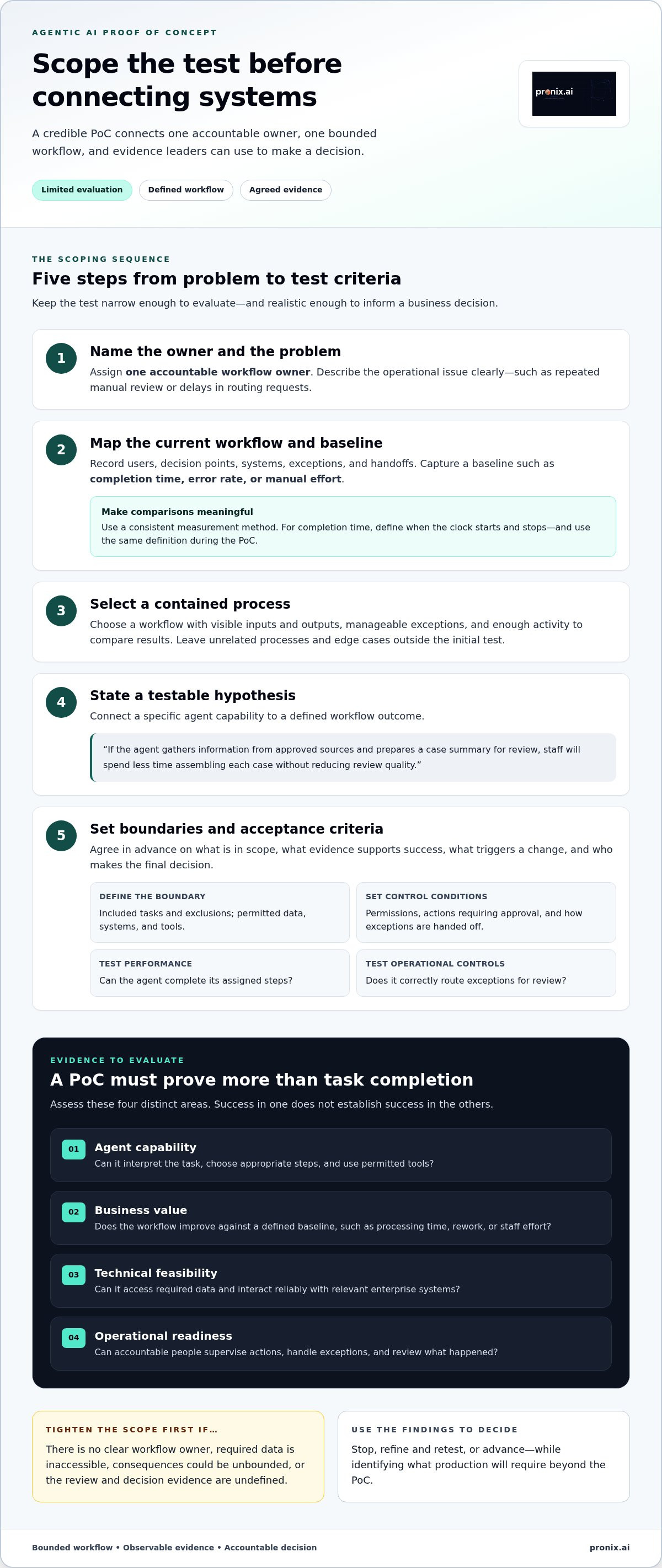
A strong PoC examines four distinct areas:
- Agent capability: Can the agent interpret the task, choose appropriate steps, and use permitted tools?
- Business value: Does the workflow improve against a defined baseline, such as processing time, rework, or staff effort?
- Technical feasibility: Can the agent access the required data and interact reliably with relevant enterprise systems?
- Operational readiness: Can accountable people supervise its actions, handle exceptions, and review what happened?
These dimensions are related, but success in one doesn’t establish success in the others. A capable agent may not create enough workflow value to justify further investment. A promising result may also depend on integrations, controls, or operating processes that need more work before production.
How an agentic AI PoC differs from a demo or prototype
A demo illustrates potential. It may show an agent responding to a prompt or completing a carefully prepared task, but it doesn’t necessarily test a business hypothesis. A prototype typically explores an interface, interaction, or design choice. A workflow-level PoC tests whether the agent can perform defined steps against real process requirements and produce evidence against agreed measures. The concept draws on the intelligent agent, which perceives its environment and acts toward a goal. Even a successful PoC doesn’t, by itself, prove production readiness.
When an enterprise should run an agentic AI PoC
Choose a workflow with a meaningful sequence of decisions or actions, a measurable baseline, and an accountable owner. For example, a team might test whether an agent can classify incoming service requests, gather relevant information, and prepare a response for human review. The steps are observable, and the review boundary keeps the test controlled. Avoid starting with a process that has no clear owner, depends on inaccessible data, or could trigger unbounded consequences. If the organization can’t define who reviews the agent’s work or what evidence would change the decision, tighten the workflow and test criteria before beginning.
How to Scope an Agentic AI Proof of Concept
Keep the test narrow enough to evaluate, but realistic enough to inform a business decision. A disciplined scope connects a workflow owner, a measurable problem, explicit agent boundaries, and agreed acceptance criteria. Use this sequence before configuring tools or connecting enterprise systems:
- 1. Name the owner and problem. Assign one accountable workflow owner and describe the process issue in operational terms, such as repeated manual review or delays in routing requests.
- 2. Map the current workflow. Document its users, decision points, systems, common exceptions, and handoffs. Record a baseline, such as completion time, error rate, or manual effort, and identify how each measure will be observed.
- 3. Select a contained process. Choose a workflow with visible inputs and outputs, manageable exceptions, and enough activity to compare results. Keep unrelated processes and edge cases outside the initial test.
- 4. State a testable hypothesis. Connect a specific agent capability to a defined outcome. For example: “If the agent gathers information from approved sources and prepares a case summary for review, staff will spend less time assembling each case without reducing review quality.”
- 5. Define boundaries and acceptance criteria. Specify included tasks, exclusions, permitted data, systems, and tools. Set the agent’s permissions, identify actions that require human approval, and define how it hands off exceptions. Agree in advance on what evidence supports success, what triggers a change, and who makes the final decision.
Choose a workflow and establish its baseline
A process map can expose dependencies that a task description hides. Note where information enters, who makes each decision, where people correct errors, and which systems the workflow relies on. Then capture baseline measures using a consistent method. For example, define when the clock starts and stops for a completion-time measure, and use the same definition during the PoC. Without a consistent reference point, a team can observe agent activity but can’t reliably tell whether the workflow improved.
Set the hypothesis, scope, and acceptance criteria
Write down what the agent may do independently, what requires approval, and what it must never do during the test. Define evidence thresholds for both performance and operational controls, such as whether the agent completes assigned steps and correctly routes exceptions for review. The Agentic AI Risk Management Profile offers a governance reference for considering agent-specific risks as you set those boundaries.
This scoping work connects business goals with technical integration and governance. Learn about pronix.ai's enterprise AI implementation approach and how these elements can align across an enterprise initiative.
How to Measure PoC Results Beyond a Convincing Demo
A convincing demonstration shows what an agent can do once. Measurement shows whether it performs reliably across representative cases and improves the workflow under test. For an agentic AI proof of concept, separate three questions: did the agent complete its assigned tasks, did the workflow improve, and can the organization operate the process with acceptable oversight?
Evaluate business metrics and agent-quality measures together. Task accuracy alone doesn’t show whether the workflow delivers value, while business gains alone can hide unreliable or difficult-to-control behavior.
Which metrics show whether the agent performs reliably?
Assess performance across routine cases, edge cases, and incomplete inputs. Track task completion, factual or procedural accuracy, how often the agent encounters exceptions, and whether it escalates those cases appropriately. Record human corrections and review effort as well. A high completion rate can be misleading if staff must frequently repair outputs or repeat the agent’s work.
Which measures show business and operational value?
Compare workflow time, manual effort, service quality, or relevant cost drivers with the baseline. Then assess operational fit: integration stability, traceability of actions, monitoring requirements, and user acceptance. Google Cloud’s guidance on implementing agentic solutions also frames evaluation as part of responsible enterprise adoption, not simply a test of model capability.
Use a comparison scorecard to keep measures, evidence, and accountability visible:
Measure: Workflow completion time
Baseline: Current average from the existing process
PoC measure: Time for the same defined work with the agent in the workflow
Evidence source: Process records or time logs
Owner: Workflow lead
Measure: Agent procedural accuracy
Baseline: Existing review or correction data, where available
PoC measure: Correct steps and outputs across representative cases
Evidence source: Human review against agreed criteria
Owner: Business subject matter expert
Measure: Exception handling
Baseline: Current exception volume and handling path
PoC measure: Appropriate identification, escalation, and handoff
Evidence source: Test logs and reviewer records
Owner: Operations or risk lead
Label results with the test conditions, sample limitations, and measurement method. Keep observed PoC findings separate from projections: a limited test can indicate potential, but it can’t establish long-term return on investment or prove performance at production scale. Conclude by stating whether the evidence supports the original hypothesis, where uncertainty remains, and what further validation is needed.
How to Test Governance, Human Oversight, and Risk
Agent autonomy must remain bounded, observable, and accountable throughout the test. Governance isn’t a review to add after the agent has been built. It shapes the experiment: which actions are allowed, who can intervene, what evidence is captured, and how failures are contained. The NIST AI Risk Management Framework can serve as a reference for organizing risk questions. Using it as a reference doesn’t, by itself, establish compliance or prove that a system is safe.
Turn controls into test criteria. For each permission or safeguard, specify how the team will verify it and who owns the evidence.
- Identity: Is the agent’s identity distinct and attributable within the test environment?
- Permissions: Can it access only the tools, systems, and actions required for the scoped workflow?
- Data access: Are the accessible data sources and permitted uses clearly defined?
- Approvals: Which actions require a person’s approval before the agent proceeds?
- Logging: Can reviewers trace relevant inputs, outputs, tool calls, approvals, and exceptions?
- Exception handling: Does the agent pause, escalate, or follow a defined fallback when it can’t proceed safely?
Define human oversight and agent action boundaries
Classify agent actions as recommendations, prepared work, or permitted execution. For example, an agent might prepare a record update for review but require approval before submitting it. Define who approves, which conditions trigger escalation, and who owns the handoff. Then test ambiguous requests, tool failures, and out-of-scope instructions. Make the expected response explicit: stop, ask for clarification, or route the case to an accountable person.
Make access, traceability, and failure handling testable
Apply least-privilege access to data, tools, and connected systems in the PoC. Review whether the captured records are sufficient to reconstruct what happened, including the information available to the agent and the action it attempted. Test failures deliberately, such as an unavailable system or missing information, and confirm that the workflow doesn’t silently continue or lose accountability.
Bring privacy, security, and relevant industry stakeholders into the design before testing. They can help identify obligations and risks tied to the specific workflow and data. Capture unresolved issues alongside the results; a successful task run doesn’t erase control gaps. This discipline makes an agentic AI proof of concept useful for evaluating both capability and governance.
Pronix supports PoC design, integration, and governance through its agentic AI implementation services.
Turn Agentic AI PoC Evidence Into a Production Decision
A PoC should end with a decision, not an assumption that a promising test is ready to scale. Review the evidence against the criteria set before testing: workflow value, agent performance, control effectiveness, and clear ownership. Then choose one of three outcomes.
- Advance: The evidence supports the agreed value hypothesis, performance is acceptable across the test cases, controls work as designed, and accountable owners are in place for the next phase.
- Refine and retest: The hypothesis still appears viable, but a specific gap needs more evidence. For example, the agent may handle routine cases but need better exception routing or a more reliable system integration. Define the change and the test that will show whether it addresses the gap.
- Stop: The results don’t support the expected value, risks can’t be bounded, or the workflow lacks an accountable owner. Stopping is a valid outcome. It prevents weak evidence from becoming a production commitment.
Record the rationale, evidence, unresolved issues, and decision owner. That creates a traceable basis for future planning and keeps enthusiasm for a successful demo from substituting for operational readiness.
Plan the next phase without treating the PoC as production
Advancing means authorizing further work, not declaring the agent production-ready. Identify what remains to be engineered and governed: integration hardening, data quality and access, monitoring, security review, support procedures, user training, and change management. Map each workstream to a business, technology, risk, or operational owner, and establish who can approve the next release decision.
Production planning also needs to address ongoing performance review, incident and exception handling, and how the workflow will adapt when systems or business needs change. The PoC may reveal these requirements, but it won’t prove they’re solved at scale. For the next stage, see this guidance on enterprise agentic AI production and this overview of building enterprise AI agents.
A well-scoped agentic AI proof of concept creates a bridge from strategy to an evidence-based decision. Pronix brings enterprise AI strategy, implementation, governance, and managed services together to support secure, scalable, and auditable outcomes. Learn about Pronix’s enterprise AI services.
Move From PoC Evidence to a Confident Next Step
A strong agentic AI proof of concept tests more than whether an agent can complete a task. It establishes whether a clearly scoped workflow can deliver measurable value, operate within defined controls, and justify further investment. Start with a business baseline, assess agent performance alongside workflow outcomes, and make the next decision explicit: stop, refine and retest, or advance.
Advancing is not the same as declaring production readiness. Integration, monitoring, governance, and operational ownership still need to be addressed. The transition is more credible when business, technology, and risk teams use the PoC evidence to plan that work together.
Pronix brings AI strategy, technical implementation, and managed services together, with experience designing and operating intelligent workflows and modern contact centers on platforms including AWS, Microsoft, Salesforce, Kore.ai, and Genesys. That combination can help connect early evaluation to a responsible production path.
Discuss an enterprise agentic AI proof of concept with Pronix to turn your next experiment into a clear, evidence-led decision.
Frequently Asked Questions
What is an agentic AI proof of concept?
An agentic AI proof of concept is a limited test of whether an AI agent can perform a defined workflow under specified business, technical, and governance constraints. It tests a hypothesis, such as whether an agent can prepare case summaries for staff review while reducing manual effort. Unlike a polished demonstration, a PoC gathers evidence to inform a decision. It does not, by itself, establish production readiness.
How do you build an agentic AI proof of concept?
Start with an accountable workflow owner, a defined process, and a testable business hypothesis. Map the current process and baseline, then specify the agent’s permitted tasks, data, tools, approval gates, and exception paths. Agree on performance and business measures, evidence sources, and decision criteria before testing. Evaluate representative cases, including exceptions, and document findings so leaders can decide whether to stop, refine, or advance.
How long should an agentic AI proof of concept take?
There’s no universal duration. The scope, data readiness, integration needs, risk review, and availability of workflow owners all affect how long a PoC takes. A contained test using accessible data and limited system connections may require less preparation than one involving multiple systems or complex approvals. Set a schedule after identifying dependencies, and define a clear endpoint based on evidence and a decision, not an arbitrary deadline.
How do you measure the success of an AI proof of concept?
Measure both agent quality and workflow outcomes against an agreed baseline. Track task completion, accuracy, exception handling, and human correction alongside measures such as processing time, manual effort, or service quality. Use consistent evidence sources and name an owner for each measure. Document test conditions and limitations, too. A PoC can show observed results in its test scope, but it can’t establish long-term return or production-scale performance on its own.
What is the difference between an AI PoC, pilot, and production deployment?
A PoC tests a specific hypothesis in a limited scope to establish feasibility and gather evidence. A pilot applies a more developed solution in a controlled, real-world setting to evaluate how it performs in ongoing operations and with intended users. Production deployment integrates the system into supported business operations, with appropriate governance, monitoring, ownership, and maintenance. These stages can vary by organization, but a successful PoC alone doesn’t mean the system is ready for production.
Can an agentic AI proof of concept use real enterprise data?
Yes, if access is authorized, appropriate to the test, and protected by the organization’s security and privacy controls. Apply least-privilege permissions, limit data to what the workflow needs, and define retention, logging, and review practices with relevant internal stakeholders. If real data isn’t appropriate or accessible, masked, synthetic, or otherwise approved test data may help evaluate parts of the workflow, though it may not represent every production condition.
What should happen after an agentic AI proof of concept succeeds?
Review the evidence against agreed criteria, then decide whether to advance to further validation and production planning. Identify remaining work, which may include integration hardening, monitoring, data readiness, security and governance reviews, support processes, and user change management. Assign business, technology, risk, and operational owners before expanding scope. Treat success as a reason to plan the next stage, not as proof that production risks and operating requirements are already resolved.