

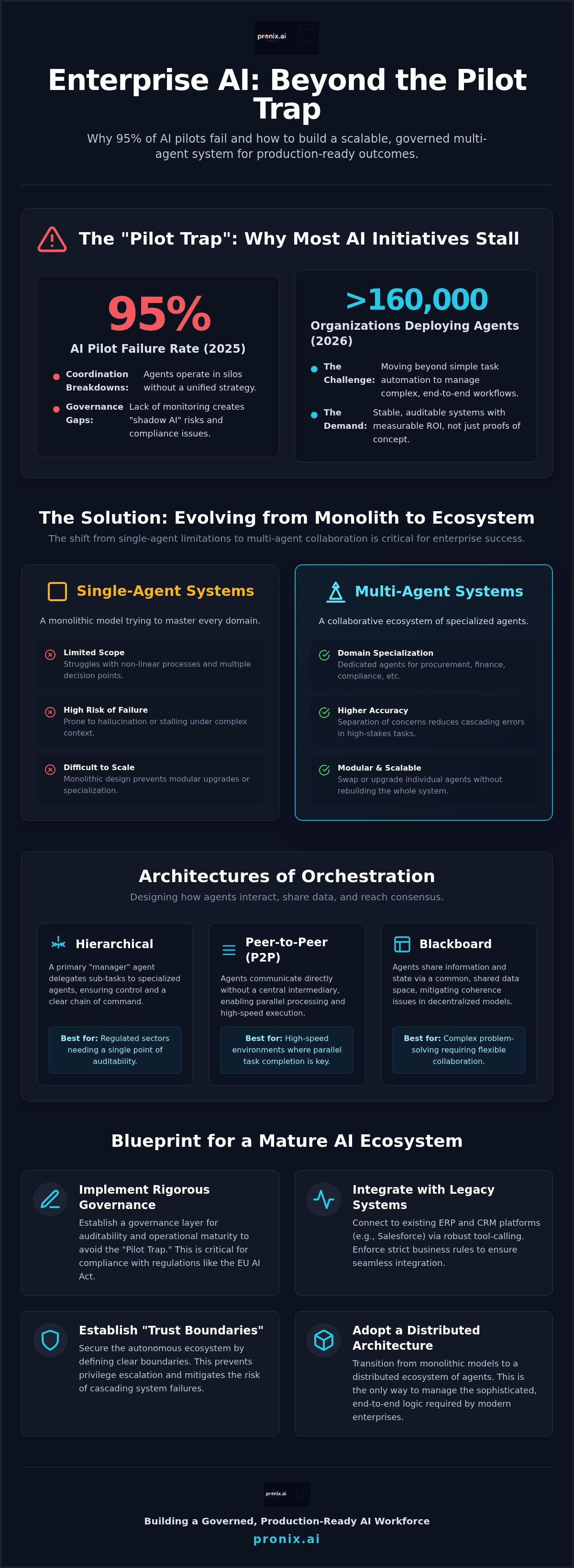
Ninety-five percent of AI pilots fail due to coordination breakdowns and governance gaps. While 2026 has seen a surge in adoption, with over 160,000 organizations deploying custom agents, most still struggle to move past basic automation. The reality is that single agents are too limited for the high-stakes logic required in modern business. To achieve true scale, you must implement multi-agent AI systems for enterprise that function as a cohesive, supervised workforce.
You likely recognize the friction of managing "shadow AI" and the risk of unmonitored agent interactions across your departments. It's a valid concern for any leader prioritizing stability and compliance. This guide provides the blueprint to design, govern, and deploy multi-agent architectures that manage complex, end-to-end workflows with precision. We'll examine the specific frameworks needed to reduce operational costs and replace fragmented automation with a centralized, intelligent orchestration layer. From navigating the transparency requirements of the EU AI Act to integrating with platforms like Salesforce Agentforce, we map the path to a mature, production-ready AI ecosystem.
Key Takeaways
- Transition from monolithic models to distributed ecosystems to manage the sophisticated, end-to-end logic required for modern enterprise workflows.
- Evaluate Hierarchical, Peer-to-Peer, and Blackboard orchestration models to ensure seamless context retention during complex agent handoffs.
- Integrate multi-agent AI systems for enterprise with legacy ERP and CRM platforms through robust tool-calling and strict enforcement of business rules.
- Secure your autonomous ecosystem by establishing "Trust Boundaries" that prevent privilege escalation and mitigate the risk of cascading system failures.
- Avoid the "Pilot Trap" by implementing a rigorous governance layer that ensures long-term auditability and operational maturity in a production environment.
Scaling Beyond the Monolith: Why Multi-Agent AI Systems are the Enterprise Standard
The era of the "monolithic" LLM is giving way to distributed intelligence. While a single, massive model can generate text, it lacks the specialized logic required for cross-functional corporate workflows. We define multi-agent AI systems for enterprise as a collaborative ecosystem where specialized agents work in concert to execute complex logic. This shift mirrors the evolution of software from monolithic applications to microservices. It moves beyond simple task completion, such as drafting an email, to autonomous process management, such as resolving a supply chain disruption.
A multi-agent system provides the modularity necessary for modern business. Instead of one model trying to master every domain, specialized agents focus on specific functions like procurement, customer experience, or financial auditing. This distributed architecture addresses three critical enterprise drivers: complexity, scalability, and domain specialization. By breaking down a workflow into discrete, agent-led steps, organizations can swap or upgrade individual components without rebuilding the entire system.
Single-Agent vs. Multi-Agent Architectures
Single-agent systems are inherently limited. They struggle with non-linear business processes that require multiple decision points and disparate data sources. When a workflow involves competing priorities, a single brain often hallucinates or stalls under the weight of excessive context. Multi-agent architectures solve this through collective intelligence. One agent handles data extraction; another applies legal compliance rules; a third manages the final stakeholder communication. This separation of concerns ensures higher accuracy and reduces the risk of cascading errors in high-stakes environments like healthcare or finance.
The 2026 Agentic Shift: From Pilots to Production
In 2025, 95% of AI pilots failed to reach production. Most of these initiatives collapsed because they lacked a robust orchestration layer. As we move through 2026, the focus has shifted from experimental "chats" to production-ready outcomes. Enterprises are no longer satisfied with proofs of concept. They demand systems that deliver measurable ROI and operational maturity through stable, auditable agent interactions. Success now depends on how well these agents are governed and how effectively they integrate with existing data foundations like AWS or Salesforce. Implementing multi-agent AI systems for enterprise requires moving beyond the pilot phase toward a disciplined, managed services approach. An Agentic Enterprise is an organization where workflows are managed by governed agent networks.
Architectures of Orchestration: Designing Collaborative Agent Ecosystems
Designing multi-agent AI systems for enterprise requires a shift from simple prompting to rigorous architectural engineering. Orchestration is the glue that holds these systems together. It determines how agents interact, share data, and reach consensus. Without a defined structure, agentic interactions become unpredictable, leading to the "shadow AI" risks that jeopardize security. Leaders must choose a model that aligns with their operational maturity and risk tolerance.
Hierarchical Orchestrators: The 'Manager' Agent Model
The hierarchical model utilizes a primary orchestrator or "manager" agent to maintain control. This manager interprets high-level intent and delegates sub-tasks to specialized agents. For example, in a procurement workflow, the manager agent assigns data retrieval to one specialist and vendor risk assessment to another. This approach creates a single point of auditability. It's the preferred choice for regulated sectors because every decision can be traced back to the manager's central logic. For organizations prioritizing stability, our Agentic AI Strategy & Consulting services help define these leadership roles within your AI workforce.
Peer-to-Peer and Decentralized Collaboration
In high-speed environments, peer-to-peer (P2P) models allow agents to communicate directly without a central intermediary. This is ideal for parallel processing where speed is the primary KPI. However, maintaining coherence across decentralized agents is difficult. To mitigate this, many architects use "Blackboard" architectures where agents contribute findings to a shared data space. This allows multiple specialists to solve a complex problem collectively while maintaining a unified record. You can explore common multi-agent architecture patterns to see how these models differ in practice.
Effective communication protocols are the backbone of any multi-agent system. Handoffs must be seamless to maintain context across agent layers. If an agent loses its "state" during a long-running workflow, the entire process can fail. State management ensures that an agent remembers previous interactions and data points, preventing redundant work and hallucinations. This is especially critical in industries like finance and healthcare, where a loss of context can lead to compliance violations.
The choice between centralized and decentralized control often comes down to your regulatory environment. Centralized models offer better governance and easier compliance with the transparency rules of the EU AI Act. Decentralized models provide the agility needed for rapid innovation but require more sophisticated guardrails. Successful multi-agent AI systems for enterprise often find a middle ground, using hierarchical managers for high-stakes decisions and P2P interactions for routine, low-risk sub-tasks.
AI Agent Orchestration for Business: Mapping Logic to Workflows
Technical connectivity is only half the battle. True orchestration is the digital enforcement of business rules across autonomous agents. In multi-agent AI systems for enterprise, orchestration ensures that every agentic action aligns with corporate policy and operational goals. This moves the technology from a series of disconnected tasks to a unified, intelligent system that adapts to real-time data changes. Scaling these systems requires a unified framework for customization and efficient deployment to ensure that agents don't just communicate, but actually execute logic in a production environment.
Modern orchestration relies heavily on "tool-calling." This capability allows agents to interact directly with legacy ERP and CRM systems. Instead of simply generating a report, an agent can query an SAP database or update a Salesforce record based on specific triggers. This level of integration transforms AI from a passive advisor into an active participant in the business lifecycle. To understand how this efficiency differs from traditional automation, see our guide on AI for business process reengineering.
Designing Intelligent Workflow Automations
Building a resilient workflow requires a methodical approach to agentic design. We recommend a three-step framework for mapping logic to multi-agent AI systems for enterprise:
- Step 1: Process Deconstruction. Break down complex business processes into discrete, manageable tasks. Each task should have a clear input, a specific logic to apply, and a predictable output.
- Step 2: Persona and Permission Assignment. Assign specific "personas" to agents. A "Compliance Agent" should have different data access and decision-making authorities than a "Sales Agent." This limits the risk surface and prevents unauthorized actions.
- Step 3: Trigger and Handoff Definition. Define the exact success criteria for agent handoffs. A resolution agent should only take over once a sentiment agent has verified the customer's intent and emotional state.
Orchestrating CX Modernization: A Use Case
Contact centers provide a perfect example of orchestration in action. By linking sentiment-analysis agents with resolution-specialist agents, enterprises can automate complex customer journeys without losing the "human" touch. These systems integrate directly with platforms like Salesforce Agentforce or Genesys Cloud to provide real-time updates. This approach has become the 2026 standard for AI-driven CX modernization. It ensures that every interaction is governed, auditable, and focused on production-ready outcomes rather than experimental chat outputs.
Solving the Governance Gap: Security and Auditability in MAS
The transition to multi-agent AI systems for enterprise expands the corporate risk surface. Distributed deployments create blind spots where agents might interact without direct oversight. Security in this context isn't just about perimeter defense; it's about enforcing "Trust Boundaries" between autonomous entities. Without these boundaries, a minor logic error in one agent can trigger a cascading failure across the entire network. Organizations must move beyond simple monitoring to active governance that prevents unauthorized agentic behavior before it occurs.
Real-time observability is the only way to maintain control over a distributed agent workforce. We implement "Human-in-the-loop" (HITL) checkpoints for high-stakes decision points, ensuring that autonomous logic never overrides executive intent. This creates a "Golden Thread" of auditability. It connects every initial prompt, agentic reasoning step, and final outcome into a single, verifiable record. This level of transparency is essential to meet the transparency obligations of the EU AI Act that became enforceable on August 2, 2026.
Mitigating Privilege Escalation and Shadow AI
Privilege escalation occurs when an agent gains unauthorized access to sensitive data or external APIs through its network interactions. We mitigate this by implementing "Least Privilege" protocols. Each agent receives only the specific permissions required for its discrete task. This framework prevents agents from "hallucinating" unauthorized actions, such as modifying procurement contracts or accessing restricted payroll data. A centralized management layer serves as the enforcement engine, validating every agentic call against your corporate security policy in real time.
Compliance in Regulated Markets
In healthcare and finance, compliance is the primary barrier to AI adoption. Multi-agent governance must align with HIPAA and FINRA standards to ensure data integrity and privacy. Enterprise-grade AI auditability is the foundation of responsible adoption. By logging the specific "reasoning" steps of each agent, we provide a transparent trail for regulatory review. This allows auditors to reconstruct the decision-making process, ensuring that every automated action follows established legal and ethical guidelines. Secure your agentic future with our Enterprise AI Managed Services to ensure every workflow is auditable and compliant.
Operationalizing Multi-Agent AI: From Pilot to Production Outcomes
Moving from a controlled experiment to a live environment is the most difficult phase of the AI lifecycle. In 2026, the "Pilot Trap" remains a significant barrier for most organizations. Verified data indicates that 95% of AI pilots fail. These failures usually stem from specification errors, coordination breakdowns, or governance gaps. To succeed, multi-agent AI systems for enterprise require more than just technical deployment. They need a roadmap for long-term operational maturity and a disciplined approach to execution.
Success requires discipline. Most enterprises lack the internal talent to manage complex agentic orchestration. This talent gap often leads to unmonitored agent interactions and "shadow AI" risks. Professional services bridge this divide by providing the specialized expertise needed to transition from experimental "chats" to production-ready outcomes. We position our team as the partner for enterprise AI automation managed services, ensuring your systems deliver measurable ROI.
Infrastructure Requirements for Production MAS
Infrastructure for multi-agent systems is complex. It requires robust data foundations that support parallel agent execution and low-latency communication. If agents in a global environment can't communicate instantly, the entire workflow stalls. We leverage AWS and Microsoft Azure to build these scalable foundations. These platforms provide the compute power necessary for multi-agent AI systems for enterprise to process massive datasets in real time without compromising security or performance.
The Managed Services Advantage
Managed services provide the governance layer necessary for sustained success. We offer continuous monitoring of agentic workflows to identify and correct model drift before it impacts your operations. This proactive approach ensures that your autonomous ecosystem remains efficient as business needs evolve. Strategic consulting allows us to iterate on orchestration logic, keeping your agents aligned with your long-term vision. We focus on three core areas to ensure secure production outcomes:
- Performance Monitoring. Tracking agent resolution rates and system latency to maintain high operational standards.
- Drift Mitigation. Updating agentic logic to account for changes in underlying LLM performance or external data sources.
- Governance Enforcement. Ensuring every agent interaction complies with the latest regulatory standards, including the EU AI Act.
Operationalizing AI is not a "set it and forget it" project. It is a professional service lifecycle that requires constant refinement. By integrating your agents with platforms like Salesforce Agentforce, we ensure that your AI initiatives are backed by a rigorous framework and a clear path to production.
Mastering the Agentic Enterprise Architecture
The transition from monolithic AI to distributed ecosystems is no longer a strategic option; it's an operational necessity for the modern enterprise. Scaling multi-agent AI systems for enterprise requires a disciplined focus on orchestration. Strict governance boundaries and a production-first mindset are essential for long-term stability. Organizations can move past the high failure rates of previous pilots by deconstructing workflows into specialized agentic tasks and enforcing real-time auditability.
Operational maturity depends on technical precision and deep domain expertise. We provide the governance layer and implementation excellence needed to secure your AI future. Our team brings decades of experience in CX and enterprise automation, specializing in AWS, Salesforce, and Kore.ai deployments. We offer dedicated managed services specifically tailored for high-stakes, regulated industries where stability and compliance are the highest priorities. This practitioner-led approach ensures that every innovation is backed by a rigorous framework and a clear path to production.
Move your multi-agent AI from pilot to production with pronix.ai and begin building a scalable, governed workforce that delivers measurable outcomes today. The era of the agentic enterprise has arrived, and your architecture is ready for the next phase of evolution.
Frequently Asked Questions
What is the difference between an AI agent and a multi-agent system?
An AI agent is a single autonomous entity designed for a specific task. A multi-agent system is a collaborative network where these specialists interact to solve complex workflows. While a single agent might summarize a document, a multi-agent system orchestrates research, analysis, and drafting across multiple specialized nodes. This distributed approach is the foundation of multi-agent AI systems for enterprise, offering modularity and resilience that single-agent monoliths cannot match.
How do multi-agent AI systems handle conflicting instructions between agents?
Conflicts are managed through a defined orchestration layer, typically utilizing a manager agent or a consensus protocol. When two agents produce contradictory outputs, the orchestrator evaluates both against established business rules and success criteria. This prevents logic loops and ensures the final result aligns with executive intent. In sophisticated architectures, a referee agent can be deployed to adjudicate these discrepancies based on real-time data priority and pre-set corporate policies.
Are multi-agent systems secure for highly regulated industries like finance?
Yes, provided they are built with enterprise-grade governance and auditability frameworks. Security is maintained through Trust Boundaries and Least Privilege protocols that limit each agent's data access. For finance and healthcare, these systems log every reasoning step, creating a Golden Thread for regulatory review. This level of transparency ensures compliance with the EU AI Act and HIPAA standards, making multi-agent AI systems for enterprise a viable solution for high-stakes environments.
What are the infrastructure requirements for deploying multi-agent AI at scale?
Scalable deployment requires robust cloud foundations, typically on AWS or Microsoft Azure, to support parallel agent execution. Low-latency communication protocols are essential for maintaining context across global environments. You need high-performance compute clusters and a centralized data architecture that allows agents to access real-time information securely. Without these foundations, agentic interactions suffer from lag and synchronization errors, which can compromise the integrity of complex, end-to-end business workflows.
How does orchestration prevent AI agents from exceeding their permissions?
Orchestration enforces Least Privilege access by validating every agentic call against a central permission engine. Each agent is assigned a specific persona with restricted credentials for external APIs and databases. If an agent attempts an unauthorized action, the orchestration layer blocks the request and triggers a governance alert. This prevents privilege escalation and ensures that autonomous agents operate strictly within the Trust Boundaries defined by your corporate security and compliance teams.
Can multi-agent systems integrate with my existing legacy ERP or CRM?
Integration is achieved through tool-calling capabilities that allow agents to interact with existing SAP, Oracle, or Salesforce environments. Agents use standardized APIs to query databases and update records in real time. This bridge between autonomous logic and legacy systems is a core component of AI business automation. By mapping agentic personas to specific ERP functions, enterprises can modernize their core operations without the need for a complete system overhaul.
What is the role of a 'human-in-the-loop' in a multi-agent workflow?
HITL serves as a critical checkpoint for high-stakes decisions and edge cases that fall outside standard logic. A human reviewer intervenes when an agent flags a low-confidence result or when a workflow reaches a pre-defined executive threshold. This ensures that autonomous systems never override human judgment in sensitive areas like financial approvals or medical diagnostics. HITL provides the final layer of safety, reinforcing the stability and operational maturity of the ecosystem.
How do I measure the ROI of a multi-agent AI implementation?
ROI is measured by tracking reductions in operational costs, accelerated cycle times, and improved accuracy in complex processes. Organizations should compare the Total Cost of Ownership against the efficiency gains achieved through intelligent automation. Key metrics include the number of resolutions handled without human intervention and the reduction in error rates for cross-functional workflows. High-performing multi-agent implementations typically see significant returns through the consolidation of fragmented tasks into a single, governed orchestration layer.