

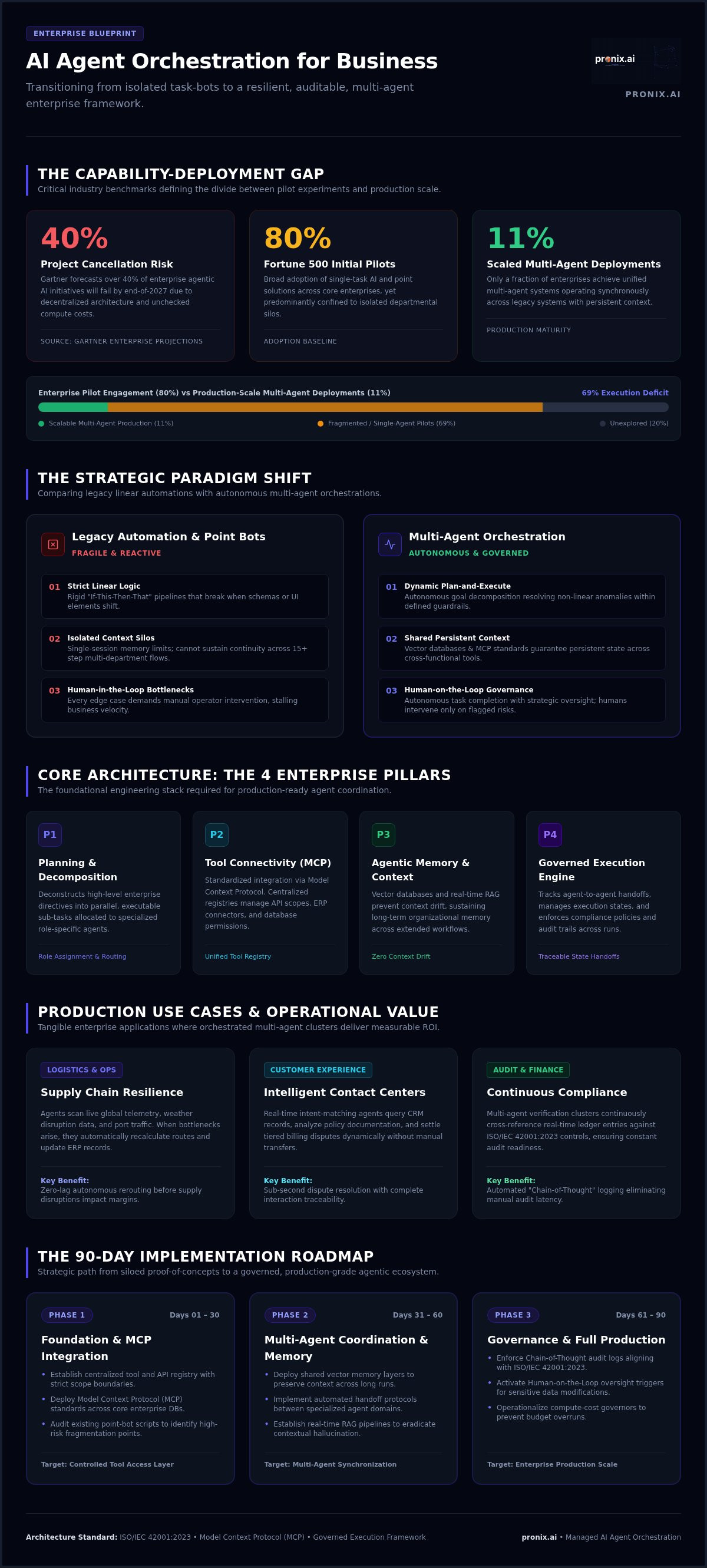
Gartner forecasts that more than 40% of agentic AI enterprise projects will be canceled by the end of 2027. This failure stems from a lack of centralized oversight and spiraling compute costs. You've likely seen the symptoms in your own organization. AI agents often operate in isolated silos, lacking the unified AI agent orchestration for business required to maintain context. These fragmented workflows create significant security risks and lack basic auditability. While 80% of the Fortune 500 have launched initial production workflows, only 11% have successfully deployed multi-agent systems at scale.
This guide helps you bridge that capability-deployment gap. We provide a unified framework for agent coordination that prioritizes auditability and operational maturity. You'll learn to move beyond experimental scripts toward a disciplined, six-layer architectural stack. We'll cover the latest Model Context Protocol (MCP) standards, production-ready governance, and the implementation strategies required to achieve measurable productivity gains. It's time to transition from fragile pilots to a stable, orchestrated enterprise.
Key Takeaways
- Define the shift from static chatbots to autonomous workflows to handle complex, non-linear business logic.
- Design a scalable architecture for AI agent orchestration for business that bridges the gap between specialized agents and your core enterprise systems.
- Compare the operational maturity of open-source frameworks against enterprise-grade platforms from hyperscalers like AWS and Microsoft.
- Secure your autonomous workflows by implementing "Chain of Thought" auditability and rigorous governance guardrails.
- Execute a 90-day blueprint to move from isolated AI pilots to a fully managed, production-ready agentic ecosystem.
Beyond Single-Task Bots: Defining AI Agent Orchestration for Business
By late 2026, the novelty of isolated chatbots has faded. Enterprises now face a stark reality: 40% of enterprise applications embed task-specific agents, yet only 11% of organizations have successfully deployed multi-agent systems into broad production. This gap exists because many leaders treat agents as sophisticated scripts rather than dynamic workers. Successful AI agent orchestration for business requires a fundamental shift. It moves the technology from a reactive "question-and-answer" model to a proactive "plan-and-execute" framework. This orchestration layer acts as the central nervous system, managing the handoffs, context, and permissions between specialized agents.
Simple prompts fail when applied to multi-departmental logic. A single prompt cannot maintain state across a 15-step procurement process or verify compliance across three different regulatory jurisdictions. Orchestration solves this by providing a unified identity layer and a tool registry. It allows the system to decompose a high-level goal, such as "optimize Q4 logistics costs," into distinct sub-tasks for specialized agents to solve in parallel.
The Orchestration vs. Automation Debate
Traditional Robotic Process Automation (RPA) is brittle. It follows linear "if-this-then-that" paths that break when a UI changes or a data field shifts. Orchestration leverages multi-agent systems to handle these non-linear edge cases through autonomous reasoning. In this environment, autonomy doesn't mean "unsupervised." It means the agent has the authority to decide the most efficient route to a result within pre-defined guardrails. This transition moves human operators from "human-in-the-loop" bottlenecks to "human-on-the-loop" strategic governors who intervene only when agents flag a high-risk anomaly.
Key Business Use Cases for Multi-Agent Systems
Orchestration delivers the most value in complex, data-heavy environments where speed and accuracy are non-negotiable. Consider these high-impact applications:
- Supply Chain Resilience: Agents monitor global shipping data and weather patterns. They proactively reroute inventory and update ERP systems before a disruption impacts the bottom line.
- Intelligent Contact Centers: Orchestration connects customer intent with real-time CRM data and service history. It enables agents to resolve complex billing disputes or technical triage without manual handoffs.
- Automated Financial Compliance: Multi-agent systems conduct real-time auditing. One agent fetches transaction logs while another validates them against the latest ISO/IEC 42001:2023 standards, ensuring constant audit-readiness.
These workflows don't just save time. They provide a level of operational maturity that manual processes can't match. By centralizing the logic, businesses ensure every agent action is logged, auditable, and aligned with corporate strategy.
The Architecture of the Agentic Enterprise: Core Components
Moving from isolated pilots to a production-ready environment requires a structural blueprint. AI agent orchestration for business relies on four integrated pillars: planning, tool connectivity, memory, and execution. Without this rigorous architecture, agents remain brittle scripts that fail at the first encounter with real-world data variability. A mature system ensures that every agent operates as a specialized component within a larger, governed ecosystem.
Tool integration is the bridge between reasoning and action. Agents must connect to live systems like ERPs, CRMs, and legacy databases through a centralized tool registry. This layer manages API permissions and ensures agents don't perform unauthorized system-of-record updates. The execution engine then manages the agent-to-agent handoffs. If a triage agent identifies a complex supply chain disruption, the engine routes the task to a logistics specialist agent, tracking the handoff to ensure no business logic is lost in transition.
Agentic Memory and Persistent Context
Short-term memory handles the immediate interaction, but enterprise workflows often span weeks. Persistent context ensures an agent remembers a customer's specific history or a previous compliance flag across multiple sessions. We leverage vector databases and real-time retrieval-augmented generation (RAG) to provide this organizational memory. This architecture prevents context drift, ensuring agents adhere to business rules throughout long-running processes. To maintain trust and safety, these memory subsystems should align with the NIST AI Risk Management Framework, which provides the necessary governance for managing AI-related risks.
The Planning Layer: Decomposing Complex Logic
The planning layer is where autonomous reasoning occurs. It decomposes a high-level business goal into a sequence of actionable sub-tasks. When agents face competing priorities, the orchestrator performs conflict resolution based on pre-set business weights and logic. Dynamic re-planning is a core requirement for 2026 workflows. If an agent encounters an error or a missing data field, it doesn't just halt the process. It analyzes the friction point, selects an alternative data source, and updates its execution plan in real-time. This level of resilience is why engaging in Agentic AI Strategy & Consulting is critical for building architectures that scale without constant human intervention.
Evaluating Orchestration Frameworks: Platforms and Integration
Selecting a framework is no longer just a developer choice. In 2026, it's a strategic governance decision. While open-source tools like LangChain and AutoGen offer rapid prototyping, they often lack the telemetry and security required for production-grade AI agent orchestration for business. Enterprise platforms provide the pre-integrated guardrails and audit logs that regulated industries demand. The decision to build or buy hinges on your internal engineering maturity and the complexity of your legacy integrations.
Hyperscaler Orchestration: AWS and Azure
AWS and Microsoft have solidified their positions as foundational orchestration layers. AWS Bedrock AgentCore serves as a framework-agnostic runtime. It allows teams to coordinate workflows across diverse models using AWS Step Functions for complex state management. This approach is ideal for businesses requiring deep customization without managing the underlying infrastructure. Azure AI Studio offers a similar advantage for organizations embedded in the Microsoft 365 ecosystem. These hyperscalers prioritize data residency and VPC-level security. They ensure that agentic communications remain within your private cloud, preventing data leakage into public training sets. Organizations using these platforms benefit from centralized identity management and unified billing across their entire agentic fleet.
Specialized CX Orchestration: Salesforce and Genesys
For customer experience, the focus shifts to domain-specific orchestration. Salesforce Agentforce uses autonomous resolution to handle multi-step service requests without manual intervention. It connects directly to your Data Cloud to provide agents with real-time customer context. Similarly, Genesys Cloud excels at managing the critical handoff between AI agents and live staff. These platforms are built for "human-on-the-loop" oversight, providing real-time sentiment analysis and historical context during every transition. This ensures that when an agent reaches its intent boundary, the human operator has all the information needed to close the case efficiently.
The "Build vs. Buy" debate has shifted toward a hybrid approach. Building from scratch allows for total customization but introduces significant maintenance overhead, especially as model standards evolve. Buying an enterprise platform accelerates time-to-value by providing pre-built tool registries and identity governance. When evaluating agentic AI systems, leaders must look beyond raw performance. You must assess the framework's ability to maintain deterministic guardrails and its compatibility with the latest Model Context Protocol (MCP) standards. Managed services often provide the most stable path, offering the expertise needed to bridge the gap between siloed tools and an integrated enterprise architecture.
Operationalizing Orchestration: Governance and Risk Mitigation
Governance is the barrier between a productive agentic workflow and an operational catastrophe. In 2026, the question for leadership has shifted from whether agents can execute tasks to whether they should be allowed to do so autonomously. Effective AI agent orchestration for business requires a framework that balances speed with absolute control. Without rigorous oversight, multi-agent systems risk creating "shadow logic" that bypasses traditional IT controls. Operational maturity demands that every autonomous decision is logged, verified, and reversible.
Enterprise Governance Frameworks
Defining decision boundaries is the first step in stabilizing the agentic enterprise. You must establish exactly where an agent's authority ends and human intervention begins. Implementing Enterprise AI Auditability ensures that your organization maintains a permanent record of the "Chain of Thought" for every business outcome. This is critical for regulated markets like finance and healthcare where explainability is a legal mandate. Role-based access control (RBAC) must also extend to the agents themselves. An agent should only access the specific data buckets and API endpoints required for its immediate task, preventing lateral movement in the event of a prompt injection attack.
Risk Mitigation and Error Handling
Designing circuit breakers for autonomous workflows is a non-negotiable requirement for production stability. These triggers detect when an agent has entered a recursive loop or is deviating from its intent boundary. If an agent attempts the same failed task three times, the orchestrator should automatically halt the process and alert a human operator. This prevents excessive token consumption and protects your annual compute budget. Managing the hallucination risk in multi-agent reasoning chains requires a "checker-voter" architecture. One agent executes the task while a secondary, higher-logic agent audits the output for accuracy. This continuous monitoring ensures that errors don't propagate through the workflow, maintaining the integrity of your system-of-record. For organizations struggling to maintain these complex guardrails, Enterprise AI Managed Services provide the necessary technical oversight to ensure long-term orchestration stability.
Security in the agentic layer must be proactive. You aren't just protecting against external hackers; you're protecting against internal logic failures. Data leaks can occur if an agent inadvertently shares sensitive PII between departments during a context handoff. Your orchestration layer must include automated PII masking and data-scrubbing filters that trigger before any information moves between specialized agents. By centralizing these security protocols, you create a unified defense that scales as you add more agents to your ecosystem.
From Pilot to Production: The Pronix.ai Managed Orchestration Strategy
Transitioning from an isolated pilot to a production-grade outcome requires more than a software license. It requires a disciplined roadmap that aligns technical capability with measurable business value. Our 90-day blueprint for AI agent orchestration for business focuses on rapid deployment without sacrificing the governance standards established in previous phases. We bridge the gap between siloed AI tools and an integrated agentic enterprise by treating orchestration as a continuous professional service rather than a one-time technical setup.
The first 30 days focus on intent boundary definition and tool registry alignment. By day 60, we implement the core orchestration layer, integrating agents with your existing ERP and CRM systems. The final 30 days are dedicated to rigorous stress testing of guardrails and performance tuning. This methodical approach ensures that when your system goes live, it's already optimized for the specific friction points of your industry.
The Managed Services Advantage
Agentic workflows aren't "set and forget" systems. They require constant optimization as model capabilities evolve and business rules change. Managed services provide the stability needed to maintain complex orchestration health and prevent context drift over time. This includes proactive monitoring of agent performance, recursive loop prevention, and continuous prompt refinement. Working with a partner gives you immediate access to specialized Enterprise AI Talent as a service. This eliminates the need for expensive, long-term internal hiring for niche roles like agentic architects or AI governance officers.
Designing for Scale and Sustainability
A sustainable architecture moves away from "one-off" agents toward a modular ecosystem. This modularity allows you to swap models or update specific tool integrations without rebuilding the entire workflow. It ensures your Agentic AI Implementation remains future-proof as new standards like MCP version 2026-07-28 gain wider adoption. Scalability isn't just about adding more agents; it's about ensuring your orchestration layer can handle increased concurrency and data volume without a degradation in reasoning quality.
Assessing your readiness is the critical next step. Organizations with high data maturity and clear operational bottlenecks are the prime candidates for immediate orchestration deployment. If your enterprise is ready to move beyond fragmented pilots, it's time to build a governed, scalable foundation. Contact Pronix.ai to modernize your enterprise workflows and take control of your agentic future.
Operationalizing Your Agentic Future
The transition from experimental AI pilots to a production-ready ecosystem is a critical maturity milestone. Successful AI agent orchestration for business requires moving beyond siloed tools toward a unified, auditable architecture. By prioritizing planning layers, persistent memory, and rigorous governance guardrails, organizations can finally bridge the capability-deployment gap. This shift transforms AI from a series of isolated tasks into a cohesive, strategic asset.
Stability in this landscape depends on deep technical expertise and seasoned oversight. Pronix Inc brings decades of systems integration experience to ensure your workflows are resilient and scalable. We provide production-ready governance frameworks tailored for regulated industries and end-to-end managed services that maintain long-term orchestration health. Don't let your agentic strategy stall at the prototype phase. Scale your agentic workflows with Pronix.ai's implementation services to build a foundation for sustainable innovation. The path to an integrated, autonomous enterprise is ready for you to lead.
Frequently Asked Questions
What is the difference between AI agent orchestration and simple automation?
Automation follows linear "if-then" paths that break when data variables shift. Orchestration manages autonomous agents capable of non-linear planning and self-correction. It uses a central layer to coordinate specialized agents across multiple systems. This shift is essential for AI agent orchestration for business success. While traditional automation handles repetitive tasks, orchestration manages the complex reasoning required to reach specific outcomes across departmental silos.
Which industries benefit most from multi-agent orchestration?
Regulated sectors like healthcare and finance see the highest ROI from these systems. These industries require the rigorous auditability and governance that orchestration provides. Manufacturing and global logistics also benefit by using agents to monitor supply chains and proactively mitigate disruptions. Any enterprise with high-volume, multi-step workflows can use these systems to reduce operational costs and accelerate productivity without increasing headcount.
How do I ensure my AI agents follow corporate compliance rules?
You must establish strict decision boundaries and role-based access control (RBAC). Every agent action should be logged in a "Chain of Thought" audit trail. This allows compliance officers to review the reasoning behind every outcome. Aligning your architecture with the NIST AI Risk Management Framework ensures your systems meet federal transparency standards. Managed services provide the continuous monitoring needed to enforce these rules as regulations evolve.
What are the hidden costs of running orchestrated AI agents at scale?
Compute costs can spiral if agents enter recursive loops or use excessive tokens during reasoning chains. You also face costs related to data egress and the maintenance of complex prompt libraries. Managed services help mitigate these risks by optimizing tool integrations and implementing circuit breakers. Without a centralized orchestration layer, organizations often face "shadow AI" costs where redundant agents perform overlapping tasks across different departments.
Can I orchestrate agents across different platforms like AWS and Salesforce?
You can coordinate agents across AWS, Salesforce, and Microsoft using framework-agnostic runtimes. Standardized protocols like the Model Context Protocol (MCP) allow different systems to communicate through a unified tool registry. This prevents vendor lock-in and allows your enterprise to leverage best-of-breed models for specific tasks. A central orchestrator manages the handoffs and maintains context as data moves between these heterogeneous cloud environments.
What is 'Agentic Memory' and why is it important for business logic?
Agentic memory is a persistent context layer that allows agents to remember user history and business rules across multiple sessions. It uses vector databases and RAG to provide long-term organizational knowledge. This is critical for AI agent orchestration for business because many workflows span days or weeks. Without persistent memory, agents lose the context of previous interactions, leading to repetitive questions and inconsistent business logic execution.
How do I prevent autonomous agents from getting stuck in infinite loops?
Designing "Circuit Breakers" is the primary defense against recursive failures. You should set a maximum threshold for agent attempts on any single task. If an agent fails to reach a result within three tries, the orchestrator halts the process and alerts a human operator. A "checker-voter" architecture also helps by having a second agent audit the execution plan, identifying logic errors before they propagate through the system.
What role does a systems integrator like Pronix Inc play in orchestration?
Pronix Inc functions as the strategic partner that transitions your organization from experimental pilots to secure production outcomes. We provide the end-to-end strategy and technical implementation required to modernize legacy systems. Our teams handle the complex integration between platforms like Genesys and AWS while providing ongoing managed services. This ensures your orchestration layer remains stable, auditable, and aligned with your long-term business goals.