

In 2026, your data is no longer just a repository; it's the sensory input for an autonomous workforce. While experimental pilots provided a glimpse of potential, the transition to production requires a fundamental shift in how information is governed. Most executives agree that the friction is palpable. You've likely seen data silos prevent AI context or realized your current enterprise data strategy for AI isn't ready for the security demands of a regulated market.
Building a resilient data foundation is the only way to move from speculative value to measurable, high-fidelity outcomes. You need an architecture that doesn't just store information but actively fuels agentic autonomy. This is critical as organizations struggle with the fact that 29% of cloud infrastructure spending is currently wasted. Mastering your data engineering ensures your systems are both scalable and auditably secure while mitigating the high costs of unstructured data processing.
This article provides a pragmatic roadmap for AI-ready data engineering. We'll explore the four pillars of a modern strategy, including metric contracts and agent governance. You'll learn to navigate the complexities of the latest transparency rules while reducing the operational costs of processing unstructured data for your production workflows.
Key Takeaways
- Learn why data for autonomous action requires a total departure from legacy analytics frameworks to prevent production failure.
- Identify the four architectural pillars necessary to build a secure enterprise data strategy for AI that scales across hybrid-cloud environments.
- Evaluate the trade-offs between centralized and federated data models to balance business unit agility with rigorous regulatory compliance.
- Discover how to operationalize data memory and state management to support the complex requirements of agentic AI workflows.
- Understand why bridging the AI talent gap requires specialized managed services to maintain and optimize your production-ready data foundations.
Why Traditional Data Strategies Fail the Generative AI Test
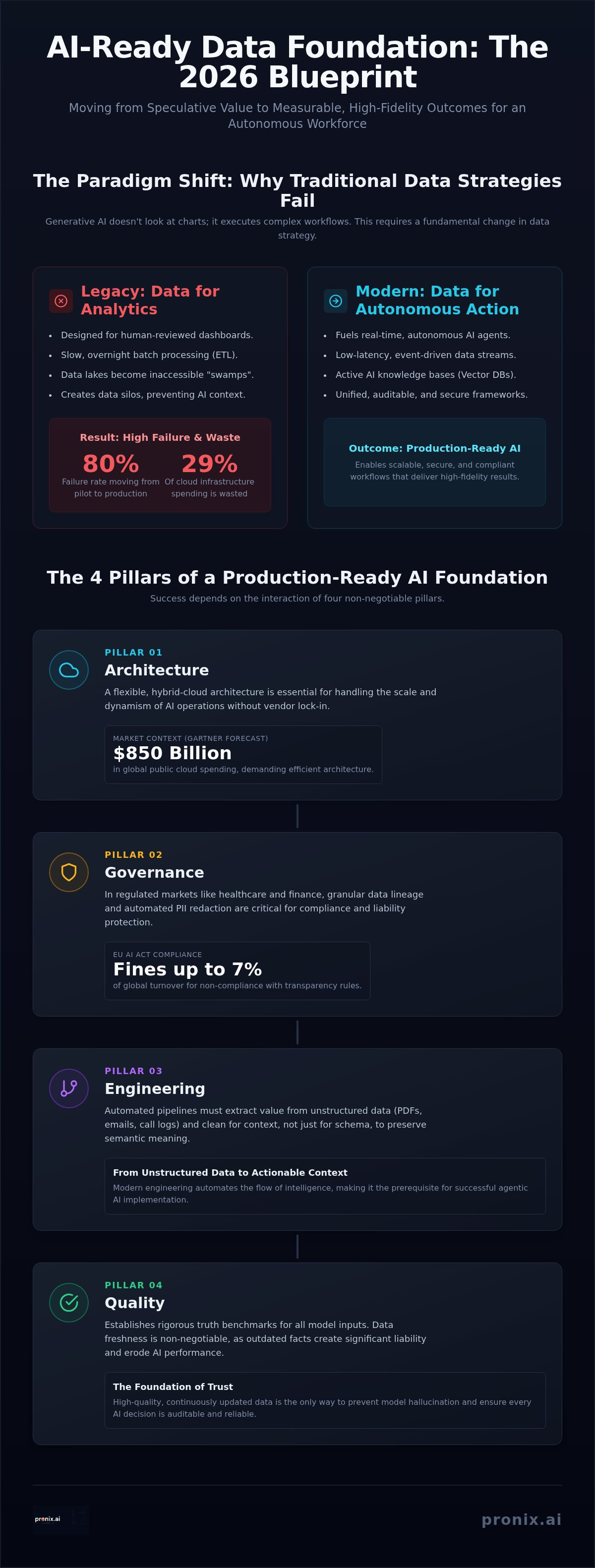
Legacy data strategies were built for dashboards. They were designed for humans to look at charts and make subjective decisions. Generative and agentic AI don't look at charts; they execute complex workflows. This shift from "Data for Analytics" to "Data for Autonomous Action" is where most companies fail. An effective enterprise data strategy for AI must treat data as a high-fidelity fuel for real-time decision-making, not just a historical record of past events.
Data silos remain the primary obstacle to production-ready outcomes. When critical information is trapped in disconnected departments, AI agents lack the necessary context to perform safely or accurately. This explains why many initiatives stall at the data layer, with some estimates suggesting an 80% failure rate during the transition from pilot to production. Without a unified framework, you're simply running expensive experiments. A 2026 strategy prioritizes intelligence over mere storage. It integrates robust data governance principles to ensure every decision made by an agent is auditable, secure, and compliant.
The Death of Passive Data Warehousing
Traditional ETL processes are simply too slow for the era of autonomous agents. Batch processing that runs overnight can't support an agent attempting to resolve a supply chain disruption in seconds. Modern workflows require low-latency processing for unstructured data, such as PDFs, emails, and voice logs. Moving from batch-heavy cycles to event-driven AI data streams allows your models to react to market changes as they happen. If your infrastructure can't handle real-time ingestion, your agents will always be one step behind.
From Data Lakes to AI Knowledge Bases
Data lakes often evolve into swamps where information becomes inaccessible. For AI to succeed, these must transform into active knowledge bases. Vector databases are now essential; they allow for efficient semantic search and retrieval. This is the foundation of Retrieval-Augmented Generation (RAG), which provides the context models need to stop hallucinating. Data freshness is non-negotiable. If your indexing isn't continuous, your agent's responses will be based on outdated facts, creating significant liability in regulated sectors.
The 4 Pillars of a Production-Ready AI Data Foundation
Moving from pilot to production in 2026 requires a shift in priorities. A robust enterprise data strategy for AI stands on four non-negotiable pillars: architecture, governance, engineering, and quality. Architecture must handle hybrid-cloud flexibility, especially as Gartner forecasts global public cloud spending to reach $850 billion this year. Governance ensures you don't face fines of up to 7% of global turnover under the EU AI Act. Engineering automates the flow of context, while quality sets the truth benchmarks for all model inputs.
Success depends on how these pillars interact. If your architecture is rigid, your engineering costs will spiral. If your quality benchmarks are weak, your governance becomes impossible. Organizations often find that stabilizing these foundations is the hardest part of the journey. If you're struggling to align these technical requirements with your business goals, exploring Data & AI Foundations can provide the necessary clarity.
Governance for Regulated Markets
In healthcare and finance, standard security isn't enough. You need granular data lineage to explain every AI-driven decision. With the EU AI Act's August 2, 2026, deadline for user-transparency rules, disclosing AI interactions is now a legal requirement. Managing PII requires automated redacting within the pipeline before data ever reaches the LLM. This is where a well-defined enterprise data strategy becomes a defensive asset. It protects the organization from liability while enabling innovation in high-stakes environments.
AI-Ready Data Engineering
Most enterprise data is trapped in unstructured formats. You need systems that extract value from PDFs, call logs, and emails automatically. Don't just clean for schema; clean for context. This means preserving the semantic relationships a model needs to understand complex intent. Data Foundations serve as the technical and strategic prerequisite for successful Agentic AI implementation services. By automating the pipeline from raw data to AI-ready context, you reduce the manual overhead that kills ROI. High-performance engineering ensures your agents have the memory and state they need to execute multi-step tasks without human intervention.
Architectural Frameworks: Centralized, Federated, and Semantic Layers
Architectural choice determines whether your AI agents are agile or anchored by technical debt. A successful enterprise data strategy for AI must reconcile the need for centralized control with the demand for decentralized speed. In high-compliance sectors like healthcare and finance, the centralized model remains the gold standard. It provides a single, auditable source of truth that simplifies regulatory reporting. However, for global organizations, this often creates a bottleneck that slows implementation across diverse business units.
The federated data mesh offers an alternative by treating data as a product owned by individual departments. This enables agility but requires a rigorous governance framework to prevent fragmentation. Most mature organizations are now adopting hybrid approaches to manage their global scale. They centralize core golden records while allowing federated autonomy for specific use cases. This balance is essential for scaling across complex environments like AWS, Azure, or Salesforce, especially given that 29% of IaaS and PaaS spending is currently wasted due to architectural inefficiencies.
Why Semantic Layers are Critical for AI Agents
Semantic layers act as the translator between raw data and AI reasoning. Without them, agents struggle to understand the business intent behind columns and rows. By providing clear data definitions, you create the business logic models need to function. This significantly reduces hallucinations by ensuring the AI doesn't have to guess at the meaning of a metric. These layers integrate directly with platforms like Snowflake and Databricks, providing a consistent version of the truth for every agentic workflow.
Choosing the Right Framework for Your Maturity Level
Choosing a framework requires an honest assessment of your current data maturity. If your information is still trapped in legacy silos, moving directly to a decentralized mesh will likely result in chaos. Start by centralizing high-value datasets to build your initial AI knowledge base. As your engineering team matures, you can transition toward a decentralized model. This progression mirrors the flywheel approach, where quick wins fund the long-term modernization of your infrastructure across the AWS, Azure, and Google Cloud ecosystems.
Operationalizing Data Engineering for Agentic AI Workflows
Agentic AI represents the next frontier in automation. It requires a fundamental evolution of your enterprise data strategy for AI. While generative AI simply answers questions, agentic AI completes objectives. This shift moves your architecture from stateless queries to stateful interactions. Agents must maintain memory, manage complex states, and use tools to interact with legacy systems securely. If your data foundation doesn't support these dynamic requirements, your agents will fail to execute multi-step tasks accurately.
Building a continuous feedback loop is essential for long-term success. Agents must learn from production data to refine their execution strategies over time. This is particularly critical for AI-driven CX modernization, where real-time orchestration determines the quality of the customer experience. Managing the "Agentic State" ensures consistency across multi-agent workflows. If one agent updates a record, every other agent in the chain must recognize that change immediately. Without this synchronization, your automation will collapse into fragmented, unreliable outcomes.
Memory and Context Management
Short-term memory allows an agent to maintain the thread of a current task. It's the working memory of the workflow. Long-term memory enables the agent to recall past interactions and user preferences across multiple sessions. In a production environment, you must store these interactions for auditability and future model fine-tuning. This isn't just a technical requirement; it's a governance necessity. High-scale environments require sophisticated techniques to manage context windows. You must prioritize the most relevant data to ensure agents don't hallucinate due to context overflow.
Agentic Data Pipelines
Modern pipelines must do more than move data from point A to point B. They must allow agents to query and update databases securely through predefined tools. This requires a granular approach to permissions and authentication. You must implement strict guardrails for tool-use to ensure an agent doesn't perform unauthorized deletions or data exfiltration. Monitoring for data drift is also mandatory. If the underlying data distribution shifts, agent performance will degrade rapidly. To ensure your infrastructure is ready for these autonomous demands, consult with our experts for a comprehensive Agentic AI Implementation strategy.
Scaling Your AI Data Strategy with Managed Services
Software is not a strategy. It's a tool that requires expert hands to yield results. Scaling an enterprise data strategy for AI requires a persistent focus on operational maturity that internal teams often lack the bandwidth to maintain. While software vendors claim their platforms solve every data silo, the reality of a 2026 production environment involves complex agentic states and fragmented information flows that require expert tuning. You can't automate your way out of a poor data foundation without human oversight.
This is where an enterprise AI managed service provider becomes indispensable. They provide the boots-on-the-ground pragmatism needed to ensure your data foundations are not just built, but sustained. A managed partner provides continuous optimization, security monitoring, and auditability. They transform your data layer from a static repository into a dynamic, reliable fuel source for autonomous agents. This transition from high-level strategy to long-term operational excellence is the difference between a failed pilot and a scalable production outcome.
Bridging the AI Talent Gap
The biggest hurdle isn't the technology; it's the people. AI data engineering is a specialized discipline that combines traditional ETL with semantic modeling and agentic memory management. Hiring for these roles is the primary bottleneck for most enterprise initiatives. Managed services offer "Talent as a Service," giving you immediate access to seasoned practitioners. This allows your internal leadership to focus on strategic business value while partners handle the technical heavy lifting of infrastructure maintenance and pipeline stability.
The pronix.ai Approach to Data & AI Foundations
The pronix.ai approach is built on decades of IT excellence and a deep understanding of legacy modernization. We bridge the gap between high-level AI vision and production-ready data architectures. Our team specializes in regulated industries like healthcare and finance, where security and risk mitigation are non-negotiable. We don't just implement software; we operationalize intelligent workflows that drive CX modernization and business automation. Our focus remains on long-term stability and evidence-based success for every agentic implementation.
Transitioning to Autonomous Operational Maturity
The transition from experimental AI pilots to scalable production requires a fundamental shift in how your organization treats its information assets. Passive storage is no longer sufficient; your data must become a high-fidelity fuel for autonomous action. By implementing a robust enterprise data strategy for AI, you ensure that your agentic workflows remain secure, auditable, and contextually aware. We've explored how architectural frameworks and semantic layers bridge the gap between raw data and AI reasoning; the final step is operationalizing these foundations for long-term excellence.
Achieving this level of maturity requires a partner who understands the friction points of legacy systems and the demands of regulated markets. pronix.ai provides enterprise-grade governance and specialized managed services for AWS, Microsoft, Salesforce, and Genesys platforms. We focus on results-oriented implementation that moves you beyond the pilot phase into secure, scalable outcomes. Secure your AI production outcomes with pronix.ai Data & AI Foundations. The path to AI-driven automation is complex, but with a stable data foundation, your organization is ready to lead the next wave of technological evolution.
Frequently Asked Questions
What is the difference between a data strategy and an AI data strategy?
Traditional data strategy focuses on storage, historical reporting, and human-led analytics. An AI data strategy prioritizes model training, real-time inference, and autonomous action. It requires high-fidelity, low-latency pipelines that feed models directly. While a standard strategy manages static records, a modern enterprise data strategy for AI manages dynamic context, embeddings, and the feedback loops necessary for machine learning models to improve over time.
How does agentic AI change my data architecture requirements?
Agentic AI requires your architecture to support state management and long-term memory. Unlike chatbots that handle one-off queries, agents execute multi-step workflows that necessitate a constant state across different tools. You must implement databases that store agent interactions and allow for secure, real-time updates to legacy systems. This shift moves your infrastructure from a passive lake to an active operational environment where agents query and write data autonomously.
Do I need a vector database for enterprise generative AI?
Yes, vector databases are essential for scaling Retrieval-Augmented Generation (RAG) in the enterprise. They store data as mathematical embeddings, allowing models to perform semantic searches rather than just keyword matching. This technology provides the specific context models need to reduce hallucinations. While some relational databases now offer vector extensions, dedicated vector stores provide the performance required for high-concurrency production workflows and complex, multi-dimensional data retrieval in 2026.
How do I ensure AI data compliance in healthcare or finance?
Ensure compliance by implementing automated data lineage and granular access controls. Under the EU AI Act, you must explain how an AI arrived at a specific decision. In healthcare, this means redacting PII before it enters the model training or inference pipeline. You should use managed foundations that offer built-in audit logs and encryption. These frameworks help you meet the August 2, 2026, transparency deadlines while maintaining HIPAA or SOC2 standards.
What is the role of a semantic layer in generative AI?
A semantic layer acts as a translator that defines business logic for AI models. It maps technical data schemas to clear business concepts like customer lifetime value or churn risk. Without this layer, AI agents often misinterpret raw data columns, leading to inaccurate or dangerous outputs. By standardizing definitions across Snowflake or Databricks, you provide a consistent source of truth that ensures your enterprise data strategy for AI remains reliable across different business units.
Why is data auditability critical for enterprise AI production?
Auditability is the only way to mitigate the liability risks associated with autonomous decisions. If an AI agent denies a loan or changes a medical record, you must have a clear record of the data inputs and model version used. This is critical for regulatory reviews and internal troubleshooting. Without a rigorous audit trail, you can't prove compliance with transparency rules, which could result in fines reaching 7% of global annual turnover.
How can I reduce the cost of processing unstructured data for AI?
Reduce costs by using specialized ingestion tools that filter and summarize data before it reaches the LLM. Processing every word of a 100-page PDF is expensive and inefficient. Instead, use automated pipelines to extract only the most relevant entities and context. Implementing a cleaning for context approach ensures you only pay to process high-value information. This strategy helps combat the fact that 29% of cloud infrastructure spending is currently wasted.
Should I centralize my data before starting an AI implementation?
You don't need to centralize every byte of data, but you must centralize your golden records for key AI use cases. A flywheel approach is often better; start with a specific pilot and centralize only the data required for that outcome. This allows you to demonstrate value quickly while building toward a broader federated data mesh. Complete centralization often becomes a multi-year bottleneck that prevents your organization from reaching production-ready AI outcomes.