

By 2026, the primary differentiator for enterprise success won't be the size of your Large Language Model, but the integrity of the architecture supporting it. Establishing robust data foundations for generative AI is the only way to move beyond experimental pilots that fail to scale. Most organizations have realized that while LLMs are powerful, they're functionally limited by data silos that undermine Retrieval-Augmented Generation (RAG) effectiveness. You've likely felt the pressure of rising pipeline costs and the lack of auditability for AI outcomes in regulated markets.
This guide provides the technical and strategic blueprint to architect a secure, scalable data infrastructure. You'll learn how to move from fragmented legacy systems to a governed framework designed for Agentic AI. We'll outline a clear roadmap for data readiness that prioritizes operational efficiency through automated workflows. This is a practitioner-led approach to ensuring your AI strategy delivers stable, production-grade results rather than just speculative potential. We'll move from high-level strategy into the specific technical execution required for long-term operational maturity.
Key Takeaways
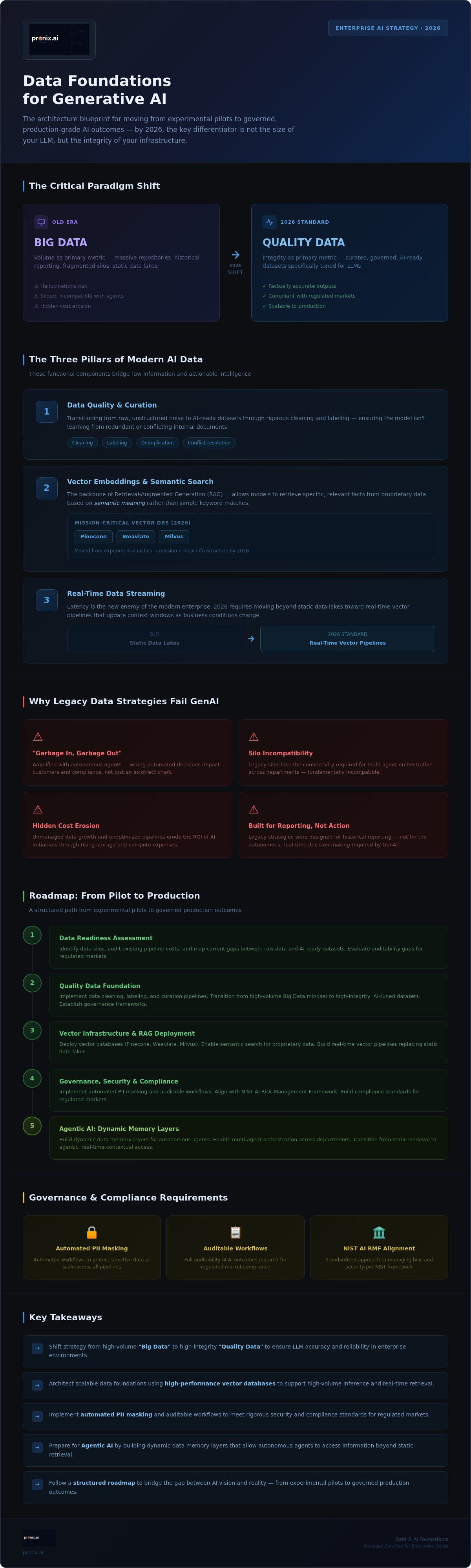
- Shift your strategy from high-volume "Big Data" to high-integrity "Quality Data" to ensure LLM accuracy and reliability in enterprise environments.
- Architect scalable data foundations for generative AI using high-performance vector databases to support high-volume inference and real-time retrieval.
- Implement automated PII masking and auditable workflows to meet the rigorous security and compliance standards required for regulated markets.
- Prepare for the evolution of Agentic AI by building dynamic data memory layers that allow autonomous agents to access information beyond static retrieval.
- Bridge the gap between AI vision and reality by following a structured roadmap to move from experimental pilots to governed production outcomes.
What Are Data Foundations for Generative AI in 2026?
In 2026, data foundations for generative AI represent the integrated architecture of engineering, governance, and orchestration required to sustain production-grade outcomes. It's no longer sufficient to merely store information in massive repositories. Enterprise leaders must now prioritize the movement, curation, and accessibility of high-integrity datasets. This shift marks the definitive end of the "Big Data" era, where volume was the primary metric. Today, success depends on "Quality Data" specifically tuned for Large Language Models (LLMs). This evolution is critical for mitigating hallucinations. By providing models with a grounded, verifiable context, organizations ensure that AI outputs remain factually accurate and safe for regulated markets.
The Three Pillars of Modern AI Data
Modern architectures rely on three functional components to bridge the gap between raw information and actionable intelligence. These pillars ensure that your AI isn't just generating text, but providing utility.
- Data Quality and Curation: Transitioning from raw, unstructured noise to AI-ready datasets requires rigorous cleaning and labeling. This process ensures that the model isn't learning from redundant or conflicting internal documents.
- Vector Embeddings and Semantic Search: These serve as the backbone of Retrieval-Augmented Generation (RAG). They allow models to retrieve specific, relevant facts from your proprietary data based on semantic meaning rather than simple keyword matches.
- Real-time Data Streaming: Latency is the new enemy of the modern enterprise. 2026 requires moving beyond static data lakes toward real-time vector pipelines that update context windows as business conditions change.
Effective implementation requires aligning these pillars with established data governance frameworks to maintain auditability and compliance across the entire pipeline.
Why Traditional Data Strategies Fail GenAI
Legacy strategies were built for historical reporting, not for autonomous action. The "Garbage In, Garbage Out" problem is amplified when dealing with autonomous agents. If an agent accesses outdated or siloed information, the operational risk increases exponentially. It isn't just about an incorrect chart anymore; it's about a wrong automated decision that impacts customers or compliance.
Legacy silos are fundamentally incompatible with modern agentic workflows. They lack the connectivity required for multi-agent orchestration across departments. Additionally, unmanaged data growth in AI environments creates significant hidden costs. Without a disciplined foundation, storage and compute expenses for unoptimized pipelines can quickly erode the ROI of AI initiatives. Organizations must move toward a governed, lean infrastructure to maintain both speed and fiscal stability. This transition is no longer optional for those seeking to move data foundations for generative AI from experimental pilots to production-ready outcomes.
The Architecture of Production-Ready Data Foundations
Production-ready architecture demands more than a simple API connection to a model. It requires a resilient core that harmonizes structured ERP data with unstructured document repositories. Implementing a comprehensive enterprise data strategy for AI ensures that every inference call is backed by a unified context. By 2026, vector databases like Pinecone, Weaviate, and Milvus have moved from experimental niches to mission-critical infrastructure. These systems enable high-speed semantic retrieval, allowing models to process proprietary information at the speed of business. Building these data foundations for generative AI is the first step toward moving beyond basic chatbots into sophisticated, high-volume inference engines.
Stability in these architectures isn't just about speed; it's about risk mitigation. Aligning your technical stack with the NIST AI Risk Management Framework provides a standardized approach to managing bias and security. This alignment ensures that your infrastructure is both high-performing and compliant with emerging national standards. If you're struggling to bridge the gap between architectural vision and technical reality, Pronix.ai offers specialized Data & AI Foundations services to accelerate your transition.
Retrieval-Augmented Generation (RAG) Infrastructure
Chunking strategies are the silent engine of RAG performance. Poorly segmented data leads to fragmented context and irrelevant model responses. In 2026, leading architectures employ hybrid search, which blends traditional keyword matching with semantic vector results to maximize precision. This approach optimizes context windows and token efficiency. It directly reduces operational costs while improving response quality for complex enterprise queries. Managing these tokens effectively ensures that your AI remains both accurate and fiscally sustainable.
Data Engineering for Enterprise AI
Automation is the only way to manage the volume of unstructured data entering the AI lifecycle. Modern ETL pipelines must now handle PDFs, audio, and video with the same rigor as SQL tables. Version control for data is now as vital as version control for code. It allows teams to audit exactly which data subset influenced a specific AI outcome. To maintain this level of control at scale, consider these core requirements:
- Automate extraction to remove manual bottlenecks in unstructured data processing.
- Maintain data lineage to ensure model reproducibility and compliance.
- Scale through scalable AI infrastructure management.
Success requires a shift from manual data handling to automated, versioned pipelines. This ensures that your AI systems are built on a foundation of evidence and traceability rather than speculation.
Governance, Risk, and Compliance: The Regulated Industry Standard
Governance in 2026 is no longer a secondary consideration; it's the primary framework for scale. Establishing secure data foundations for generative AI allows organizations to move away from "black box" systems toward transparent, auditable workflows. This transition is essential for securing board-level approval and maintaining public trust. Achieving enterprise-grade AI auditability ensures that every model output is traceable back to its source data and logic. By implementing data-level filters, enterprises can proactively manage bias and toxicity before they reach the end user. This proactive stance transforms compliance from a defensive hurdle into a competitive advantage.
Effective risk management requires more than just policy; it requires technical enforcement. Adhering to NIST AI governance and risk management frameworks ensures your infrastructure meets national standards for reliability and safety. This involves integrating PII masking directly into LLM prompts to prevent sensitive data leakage. These safeguards allow teams to innovate rapidly while remaining within the strict boundaries of regulated markets.
AI Compliance in Healthcare and Finance
In healthcare and finance, the stakes for AI failure are exceptionally high. Meeting HIPAA and SOC2 standards in generative AI production requires a rigorous approach to data handling. Organizations must create immutable audit trails for every AI-generated decision or customer interaction. This level of detail is necessary for regulatory reviews and internal quality control. For high-stakes automated workflows, implementing "Human-in-the-Loop" (HITL) protocols is mandatory. HITL ensures that while AI handles the heavy lifting, a human expert provides the final verification for critical outcomes. This balance maintains speed without sacrificing professional accountability.
Data Privacy vs. Model Performance
Enterprise leaders often face a perceived trade-off between data anonymization and context richness. Over-masking can strip away the nuances that make RAG systems effective. To solve this, many organizations now use synthetic data for model testing in highly regulated environments. Synthetic datasets mirror the statistical properties of real data without exposing actual PII. This allows for robust testing and optimization before moving to live production. Governance should be viewed as an enabler of AI innovation. It provides the "safety rails" that allow developers to push the boundaries of what's possible. When your data foundations for generative AI are built with compliance at the core, you eliminate the friction that typically stalls large-scale deployments.
Operationalizing Data for Agentic AI: The Next Evolution
Agentic AI represents the shift from passive information retrieval to autonomous execution. While traditional RAG systems focused on providing answers, agents are designed to perform actions. This transition requires a fundamental re-engineering of your data foundations for generative AI. Agents don't just need static documents; they require dynamic access to live business systems and a shared data memory layer. This memory layer allows multi-agent systems to maintain context across complex, multi-step workflows. Without this architecture, agents remain isolated chatbots rather than functional team members. Success in 2026 depends on building enterprise AI agents that possess real-time tool access and long-term state management capabilities.
From Static RAG to Autonomous Agents
The move to autonomy changes the data requirements from "read-only" to "read-write-interact." Agents must be able to trigger API calls, update database records, and react to real-time data changes. Managing agent state and history is a critical challenge in large-scale environments. If an agent loses track of previous interactions, the entire workflow collapses. Reliability is ensured through rigorous data-driven testing that simulates various operational scenarios. This ensures that the agent's logic remains consistent even as the underlying data evolves. If you're ready to move beyond basic retrieval, our Agentic AI Strategy & Consulting services can help you architect these advanced systems.
CX Modernization via Agentic Foundations
Customer experience is the most immediate beneficiary of agentic workflows. Effective AI-driven CX modernization relies on deep integration with existing customer data. By connecting CRM data directly to agentic workflows, organizations can deliver personalization at an unprecedented scale. These agents don't just quote policy; they can resolve billing issues, update account details, and provide tailored recommendations based on a customer's full history. This level of empowerment reduces contact center friction and improves operational efficiency. The result is a seamless, data-empowered experience that moves beyond the limitations of legacy IVR and basic chat tools. You're no longer just managing data; you're orchestrating outcomes through a resilient, agent-ready foundation.
Pronix.ai: Managed Services for Data and AI Foundations
Pronix.ai specializes in moving enterprises from fragmented AI pilots to secure, production-grade outcomes. We deliver the data foundations for generative AI required to sustain long-term business value and operational stability. Our methodology focuses on a high-velocity transition, moving from initial assessment to live production in 90 days. As a specialized systems integrator, pronix inc serves as the partner of choice for organizations navigating the complexities of large-scale AI transformation. We prioritize operational maturity over speculative hype, ensuring every implementation is backed by a rigorous governance framework and a clear path to ROI. Our focus remains on reducing the high costs associated with unoptimized data pipelines and legacy technical debt.
Our Managed Services Framework
We provide end-to-end management of the enterprise AI automation managed services lifecycle. This isn't a one-time setup; it's a commitment to continuous optimization and risk mitigation. Our framework is designed to bridge the internal skills gap that often stalls enterprise innovation. We provide the specialized talent necessary to manage the intersection of data engineering and AI orchestration.
- Continuous Pipeline Optimization: We monitor your data flows to ensure they remain efficient and cost-effective for high-volume inference calls.
- Proactive Governance: Our team handles the ongoing risk mitigation required to maintain compliance in regulated markets like healthcare and finance.
- Talent-as-a-Service: We provide elite practitioners who understand how to modernize legacy systems without disrupting current business operations.
The Roadmap to Production-Ready AI
Moving toward a mature AI environment requires a methodical progression from strategy to execution. We follow a structured three-step process to ensure your data foundations for generative AI are resilient and scalable. This logic mirrors a professional service lifecycle, moving from broad strategy to specific, time-bound milestones.
The journey begins with a comprehensive Data Audit and Strategy Alignment. We identify the specific data silos and quality issues that prevent effective RAG implementation. Once the strategy is set, we move to the Technical Implementation of the Data Foundation. This involves building the vector pipelines, orchestration layers, and security filters discussed in earlier sections. Finally, we scale the environment to support advanced agentic workflows and CX modernization. This phased approach allows your organization to realize productivity gains quickly while maintaining a disciplined, auditable framework. We ensure that your AI strategy delivers evidence-based success rather than just experimental potential.
Transitioning from Vision to Production Reality
The window for experimental AI is closing. By 2026, the competitive landscape will be defined by those who successfully architected their data foundations for generative AI to support autonomous agents and real-time inference. Success requires moving beyond legacy silos toward a governed, auditable framework that prioritizes data integrity over sheer volume. You've seen that high-performing RAG systems and CX modernization depend on this structural readiness.
Pronix.ai bridges the gap between strategic vision and technical implementation. As official partners of AWS, Microsoft, and Salesforce, we provide the specialized talent needed to secure your infrastructure. Our managed services approach delivers production-ready AI outcomes in 90 days with a relentless focus on enterprise-grade security and governance. Don't let technical debt or fragmented pipelines stall your transformation. It's time to move toward a mature, automated future with confidence.
Schedule your Data Foundations Assessment with Pronix.ai today and build the resilient architecture your enterprise requires for the next era of automation.
Frequently Asked Questions
What is the difference between a data lake and a data foundation for GenAI?
A data lake is primarily a storage repository for raw data, whereas data foundations for generative AI encompass the orchestration and governance layers required for model inference. Traditional lakes often become data swamps without the curation needed for LLMs. Foundations ensure that data is high-quality, vectorized, and accessible in real-time. This transition allows enterprises to move from simply collecting information to actively utilizing it for stable, production-grade AI outcomes.
How do I ensure data privacy when using third-party LLMs?
Ensuring privacy involves implementing automated PII masking and data-level filters before information reaches the model. Use synthetic data for testing in regulated environments to avoid exposing sensitive records. Organizations should also establish secure API gateways with strict data residency controls. These measures ensure that proprietary information remains protected while still benefiting from the contextual richness required for effective Retrieval-Augmented Generation (RAG) workflows. This approach maintains security without sacrificing performance.
Do I need to fine-tune a model or is RAG enough for enterprise use?
RAG is typically the standard for enterprise use because it provides models with dynamic, up-to-date context without the high cost of retraining. Fine-tuning is better suited for specialized tasks where the model must learn a specific vocabulary or tone. Most production-ready outcomes rely on a robust RAG architecture to mitigate hallucinations. This approach ensures that the AI remains grounded in the latest proprietary data rather than relying on static training weights that quickly become obsolete.
What are the common pitfalls in building data pipelines for AI agents?
Common pitfalls include relying on static data retrieval and failing to manage agent state across multi-step workflows. Many organizations struggle with data silos that prevent agents from accessing a unified context. Additionally, the hidden costs of unoptimized pipelines can quickly erode ROI. Success requires designing infrastructure that supports long-term agentic memory and provides real-time tool access. Avoiding these friction points is essential for transitioning from experimental pilots to production-ready outcomes that deliver value.
How does real-time data integration impact AI hallucination rates?
Real-time integration significantly lowers hallucination rates by providing the model with the most current factual context. When an LLM relies on outdated data, it's more likely to "fill in the gaps" with incorrect information. Real-time vector pipelines ensure that the context window reflects live business conditions. This grounding is critical for maintaining accuracy in high-stakes environments like finance or healthcare, where factual errors carry significant operational and compliance risks. It replaces guesswork with evidence-based responses.
What specific governance frameworks are required for AI in financial services?
Financial services require frameworks that emphasize transparency and immutable audit trails. Adhering to the NIST AI Risk Management Framework provides a standardized approach to managing bias and security. Compliance also involves meeting SOC2 and SEC requirements for data handling and model reproducibility. Implementing these data foundations for generative AI ensures that every automated decision is traceable. This level of governance is necessary to secure board-level approval and maintain regulatory standing during large-scale AI deployments.
How can I measure the ROI of my AI data infrastructure?
ROI is measured through tangible metrics like reduced operational costs and accelerated productivity. Efficient data pipelines lower the compute and storage expenses associated with high-volume inference. Additionally, AI-driven CX modernization reduces contact center friction, leading to measurable improvements in service speed and customer satisfaction. By focusing on these outcomes, enterprises can justify the investment in their data architecture. The goal is to move from speculative experimentation to evidence-based success through improved operational efficiency.
Why is auditability critical for production-grade generative AI?
Auditability is the backbone of responsible AI adoption in the enterprise. It allows organizations to trace every AI-generated interaction or decision back to its specific data source and logic. This transparency is vital for meeting regulatory standards and maintaining public trust. Without an auditable trail, AI outcomes remain a "black box" that poses significant legal and reputational risks. A disciplined foundation ensures that every innovation is backed by a rigorous, verifiable framework that survives internal and external scrutiny.