

About 95% of generative AI pilots don’t deliver measurable returns on the profit-and-loss statement, according to MIT’s Project NANDA. That gap helps explain the challenges in scaling AI projects: a pilot can perform well in a controlled setting, then falter when it meets real workflows, legacy systems, data constraints, and operational risk.
If your team has a promising proof of concept but no reliable path to production, the problem may not be the model. Scaling also requires clear business ownership, usable data, integration with existing systems, and controls that work beyond the pilot. Without these foundations, success is difficult to repeat or measure.
This guide explains why AI pilots stall, how to identify barriers in your organization, and what evidence to use when assessing readiness. It covers practical improvements across business alignment, technical foundations, governance, and ongoing operations, so your team can plan its next steps with greater reliability and accountability.
Key Takeaways
- Assess whether your pilot can support more users, workflows, system dependencies, and operational demands before expanding it.
- Identify the challenges in scaling AI projects by tracing symptoms such as latency, errors, low adoption, and manual rework to their root causes.
- Use five readiness gates to align business value, data and technical foundations, controls, operational testing, and incremental expansion.
- Assign an accountable owner and document evidence at each gate to make scale decisions measurable and auditable.
- Connect strategy, integration, governance, and ongoing operations to build a more reliable path from pilot to production.
Why AI Projects That Succeed in Pilots Struggle to Scale
A pilot shows that an AI system can work under defined conditions. Enterprise scaling asks a harder question: can it keep delivering useful, reliable results across more users, workflows, systems, and operational responsibilities? The challenges in scaling AI projects often appear in the gap between those tests. A controlled trial may use selected data, a small group of users, and close expert supervision. Production introduces variation the pilot may not have been designed to handle.
AI project scaling is the sustained delivery of business value through reliable performance, integrated workflows, and accountable governance as usage expands. A convincing demonstration shows potential, not production readiness. Leaders need to assess whether the results can be repeated in normal operating conditions and whether ownership is clear when the system is wrong, unavailable, or out of scope.
What changes when an AI pilot becomes an enterprise capability?
A pilot may serve a small group of trained users with similar permissions and predictable requests. An enterprise capability must support different roles, access levels, working habits, and expectations. Higher volumes can expose latency or availability constraints. They also raise practical questions: who monitors the service, handles escalations, and communicates when outputs need review?
The workflow must work beyond the model’s response. For example, an AI assistant that summarizes a request may appear successful in a demo. In production, its output may need to reach a case-management system, preserve the right context, and route exceptions to a responsible employee. If a handoff fails, staff may have to re-enter information or may lose track of the request. Reliability depends on the whole process, not just the model’s answer.
Why a promising proof of concept can create false confidence
Proofs of concept often rely on curated data and close attention from the people who built them. Experts can clarify unclear inputs, spot faulty outputs, and keep the demonstration on track. Those interventions may not be available in day-to-day operations. A narrow success measure, such as answer quality on selected examples, can also miss adoption, exception rates, review effort, and the work needed to maintain results.
Measure the full operating path before treating a positive result as a decision to scale. Track whether intended users adopt the capability, how often people must correct or redo work, and what happens when inputs fall outside expected patterns. Assign owners for performance, workflow outcomes, and escalation. This evidence helps distinguish a production barrier from a pilot condition that simply made success easier to achieve.
As AI becomes more autonomous, weak handoffs and unclear accountability deserve more attention. Public discussion of AI takeover considers broader risks associated with advanced AI. Enterprise readiness starts with practical controls: define permitted actions, human review points, and escalation paths that fit the system’s role.
The operating model must mature alongside the technology. Set expectations for response times, availability, support, and ownership before expanding access. Then test the workflow under realistic conditions and document where human judgment remains necessary. A pilot is ready to scale when performance, user adoption, operational effort, and governance can be assessed together, not simply when a demonstration looks impressive.
The Connected Technical and Organizational Challenges in Scaling AI
The challenges in scaling AI projects rarely sit in one layer. Data quality affects model evaluation; architecture shapes performance; and integration determines whether outputs reach the right workflow. Governance, skills, and operating costs then influence whether the capability can be used and maintained reliably. Treating these as separate checklist items can hide the dependencies behind production failures.
Consider a support assistant drawing from several systems. If teams define a customer or case differently, the data may be inconsistent. That weakens evaluation and makes it harder to tell whether an inaccurate answer came from the model, the source, or the workflow. Without an accountable data owner, there may be no clear decision-maker to correct the definition or approve a change. Monitoring and responsibility become difficult at the same time.
Where data, architecture, and integration become bottlenecks
Start by mapping the information the AI uses: where it lives, how it is defined, who can access it, and who owns its quality. Fragmented sources and inconsistent permissions can limit retrieval or leave out context needed for a useful response. This is a foundation problem, not automatically a reason to replace infrastructure.
Assess architecture against the actual workload. Increased demand may reveal latency, capacity, or reliability limits, but the right response depends on where the constraint occurs. Trace the path from data source through APIs and enterprise applications to the operational process. If an AI output doesn’t update a record, trigger an approved action, or reach the employee responsible for the next step, it remains disconnected from the work. Existing integration patterns and systems may be sufficient if the end-to-end handoff is dependable.
Why governance, skills, and ownership matter as much as models
Production requires clear decision rights. Teams need to know who approves model or prompt changes, handles exceptions, responds to incidents, and accepts residual risk. If data science, IT, security, legal, operations, and business leaders work from different assumptions, reviews can stall or critical decisions can fall between teams. Assign owners and define escalation paths before broader deployment.
People are part of the operating system. Employees need role clarity, practical training, and guidance on when to rely on AI and when to review or override its output. Without that clarity, adoption can be uneven, and staff may create manual workarounds that undermine process consistency. MIT’s AI Value Creation: Five Provocative Propositions underscores that scaling requires organizational change alongside technical capability.
At scale, governance defines who can act, ownership ensures someone is accountable, and operations turn both into reliable performance. Assess costs across the full lifecycle, including integration, monitoring, human review, and ongoing support, rather than model usage alone. This connected view helps leaders locate the constraint before investing in a fix. For organizations aligning strategy, integration, and oversight, enterprise AI implementation and operations can support that work.
How to Tell a Scaling Barrier from a Symptom
A slow response, a rising error count, or low adoption signals a problem, but not what to fix. The challenges in scaling AI projects are often misdiagnosed when teams treat the most visible symptom as the root cause. Adding compute may reduce latency caused by a capacity limit, but it won’t clarify who owns a data definition, repair a broken handoff, or make a poorly designed workflow fit the work.
Separate four outcomes before choosing an intervention: model quality measures whether outputs are useful and accurate; production reliability measures whether the service performs consistently; user adoption shows whether people use it in practice; and business value assesses whether that use improves a defined outcome. Progress in one area doesn’t prove the others are ready.
Match common scaling symptoms to the underlying cause
Use operational evidence to narrow the diagnosis. Each symptom can have multiple causes, so treat it as a starting point for investigation, not a conclusion.
| Symptom | Possible root causes to investigate |
|---|---|
| Slow responses | Workload or capacity limits, network delays, retrieval inefficiency, or a slow application handoff. |
| Errors or inconsistent outputs | Changing input quality, unreliable data sources, model behavior, or failures in the surrounding application. |
| Low user adoption | Poor process fit, limited trust, unclear access, or inadequate change support. |
| Repeated manual review or rework | Weak evaluation criteria, unclear exception handling, missing workflow steps, or controls that require more review than expected. |
For example, if employees repeatedly copy an AI-generated summary into another system, the model may be performing well. The root cause could be a missing integration or a workflow that leaves the handoff to the user. Improving the model won’t remove that extra step.
Choose a response based on evidence, not escalation pressure
Trace a failed or delayed task from end to end: data source, model, application, business workflow, and human handoff. Record where it breaks, how often it happens, and the consequence. This helps distinguish a retrieval delay from an access issue, or an inaccurate result from an undefined business rule.
Compare possible interventions by risk reduction, business value, implementation effort, and reversibility. A targeted configuration change may be easier to test and roll back than a major infrastructure expansion. A workflow redesign may reduce repeat rework more directly than a larger model. Choose the smallest intervention that tests the suspected cause, then measure whether the symptom changes.
Pause expansion when the team can’t explain recurring failures, assign an owner to resolve them, or show that safeguards work in the intended workflow. A pause doesn’t mean discarding the pilot. Preserve its evaluation data, user feedback, incident examples, and assumptions. That evidence can guide the next controlled test and prevent pressure to scale from turning an unresolved diagnosis into a larger operational problem.
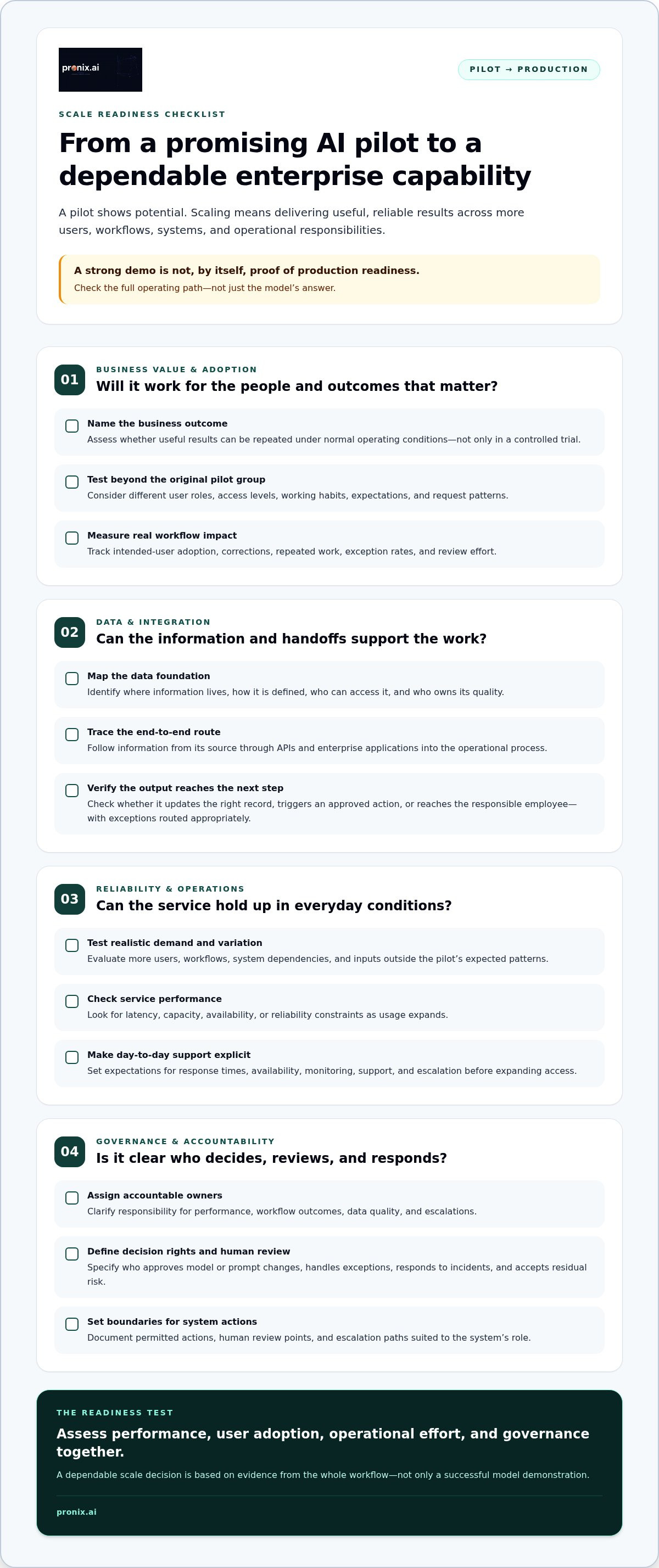
A Practical Readiness Framework for Scaling an AI Project
Readiness is a sequence of evidence-based decisions, not a single approval to launch. This framework helps teams address the challenges in scaling AI projects in order, with an accountable owner and a documented decision gate at each stage. If a gate fails, resolve the gap before expanding the system’s reach.
Set measurable gates before expanding users or workflows
Business and technical stakeholders should agree on the starting baseline and target outcomes before deployment expands. Define how the team will evaluate representative cases, edge cases, and failure handling. Document permissions, human review points, escalation paths, and audit needs so each decision is based on evidence, not confidence alone.
- Define value. Specify the business outcome, its baseline, and how progress will be measured. Gate: the business owner confirms the use case has a measurable purpose and accepts the outcome measures. Record the agreed metrics and assumptions.
- Validate foundations. Review data access, definitions, quality ownership, system dependencies, and technical performance against the intended workflow. Gate: the data or technology owner documents that required inputs and integrations are fit for the planned use, or records gaps and remediation actions.
- Design controls. Set permissions, review requirements, escalation paths, and responsibilities for exceptions or changes. Gate: the risk or governance owner approves the control design for the use case. Keep the decision record, control requirements, and named owners together.
- Test operations. Evaluate representative and edge cases, failure handling, latency, user adoption, and the effort required to review or correct outputs. Gate: the operational owner confirms support processes and handoffs are workable, using test results and documented procedures as evidence.
- Expand incrementally. Add a user group, workflow, or integration boundary at a time. Gate: the business owner and operational owner review performance, incidents, exceptions, effort, and value from the current scope before authorizing the next expansion. Record the rationale and any changes required.
Scale in controlled increments and learn from operations
After each expansion, compare actual outcomes with the baseline. Track quality, reliability, latency, adoption, operational effort, incidents, and exceptions. Review the measures together: strong model performance cannot make up for low usage, and adoption alone doesn’t establish business value. Use the findings to revise architecture, controls, training, or the next rollout decision.
A simple scorecard can list each dimension as ready, needs action, or not assessed, alongside its evidence, accountable owner, and next decision. Set criteria for the use case rather than applying a universal threshold. This makes gaps visible and keeps expansion decisions auditable.
For support aligning strategy, implementation, and ongoing oversight with these readiness gates, work with pronix.ai on enterprise AI scaling.
Move from AI Scaling Challenges to Governed Production
Moving an AI initiative into production takes more than resolving a technical issue. Business outcomes, data foundations, controls, workflows, and operational ownership must work together. Enterprises address the challenges in scaling AI projects by deciding how the capability will be integrated, governed, measured, and managed as needs evolve, rather than treating deployment as the finish line.
An implementation partner can help connect those decisions. The work starts with business priorities, then turns them into a scoped roadmap with clear outcomes and dependencies. Integration planning links AI workflows to enterprise platforms, data, and existing processes, while governance and operational considerations are built into delivery rather than added after launch.
What an enterprise implementation partner contributes
Effective implementation brings business, technical, and operational teams into the same delivery plan. That means defining where AI fits in a workflow, how it exchanges information with enterprise systems, and which people remain responsible for decisions and exceptions. The roadmap should make scope, ownership, measures, and dependencies visible, giving leaders the information to make decisions as the initiative moves toward production.
pronix.ai works with enterprises on agentic AI implementation and strategy, AI business automation, Data & AI Foundations, and AI-driven customer experience modernization. These capabilities support different points in the journey, from preparing data foundations to integrating AI into customer or employee workflows. The right scope depends on the organization’s objectives, systems, controls, and operational requirements.
When managed services can support sustained scaling
Some organizations need ongoing support after implementation, particularly when internal teams must balance AI operations with existing responsibilities. Enterprise AI Managed Services provide ongoing operational oversight, shaped around the system and the organization’s needs. This can support security, auditability, performance monitoring, and incident processes, while internal accountability remains clear.
Before engaging ongoing support, define how responsibilities will be divided. Identify who approves changes, reviews performance, manages incidents, and owns business outcomes. Clarify how internal teams and external specialists will share operational knowledge. These decisions help preserve continuity and make oversight practical as workflows or usage expand.
Governed production is an operating capability, not a one-time launch. It requires strategy to keep the work tied to business priorities, integration to connect AI with real processes, governance to establish appropriate controls, and operations to maintain visibility over time. pronix.ai brings strategy, implementation, and managed services together to support this enterprise delivery lifecycle, including initiatives involving agentic AI and CX modernization.
If your team is preparing to move an AI pilot into production, discuss a production-focused AI initiative with pronix.ai. Bring the intended business outcome, the current workflow, and the main operational barrier. That gives the conversation a practical starting point for defining scope, ownership, and the work required to progress responsibly.
Make Your Next AI Initiative Production-Ready
Treat AI scaling as an operating decision, not only a technology rollout. Choose an initiative with a clear business purpose, define who owns its performance, and establish how the organization will adapt as workflows and requirements change. That discipline turns the challenges in scaling AI projects into a focused plan for responsible progress.
pronix.ai supports enterprise AI strategy, implementation, and managed services, with experience across AWS, Microsoft, Salesforce, Kore.ai, and Genesys platforms. Its enterprise work spans healthcare, finance, and manufacturing. Whether your priority is agentic AI, business automation, data foundations, or customer experience modernization, align the next move with your organization’s goals and readiness.
Discuss your enterprise AI scaling priorities with pronix.ai to identify a practical path from your current initiative to governed production. Clear ownership and evidence can guide each decision as your team moves forward.
Frequently Asked Questions
What does scaling an AI project mean?
Scaling an AI project means expanding its use without losing dependable outcomes or control. For example, a tool that drafts internal case notes may need to support several departments, each with different source systems and review practices. Scale is demonstrated when the expanded workflow remains useful for those teams and owners can detect and address performance changes, not merely when access is switched on.
Why do AI projects fail to scale after a successful pilot?
AI projects often stall because pilot conditions don’t reflect day-to-day operations. The challenges in scaling AI projects can emerge when new teams bring unfamiliar inputs, established systems require different data formats, or exceptions need review by people outside the pilot group. Before expansion, test with representative users and requests, and record where staff must intervene. That evidence can show whether the next step is technical remediation, a workflow change, or stronger operational support.
How can an organization measure AI scalability?
Measure scalability against the intended use, not a generic benchmark. Compare results with a baseline, then assess whether the system meets agreed service and business needs under realistic workloads. For a document-processing workflow, teams might track completion quality, processing delays, correction rates, user activity, and how often work is routed for manual review. Review these measures together over time, since improvements in one area may conceal added effort elsewhere.
Can existing enterprise systems support AI at scale?
Existing systems can support AI at scale when their data access, interfaces, capacity, and controls fit the intended workload. Start with a technical walkthrough of one real transaction, including how information enters the AI workflow and how the result is written back or reviewed. Test peak-use conditions and failure recovery. This can show whether a focused API or process change is sufficient instead of defaulting to a broad infrastructure replacement.
What is the difference between model scalability and project scalability?
Model scalability is the ability to serve a larger or more demanding workload while maintaining suitable model performance. Project scalability also depends on the surrounding business system. For instance, a model might handle more requests, but the process could still bottleneck if employees must approve every output or a downstream application can’t accept results. Evaluate capacity and workflow throughput separately to see whether growth is technically possible and operationally sustainable.
When should a company pause an AI rollout?
Pause an AI rollout if testing reveals a failure that could materially affect users or business decisions, or if the team can’t determine who is responsible for resolving it. Preserve logs, representative inputs, user feedback, and the conditions that triggered the problem. Then document what must change and what evidence will support restarting. A defined pause-and-resume process prevents teams from treating a setback as either an automatic failure or a reason to expand regardless.
Does scaling AI always require moving to the cloud?
No. Cloud deployment is one option, not a prerequisite for scaling. The appropriate environment depends on workload patterns, data handling needs, integration design, security controls, and how the system will be maintained. Compare options using a representative workflow, including routine and peak demand, access requirements, and recovery needs. A cloud move may address a specific constraint, but it won’t by itself fix an inefficient process or unclear responsibility for ongoing operation.