

What if your AI pilot works exactly as designed, but your enterprise still isn’t ready to run it? That gap is where enterprise AI operational readiness matters. A successful demonstration shows that a use case can work under controlled conditions. It doesn’t prove your data, systems, teams, and controls can support it safely and reliably at scale.
Moving from pilot to production takes more than selecting a capable platform. It requires clear ownership, workflows designed for AI-enabled work, trusted data, integration planning, and governance that keeps decisions accountable. Without those foundations, promising initiatives can stall, create avoidable risk, or fail to deliver measurable business value.
This guide gives business and technical leaders a shared way to assess readiness across people, processes, data, technology, and governance. You’ll learn how to identify gaps that could block secure deployment, prioritize practical actions based on business outcomes and risk, and build a phased path from assessment to governed production and ongoing operations. The goal isn’t to slow innovation. It’s to make sure your organization can operate AI with the discipline, accountability, and confidence that scale demands.
Key Takeaways
- Define production readiness by the ability to deploy, monitor, govern, and improve AI in real workflows, not by a successful demo or platform purchase.
- Use enterprise AI operational readiness to assess business alignment, ownership, data, technology, and governance against evidence your teams can verify.
- Apply pass, remediate, or defer gates to make readiness decisions explicit, with accountable owners and evidence behind each outcome.
- Move through five practical steps, from selecting a workflow and baselining outcomes to closing gaps and validating operations.
- Treat readiness as an ongoing discipline, with clear responsibilities for monitoring performance, handling incidents, reviewing access, and gathering employee feedback.
What Enterprise AI Operational Readiness Means Before Production
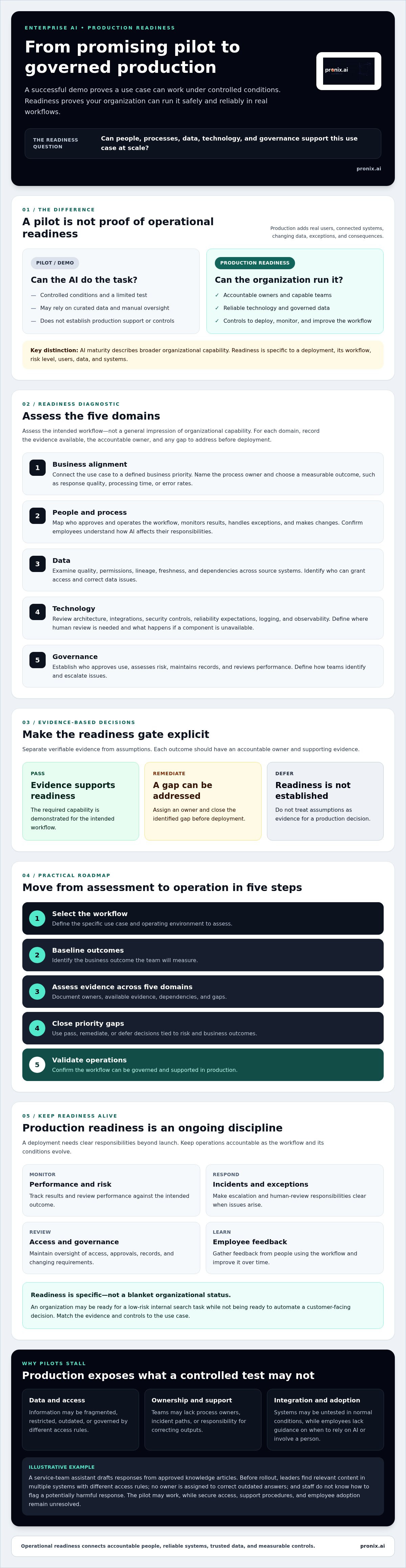
A promising demonstration shows that an AI system can perform a task under specific conditions. It doesn’t show that the organization can rely on it in a live workflow. Production introduces real users, connected systems, changing data, exceptions, and consequences when outputs are wrong or unavailable.
Enterprise AI operational readiness is the evidence that accountable owners, capable teams, reliable technology, governed data, and measurable controls are in place to deploy, monitor, and improve AI in real workflows. It connects people, processes, data, technology, and governance to a specific business use case. Teams need to know who oversees the workflow, how performance and risk are tracked, and what happens when the system fails or produces an uncertain result.
Readiness is not the same as AI ambition or buying a platform. A successful pilot also doesn’t establish that access is controlled, integrations are reliable, employees know how to use the system, or the organization can maintain performance as conditions change. Those capabilities need evidence before deployment, not assumptions based on a controlled test.
How is operational readiness different from AI maturity?
AI maturity describes an organization’s broader ability to develop and use AI across its business. Readiness is narrower: it asks whether a particular deployment can operate responsibly in a defined environment. The answer depends on the workflow, risk level, users, data, and systems involved. An organization may be ready to assist employees with a low-risk internal search task, yet not ready to automate a customer-facing decision. Readiness is specific, not a blanket status.
Why do enterprise AI pilots stall before production?
Pilots often run with curated data, a small user group, and manual oversight. Production exposes dependencies the test didn’t resolve: fragmented or restricted data, unclear process ownership, and integrations that haven’t been tested under normal operating conditions. Teams may also lack monitoring for output quality, escalation paths for incidents, or employee guidance on when to rely on AI and when to involve a person.
Illustrative example: A service team pilots an AI assistant that drafts responses using approved knowledge articles. Before rollout, leaders discover that relevant content sits in multiple systems with different access rules. No owner is assigned to correct outdated answers, and staff don’t know how to flag a potentially harmful response. The assistant may work in the pilot, but secure access, support procedures, and employee adoption remain unresolved.
Operational practices such as MLOps help teams deploy and maintain machine learning systems reliably. But production readiness extends beyond model operations. It also requires clear business ownership and controls that can be reviewed, tested, and improved as the workflow evolves.
Assess the Five Domains of Enterprise AI Operational Readiness
Assess readiness against the workflow you intend to put into production, not against a general impression of organizational capability. The five domains below give business, technical, data, and risk leaders a shared diagnostic. For each domain, record the evidence available, the accountable owner, and any gap that must be addressed before deployment.
- Business alignment: Confirm the use case supports a defined business priority. Name the process owner and select an outcome the team can measure, such as response quality, processing time, or error rates.
- People and process: Map who approves the workflow, operates it, monitors results, handles exceptions, and makes changes. Confirm employees understand how AI changes their responsibilities.
- Data: Work with the data team to examine data quality, permissions, lineage, freshness, and dependencies across source systems. Identify who can grant access and correct data issues.
- Technology: Review architecture, integration points, security controls, reliability expectations, logging, and observability. Specify where human review is required and how the workflow behaves when an integration or AI component is unavailable.
- Governance: Establish who approves use, assesses risk, maintains records, and reviews performance. Define how teams identify, escalate, and resolve issues.
Workforce capability, named workflow ownership, and documented governance evidence together show whether an AI use case is ready to operate responsibly. A gap in any one area can undermine the others. Strong infrastructure, for example, won’t compensate for unclear accountability when an AI-supported decision needs review.
Are employees and process owners prepared for AI-enabled work?
Map responsibilities to the actual workflow. Identify who approves AI use, operates the process, monitors outcomes, and handles exceptions. Then pinpoint role-specific learning needs: a reviewer may need guidance on checking outputs, while a process owner may need to interpret performance signals and coordinate escalation. Give employees a clear route to report errors or concerns, and use their feedback to identify friction before it becomes an operating risk.
Can data, systems, and governance support production use?
Check that access follows least-privilege principles and reflects business permissions. Don’t assume that data available during a pilot is appropriate for broader use. Document lineage and integration dependencies so teams can trace inputs and understand downstream effects. The enterprise data strategy for AI can help frame these data prerequisites.
Finally, assign owners for integrations, logs, monitoring, and incident response. Confirm what evidence they will review and how they’ll act on it. If your assessment surfaces gaps in implementation or ongoing operations, pronix.ai’s enterprise AI implementation and managed services can help address validated needs as part of a path to production.
Use Enterprise AI Readiness Gates to Separate Evidence from Assumptions
A readiness review is useful only if it informs a decision. For each domain, record what has been demonstrated, who is accountable, and whether the evidence supports the intended workflow and risk level. A team’s confidence that access is secure, for example, is still an assumption until permissions have been reviewed and tested.
| Readiness domain | Evidence to inspect | Accountable owner | Gate outcome |
|---|---|---|---|
| Business alignment | Approved use-case scope, baseline, and agreed measures for the intended outcome | Business sponsor or process owner | Pass, remediate, or defer based on clarity of value and ownership |
| People and process | Validated user workflow, role guidance, human escalation route, and operating procedures | Process owner | Pass if users and exception handling are prepared; otherwise remediate or defer |
| Data | Tested access permissions, documented lineage, and verified data quality for the use case | Data owner | Pass if approved access and data dependencies are evidenced; otherwise remediate or defer |
| Technology | Test results for integrations, security controls, logging, monitoring, and reliability | Technology or system owner | Pass if the operating environment is validated; otherwise remediate or defer |
| Governance | Named risk owner, evaluation records, incident process, and documented approvals | AI governance or risk owner | Pass if controls are assigned and usable; otherwise remediate or defer |
Pass means the evidence supports proceeding within the defined scope. Remediate means a gap is understood, assigned, and addressable before broader release. Defer means a critical issue, such as unresolved risk ownership or unapproved data use, makes deployment premature. These are decision labels, not universal thresholds. Leaders should set criteria that reflect the use case, its risks, and the organization’s control requirements.
What evidence shows an AI workflow is ready to scale?
Look for an approved scope, named business and technical owners, tested integrations, and a clear human escalation path. Request evidence of access controls, monitoring, evaluation, and incident handling. Validate the workflow with its intended users instead of assuming pilot behavior represents production use. A business baseline and agreed measures should also exist before teams claim value or use early results to justify expansion.
When should an enterprise remediate, defer, or proceed?
Proceed when material risks have controls, owners, and documented operating procedures. Remediate when gaps are bounded, assigned, and have a clear path to closure. Defer when teams can’t establish risk ownership, confirm permitted data use, or demonstrate critical operational controls.
Readiness gates aren’t bureaucracy when each check is tied to a business outcome or a specific risk. They make trade-offs visible, prevent assumptions from becoming deployment decisions, and give leaders a consistent basis for enterprise AI operational readiness across business and technical teams.
Build an Enterprise AI Operational Readiness Roadmap in Five Steps
Turn assessment findings into a sequence of decisions, each with an owner, evidence, and a defined next action. Start with one bounded workflow. Expand to additional teams, processes, or autonomous actions only after the first workflow’s controls and operating model have been validated. This keeps enterprise AI operational readiness tied to evidence, not momentum alone.
- 1. Select a workflow. Decision owner: business sponsor. Evidence: documented user need, process boundaries, affected users, and risk considerations. Next action: approve a specific workflow for assessment, rather than a broad department-wide ambition.
- 2. Baseline outcomes. Decision owner: process owner. Evidence: current performance measures, such as processing time, quality, or exception volume, where relevant. Next action: agree how the team will evaluate change and avoid claiming value without a credible comparison.
- 3. Assess the domains. Decision owner: cross-functional readiness lead. Evidence: findings on people, process, data, technology, and governance, with accountable owners for each. Next action: record what is verified, what is assumed, and what needs a readiness decision.
- 4. Close priority gaps. Decision owner: the relevant business, data, technology, or risk owner. Evidence: assigned actions, dependencies, and review dates. Next action: resolve foundational issues before use-case-specific fixes that depend on them.
- 5. Validate operations. Decision owner: business sponsor with operational and governance owners. Evidence: tested workflow, monitoring, human escalation, incident handling, and employee feedback. Next action: decide whether to proceed within scope, remediate further, or defer expansion.
Agentic workflows need particular care around delegated actions, approval points, and exceptions. For considerations specific to agent deployments, consult the enterprise agentic AI production guide.
How should leaders prioritize readiness gaps?
Rank gaps using organization-defined criteria for business impact, exposure, dependency, and effort. Separate foundational work, such as resolving shared data access or ownership issues, from remediation unique to one workflow. That distinction helps avoid expanding platforms to solve a narrower process problem. Give every high-priority action an accountable owner, a clear next step, and a review date.
How can workforce upskilling support operational readiness?
Map skills to changed responsibilities. Employees reviewing AI outputs need practice assessing quality; those handling exceptions need clear escalation procedures; process owners need to interpret operating evidence. Use role-based exercises that reflect real tasks, then track demonstrated capability and employee feedback, not training attendance alone.
For help translating validated gaps into implementation and ongoing operations, explore pronix.ai’s enterprise AI implementation and managed services.
Move from Readiness Assessment to Governed Enterprise AI Operations
Production readiness doesn’t end at launch. It becomes an operating discipline: review the workflow regularly, confirm controls still fit, and reassess when models, data, integrations, business rules, or risks change. A system that was appropriate for one version of a process may need new evaluation or approval after a material change.
Assign ongoing responsibilities before deployment. Define who reviews business outcomes and quality signals, monitors exceptions and incidents, reviews access, and gathers employee feedback. Set review triggers that prompt reassessment, such as a change to a data source, integration, model, user group, or workflow. Record decisions and follow-up actions so the organization can see what changed and who is accountable.
What should leaders monitor after an AI workflow goes live?
Use the baseline and measures established for the use case. Track agreed business outcomes alongside quality signals, exception rates, and operational incidents. Review human overrides and user feedback, too. A rise in overrides may point to output-quality concerns, unclear guidance, or a workflow that needs adjustment. Treat these as signals to investigate, not automatic conclusions.
Monitoring needs named owners and response procedures. Specify who investigates an unexpected result, who can pause or change the workflow, and how the issue is documented and escalated. Review access on a defined schedule and whenever roles or data dependencies change. This keeps operational controls connected to the way the workflow is actually used.
When does an enterprise need implementation or managed-services support?
Consider implementation support when validated architecture, integration, security, or governance gaps exceed the capacity of internal teams. Strategy and consulting can help clarify priorities and sequence decisions; implementation can address defined technical and workflow needs. Managed services may fit when monitoring, maintenance, governance activities, or continuous improvement need sustained ownership. Match support to evidenced gaps, not a general desire to add more technology.
Use the readiness assessment to define the scope of any support: the workflow, unresolved gaps, accountable owners, and evidence needed to verify progress. That gives internal leaders and delivery teams a shared basis for planning without assuming a fixed deployment timeline or guaranteed result.
Ready to turn your assessment findings into a practical next step? Discuss enterprise AI readiness with pronix.ai, including the strategy, implementation, or managed-services support that fits your validated needs.
Make Production the Next Measured Step
Moving AI beyond a pilot takes more than a capable model. It takes clear business ownership, prepared employees, dependable data and integrations, and governance backed by evidence. Use readiness gates to distinguish verified controls from assumptions, then sequence the work: choose a bounded workflow, establish a baseline, assess gaps, and validate operations before expanding.
Enterprise AI operational readiness is not a one-time approval. It’s an ongoing discipline that adapts as workflows, data, models, and risks change. Monitoring performance, reviewing incidents and access, and listening to employees help teams keep AI accountable in day-to-day operations.
pronix.ai supports enterprises through strategy, implementation, and managed services, including support for organizations in healthcare, finance, and manufacturing. Its focus includes secure, scalable, governed, and auditable AI operations. If your assessment has surfaced capability gaps, discuss your enterprise AI operational readiness with pronix.ai and explore a practical path forward. With clear evidence and accountable teams, your organization can advance with greater confidence.
Frequently Asked Questions
What does enterprise AI operational readiness mean?
Enterprise AI operational readiness means an organization can deploy, monitor, govern, and improve an AI system within a real business workflow. It’s demonstrated through evidence, not ambition or a successful pilot alone. That evidence includes a defined use case, accountable owners, appropriate data access, tested technology, prepared employees, and controls for monitoring and escalation. Readiness is specific to the workflow, its users, its operating environment, and the risks involved.
How do you assess whether an enterprise is ready for AI?
Assess readiness for a defined use case across business alignment, people and process, data, technology, and governance. Identify the outcome to measure, name owners, and inspect evidence such as tested integrations, access permissions, user guidance, monitoring plans, and incident procedures. Record gaps and make a decision to proceed, remediate, or defer. Criteria should reflect the workflow and its risks rather than rely on one universal readiness score.
What are the main barriers to moving enterprise AI from pilot to production?
Common barriers include fragmented or unsuitable data, unclear process ownership, and integrations that haven’t been tested in the production environment. A pilot may also lack ongoing monitoring, incident escalation procedures, or clear guidance for employees using AI outputs. These gaps matter because a demonstration may operate under controlled conditions, while production depends on connected systems, defined responsibilities, and repeatable processes for handling exceptions.
How can employees be prepared for an AI-first company?
Prepare employees for the responsibilities their workflows will actually require. People who review AI outputs need practice checking quality and knowing when to escalate; process owners need to understand monitoring signals and how to respond to issues. Explain how the system affects decisions and handoffs, provide clear routes for feedback, and use realistic practice scenarios. Assess demonstrated capability and employee feedback, not just course completion or training attendance.
Does enterprise AI readiness require a new AI platform?
No. Readiness doesn’t automatically require a new platform. First, define the workflow’s requirements and review existing architecture, data access, integrations, security controls, reliability, and monitoring. Then identify which gaps are genuinely blocking production. An organization may be able to address them through changes to its current environment or workflow. Consider additional technology only when the assessment shows a specific need, rather than treating platform expansion as a readiness goal.
What should an enterprise AI readiness assessment include?
An assessment should document the use case, business baseline, intended users, accountable process owner, and evidence across people, process, data, technology, and governance. Review data quality and permissions, integration tests, security and monitoring controls, employee guidance, human oversight, and incident handling. For each gap, record its owner, priority, and next action. Conclude with a scope-specific decision to proceed, remediate, or defer, plus a plan to validate operations.
How often should enterprise AI operational readiness be reviewed?
Review enterprise AI operational readiness on a planned basis and whenever a material change could affect the workflow or its risks. Triggers can include changes to models, data sources, integrations, users, business rules, or the process itself. After deployment, monitor agreed business and quality measures, incidents, exceptions, access, and employee feedback. Set review timing and escalation triggers according to the use case, its risk, and the organization’s operating requirements.