

RAND’s analysis of more than 2,400 enterprise AI initiatives found that roughly 80% fail to deliver their intended business value. De-risking enterprise AI projects means testing business value and the riskiest assumptions with real data, then applying human review, privacy and IP controls, and security checks before production. A successful pilot is a starting point, not proof that an AI system is ready to operate at scale.
That distinction matters: an AI model can perform well in a demo yet fail when it encounters real workflows, sensitive information, and production systems. This guide explains how to set measurable pilot criteria, address bias and data risks, validate outputs, meet relevant obligations, and make production integration secure and supportable. You’ll also learn why pilots stall and how clear decision gates help teams decide whether to proceed, pause, or adjust. The focus is practical: build evidence at each stage so teams can move forward with control rather than assumptions.
Key Takeaways
- Map bias, privacy, and intellectual property risks before selecting data or connecting an AI system to sensitive workflows.
- Set pilot goals and decision criteria in advance, then test the riskiest assumption with real data and users.
- Build human review into output workflows so experts can validate answers and catch errors before they inform decisions.
- Translate regulatory and contractual obligations into clear controls, owners, and evidence that teams can maintain.
- Plan production readiness across system integration, security, monitoring, and day-to-day operations, not just model performance.
1. Bias, privacy, and intellectual property risks
What data governance and security controls are needed for enterprise AI? Start with data classification, access limits, encryption, retention rules, and audit logs. Assign an owner to approve each dataset, model connection, and permitted use. These controls help teams trace sensitive information from its source through processing and output, instead of treating the model as an isolated tool.
Security and privacy concerns can stall adoption before a pilot reaches production. In one survey, 48% of companies said security concerns prevented them from moving file data to the cloud, while 34% considered security and privacy roadblocks to successful AI adoption. Treat those barriers as design requirements: document data flows, restrict access by role, and test controls in the environment where the AI will perform.
Data governance also needs to address personal information and proprietary material. The European Union identifies GDPR as a data-protection requirement relevant to personal data; organizations operating across jurisdictions should map where data originates and how it is used. In the United States, CCPA is a privacy law organizations may need to consider for AI projects. Record the purpose for each dataset and limit collection to what the use case needs.
Bias risk starts with the examples and labels used to build or evaluate a system. Compare performance across relevant user groups, check source data for missing or skewed records, and route sensitive decisions to qualified reviewers. For example, if a hiring assistant ranks applicants, examine whether recommendations differ across groups and which input features drive those differences. Record the test method and corrective actions for auditability.
Intellectual property requires the same discipline. Before connecting a generative AI model, understand what it was trained on and how submitted data will be used. Review vendor terms, data retention settings, and restrictions on using prompts or outputs for further training. Separate confidential source material from general prompts, and prevent users from pasting trade secrets into tools without approved handling controls.
Use NIST’s AI Risk Management Framework (AI RMF) to identify, assess, and manage risks throughout the AI lifecycle. Gartner’s AI TRiSM (Trust, Risk & Security Management) offers another framework for structuring AI risk management. In practice, assign owners, document controls, and revisit risks when data, models, or workflows change. Data preparation accounts for 80% of AI project work, making early governance a practical delivery step, not an administrative afterthought.
A disciplined approach to de-risking enterprise AI projects links governance to specific actions: approve data access, test for bias, protect intellectual property, and retain evidence. Review these controls at every project gate. If a team cannot explain where data came from, how the model may be used, or how it will handle an unsafe output, pause that workflow until the necessary controls are in place.
2. Common causes of stalled AI pilots
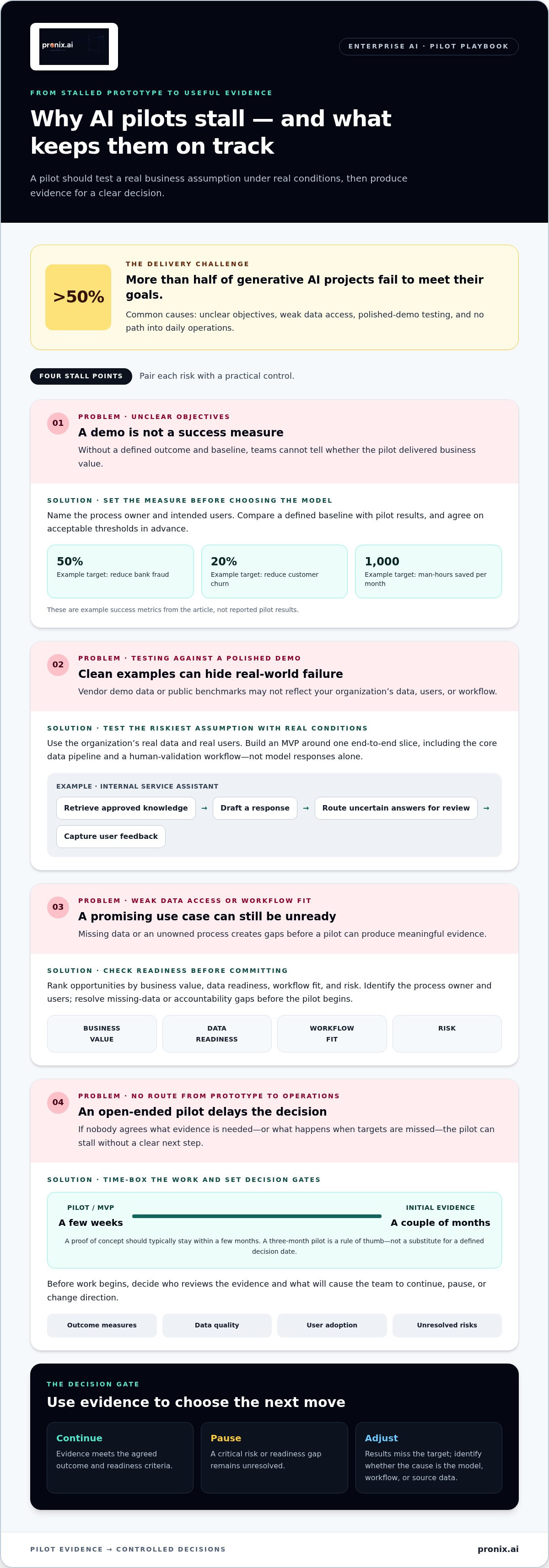
How should enterprises assess AI use cases before investing? Rank opportunities by business value, data readiness, workflow fit, and risk. Name the process owner and intended users, and define a measurable outcome before selecting a model. If required data is missing or the workflow lacks an accountable owner, address that gap before committing to a pilot.
How do companies measure enterprise AI project ROI and success? Compare a defined baseline with post-pilot results, using a business metric such as reducing bank fraud by 50%, reducing customer churn by 20%, or saving 1,000 man-hours per month. Set acceptable thresholds in advance, then track output quality, adoption, operating effort, and exceptions alongside the financial or service outcome.
More than 50% of generative AI projects fail to meet their goals. Common causes include unclear objectives, weak data access, testing against polished demos, and no route from prototype to daily operations. A proof of concept should test the riskiest assumption with the organization’s real data, not vendor demo data or public benchmarks. This reveals whether the opportunity fits actual conditions.
Keep the pilot focused and time-boxed. A few weeks to a couple of months can produce an initial pilot or minimum viable product; a proof of concept should typically stay within a few months. A three-month pilot is a useful rule of thumb, not a replacement for a defined decision date. Before work begins, agree who will review the evidence and what to do if results miss the target.
A useful MVP proves one end-to-end slice under real conditions with real users. Include the core data pipeline and a human-validation workflow, rather than demonstrating model responses alone. For example, an internal service assistant should retrieve approved knowledge, draft a response, route uncertain answers for review, and capture user feedback. Governance should cover every handoff, not just model access.
Set decision gates before each phase begins. Specify the evidence required to continue, pause, or change direction, including outcome measures, data quality, user adoption, and unresolved risks. If results fall short, identify whether the cause is the model, workflow, or source data before expanding scope. Fixed-price milestones can also give stakeholders review points during uncertain early stages. Teams that need help turning pilot evidence into an operational plan can explore enterprise AI delivery support.
Speed matters only when the work answers a decision. Building an AI pilot or MVP in a few weeks to a couple of months keeps effort focused on evidence rather than an open-ended demonstration. Make the intended operating path visible: test an end-to-end slice, not an isolated model response. This helps reveal whether the system can function within the actual workflow while keeping attention on the outcomes and risks set for review.
A minimum viable product should prove an end-to-end slice of the system under real conditions with real users, including core data pipelines and a human-validation workflow. Without those elements, the result cannot show whether the complete process works in practice. Treat each handoff as part of the pilot evidence, then use user experience to decide whether to proceed, adjust the workflow, or address data readiness before a wider rollout.
3. Human expert oversight and AI output quality assurance
After deployment, monitor output quality, user corrections, exceptions, and changes in input data. Assign an operational owner to review these signals, investigate failures, and pause workflows when outputs could cause harm. For example, a claims team can sample AI-generated summaries and compare them with source documents before relying on them.
Match human review to the impact of the decision. A low-risk draft may need spot checks, while a recommendation affecting a customer or employee needs review by a qualified person before action. Define what reviewers must verify, including factual accuracy, relevant context, and whether cited evidence supports the output. Never assume a confident response is correct.
Generative AI can produce hallucinations: fluent statements without reliable support. Give reviewers a repeatable verification process. They can compare claims with approved records, check citations against source material, and flag unsupported answers for correction. If the system cannot retrieve adequate evidence, route the request to an expert rather than letting an uncertain output proceed.
Build exception handling into the workflow before launch. Set clear escalation triggers, such as conflicting source records, low confidence, missing required fields, or an answer outside the system’s approved scope. Log the trigger, reviewer decision, and correction. These records help teams identify recurring failure patterns and refine prompts, retrieval rules, and confidence thresholds.
Workforce training helps make oversight consistent. Train each role on its review responsibilities, escalation path, and the AI system’s limits. A customer service representative, for example, needs to know when to verify an AI-drafted policy answer and when to transfer the case. Practice with sample outputs from real workflows, then update guidance as the system changes.
- Review: Compare a sample of outputs with trusted source records.
- Escalate: Route ambiguous or high-impact cases to a qualified person.
- Correct: Capture reviewer changes and identify repeated error types.
- Improve: Use corrections to refine extraction rules and confidence thresholds.
Track operational measures that show whether safeguards are working: correction frequency, escalation volume, unresolved exceptions, and time spent reviewing outputs. Interpret each measure in context. An increase in escalations may reflect a new data issue, a workflow change, or appropriately cautious reviewers. Assign an owner to investigate the cause and document the response, rather than reducing escalations at the expense of reliable decisions.
Human experts should adapt and fine-tune AI systems as conditions change. Schedule reviews after material changes to data, prompts, or workflow rules, and use live feedback to improve system behavior. This makes oversight part of ongoing operations rather than a one-time approval before launch.
4. Regulatory and contractual compliance
How can companies evaluate AI vendors and model providers? Review data handling, access controls, retention terms, model limitations, and incident processes. Before approving a deployment, require clear documentation of training-data use, prompt handling, output ownership, and subcontractors.
Contracts should translate those reviews into operational commitments. Define permitted data uses, security responsibilities, breach notification processes, audit evidence, and service changes. For a customer-support assistant, specify who handles an incorrect answer, how records are retained, and which party can investigate an incident. Strategic alignment matters, but policies must also work in daily operations.
What AI governance frameworks and standards should businesses follow? NIST’s AI Risk Management Framework (AI RMF) provides guidance for identifying, assessing, and managing risks across the AI lifecycle. Gartner’s AI TRiSM (Trust, Risk & Security Management) is another framework for structuring AI risk management. Integrate AI controls into existing enterprise risk processes and assign clear owners.
Regulatory scope depends on the organization’s activities, location, and use case. The EU AI Act is a compliance consideration for organizations operating in the EU; it codifies human oversight and addresses robust cybersecurity. In healthcare, FDA guidance for AI may also be relevant. Map each use case to applicable obligations, then document the controls, review steps, and evidence supporting compliance.
Ethical compliance takes more than policy statements. Turn principles into testable checks, such as reviewing outputs for unsupported claims, recording human decisions, and escalating exceptions. The EU AI Act’s focus on human oversight reinforces the value of named reviewers and clear intervention points. Use control testing to show whether written policies work in real workflows.
Compliance operations also shape identity and customer-verification workflows. For a know-your-customer process, define which information AI may extract, how staff validate it, and when exceptions go to a trained reviewer. Generative AI can help automate control testing, but the organization still needs evidence that each check ran and that failures received follow-up.
What are the costs of deploying and operating enterprise AI? Costs depend on scope, data readiness, integration complexity, security controls, and ongoing monitoring needs. The price depends on the case and is provided after a quote request; these factors determine the work involved.
Before launch, maintain a compliance record that connects each obligation to an owner, control, and evidence source. A model change, new data source, or workflow expansion can alter the risk profile. Reassess changes through governance review, then update operational policies and contractual safeguards before the revised system takes on new tasks.
5. Production integration and security
A pilot proves a use case under limited conditions; production connects it to business systems and routine operations. Map every technical dependency, including data sources, identity controls, APIs, downstream applications, and support ownership. Then test the complete workflow, not just the model endpoint. The result should be a system teams can monitor, recover, and maintain.
Security needs to cover the full data path. In one survey, 53% of companies said their data was not backed up, immutable, and easily recoverable. Define backup and recovery procedures, restrict service accounts to necessary permissions, and log access to prompts, retrieved records, and outputs. For manufacturing, production logs, sensor readings, and inspection images require secure storage, tracking, and auditability.
Threat exposure continues after launch. In a survey, 70% of companies had experienced a cyberattack in the previous 12 months, while 45% reported a breach resulting in ransom, downtime, data loss, or reputational damage over the last year. Treat model endpoints and connected tools as part of the attack surface. Test authentication, network boundaries, secrets handling, and failure behavior before enabling live transactions.
Recovery planning is part of operational risk management. Some industry estimates suggest only four in every thirty-three AI proofs of concept reach production, so teams need a controlled path from pilot to service. Define rollback conditions, preserve a known-good version, and test how staff can continue working if an AI component fails. In some markets, including manufacturing, malicious activity has caused downtime lasting as much as six weeks.
Only 24% of organizations secure their generative AI initiatives today. Production readiness therefore needs explicit security ownership, not an assumption that existing application controls cover every model interaction. Establish a change process for model, prompt, and integration updates. For each release, record what changed, who approved it, and how teams will detect degraded behavior or unauthorized access.
- Integrate: Connect the AI workflow to approved data, identity, and business systems.
- Harden: Restrict access, protect credentials, and log relevant system activity.
- Recover: Test backups, rollback procedures, and fallback work processes.
- Operate: Assign owners for incidents, updates, monitoring, and service continuity.
Use these gates to confirm the system can achieve its intended outcome under real operating conditions. Production integration is complete only when the workflow is secure, supportable, and embedded in business-as-usual operations. Plan secure AI production integration with a clear technical path from pilot to live service.
Pronix.ai: Agentic AI Implementation
pronix.ai helps enterprises move AI pilots into secure, scalable production. Turn to its Agentic AI Implementation service when a validated use case needs workflow integration, operational controls, and a path into day-to-day operations. Data & AI Foundations address the data and architecture needed to support enterprise AI. AI Business Automation and AI-Driven CX Modernization can align implementation with specific process and customer experience priorities.
The next step is to define the use case, current constraints, and evidence required for production readiness. This creates a practical basis for aligning implementation with business outcomes, security needs, and governance. Visit pronix.ai to discuss your enterprise AI initiative.
Turn AI risk controls into a production advantage
Treat de-risking enterprise AI projects as an ongoing operating discipline, not a one-time approval. Start with a use case that has an accountable owner, a clear business outcome, and a defined path into production. Then align technical decisions with the people responsible for security, compliance, and day-to-day performance. This creates a practical basis for scaling what works and changing course when the evidence points elsewhere.
When moving from pilot to production requires implementation support, pronix.ai offers Agentic AI Implementation, AI-Driven CX Modernization, and AI Business Automation. These services help enterprises connect AI initiatives to workflows and operational needs while maintaining focus on governance and security. The next step is a focused discussion about your use case, constraints, and production goals.
Discuss enterprise AI risks with pronix.ai. Build the controls and delivery plan your teams need to move forward with confidence.
Frequently Asked Questions
What does de-risking enterprise AI projects mean?
De-risking enterprise AI projects means reducing uncertainty before AI affects business operations or customer decisions. Teams identify where errors, data exposure, or workflow disruption could occur, then design controls around those points. For example, an AI assistant that drafts payment instructions can prepare recommendations while an authorized employee reviews and submits each instruction. The goal is controlled adoption with clear accountability, not the elimination of every possible risk.
What are the biggest risks of enterprise AI projects?
The biggest risks depend on the use case but often include inaccurate outputs, biased results, sensitive data exposure, unclear intellectual property rights, and weak integration with existing systems. A procurement assistant, for example, could misread a supplier clause or expose restricted contract details. Teams should also consider operational dependencies, such as what happens when a model or connected data source changes, becomes unavailable, or produces an unexpected result.
How should enterprises run an AI proof of concept and pilot?
Begin with a specific workflow and a baseline showing how the task performs without AI. During the proof of concept, test representative edge cases, such as incomplete records or unusual requests, and document where staff must intervene. For the pilot, involve the employees who will use the system and capture their corrections. Finish with a written decision to expand, revise, or stop, based on evidence and accountable ownership.
How can enterprises reduce hallucinations, bias, and model errors?
Use approved source material and require the system to show supporting evidence for factual responses. Test it with examples covering different user groups, request types, and difficult edge cases. Set a clear fallback for unsupported answers, such as requesting clarification or routing the task to staff. Track error categories over time, then update source content, workflow rules, or review procedures when recurring patterns appear.