

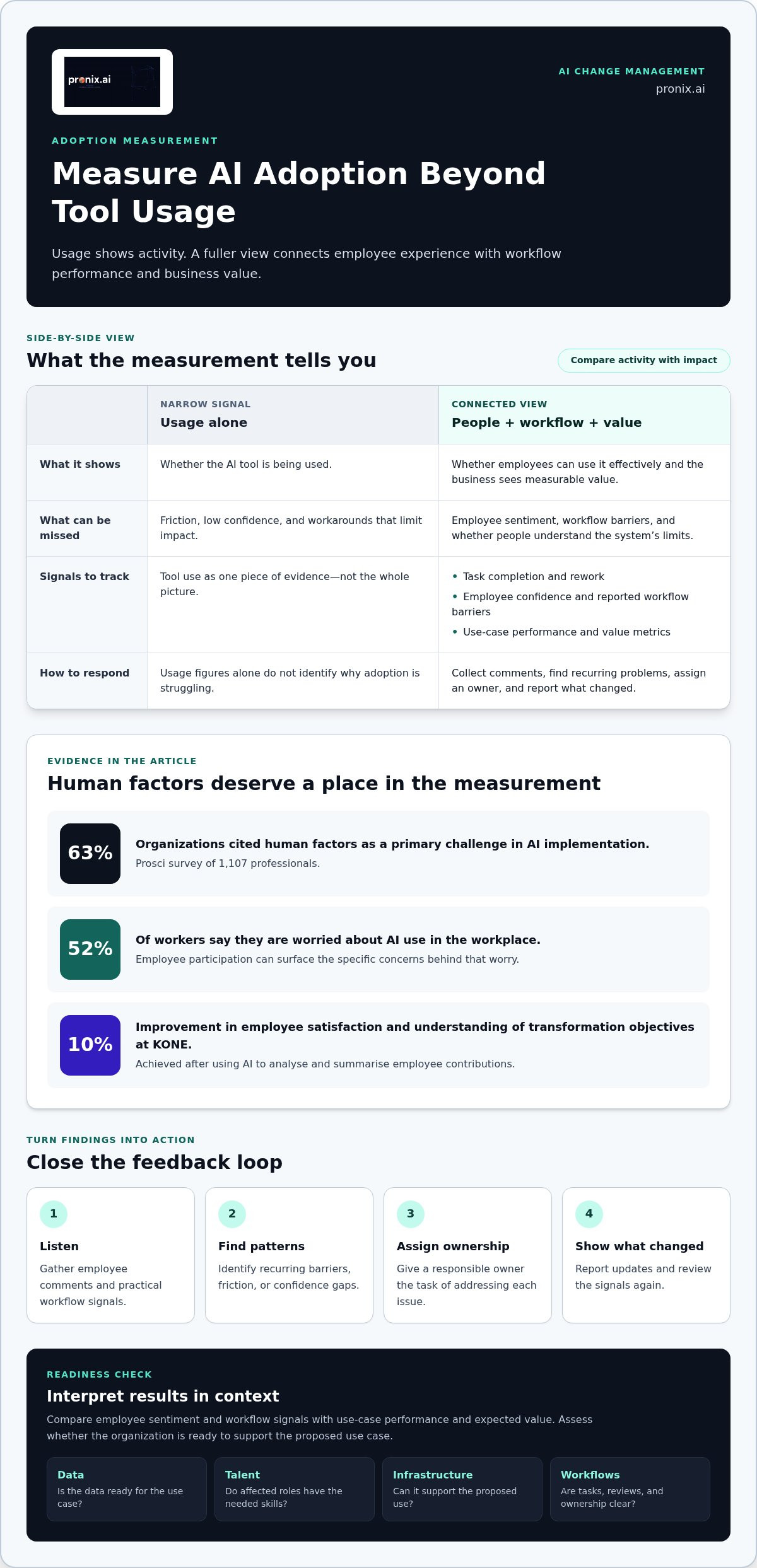
AI adoption is working only when people can use it effectively and the business sees measurable value. Change management for AI adoption should track more than tool usage: assess employee readiness and sentiment alongside workflow performance, quality, and outcomes. Prosci’s survey of 1,107 professionals found that 63% of organizations cited human factors as a primary challenge in AI implementation.
It’s reasonable to expect adoption metrics to show whether a tool is being used. But usage alone can conceal friction, low confidence, or workarounds that limit impact. A stronger approach connects employees’ experience with what the organization needs AI to achieve.
This article explains how to assess adoption, address human factors, and assign clear responsibility for change. It also shows how to involve stakeholders, build executive sponsorship, and use ongoing feedback to guide implementation. The aim is to help leaders distinguish activity from meaningful progress and address barriers before they become operational problems.
Key Takeaways
- Measure AI adoption through employee readiness, sentiment, and workflow outcomes, not tool usage alone.
- Assign shared responsibility across executives, AI specialists, and frontline teams, with clear accountability for performance, ethics, and data privacy.
- Use employee feedback and role-specific training to surface friction early and help people apply AI confidently in their work.
- Scale from focused pilots by assessing data, talent, and infrastructure, then aligning expansion with a business case and roadmap.
- Keep adoption on track with ongoing feedback, performance and safety monitoring, and scenario-based testing for bias, drift, and edge cases.
Who should be responsible for AI change management?
Responsibility should be shared: executives set direction, while functional leaders and employees make change workable. The right structure connects AI’s business purpose with employee experience and measurable outcomes.
Strategic Alignment and Employee Understanding
Strategic alignment connects an AI initiative’s purpose to business priorities, employee responsibilities, and governance. Employees need to understand what the system changes, what remains a matter of human judgment, and how success will be assessed.
Executives should define the vision and explain how AI supports it; department leaders should translate that direction into team-level expectations. For example, a service leader can clarify which customer inquiries AI may summarize and when an employee must make the final decision. Clear boundaries help employees apply the strategy consistently in their daily work.
Employee Feedback and Adoption Metrics
Employee feedback and adoption metrics combine workforce insights with measures of AI use and business performance. This view matters because usage alone cannot show whether employees trust a system, understand its limits, or can complete work effectively.
Track practical signals such as task completion, rework, employee confidence, and reported workflow barriers. Review them alongside the use case’s performance and value metrics. Then establish a feedback loop: collect comments, identify recurring problems, assign an owner, and report what changed. Thoughtful use of anonymity can give employees an equal voice and encourage candid responses.
KONE achieved a 10% improvement in employee satisfaction and understanding of transformation objectives after using AI to analyse and summarise employee contributions. The example shows how feedback analysis can reveal employee perspectives, not just system activity. Leaders can use the same principle to compare themes over time and adjust communication or support.
Employee Participation and Change Agents
Employee participation gives affected teams a role in shaping implementation, while change agents connect those teams with decision-makers. This matters because 52% of workers say they are worried about AI use in the workplace.
Involve employees early through workshops, feedback loops, and consistent communication. Ask frontline teams where AI could reduce friction, where human review remains essential, and what risks concern them. These discussions turn general resistance into specific issues leaders can address, such as unclear accountability or a workflow that adds steps.
Identify respected employees as change agents and involve them in testing, peer support, and ongoing improvement. A Center of Excellence that brings together AI specialists and frontline power users can review feedback and surface recurring issues. Give the group a clear way to escalate concerns and influence implementation decisions.
AI Readiness and Affected Roles
AI readiness means assessing whether an organization’s data, talent, infrastructure, and workflows can support a proposed use case. It matters because the same system can affect roles differently, depending on the tasks it automates or informs.
In the United States, workplace AI decisions and employee data can involve employment, privacy, and data-protection requirements. Relevant obligations depend on the decision being supported, the data processed, and the jurisdictions involved. Include legal and compliance teams in governance.
Map the workflow before rollout. Identify who supplies data, uses AI outputs, reviews decisions, handles exceptions, and owns the final outcome. Then assess each affected role’s access, skills, training needs, and exposure to changed responsibilities. Compare readiness findings with employee sentiment, use-case performance, and expected value. This gives leaders a practical basis for sequencing adoption and assigning accountability.
Human factors in AI implementation
Artificial intelligence changes how work moves through a team, not just which tools employees use. Human-centered implementation considers judgment, trust, skills, and workflow design from the start.
Human-Centred Decision-Making
Human-centered decision-making keeps people accountable for choices while using AI to inform them. AI outputs can support analysis, but context and consequences still require human judgment.
Define which decisions AI can recommend, which require employee review, and who owns the final call. For example, a system might categorize customer requests, while a service representative reviews unusual cases and decides how to respond. Clear review points help teams use AI without treating its output as automatically correct.
Human-centered design makes those boundaries workable. Observe employees completing real tasks, then test whether AI reduces friction or adds steps. If a summary omits a key detail, employees need a clear way to correct it and continue the workflow. Use feedback to refine the interface, instructions, and escalation path before wider deployment.
Human-AI Collaboration
Human-AI collaboration pairs machine capabilities with employee expertise to complete work more effectively. AI can shift tasks toward review, problem-solving, and higher-value decisions rather than eliminate the need for people.
Map the workflow into tasks AI can support and tasks that depend on human context. For instance, AI can draft a response from approved information; an employee checks its accuracy, tone, and customer-specific details before sending. This division of work makes responsibilities visible and gives employees a practical way to assess output quality.
Training should reflect each role’s interaction with the system. A frontline employee needs practice reviewing recommendations and escalating exceptions. A data specialist may need deeper technical instruction, while a manager needs to interpret performance signals and address workflow impacts. Role-based learning turns general awareness into applied capability.
Keep collaboration under review after launch. Compare employee feedback with output quality, correction patterns, and workflow bottlenecks. If employees repeatedly override a recommendation, investigate whether the model lacks context, the process is poorly designed, or training is insufficient. Treat these signals as operational insights, not individual failures.
For enterprises sustaining human oversight as AI workflows evolve, Enterprise AI Managed Services can support ongoing implementation and operations.
What causes organizational change?
AI can reshape operations when organizations redesign workflows, decisions, and employee responsibilities. Scaling adoption means connecting those changes to clear business needs and organizational culture.
Organizational Drivers of Change
Organizational drivers are the business pressures and opportunities that make existing processes insufficient. Leaders need a clear reason to change before expanding AI across teams.
AI can streamline processes, strengthen decision-making, and increase productivity. A claims team, for example, might use AI to organize incoming documents, then redesign review steps around the time saved. The driver is not the tool itself, but the operational need it helps address.
Growth, service expectations, and inefficient handoffs can all prompt operational change. To identify the strongest driver, map where work stalls, decisions lack timely information, or teams repeat manual tasks. Then connect each opportunity to an intended outcome, such as faster case handling or more consistent analysis.
Scaling requires more than duplicating a pilot. Compare the pilot workflow with other departments’ processes, data, and accountability structures. A successful use case in one team may need revised inputs, review steps, or training elsewhere. This helps organizations expand what works without assuming every team operates the same way.
A 2026 McKinsey report identifies organizational challenges, including change management and silos, among the top barriers to scaling AI. For example, a model may perform well within one department but fail to deliver value when another team cannot access its outputs. Shared ownership and connected processes help address that gap.
Organisational Culture Transformation
Organizational culture transformation changes the norms that shape how people use AI, share feedback, and respond to new workflows. A technically sound system cannot scale if daily practices discourage its use.
Leaders influence culture through visible decisions. If managers expect employees to use AI but provide no time to learn new workflows, adoption competes with existing priorities. Instead, clarify what work changes, how employees can raise issues, and which decisions still require human review.
Confidence grows through experience and transparent feedback. A team piloting AI for report summaries can compare outputs with source documents, log recurring errors, and refine review practices. Sharing those lessons across departments makes improvement part of operations, not an isolated pilot activity.
Culture also affects whether employees flag problems early. Recognize useful feedback, document resulting changes, and explain why some suggestions cannot be adopted. This creates a visible link between employee input and implementation decisions. Over time, organizations can build habits that support responsible experimentation and consistent learning.
Stakeholder engagement and executive sponsorship
Effective sponsorship connects AI investment to decisions, workforce needs, and operational accountability. Leaders must do more than announce a vision. They need to explain why artificial intelligence is being introduced, what success means, and how employees can raise concerns. A reported 43 respondents attributed AI adoption failure to insufficient executive sponsorship, underscoring the risk of leadership disengagement.
Engage executives, domain experts, compliance teams, and frontline employees during planning. Each group sees different risks: executives assess strategic fit, specialists understand system limits, compliance teams examine governance, and frontline staff know where workflows break down. Give each stakeholder a defined role in reviewing use cases, surfacing constraints, and resolving decisions. For example, a customer-service team can identify when an AI tool’s suggested response needs human review.
Use small participation activities to sustain engagement without adding heavy meeting demands. A brief survey can ask whether an AI tool helps with a task, creates friction, or needs clearer guidance. Pair responses with short demonstrations or team check-ins. Then share the action taken, such as revising an instruction or routing a recurring issue to its owner. Feedback matters when employees can see how it informs decisions.
Executive sponsorship must continue after rollout. Leaders can review performance and safety dashboards, assign owners to emerging issues, and remove workflow barriers that frontline teams cannot resolve. Ongoing governance should clarify accountability for model performance, ethics, and data privacy. If an AI tool changes how a department handles cases, managers should also revisit decision rights and escalation routes. This keeps responsibility visible as operations evolve.
Workforce engagement also depends on practical skill development. 88% of employers say AI will require their workforce to build new skills. Match learning to the work: frontline employees need practice using AI tools in real tasks, while technical teams need deeper skills for system oversight. Leaders can make learning part of implementation by providing role-relevant guidance, space to practise, and a clear route for questions. That approach helps employees apply new capabilities without losing sight of quality, customer needs, or human accountability.
AI change management and adoption
Adoption succeeds when an AI initiative delivers business value and employees can use it effectively. A practical plan connects a defined use case to readiness, training, governance, communication, and ongoing measurement.
Build the plan around five connected activities:
- Set the outcome. Define the business problem, intended benefit, and human decisions that remain essential. A focused pilot should test a clear use case before wider deployment.
- Assess readiness. Review data, infrastructure, skills, workflow impacts, and employee concerns. Identify affected roles and the support each group needs.
- Design the change. Set ownership, governance, communication, role-based training, and feedback channels. Adapt the approach to the organization’s context and tools.
- Test and learn. Run a targeted pilot, monitor performance and safety, and gather employee feedback. Use findings to resolve bottlenecks before expanding.
- Scale and sustain. Expand through a roadmap tied to a business case. Keep documentation current and review adoption, value, and system performance after rollout.
Training deserves specific attention. Prosci’s enterprise AI adoption research found that 38% of AI adoption challenges stem from insufficient training, while Prosci research found that 22% of employees struggle with AI’s learning curve. Those findings point to a practical response: train people for their actual tasks, then provide opportunities to apply new capabilities in the workflow.
Training access also needs attention. 44% of employees say they have ever received AI training. SHRM reports that 8% of workers were using AI for work before AI had been implemented in their organizations. These figures highlight why plans should address both formal instruction and existing employee practices, including clear guidance on approved use.
Set measures before the pilot begins. Track task completion, output quality, employee feedback, and whether the use case delivers its intended value. Pair these indicators with performance and safety monitoring. Scenario-based testing can reveal bias, drift, or edge cases that routine use may not expose. If results fall short, adjust the workflow, training, or safeguards before scaling.
Prosci’s study found that 61% of respondents believed GenAI adoption would make projects more successful, 65% believed it would boost their personal success, and 73% believed their organizations would be more successful. Treat these beliefs as a reason to connect initiatives to measurable outcomes, not as proof of results. Advance your AI adoption planning with support for implementation and ongoing operations.
Pronix.ai: Agentic AI Implementation
pronix.ai helps enterprises move AI initiatives from pilots toward secure, scalable production. Its Agentic AI Implementation offering can support organizations with a defined use case that need to operationalize it through clear workflows and governance. For customer-facing transformation, AI-Driven CX Modernization aligns AI capabilities with service operations. AI Business Automation and Data & AI Foundations address workflow automation and the data foundations that support AI initiatives.
These offerings fit when readiness, implementation, or scaling calls for coordinated technical and operational work. The right next step depends on the use case, existing systems, and business priorities. Visit pronix.ai to discuss your AI adoption goals.
Make the next AI move deliberate
AI adoption is not a one-time deployment. It is an operating capability that develops as teams learn, workflows evolve, and governance responds to new demands. A disciplined approach to change management for AI adoption keeps progress connected to business priorities and employee experience.
Choose the next move based on the challenge at hand. pronix.ai offers Agentic AI Implementation, AI-Driven CX Modernization, and AI Business Automation for distinct enterprise needs. Keep the focus on a defined outcome, a workable path into operations, and clear ownership as the initiative develops.
If you’re preparing an initiative or need to move beyond a pilot, Discuss AI adoption with pronix.ai. Build the next phase with clarity, purpose, and confidence.
Frequently Asked Questions
How do you measure whether AI adoption is actually working?
Measure whether AI improves a defined task without weakening quality or accountability. For example, compare a team’s handling of service requests before and after introducing AI assistance. Review completion quality, correction patterns, employee experience, and customer impact together. Segment results by workflow or role to uncover uneven effects. If speed improves but errors or escalations rise, adjust the use case rather than simply widening deployment.
How long does it typically take for an organization to fully adopt AI?
There’s no universal adoption timeline; it depends on the use case, data readiness, workflow complexity, and workforce needs. A contained task with clear ownership can progress differently from AI affecting multiple departments and decision paths. Define milestones around readiness, pilot evidence, training, governance, and operational performance. Treat adoption as an ongoing capability, not a finish line. Expand only when evidence shows the system works in its intended context.
What's the biggest mistake companies make when introducing AI to employees?
A common mistake is announcing a tool before explaining how it changes work. Employees may interpret the rollout as a mandate without clear boundaries, training, or decision rights. For example, if a team receives AI-generated summaries without guidance on validating them, staff must invent their own review process. Set expectations before launch: explain the intended task, what requires human judgment, and where employees can report problems.
What is change management for AI adoption?
Change management for AI adoption is the coordinated work of helping people and operations adapt as AI enters real workflows. It connects implementation decisions with communication, role changes, learning, governance, and feedback. For example, introducing AI to prepare internal reports affects not only software configuration, but also who checks source material and approves distribution. The goal is to embed a useful capability responsibly, rather than treat deployment as the endpoint.
How can leaders communicate AI changes and address employee concerns?
Leaders should explain the specific work affected, the reason for the change, and how employees can raise concerns. Use plain language to clarify what AI will do, what remains a human responsibility, and how outputs are reviewed. For a scheduling team, demonstrate a recommendation and explain how staff can correct it. Follow up by sharing feedback themes and actions taken, keeping communication a two-way process.
What training and reskilling do employees need to adopt AI tools?
Training should match each employee’s tasks and level of responsibility. A frontline worker may need to practise checking an AI-generated response, while a manager needs to interpret workflow impacts and escalate issues. Provide a safe practice environment, realistic examples, and clear guidance on sensitive data and output review. Reinforce learning as tools and processes change. Role-based practice builds judgment, not just familiarity with interface features.
How can organizations measure AI adoption and change management success?
Use a balanced scorecard that separates system performance from workforce adoption and business outcomes. For instance, a document-review team could monitor usage, corrections, turnaround quality, employee confidence, and downstream rework. Establish a baseline before launch, then compare results across relevant roles and workflows. Review qualitative comments alongside operational data. This helps leaders distinguish a technical issue from a training gap or a process that needs redesign.
What are the common risks and barriers to AI adoption in the workplace?
Common barriers include poor system integration, unreliable data, unclear accountability, security concerns, and employee distrust. Prosci’s report attributed 16% of AI adoption challenges to system integration issues and AI tool functionality. A practical response is to test the system within the actual workflow, document who handles failures, and monitor outputs for unexpected behavior. Include compliance and operational owners in risk reviews, especially when AI influences consequential decisions.