

A successful AI pilot is not yet a business case. The business case for AI automation must show that a workflow can deliver measurable value in production after integration, oversight, security, and ongoing operating costs are counted. That distinction matters when leadership needs a credible investment view and pilot results may not hold at scale.
Executives need more than proof that a model can complete a task. They need to know whether the workflow is worth automating, whether the organization can run it reliably, and what controls will limit operational and governance exposure. A forecast is difficult to defend if it does not explain how benefits will be measured, what it will cost to operate, and who will be accountable.
This guide offers a practical way to build an auditable case for AI automation in 2026. You’ll learn how to connect expected outcomes to baseline measures, estimate total cost of ownership without overlooking production needs, and prioritize workflows with a feasible implementation path. It also outlines readiness checks and decision gates leaders can use to evaluate a pilot, authorize expansion, or stop before risk and cost outrun value.
Key Takeaways
- Separate business outcomes from technology activity so your investment case measures operational impact, not just automation volume.
- Build a transparent business case for AI automation from a reliable baseline, explicit benefit assumptions, full costs, and sensitivity checks.
- Compare candidate workflows using consistent criteria for value, feasibility, risk, and time to evidence.
- Set decision gates that test reliability, user adoption, and operational ownership before expanding beyond a pilot.
- Translate approval into production by assigning an owner, validating the baseline, and planning for integration, governance, and ongoing operations.
What a business case for AI automation must prove
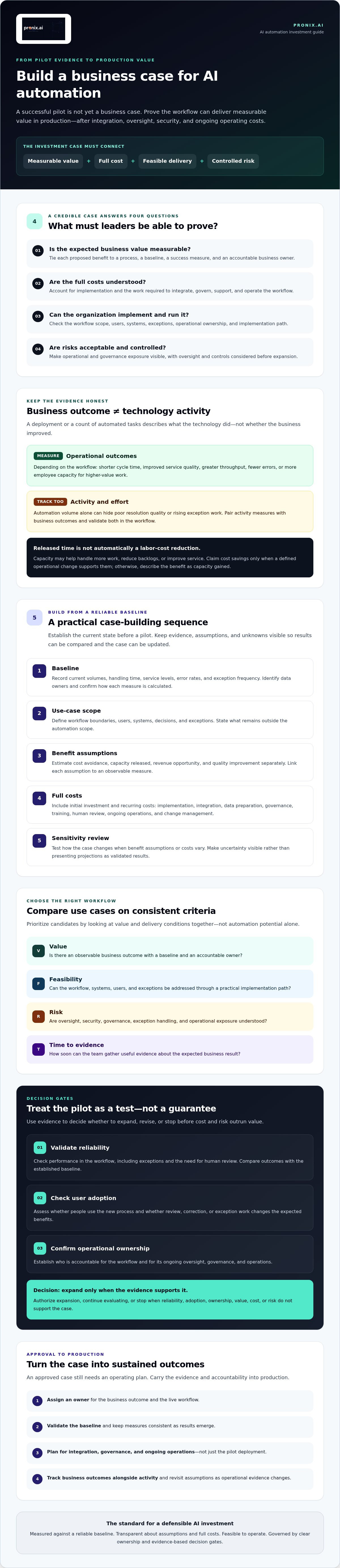
A credible investment case does more than show that a model or agent can perform a task. It answers four connected questions with evidence: Is the expected business value measurable? Are the full costs understood? Can the organization implement and operate the workflow? Are the risks acceptable and controlled?
A business case for AI automation is a documented assessment of expected value, total cost, implementation feasibility, and risk, with projected benefits kept distinct from outcomes validated in operation. That distinction matters. “An agent was deployed” or “tasks were automated” describes technology output. It does not establish that the business improved.
AI automation may combine capabilities such as artificial intelligence and robotic process automation. Wikipedia’s overview of intelligent process automation provides background on this intersection. The technology label, however, is not the investment rationale. The case must connect the proposed capability to a specific process and business result.
Which business outcomes can AI automation support?
Start with outcomes leaders can observe and verify. Depending on the workflow, these may include shorter cycle time, improved service quality, greater throughput, fewer errors, or more employee capacity for higher-value work. Customer and employee experience can also be measured through relevant satisfaction feedback, resolution quality, or employee effort measures. Treat each as a hypothesis until the organization defines how to measure it.
For every proposed benefit, identify the process it affects, the accountable business owner, the baseline, and the measure of success. A customer operations owner might track resolution time and quality in a support workflow. A finance owner might track processing time and correction rates for a review process. Naming the owner and measure makes assumptions visible and gives someone responsibility for validating them.
Why automation potential is not the same as business value
Automating a task creates potential, not guaranteed savings. Staff may still need to review outputs, handle exceptions, correct errors, or complete steps the system cannot perform. If employees do not adopt the new process, expected capacity may not materialize. Process redesign and clear operational ownership are often needed to turn technical capability into sustained results.
Be precise about capacity. Time released can support more work, reduce backlogs, or improve service, but it is not automatically a labor-cost reduction. Cost savings require a defined operational change, such as reducing paid overtime or avoiding planned capacity increases. Otherwise, describe the benefit as capacity gained and explain how the business will use it.
Do not use automation volume as a stand-in for value. A high count of automated interactions could coincide with poor resolution quality or rising exception work. Pair activity measures with business outcomes, then validate both in the workflow. This gives decision-makers a sound basis for assessing whether the initiative is delivering the result the investment case projected.
Build the AI automation business case from a reliable baseline
Start with evidence from the process as it operates today. A baseline must be established before a pilot so later changes can be compared with the same starting conditions, rather than attributed to automation by assumption. Without that reference point, leaders cannot reliably tell whether a pilot improved performance or merely coincided with other changes.
Build the case in sequence. Keep evidence, assumptions, and unknowns visible so reviewers can challenge the model and update it as results emerge.
- 1. Baseline: Record current volumes, handling time, service levels, error rates, and exception frequency. Identify each data owner and confirm how each measure is calculated.
- 2. Use-case scope: Define the workflow boundaries, users, systems, decisions, and exceptions included. State what remains outside the automation scope.
- 3. Benefit assumptions: Estimate potential cost avoidance, capacity released, revenue opportunity, and quality improvement separately. Tie each assumption to an observable measure.
- 4. Full costs: Include implementation, integration, data preparation, governance, training, human review, ongoing operations, and change management. Capture recurring costs as well as initial investment.
- 5. Sensitivity review: Model conservative, expected, and upside scenarios. Test how the result changes if adoption is lower or exception rates are higher than expected.
Measure the current process before estimating benefits
Use internal operational records where possible, and document how each measure is calculated and over what period. For example, define whether handling time includes review and rework, and use a consistent denominator when calculating exception frequency. If reliable data is missing, flag the gap and agree how to validate it. Do not substitute an unsupported industry benchmark for evidence about your own workflow.
Model benefits, total costs, and uncertainty
Keep benefit categories distinct. Cost avoidance differs from capacity freed for other work, and neither should be reported as realized savings unless an operating change supports that claim. Revenue opportunity and quality improvement need their own measures as well. Include the people and systems required to review outputs, resolve exceptions, maintain integrations, and govern the capability after launch.
Net benefit = validated benefits − total costs. Before validation, benefits remain projections, not realized value. Sensitivity analysis shows which assumptions most influence the decision and where pilot evidence matters most. For a defensible business case for AI automation, keep an auditable record of assumptions and revise the model as measured results replace estimates.
When internal teams need support connecting the case to implementation and operational readiness, AI business automation expertise can help shape a path from analysis toward governed production.
Compare AI automation use cases by value, feasibility, and risk
Once candidate workflows are defined, compare them on the same terms. Do not prioritize the one with the most visible AI features. A strong first initiative has a measurable outcome, a practical implementation path, and risks the organization can manage. Score technical feasibility separately from organizational readiness. Usable data and system access will not compensate for unclear process ownership or low user adoption.
The comparison below is illustrative, not a forecast. Replace the ratings with evidence from your own workflows, and define what each rating means before scoring candidates.
| Example workflow | Business value | Feasibility | Risk exposure | Time to evidence |
|---|---|---|---|---|
| Customer operations: classify and route incoming requests | Medium to high | Depends on request consistency and system access | Moderate if routing errors affect service | Potentially short if outcomes are tracked |
| Finance: extract and validate information for review | Potentially high where volume and rework justify it | Depends on document quality and exception handling | Moderate to high if errors affect financial decisions | Depends on review cycles and error measures |
| Manufacturing: support inspection or production workflows | Potentially high where quality or throughput is affected | Depends on process conditions and system integration | Higher when workflow disruption could affect operations | Depends on access to reliable operational measures |
These examples do not imply a guaranteed result or rank industries. They show why the same criteria should be applied to each candidate. For a defensible business case for AI automation, document the evidence behind every rating and why a workflow advances or is excluded.
Prioritize workflows with measurable outcomes
Favor processes with repeatable steps, observable results, and an accountable owner. Examine where the process varies, which exceptions matter most, and where human judgment is essential. Then trace the workflow from beginning to end. Automating one handoff may simply shift work downstream, so include affected teams and measures across the full process.
Score feasibility and exposure before selecting a first initiative
Assess data quality, system access, integration effort, and workflow criticality alongside privacy, security, explainability, and human-oversight needs. Score organizational readiness too: confirm process ownership, user involvement, and capacity to manage exceptions. Record score definitions, weights, evidence, and reasons for excluding candidates. A transparent scorecard lets leaders compare trade-offs, challenge assumptions, and select a workflow that can produce credible evidence without overlooking exposure.
Address the hardest objection: uncertain returns and production risk
Forecasts are uncertain, especially before a workflow has been tested under real operating conditions. That does not make the investment case unusable. It means leaders should limit commitment until evidence supports the next step, with explicit gates to continue, revise, or stop.
A pilot validates assumptions about a workflow; it does not prove that value will hold at production scale. Production readiness also depends on reliability across real cases, user adoption, exception handling, integration performance, and clear operational ownership. A successful demonstration may establish technical potential without showing that the process can deliver consistent outcomes day after day.
Account for the controls needed to operate safely, not just the automation itself. Monitoring, audit records, human review, incident response, and fallback paths affect both cost and risk. If the process cannot safely continue when the system is unavailable or produces an uncertain result, define how work returns to people and include that operating effort in the assessment.
What can prevent projected benefits from materializing?
Benefits can fall short when employees avoid the new workflow, process design leaves unnecessary steps in place, or data is incomplete or inconsistent. Integration friction can create delays, while overlooked exceptions may send more work to manual review than expected. Each issue can reduce service performance or consume the capacity the initiative was intended to release.
Released capacity needs an explicit plan. Assign it to reducing a backlog, handling more demand, or another defined business priority, then track whether that change occurs. Do not present illustrative benefits as guaranteed savings. Show what must change operationally for each benefit to be realized.
Set evidence gates before scaling beyond a pilot
Define decision criteria before the pilot begins. Set measurable thresholds for output quality, user adoption, operating cost, risk events, and service performance. Base the thresholds on the process’s requirements and risk tolerance, not on results selected after the fact. If a measure misses its threshold, specify whether the response is to adjust, extend testing, or stop.
- Assign accountable owners: Name who approves changes, responds to incidents, monitors performance, and reports outcomes.
- Maintain evidence: Record results, exceptions, human interventions, and material changes so decisions can be reviewed.
- Plan for safe operation: Document escalation routes and fallback procedures before expanding access or scope.
The NIST AI Risk Management Framework offers a voluntary structure for identifying, measuring, and managing AI risks. It can inform governance and technical controls, but it does not replace legal review or organization-specific obligations. A disciplined business case for AI automation includes these controls in the decision rather than treating them as a separate task after approval.
To move from pilot evidence toward a governed production capability, explore AI implementation and managed services.
Turn an approved AI automation business case into production outcomes
Approval is a decision to proceed with disciplined execution, not a guarantee of return. Convert the investment case into a controlled deployment plan with an accountable owner, a validated baseline, a defined workflow, and evidence gates. These steps keep delivery tied to the outcomes leadership approved.
Move from investment approval to a controlled deployment
Translate the proposed outcomes into specific scope, architecture, responsibilities, and acceptance criteria. Confirm which systems and data the workflow requires, where people review or override outputs, and how exceptions will be handled. Before launch, plan testing, user enablement, monitoring, and escalation. Assign responsibility for each so operational teams know how the process will run and who acts when it does not perform as expected.
Start with a limited, well-defined deployment. Review results against the agreed gates before expanding the workflow, user group, or level of automation. If evidence falls short, adjust the design or pause expansion. Strategy sets the direction; implementation and integration connect the capability to real processes; governance and managed operations help maintain accountability after launch.
A practical sequence for the accountable business owner is:
- Confirm the baseline and the measures used to assess outcomes.
- Select the workflow and document scope, dependencies, and human oversight.
- Set acceptance criteria and decision gates before deployment.
- Review evidence at each gate before proceeding, revising, or stopping.
Keep measuring value after launch
Production is the start of value tracking, not the end. Compare performance with the original baseline at agreed reporting intervals. Track business outcomes alongside operating cost, adoption, quality, exception volume, and risk. Review whether the workflow is being used as designed and whether released capacity or service improvements are materializing. If process conditions change, revisit assumptions and controls rather than relying on the initial forecast.
The business case for AI automation remains credible when actual performance informs ongoing decisions. pronix.ai can be considered as an enterprise implementation partner, with capabilities spanning strategy, technical implementation, integration, governance, and managed services. These capabilities support the path from an approved case to governed production, while results depend on the workflow, organizational readiness, and measured execution.
Discuss an enterprise AI automation business case with pronix.ai.
Move from a credible case to controlled progress
A strong business case for AI automation connects a measurable business outcome to a reliable baseline, realistic total costs, and an implementation path the organization can support. It treats a pilot as evidence to assess, not a promise of scaled value. Clear decision gates help leaders expand, revise, or stop based on what the workflow demonstrates in practice.
After approval, keep ownership and measurement in place. Track outcomes alongside adoption, quality, operating costs, exceptions, and risk. This discipline helps teams identify whether the capability is delivering the intended value and what needs to change as it moves into production.
pronix.ai supports enterprises across AI strategy, implementation, and managed services, with experience working in environments that include AWS, Microsoft, Salesforce, Kore.ai, and Genesys. Its stated focus includes secure, scalable production outcomes, governance, and auditability, without promising a predetermined return.
To identify a practical, evidence-led next step for your organization, discuss an enterprise AI automation business case with pronix.ai. Clear ownership and disciplined execution can help turn a justified investment into responsible progress.
Frequently Asked Questions
What is a business case for AI automation?
A business case for AI automation is an evidence-based assessment of whether automating a defined workflow is worth pursuing. It connects measurable business outcomes to expected benefits, total costs, implementation feasibility, and risk. It also distinguishes projected gains from results validated in operation. For example, the number of tasks an AI system completes is a technology measure; changes in cycle time, quality, or capacity show whether the business process improved.
How do you calculate the ROI of AI automation?
Compare validated financial benefits with the full costs over a clearly defined period. A common formula is ROI = (validated benefits − total costs) ÷ total costs × 100. Identify which benefits can be financially realized, such as avoided expenses, and keep capacity gains or quality improvements separate unless they are converted into measurable financial value. Include recurring costs and human review, then show conservative, expected, and upside scenarios. Do not present projected benefits as validated returns.
What costs should an AI automation business case include?
Include implementation and integration, data preparation, governance, security controls, training, change management, and ongoing operations. Account for monitoring, maintenance, human review, exception handling, and any cloud or platform consumption relevant to the solution. Separate one-time costs from recurring costs, and state the assumptions behind each estimate. Omitting operational effort can make a project look more attractive on paper while understating what it takes to keep the workflow reliable in production.
Which AI automation use cases are best for a first business case?
Start with a workflow that has repeatable steps, observable outcomes, an accountable business owner, and manageable risk. Assess data quality, system access, process variability, exceptions, and the level of human judgment required. Customer request routing, finance document review, or a manufacturing inspection workflow may be candidates, depending on the organization’s processes and controls. Compare them using consistent criteria for value, feasibility, risk, and time to evidence, rather than AI visibility alone.
How can a company prove AI automation savings?
Establish a baseline before deployment, including relevant volumes, handling time, error rates, service performance, and exception frequency. After launch, measure the same indicators using consistent definitions and compare results with the baseline. To claim cost savings, document the operational change that turns released capacity into avoided spending, such as reduced overtime or a planned expense that no longer occurs. Otherwise, report capacity gained or quality improved without labeling it as realized savings.
Why do AI automation pilots fail to produce a business case?
Pilots may test a narrow task without accounting for real production conditions. Poor data, integration friction, low user adoption, weak process design, and unplanned exceptions can all reduce results at scale. A demonstration may also lack a reliable baseline or an accountable owner who can validate outcomes. Before testing, define what evidence would support expansion, including service quality, operating effort, adoption, and exception handling. Pilot performance is evidence about assumptions, not proof of scaled value.
How do you account for risk in an AI automation business case?
Identify risks tied to the workflow, data, integrations, security, privacy, output quality, and operational continuity. Estimate the controls and work needed to manage them, including monitoring, auditability, human oversight, escalation, and fallback procedures. Assign owners for approvals, incident response, and ongoing review. Set measurable thresholds for quality, service performance, cost, and risk before expanding deployment. Frameworks such as the NIST AI Risk Management Framework can inform risk practices, but they do not replace applicable legal review.