

Most enterprises have spent the last two years applying "digital lipstick" to legacy friction rather than modernizing the core architecture. You've likely seen the results: a fragmented collection of AI pilots that create more operational noise than actual value. While these experiments show promise, they often lack the governance and security required for regulated industries. Implementing AI-driven employee experience tools shouldn't be an exercise in aesthetic patches. It's a frustrating cycle where tools meant to save time end up consuming more of it.
This guide provides a blueprint for breaking that cycle. You'll learn how to transition from disconnected pilots to a governed, production-ready ecosystem of AI-driven employee experience tools that drive measurable productivity. We'll move beyond the hype to focus on what matters for 2026: reducing operational friction and building auditable workflows. By adopting a managed approach to AI-driven employee experience tools, you can bridge the internal talent gap and ensure your automation strategy is both scalable and secure. At pronix.ai, we specialize in moving these complex systems from pilot to production with speed and stability.
Key Takeaways
- Understand the transition from passive chatbots to autonomous agents that proactively manage internal workflows.
- Learn how to leverage AI-driven employee experience tools through Retrieval-Augmented Generation (RAG) to ensure accuracy and data security.
- Establish enterprise-grade governance by prioritizing auditability and bias control to mitigate long-term reputational risk.
- Use a structured five-step roadmap to move internal AI projects from experimental pilots to secure production environments.
- Discover how managed services bridge the talent gap and provide the specialized expertise needed for scalable AI ecosystems.
The Evolution of AI-Driven Employee Experience (EX) Tools
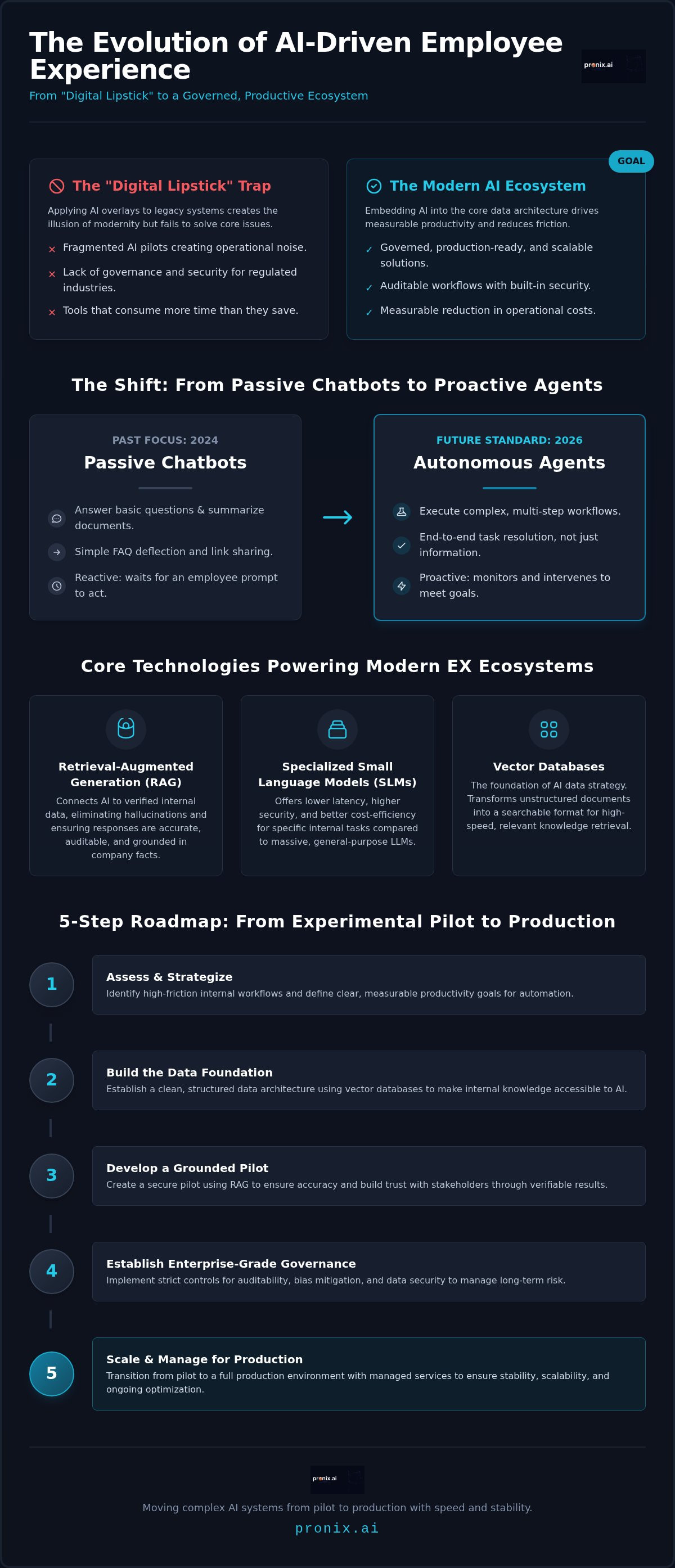
Modern AI-driven employee experience tools have moved beyond simple conversational interfaces. They are now defined as intelligent systems that automate complex internal workflows and streamline knowledge retrieval. In 2024, the enterprise focus was largely on "chatbots" that could summarize documents or answer basic questions. By 2026, the standard has shifted toward autonomous agents capable of independent execution. This evolution is driven by the need for measurable productivity gains and significant operational cost reduction.
Many organizations initially fell into the "digital lipstick" trap. They deployed basic AI overlays on top of fragmented legacy systems. While these tools looked modern, they failed because they lacked deep integration into the core business architecture. Real transformation requires moving past these superficial layers. True value emerges when AI is embedded into the data foundations of the company, allowing it to act on information rather than just describing it.
From Deflection to Resolution: The 2026 Shift
Simple FAQ deflection is no longer sufficient for the modern enterprise workforce. Employees expect their internal tools to function with the same efficiency as consumer-grade technology. The 2026 era is defined by end-to-end task resolution through agentic workflows. Instead of receiving a link to a policy document, an employee receives a completed action. These tools now handle complex logic and multi-step processes, moving far beyond simple text generation to deliver concrete results.
The Role of Agentic AI in Internal Operations
Agentic AI represents a fundamental shift from reactive to proactive operations. Reactive tools wait for a prompt; agentic tools monitor environments and intervene based on predefined goals. This is particularly effective in high-friction areas of internal management. For example, agents can now manage IT ticketing by diagnosing hardware issues and triggering replacement orders without manual intervention. In HR onboarding, agents orchestrate background checks, equipment provisioning, and training schedules across multiple departments simultaneously.
Successful implementation requires a managed approach to ensure these agents work in concert. Procurement agents can now manage vendor communication and budget approvals through automated multi-agent orchestration. At pronix.ai, we help organizations build these secure ecosystems to ensure cross-departmental tasks are governed, auditable, and aligned with enterprise standards.
Core Technologies Powering Modern AI-Driven EX Ecosystems
The shift toward agentic AI-driven employee experience tools relies on a sophisticated tech stack that prioritizes precision over creative generation. Retrieval-Augmented Generation (RAG) is the primary mechanism for ensuring internal knowledge is accurate and grounded in company facts. By connecting models to verified internal data sources, RAG eliminates the risk of hallucinations that plague general-purpose AI. This architecture allows an agent to cite specific internal policies or project files, providing an auditable trail for every response.
Efficiency in 2026 is further driven by the transition from massive Large Language Models (LLMs) to specialized Small Language Models (SLMs). These smaller models offer lower latency and higher security for specific internal tasks. They are easier to govern and more cost-effective to scale across global teams. Because SLMs require less compute power, they can often be deployed in private cloud environments, keeping sensitive enterprise data within your own security perimeter.
Data Foundations: The Bedrock of Employee AI
Your AI is only as good as your enterprise data architecture. Without clean, structured data, even the most advanced agents will fail to deliver value. Vector databases play a critical role here by transforming unstructured documents into searchable mathematical representations. This allows for high-speed, relevant queries across vast internal repositories. An effective enterprise data strategy for AI ensures that your production environment remains stable and scalable from day one.
Integration with Legacy Enterprise Workflows
Modern AI agents must coexist with legacy ERP and CRM systems. Bridging this gap requires robust APIs and sophisticated middleware to ensure seamless transitions for employees. We leverage major platforms like Salesforce Agentforce, AWS, and Genesys to orchestrate these connections. This ecosystem approach allows AI-driven employee experience tools to pull data from a legacy database and push it into a modern interface without friction.
High-stakes internal decisions still require a "Human-in-the-loop" (HITL) approach. While agents can automate the heavy lifting, human oversight ensures that governance standards are met in regulated industries. This balance between automation and accountability is essential for long-term operational maturity. Organizations looking to stabilize their tech stack often start with Agentic AI Strategy & Consulting to map these complex workflows before deployment.
Evaluating AI EX Tools for Enterprise-Grade Governance
Enterprise leadership often views AI adoption through a lens of skepticism, and for good reason. Security, privacy, and brand reputation are the primary hurdles for any large-scale deployment. Selecting AI-driven employee experience tools requires more than a feature-by-feature comparison. It demands a rigorous evaluation of governance frameworks. Auditability, scalability, and bias control are the pillars of a mature production environment. Without these, even the most innovative tool remains a liability.
In regulated sectors like healthcare and finance, governed AI prevents sensitive data leakage by enforcing strict access controls at the model layer. This ensures that internal agents only access information they are authorized to see. When choosing between open-source models and proprietary enterprise platforms, the trade-offs are clear. Proprietary platforms often provide better out-of-the-box compliance and support. Open-source models offer flexibility but require significant internal engineering to achieve the same level of security and auditability.
Risk Mitigation and Ethical AI Frameworks
Implementing guardrails is the first step in preventing unauthorized data access by internal agents. These guardrails act as an invisible security layer, filtering prompts and responses to ensure compliance with corporate policy. For HR and employee performance monitoring, "Explainable AI" is critical. It provides transparency into how the AI reached a specific conclusion, which is essential for maintaining trust. Every AI-driven resolution must leave an immutable audit trail, allowing for retrospective reviews and regulatory compliance checks.
Scalability vs. Security: Finding the Balance
Rapid scaling often breaks traditional enterprise security protocols. A tool that works for a fifty-person pilot might fail when exposed to a global workforce of fifty thousand. You must evaluate tools based on their ability to handle high-volume, regulated interactions without compromising latency or safety. The necessity of enterprise-grade AI auditability is non-negotiable for 2026. As your ecosystem grows, your ability to monitor, record, and report on every agentic interaction becomes the foundation of your operational stability. At pronix.ai, we focus on building these governed frameworks to ensure your transition to production is both fast and secure.
Bridging the Gap: Moving AI-Driven EX from Pilot to Production
Most enterprise AI initiatives fail not because the technology is flawed, but because the path to production is undefined. Moving AI-driven employee experience tools out of the laboratory requires a structural change in how internal services are managed. It's a transition from testing features to managing outcomes. Success in 2026 depends on a disciplined, five-step roadmap that prioritizes operational stability over experimental curiosity.
- Step 1: Identify High-Impact Use Cases. Focus on high-friction, low-risk areas like IT helpdesk support. These provide clear benchmarks for success and immediate data for refinement.
- Step 2: Architect the Foundation. Secure the data environment and technical stack before expanding the user base. This ensures the system can handle enterprise-scale queries.
- Step 3: Refine via Controlled Pilots. Use a dedicated feedback loop with a core group of users to iron out hallucinations and workflow bottlenecks.
- Step 4: Deploy Managed Services. Shift to a production-grade monitoring model that prioritizes uptime, security, and continuous improvement.
- Step 5: Departmental Scaling. Expand the ecosystem across the organization while measuring ROI of enterprise AI using a strategic framework.
The 90-Day Blueprint for Governed Deployment
Setting realistic 30, 60, and 90-day milestones prevents the common trap of "Pilot Purgatory." You must define specific success metrics early to justify continued investment. The transition from technical implementation to operational management is the final hurdle. This phase ensures the tool becomes a core part of the employee workflow rather than a temporary novelty. Operational maturity is reached when the AI agent is as reliable as the legacy systems it augments.
Solving the AI Talent Gap
Enterprises frequently struggle to find specialized talent to manage internal AI agents. The demand for architects who understand both RAG and enterprise security far exceeds the current supply. Many organizations are now leveraging Enterprise AI talent as a service to bridge this gap. This approach allows you to upskill existing HR and IT teams while relying on external experts for complex orchestration. It ensures that your internal teams can focus on human-to-human collaboration while the AI handles the heavy lifting. If you are ready to secure your production outcomes, contact us for Agentic AI Implementation support.
Scaling EX Transformation with AI Managed Services
Software licensing is only the first step toward modernization. Long-term production outcomes require more than just access to AI-driven employee experience tools. They require a dedicated operational layer. Managed Service Providers (MSPs) fill this gap by providing the technical oversight and continuous optimization that internal teams often lack. This ensures that your investment doesn't stagnate after the initial deployment. Without an ongoing management layer, models drift, security protocols age, and employee adoption plateaus.
At pronix.ai, our approach integrates strategy, implementation, and ongoing managed services. This lifecycle-based model ensures that every agentic workflow remains secure and auditable. We don't just deploy a tool; we manage the outcome. This involves real-time monitoring of agent performance and proactive adjustments to the underlying data architecture. Managed services provide the "boots-on-the-ground" pragmatism needed to keep complex ecosystems running at peak efficiency.
Why Managed Services are the Future of Enterprise AI
The enterprise market is shifting from "buying tools" to "buying outcomes." In 2026, the value of an AI tool isn't in its feature list but in its ability to resolve tasks without human intervention. Regulated industries, such as healthcare and finance, require the stability that only a structured service model can provide. This includes rigorous bias control and constant auditability. For leadership teams vetting partners, the 2026 Selection Framework for AI Managed Service Providers offers a methodology for identifying partners capable of handling production-grade complexity.
The pronix.ai Advantage: Decades of CX Excellence
pronix.ai brings a unique perspective to internal automation. We leverage the extensive legacy of our parent company, Pronix Inc., which has spent decades modernizing contact centers and customer experience workflows. This background allows us to apply high-stakes CX standards to internal AI-driven employee experience tools. We understand that an internal helpdesk agent requires the same reliability and security as a customer-facing one. Our focus remains strictly on Agentic AI and secure, scalable production outcomes.
We bridge the talent gap by providing specialized expertise that is difficult to source internally. Our teams handle the multi-agent orchestration and data foundation maintenance that keep your operations lean. If you're ready to stabilize your AI roadmap and move beyond the pilot phase, contact us to discuss our Enterprise AI Managed Services. Request a consultation today to transform your internal service delivery into a governed, high-performance ecosystem.
Securing Your Production Roadmap for 2026
The window for experimental AI pilots is closing. Enterprises must now focus on building a stable, governed ecosystem that delivers measurable ROI. We've explored how AI-driven employee experience tools are evolving from reactive chatbots into autonomous agents capable of end-to-end task resolution. Success requires a robust data foundation and a disciplined move toward production-grade managed services. By prioritizing auditability and risk mitigation, your organization can accelerate productivity without compromising security in regulated markets.
Moving from a fragmented pilot to a scalable, production-ready environment is a complex journey. It requires specialized expertise across platforms like AWS, Salesforce, and Genesys. At pronix.ai, we provide the end-to-end strategy and managed service excellence needed to navigate this transition safely. Don't let your transformation stall in "pilot purgatory" due to a lack of specialized internal talent. We specialize in high-scale production for regulated industries, ensuring every workflow is both auditable and optimized.
Request an Enterprise AI Strategy Consultation with pronix.ai to stabilize your operations and unlock the full potential of your workforce. The future of internal efficiency is agentic; start building your foundation today.
Frequently Asked Questions
What are AI-driven employee experience tools?
AI-driven employee experience tools are intelligent systems designed to automate internal business processes and streamline knowledge access. Unlike basic software, these tools use agentic workflows to resolve tasks independently, such as processing IT tickets or managing HR onboarding. They integrate directly with enterprise data to provide accurate, grounded responses. By reducing operational friction, these tools allow employees to focus on high-value work while the AI handles repetitive administrative cycles.
How do AI agents differ from traditional HR chatbots?
Traditional HR chatbots typically focus on FAQ deflection, providing links to documents or basic text responses. In contrast, AI agents are proactive and capable of end-to-end task resolution. They don't just point to a policy; they execute the workflow associated with it. This shift from reactive to agentic means the system can autonomously coordinate with other enterprise applications, such as CRM or ERP systems, to complete requests without manual human intervention.
Is AI-driven EX secure for regulated industries like finance and healthcare?
Yes, provided the implementation utilizes an enterprise-grade governance framework. Managed solutions ensure security by employing Retrieval-Augmented Generation (RAG) and private cloud deployments, keeping sensitive data within the corporate perimeter. These tools include strict audit trails and bias controls required by finance and healthcare regulators. By enforcing granular access permissions, organizations ensure that AI agents only retrieve information appropriate for the specific user's role, preventing unauthorized data leakage across the enterprise.
How can I measure the ROI of AI-driven employee tools?
Measuring ROI involves tracking specific operational metrics such as the reduction in average resolution time for internal support tickets. You should also quantify the total hours saved by employees through automated knowledge retrieval and task execution. Beyond time savings, consider the reduction in operational costs associated with manual administrative overhead. A successful implementation provides measurable data on workflow efficiency, allowing leadership to calculate the direct impact on the bottom line through increased workforce output.
What is the biggest challenge in moving AI from pilot to production?
The biggest challenge is bridging the gap between an experimental pilot and a secure, production-ready environment. Many organizations struggle with "Pilot Purgatory" because they lack a governed data foundation or the specialized talent required for multi-agent orchestration. Transitioning to production requires moving beyond superficial overlays to deep architectural integration. Without a clear roadmap for scalability and security, internal AI projects often fail to provide the stability needed for long-term enterprise use.
Can AI-driven EX tools integrate with my existing legacy systems?
Yes, modern AI-driven employee experience tools are designed to integrate with legacy ERP and CRM systems through robust APIs and middleware. These tools act as an intelligent orchestration layer, pulling data from older databases and presenting it through modern conversational interfaces. This allows employees to interact with complex legacy systems using natural language. Successful integration ensures that the AI can read and write data across your existing tech stack, preserving previous infrastructure investments.
Why do I need a managed service provider for enterprise AI?
Software licensing alone does not guarantee a successful production outcome. A managed service provider offers the specialized expertise needed to handle continuous optimization, security monitoring, and model maintenance. As enterprise environments change, AI models can drift or encounter new security risks. An MSP like pronix.ai ensures that your ecosystem remains stable, auditable, and aligned with evolving business goals. This approach allows your internal teams to focus on strategy while experts manage the technical complexity.
How long does it take to deploy a governed AI agent for employees?
A governed deployment typically follows a structured 90-day blueprint. The first 30 days focus on identifying high-impact use cases and establishing the data foundation. The middle phase involves executing a controlled pilot with a feedback loop for refinement. By the 90-day mark, the system is ready for a managed transition into a production environment. This methodical approach ensures that speed never compromises security, allowing for a stable rollout that builds trust among the workforce.