

Your enterprise AI strategy isn't failing because of the technology. It's failing because your hiring pipeline cannot keep pace with the 2026 regulatory and technical curve. You've likely seen the friction firsthand. Pilots stall in the lab. Technical debt climbs. Even with 76% of organizations now employing a Chief AI Officer, the scarcity of qualified Agentic AI architects makes scaling feel like an impossible climb. This is why enterprise AI talent as a service has shifted from a niche alternative to a core strategic requirement for the Fortune 500.
We understand the pressure to deliver results while navigating a complex patchwork of state laws like the Colorado AI Act and California's SB 53. You need more than just bodies in seats; you need a managed ecosystem of expertise. This guide promises to show you how to bridge the critical skills gap and move from experimental pilots to secure, scalable production. We'll explore the 2026 resource landscape, provide a framework for reducing time-to-value, and outline how to access elite engineering talent without the overhead or risk of traditional executive search.
Key Takeaways
- Understand why traditional hiring cycles fail to match the rapid 2026 AI skill lifecycle and how this gap stalls enterprise pilots.
- Discover how enterprise AI talent as a service provides a managed, outcome-based model that prioritizes operational maturity over simple staff augmentation.
- Compare the time-to-value and cost structures of internal recruitment versus managed services to accelerate your AI roadmap.
- Identify the specialized roles, such as Agentic AI architects and governance leads, required to move AI initiatives into secure production.
- Learn a structured approach to bridging the gap between experimental AI strategy and scalable, governed business automation.
The AI Talent Deficit: Why Enterprise Pilots Stall in 2026
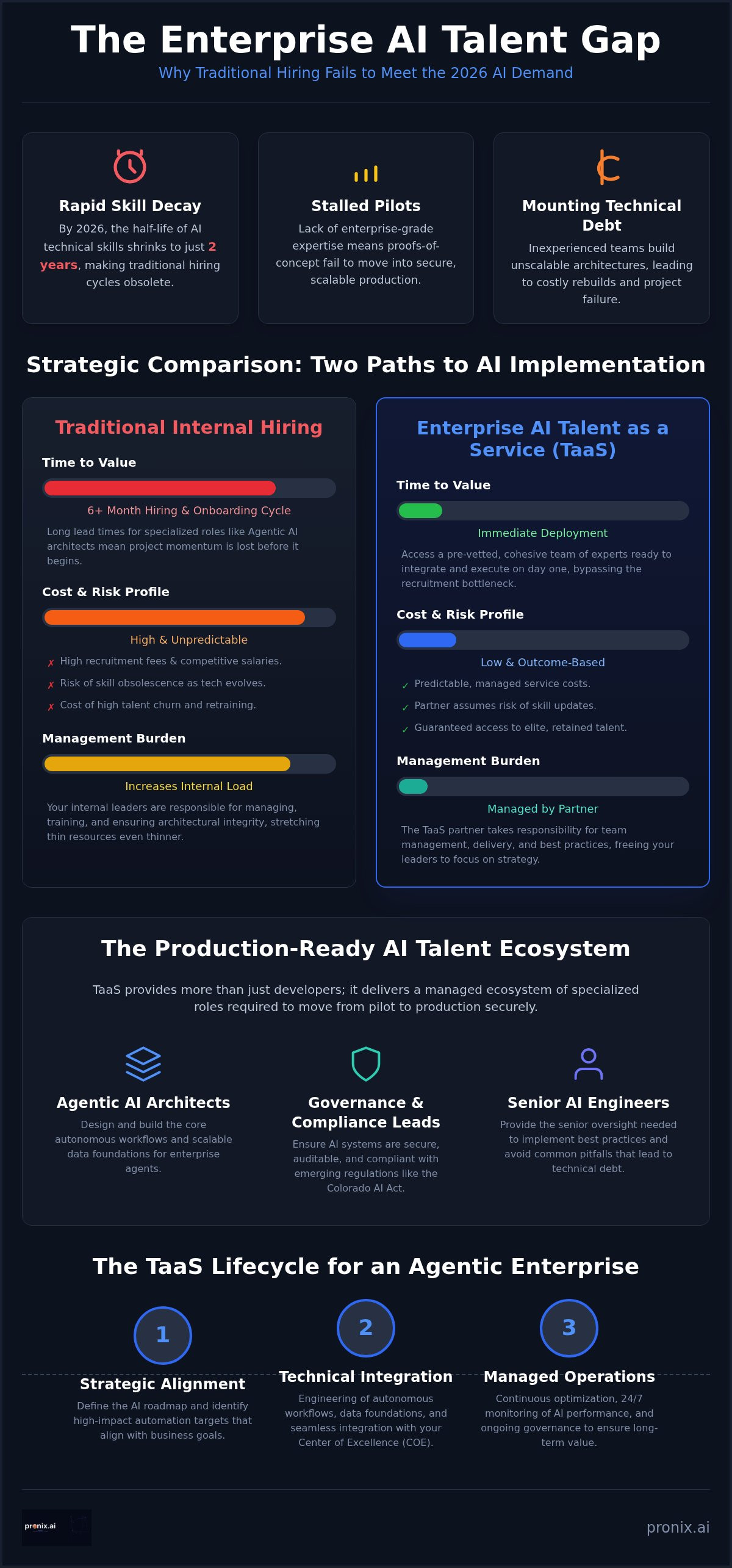
Enterprise AI ambition has hit a wall. While leadership teams prioritize generative AI and autonomous agents, execution capacity remains stagnant. The core issue isn't a lack of budget. It's a fundamental deficit in specialized capability. By 2026, the half-life of AI technical skills has shrunk to just two years. This rapid decay makes traditional hiring cycles, which often last six months, functionally obsolete. By the time a candidate is onboarded, their framework expertise is already nearing expiration.
Organizations are realizing that "DIY" AI implementation using generalist IT staff creates more friction than value. Transitioning from experimental "AI playgrounds" to governed production environments requires a level of operational maturity that internal teams often lack. This shift is driving the adoption of Managed Service Provider (MSP) models, specifically enterprise AI talent as a service. This model allows firms to bypass the recruitment bottleneck and deploy production-ready expertise immediately.
The Friction Points of Traditional AI Hiring
Executive search for Agentic AI architects is currently plagued by extreme lead times and hyper-competitive global poaching. Hiring for specific LLM frameworks carries a high risk of technical obsolescence as models evolve monthly. Retaining elite talent is equally difficult; engineers often leave for startups after gaining enterprise-scale experience on your dime. This churn creates a cycle of perpetual restarting that kills project momentum and drains resources without delivering a single production-grade agent.
Technical Debt and the Cost of Inexperience
Inexperienced teams often prioritize "cool" features over stable data foundations. This leads to unscalable architectures and massive technical debt that eventually requires a total rebuild. Enterprise AI talent as a service provides the senior oversight needed to avoid these traps. Poorly governed AI systems also pose a significant risk to brand reputation through algorithmic bias or data leaks. In 2026, the pilot-to-production gap is defined as the structural inability to move beyond experimental proofs-of-concept due to a lack of enterprise-grade governance and operational expertise.
Defining Enterprise AI Talent as a Service (TaaS)
Enterprise AI talent as a service is a managed delivery model designed to provide immediate access to elite engineering expertise. Unlike traditional recruiting, which focuses on individual headcount, this model provides a cohesive, outcome-focused team. It functions as a strategic extension of your organization. It bridges the gap between high-level strategy and the technical reality of production environments. This isn't a software solution. It's a human-led, framework-driven approach to scaling intelligence.
Research from Georgetown University highlights The AI Talent Deficit as a primary barrier to national and corporate competitiveness. Enterprise AI talent as a service addresses this by offering a ready-to-deploy workforce. This workforce is already trained in the latest agentic frameworks and governance protocols. It's about stability, not just speed. It ensures that your AI initiatives are built on secure foundations from day one.
Managed Services vs. Staff Augmentation
Staff augmentation often leaves the burden of management and architectural integrity on your internal team. If your in-house leaders are already stretched thin, adding more contractors only increases their management load. Enterprise AI talent as a service shifts that responsibility to the partner. You aren't just hiring a developer; you're adopting a tested methodology for AI deployment. This distinction is vital when choosing an enterprise AI managed service provider. TaaS partners bring baked-in best practices that ensure your agents are secure, auditable, and compliant with emerging 2026 regulations.
The TaaS Lifecycle for Agentic AI
The transition to an agentic enterprise follows a rigorous, three-phase lifecycle. It starts with strategic alignment, where we define the roadmap and identify high-impact automation targets. Next is technical integration, involving the actual engineering of autonomous workflows and data foundations. Finally, the model moves into managed operations. This phase ensures continuous optimization and 24/7 monitoring of AI performance.
Integration with your existing Center of Excellence (COE) is seamless. The TaaS model acts as a force multiplier for your IT department. It provides the specialized support needed to execute complex roadmaps without the risk of internal technical debt. For leaders ready to move beyond the pilot phase, exploring managed AI implementation is the logical next step toward operational maturity.
Strategic Comparison: Internal Hiring vs. Managed AI Talent
Choosing between internal recruiting and a managed partnership is a choice between legacy speed and modern agility. Traditional hiring cycles often exceed 180 days for senior roles. By contrast, enterprise AI talent as a service reduces deployment time to under 14 days. This speed is vital when technical frameworks shift every few months. Predictable managed fees eliminate the hidden variable costs of full-time employees, such as recruitment premiums, benefits, and the continuous upskilling required to combat skill decay.
Project bursts often require a surge in engineering capacity that doesn't justify permanent headcount. Managed models provide this elasticity. You can scale resources up for a major implementation and down once the system enters maintenance. Scaling down is just as critical as scaling up for maintaining a lean balance sheet. By transferring implementation risk to a specialized partner, enterprises protect themselves from the high cost of technical dead ends and failed pilots.
Operational Maturity and Governance
In regulated sectors like finance and healthcare, auditability is non-negotiable. Specialized partners maintain "Responsible AI" standards as a core service component rather than an afterthought. They ensure every agentic workflow is documented and compliant with 2026 standards like the Colorado AI Act. While internal training programs often struggle to keep pace with rapid regulatory updates, managed talent models provide a faster path to ROI by delivering production-ready outcomes months before an internal hire finishes onboarding.
Flexibility in a Volatile Tech Landscape
Elite talent must master diverse ecosystems, from AWS and Microsoft to Salesforce and Kore.ai. Relying on a single internal team often leads to "Vendor Lock-in" because their skills are tied to a specific stack. Enterprise AI talent as a service offers platform-agnostic expertise. This ensures your architecture remains flexible as better models emerge. To understand how these efficiencies impact your bottom line, see our guide on measuring ROI of enterprise AI for production outcomes. This framework helps leadership move beyond vanity metrics toward evidence-based success.
Key Roles in a Production-Ready AI Talent Ecosystem
A production-ready environment requires more than generic engineers. You need a specialized hierarchy of talent to ensure stability and scale. Agentic AI Architects focus on the blueprint of autonomous systems. They design the logic that allows AI to perform multi-step tasks without constant human intervention. AI Governance and Ethics Leads act as the regulatory guardrails. They ensure every model output is unbiased and compliant with localized legal frameworks. Data Foundation Engineers build the structural bedrock. Without their expertise in high-quality data pipelines, even the most advanced generative models fail in production.
Accessing these specific profiles through enterprise AI talent as a service ensures you have the right mix of seniority and specialization for each project phase. This model eliminates the talent lottery associated with traditional hiring. You get proven practitioners who understand how to move from a proof-of-concept to a secure, governed environment. This level of specialization is critical for maintaining a competitive edge as the complexity of agentic workflows increases.
The Rise of the Agent Orchestrator
The complexity of 2026 AI ecosystems often involves multi-agent systems where different agents handle specific business domains. Agent Orchestrators manage these interactions. They oversee the complex handoffs between AI agents and human employees to prevent workflow bottlenecks. This specialized role is a core component of enterprise agentic AI implementation services. They ensure that as your agentic network grows, it remains manageable, efficient, and aligned with your broader business objectives.
Modern Contact Center AI Experts
Customer experience is the most immediate battlefield for AI ROI. Modern contact center experts specialize in specific platforms like Amazon Connect, Genesys, and Salesforce Agentforce. They don't just install software; they optimize the entire customer journey. They integrate intelligent automation to reduce wait times and improve resolution rates without sacrificing the human touch. This focus on AI-driven CX modernization allows enterprises to reclaim thousands of hours in operational efficiency while improving CSAT scores. Leveraging a managed talent model allows you to deploy these roles instantly, bypassing the months of searching for rare profiles. If you are ready to scale your engineering capacity, consider how Pronix.ai's managed AI talent can accelerate your production roadmap.
Scaling with Pronix.ai: Your Partner for Managed AI Excellence
Scaling AI requires more than a visionary roadmap. It requires a partner who understands the friction of legacy systems and the complexity of modernizing them. Pronix.ai bridges the gap from experimental pilots to secure, governed production. We provide a "Boots-on-the-Ground" approach that prioritizes operational stability over speculative hype. By leveraging enterprise AI talent as a service, we help you bypass the recruitment bottleneck and deploy elite engineering teams within days. Our focus remains fixed on delivering auditable outcomes that withstand the scrutiny of 2026 regulatory frameworks.
The Pronix.ai advantage lies in our end-to-end service model. We don't just advise; we execute and manage. Our engineers bring deep expertise in AWS, Microsoft, and Salesforce Agentforce. This ensures your AI infrastructure is not just functional but globally scalable. We treat data foundations as the bedrock of every project. This rigorous methodology prevents the technical debt that often cripples internal initiatives. We prioritize stability and risk mitigation in every workflow we design to ensure long-term operational success.
A Disciplined Path to Production
Success in the agentic enterprise is built on a 90-day blueprint. This structured timeline moves your organization from strategic alignment to a fully governed deployment. We focus on measurable business value and aggressive cost reduction from the start. Central to this process is our commitment to enterprise AI automation managed services. This ensures your agents operate with 24/7 reliability and continuous optimization. We move beyond the "AI playground" phase to deliver functional automation that impacts your bottom line immediately.
Your Next Steps Toward Operational Maturity
Assessing your current technical maturity is the first step toward scaling. Most organizations have the ambition but lack the specific engineering capacity to reach production. Engaging with Pronix.ai starts with a strategic assessment of your existing talent and infrastructure. We identify the specific gaps in your enterprise AI talent as a service strategy to ensure a seamless transition. This assessment provides a clear roadmap for your leadership team. It defines the exact roles and frameworks needed to achieve your automation goals. Ready to move to production? Contact Pronix.ai for an AI Talent Assessment today to secure your competitive position in the agentic era.
Accelerating Your Transition to an Agentic Enterprise
The transition toward an agentic enterprise isn't a software procurement challenge. It's a race for specialized engineering capacity. We've established how enterprise AI talent as a service provides the necessary bridge to move your initiatives from experimental pilots into secure, governed production. By prioritizing operational maturity and auditable data foundations, you protect your organization while accelerating time-to-value. This disciplined approach ensures that your AI strategy delivers measurable results instead of mounting technical debt.
Pronix.ai leverages decades of expertise in CX and AI through Pronix Inc. to navigate these complexities. Our strategic partnerships with AWS, Microsoft, and Salesforce allow us to deploy production-ready solutions across your existing technical stack. We have a proven track record of helping leaders move beyond the laboratory and into scalable automation. Your roadmap to a secure and intelligent future requires a partner who values evidence over hype. Secure your enterprise AI future with Pronix.ai Managed Services. Let's build a more efficient, automated organization together.
Frequently Asked Questions
What is the difference between AI staff augmentation and AI talent as a service?
Staff augmentation focuses on individual headcount and leaves the burden of management to your internal team. In contrast, enterprise AI talent as a service provides a managed, outcome-based team with built-in governance and proprietary frameworks. You aren't just adding developers; you're adopting a tested methodology for AI deployment. This model reduces your internal management burden and ensures that project milestones are met with technical precision and operational maturity.
How does enterprise AI talent as a service ensure data security?
Security is integrated into the architecture through rigorous data foundation engineering and automated governance protocols. Our teams implement enterprise-grade encryption and access controls that align with 2026 standards, such as the Colorado AI Act. We prioritize auditability and risk mitigation at every stage of the lifecycle. This disciplined approach prevents data leaks and ensures that your autonomous agents operate within a secure, compliant environment that protects your brand reputation.
Can managed AI talent work with our existing cloud platforms like AWS or Azure?
Yes, our specialized teams are platform-agnostic and hold deep expertise in AWS, Microsoft Azure, and Salesforce Agentforce. We integrate seamlessly with your current technical stack to modernize legacy systems without requiring a total rebuild. This flexibility allows your organization to leverage the latest cloud-native AI services while maintaining architectural stability. We focus on optimizing your existing environment to ensure that your AI initiatives reach production faster and scale efficiently.
What specific roles are included in an AI talent as a service model?
The model provides a comprehensive hierarchy of specialized roles, including Agentic AI Architects, Data Foundation Engineers, and AI Governance Leads. You also gain access to CX Modernization Specialists and Agent Orchestrators who manage multi-agent handoffs. These practitioners bring the specific expertise needed to move beyond experimental pilots. By using enterprise AI talent as a service, you secure a balanced team that covers strategy, technical implementation, and long-term managed operations.
How quickly can we scale an AI implementation team using this model?
You can deploy a production-ready team in as little as 14 days, compared to the six-month cycle typical of traditional executive search. This speed allows your enterprise to respond immediately to market shifts or project bursts without the risk of headcount bloat. We maintain a ready-to-deploy workforce of elite engineers who are already trained in the latest agentic frameworks. This elasticity ensures that your AI roadmap remains on track despite technical volatility and talent scarcity.
Is AI talent as a service suitable for regulated industries like healthcare or finance?
It's specifically designed for regulated environments where auditability and compliance are non-negotiable. Our teams prioritize "Responsible AI" standards and ensure that every autonomous workflow meets the strict transparency requirements of finance and healthcare. We implement documented risk assessments and safeguards against algorithmic discrimination. This disciplined approach allows organizations in high-stakes sectors to innovate safely while adhering to emerging 2026 legal mandates and privacy frameworks that govern automated decision-making.
How do we measure the ROI of a managed AI talent engagement?
ROI is measured through specific production outcomes, such as reduced time-to-value for AI initiatives and improvements in operational efficiency. We track metrics like cost reduction in contact centers, increased throughput in automated workflows, and the successful transition of pilots to governed production. By eliminating the variable overhead of internal hiring and training, you gain a predictable cost structure. This evidence-based approach ensures that every talent investment directly impacts your bottom line and operational maturity.