

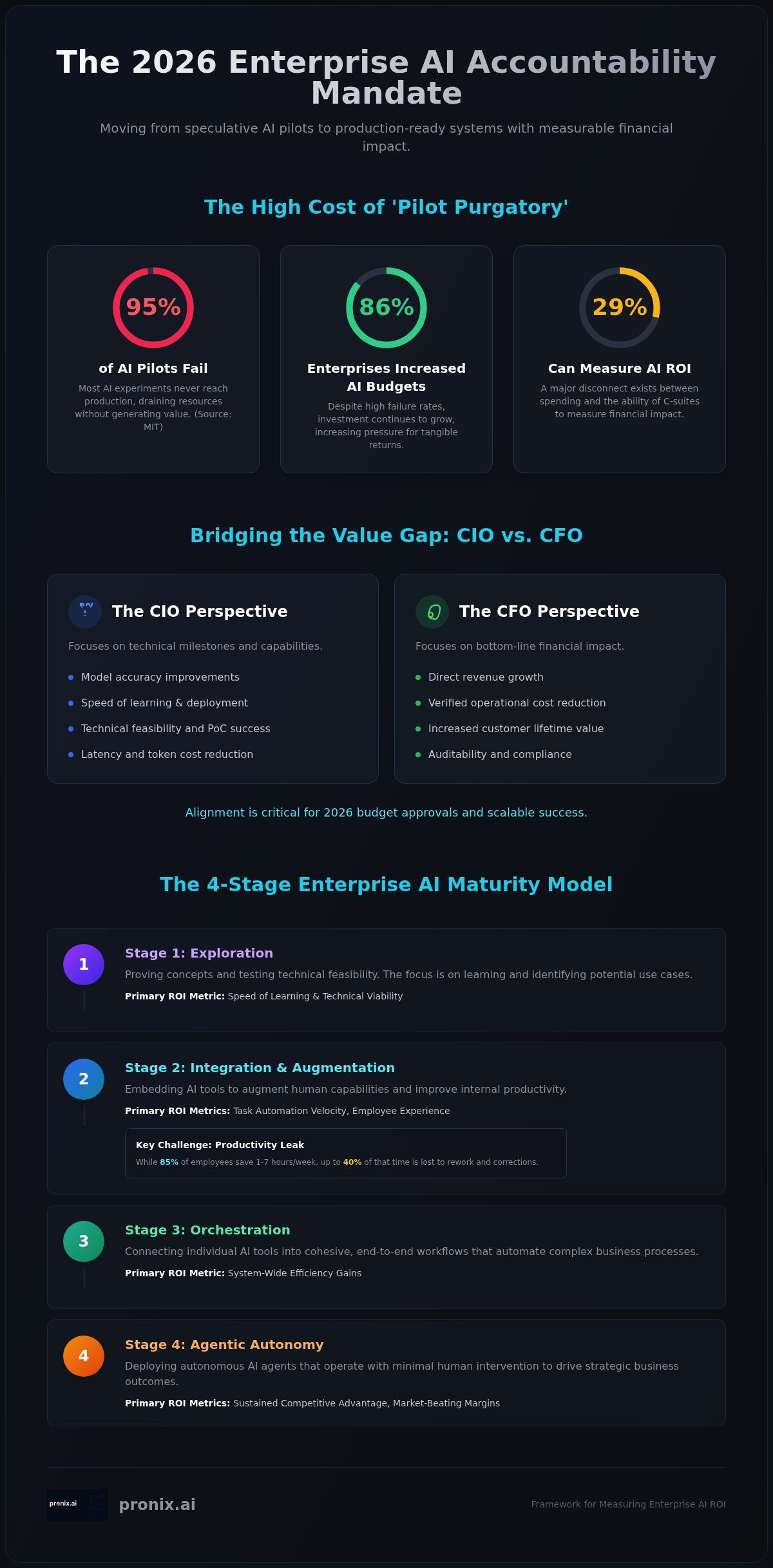
Ninety-five percent of AI pilots fail to reach production, according to recent MIT research. While 86% of enterprises increased their AI budgets over the last year, only 29% of C-suite executives can reliably measure the return on that investment. In 2026, the era of "vibe-based" experimentation is over. Success now depends on a disciplined approach to measuring ROI of enterprise AI that connects technical milestones directly to the bottom line. Speculative spending must give way to evidence-based governance and operational maturity.
You likely feel the mounting pressure to move beyond impressive demos and start showing real financial impact. It's frustrating to watch upfront costs climb while value realization remains a distant milestone on a roadmap. We understand that alignment between technical pilots and business outcomes is often the missing link in large-scale transformations. This article provides a repeatable framework to bridge that gap. You'll learn how to shift from speculative pilots to production-ready outcomes using a rigorous maturity model. We'll examine specific KPIs for autonomous agents and the operational metrics needed to justify your 2026 AI roadmap with total confidence.
Key Takeaways
- Transition from speculative experimentation to the 2026 accountability mandate by aligning AI investments with probabilistic financial outcomes.
- Identify your current stage in the 4-stage Enterprise AI Maturity Model to ensure your success metrics match your operational reality.
- Master a rigorous framework for measuring ROI of enterprise AI that differentiates between immediate cost savings and long-term strategic value.
- Implement a five-step execution plan to bridge the gap between technical pilots and scalable, production-ready business results.
- Leverage managed services to establish the governance and auditability required to prevent ROI erosion as your AI ecosystem evolves.
The 2026 Accountability Mandate: Why "Vibe-Based" AI Spending Fails
The period of unbridled AI experimentation has ended. In 2024, enterprises poured capital into Large Language Models based on potential. By 2026, the focus has shifted toward rigorous accountability. Boards now demand proof that these investments move the needle on profitability. Traditional Return on investment (ROI) models often fail here because they were built for deterministic software. Unlike a standard ERP rollout where an input leads to a predictable output, AI outcomes are probabilistic. This shift requires a new approach to measuring ROI of enterprise AI that accounts for model drift, token costs, and human-in-the-loop latency. We're moving away from vanity adoption metrics like login counts. In 2026, the only metrics that matter are direct revenue growth and verified cost reduction.
The High Cost of Pilot Purgatory
Most organizations are stuck in a cycle of perpetual experimentation. IBM reports that 95% of AI pilots never reach full production. This "Pilot Trap" creates a massive financial drain without generating a single dollar of realized value. Vibe-Based Spending is investment driven by FOMO rather than functional KPIs. To break this cycle, leaders must address three primary friction points: fragmented governance, entrenched data silos, and internal talent gaps. When projects stay in the lab too long, the opportunity cost grows. Real value only appears when an agentic system handles live traffic and automates actual business processes. Scaling requires moving beyond the "wow factor" of a demo to the "work factor" of a production environment.
The CFO vs. CIO Value Gap
A fundamental disconnect exists between technical milestones and financial reporting. A CIO might celebrate a 20% improvement in model accuracy. However, a CFO only cares how that accuracy reduces operational overhead or increases customer lifetime value. Aligning these perspectives is critical for 2026 budget approvals. Every technical pilot must be fluent in board-level objectives. This requires a shift toward auditability and transparency. Decisions must be backed by evidence-based success rather than speculative promises. If an AI agent can't be audited for compliance and financial impact, it isn't production-ready. Leaders must establish a baseline of current-state metrics before deployment to ensure every gain is documented and defensible during quarterly reviews.
The Enterprise AI Maturity Model: Mapping ROI Stages
ROI is not a static calculation. It's a moving target that evolves alongside your technical capability. To avoid the pilot trap, you must align your expectations with a structured maturity model. We categorize this journey into four distinct stages: Exploration, Integration, Orchestration, and Autonomous. This structure aligns with the Enterprise AI ROI Value Framework, which helps leadership teams move from tactical experiments to strategic transformation. At Stage 1 (Exploration), success is measured by technical feasibility and speed of learning. By Stage 4 (Autonomous), the definition of success shifts toward sustained competitive advantage and market-beating operational margins.
Stage 1 & 2: Efficiency and Augmentation
In the initial phases, measuring ROI of enterprise AI focuses primarily on "Time-to-Value" and internal productivity gains. Stage 1 is about proving the concept. Stage 2 (Integration) moves toward augmenting human capabilities through embedded tools. Here, ROI is calculated by tracking employee experience and the velocity of task automation. For example, 2026 research from Workday shows that 85% of employees save between one and seven hours per week using AI tools. However, nearly 40% of those savings are often lost to rework. Success at this stage means reducing that correction time through better prompt engineering and cleaner data. Many enterprises also find significant ROI by using AI to refactor legacy code, which modernizes the data foundation and reduces technical debt. If you're evaluating your current position, our Enterprise AI maturity model serves as an excellent selection framework for choosing a strategic partner.
Stage 3 & 4: Orchestration and Agentic Autonomy
The most significant financial impact occurs when you transition from individual tools to interconnected systems. Stage 3 (Orchestration) involves weaving AI into complex, cross-departmental workflows. Stage 4 (Autonomous) represents the pinnacle of maturity, where you deploy Agentic AI implementation services to manage end-to-end business processes with minimal intervention. According to a 2026 Google Cloud report, 74% of executives using AI agents in production reported positive ROI within the first year. These autonomous agents drive compound returns by providing 24/7 intelligent processing and eliminating human bottlenecks. This shift changes the fundamental unit of value. You're no longer measuring "per-seat" software costs. You're measuring "per-outcome" business value, such as cost per resolved claim or revenue per automated lead. For those looking to accelerate this transition while maintaining stability, Enterprise AI Managed Services can provide the operational maturity required to scale these advanced agentic systems.
Quantifying Value: Hard ROI vs. Soft ROI in Agentic AI
Effective valuation in 2026 requires a binary view of success. You must distinguish between immediate cash flow improvements and the strategic enablement that secures future market share. While 76% of enterprises prioritize cost savings as their primary metric, the most successful organizations use a balanced scorecard that weights both hard and soft returns. Achieving a complete picture of measuring ROI of enterprise AI means looking past simple efficiency to find where AI creates new, scalable revenue streams.
Hard ROI: Direct Financial Impact
Hard ROI delivers direct, auditable financial impact. Labor arbitrage remains the most visible driver. Instead of simple headcount reduction, 2026 leaders focus on redirecting talent to high-value tasks that AI cannot yet replicate. Operational efficiency is achieved by reducing resource consumption in contact centers and back-office functions. McKinsey research indicates that companies implementing enterprise AI see revenue increases between 3% and 15%. This revenue acceleration is driven by AI-powered lead conversion and hyper-personalization at scale. When you automate a core business process, the financial return is immediate and measurable through reduced cost-per-transaction.
Soft ROI: Strategic and Cultural Gains
Soft ROI is the strategic enablement that precedes financial capture. These gains are often intangible but serve as the foundation for long-term stability. Employee morale and retention improve significantly when you eliminate repetitive drudge work through automation. High-performing teams use AI to modernize their internal culture, positioning responsible AI adoption as a market differentiator. Brand reputation also sees a lift when customers experience faster, more accurate service. While harder to quantify on a balance sheet, these cultural shifts reduce recruitment costs and improve organizational agility.
Focusing on AI-driven CX modernization provides a clear path to both value types. Agentic AI reduces the cost-per-interaction by handling complex, multi-step queries without human intervention. This increases customer satisfaction while simultaneously lowering overhead. Key KPIs for CX modernization include:
- Cost per resolved interaction: The total spend required to close a customer ticket.
- First-contact resolution (FCR) rate: The percentage of issues solved by an agentic system on the first attempt.
- Customer Satisfaction Score (CSAT): Real-time sentiment analysis of automated interactions.
- Lead-to-opportunity conversion velocity: The speed at which AI agents qualify and move prospects through the funnel.
ROI is not permanent. Value decay occurs when models drift or data foundations degrade over time. Continuous governance through managed services is essential to prevent this erosion. Without proactive management, the initial gains of an autonomous agent can evaporate within six months as business logic changes. Consistent measuring ROI of enterprise AI requires a partner who ensures your systems stay optimized and compliant as the technological landscape evolves.
Overcoming the Production Gap: Scaling ROI at Enterprise Level
Scaling AI beyond a single department requires a systematic transition to a production-ready ROI model. The move from a successful pilot to an enterprise-wide deployment is where most initiatives stall. In 2026, success is defined by your ability to move from isolated use cases to a unified, scalable architecture. This process requires a five-step execution plan that prioritizes stability and auditability over speculative speed.
Step 1-3: Foundation, Governance, and Integration
The first three steps focus on the structural integrity of your AI ecosystem. You must begin by refining your data assets. A comprehensive enterprise data strategy for AI ensures your models operate on high-fidelity information. This directly impacts the bottom line by lowering token costs and reducing the frequency of hallucinations. Step two involves implementing a "Responsible AI" governance framework. This protects your ROI from regulatory risks and brand damage by ensuring every autonomous decision is auditable. Step three is seamless integration. Your AI agents must be woven into existing enterprise workflows, including Salesforce, AWS, and Microsoft platforms. Without deep integration, AI remains a siloed tool rather than a core business driver.
Step 4-5: Scaling and Continuous Optimization
The final phases move the organization from tactical wins to strategic orchestration. Step four is cross-functional scaling, where AI agents manage workflows that span multiple departments. This creates compound value that a single-use pilot cannot match. Step five is continuous optimization. Because AI models are probabilistic, they require constant monitoring and retraining to maintain peak performance. Most enterprises struggle here because of a significant internal skills gap. Utilizing "Managed Talent" allows you to bridge this gap without the overhead of massive internal hiring. Managed services provide the specialized oversight needed to monitor drift and retrain models as business logic evolves.
When measuring ROI of enterprise AI, you must calculate the Total Cost of Ownership (TCO) against long-term gains. This includes infrastructure spend, consumption fees, and the human-in-the-loop costs required for safety. While the initial investment is substantial, the long-term ROI is driven by the system's ability to handle increasing volumes without a linear increase in operational headcount. To ensure your initiatives reach this level of maturity, consider engaging with Agentic AI Strategy & Consulting to build a production-ready roadmap.
Securing Long-Term Value: The pronix.ai Managed Services Advantage
Transitioning from a technical pilot to a production environment is the most significant hurdle in the 2026 AI lifecycle. Pronix.ai serves as the strategic partner for organizations looking to bridge this gap. We focus on measuring ROI of enterprise AI through the lens of operational stability and long-term auditability. While many firms can build a demo, few can manage the rigors of a live, agentic ecosystem. Our approach moves beyond the initial deployment to ensure your investment delivers sustained financial impact month after month.
Managed Services for Sustained ROI
AI systems are probabilistic and prone to drift. Without constant oversight, the ROI realized in the first quarter can quickly erode as business logic or data inputs change. Our Enterprise AI Managed Services provide the proactive governance required to prevent this decay. We monitor model performance in real-time and retrain agents to keep them aligned with your evolving business objectives. This reduces your internal operational costs by outsourcing the heavy lifting of AI infrastructure management. For organizations focused on continuous CX modernization, this means your contact centers stay ahead of the curve without requiring a massive internal DevOps team to maintain the underlying architecture.
Immediate scaling often hits a wall due to the global AI skills shortage. To solve this, we offer Enterprise AI Talent as a Service. This model provides your team with immediate access to seasoned practitioners who understand data architecture, automation frameworks, and governance. You gain the specialized expertise needed to scale production outcomes without the six-month delay of traditional executive search and onboarding.
Strategic Consulting: Your AI Roadmap
Success starts with alignment. Our Agentic AI Strategy & Consulting services help you identify which stage of the maturity model your organization currently occupies. We then tailor an investment strategy that matches your specific readiness level. Pronix.ai brings deep vertical expertise in healthcare, finance, and manufacturing, ensuring that your AI roadmap is grounded in your industry's specific regulatory and operational realities. We don't just implement technology; we build the frameworks that make measuring ROI of enterprise AI a transparent, board-ready process.
The 2026 outlook is clear. The market has no more patience for speculative experimentation. Only governed, production-ready AI systems will deliver the positive ROI required to justify continued spend. It's time to transition your AI strategy from "vibe-based" promises to evidence-based outcomes. Contact pronix.ai today to secure your path from pilot to production and turn your AI vision into a measurable business asset.
Scaling Production Outcomes: Your 2026 AI Roadmap
The transition from speculative experimentation to operational maturity is the defining challenge for enterprise leaders this year. Success requires a departure from vanity metrics and a commitment to a rigorous maturity model that aligns technical milestones with financial reporting. By focusing on production-ready outcomes and addressing the production gap through structured governance, you ensure that your investments deliver tangible financial impact. Measuring ROI of enterprise AI has evolved into a disciplined process that demands both strategic vision and technical precision.
Pronix.ai has transitioned dozens of enterprises from stagnant pilots to high-performing production environments. We specialize in Agentic AI and CX Modernization, bringing deep technical expertise across AWS, Microsoft, Salesforce, and Genesys to every engagement. Our managed services provide the stability and auditability needed to secure long-term value in an increasingly complex landscape. It's time to replace uncertainty with evidence-based results and move your initiatives forward with total confidence.
Move your AI agents from pilot to production with pronix.ai and build a foundation for sustainable growth. We're ready to help you lead the next era of enterprise transformation.
Frequently Asked Questions
How do you measure the ROI of Agentic AI compared to traditional GenAI?
Agentic systems are measured by their ability to close business outcomes autonomously. While traditional GenAI focuses on assistance and drafting, Agentic AI ROI is calculated by the success rate of complex, multi-step workflows. We move from measuring "time saved" to measuring "cost per resolved transaction." This shift is essential for measuring ROI of enterprise AI at the orchestration level. It requires tracking the success rate of autonomous decisions against human benchmarks.
What is the average time-to-value for enterprise AI implementation in 2026?
Time-to-value varies by the specific use case. Process automation projects targeting cost reduction typically show positive returns within 9 to 15 months after full deployment. However, infrastructure investments like LLM platforms often require 18 to 30 months to break even. Quick wins are found in AI copilot tools, which can demonstrate measurable productivity gains within 60 to 90 days. These timelines depend heavily on the maturity of your data foundation and governance readiness.
Should we focus on labor cost reduction as our primary ROI metric?
Labor cost reduction is a valid starting point, but it shouldn't be your only focus. A 2026 report from Battery Ventures found that 76% of enterprises track cost savings, yet revenue generation is becoming a primary metric for top performers. McKinsey research indicates that companies in the top quartile of AI adoption generate 3 to 5 times better returns by focusing on revenue growth and sales ROI rather than just headcount reduction.
How does the Enterprise AI Maturity Model help in securing budget approval?
The maturity model provides a structured framework for setting executive expectations. It prevents the "pilot trap" by defining what success looks like at each phase of implementation. When you present a roadmap that transitions from technical feasibility to autonomous business value, you build trust with the board. This alignment ensures that budget is allocated based on specific, time-bound milestones rather than speculative promises or technological hype. It turns AI spend into a predictable investment.
What are the biggest risks that destroy AI ROI in large organizations?
ROI is primarily destroyed by the "Production Gap." When 95% of pilots fail to reach deployment, the upfront investment becomes a total loss. Other risks include model drift, where accuracy declines over time, and fragmented data silos that increase token consumption. Regulatory non-compliance can also lead to significant fines. Successful measuring ROI of enterprise AI requires proactive governance to mitigate these operational and financial risks before they escalate into systemic failures.
Can soft ROI metrics like employee satisfaction be quantified for the board?
You can quantify soft ROI by connecting employee sentiment to operational stability. Workday research shows employees save between one and seven hours per week with AI. You can translate this into reduced burnout and lower turnover rates. When you show the board that AI reduces "drudge work," you're presenting a strategy for lowering recruitment costs and maintaining institutional knowledge. This strategic enablement is a necessary precursor to achieving long-term financial capture.
Why do 95% of AI pilots fail to deliver measurable ROI?
Most pilots fail because they are built as isolated experiments without a clear path to production. They often lack the governance, data architecture, or internal talent needed to scale across the organization. Many initiatives are driven by FOMO rather than functional KPIs. Without a rigorous framework to align technical pilots with business outcomes, these projects remain stuck in "pilot purgatory," consuming resources without ever impacting the bottom line or the customer experience.
How do managed services help in maintaining AI ROI after deployment?
Managed services prevent "value decay" by providing continuous oversight. AI models are not "set and forget" systems; they require constant monitoring to ensure they remain aligned with shifting business logic. By outsourcing the complexity of model retraining and infrastructure management, you maintain peak performance and lower your Total Cost of Ownership. This ensures that the ROI achieved at launch doesn't evaporate as your data, user behavior, or market conditions evolve over time.