

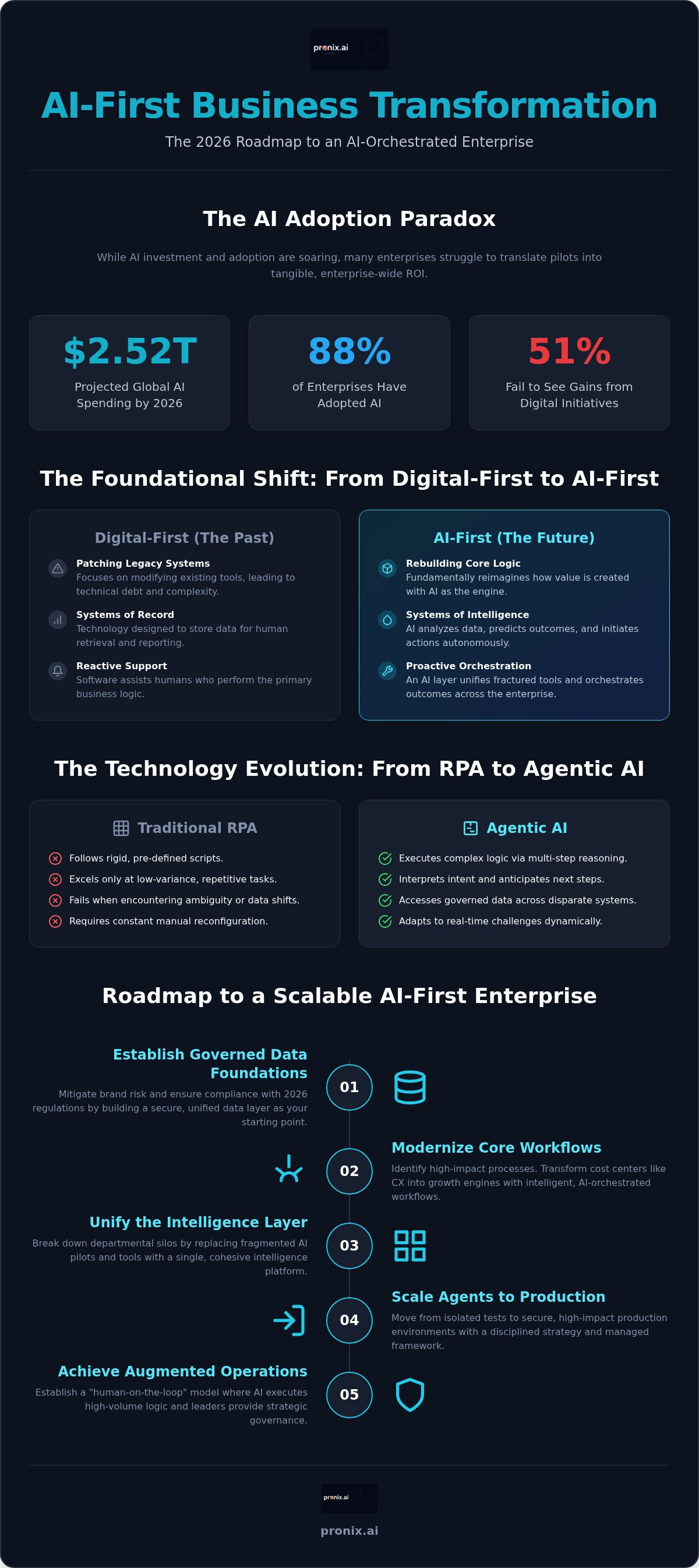
With global AI spending forecasted to reach $2.52 trillion in 2026, the pressure to deliver measurable results has never been higher. Yet, while 88% of enterprises have adopted AI, many still struggle with departmental silos and stagnant ROI from their legacy digital investments. You've likely seen the friction where experimental pilots fail to reach production because of data gaps or governance fears. It's a common challenge for leaders who want innovation but prioritize stability and brand reputation. To win in this environment, your organization requires a comprehensive AI-first business transformation that moves beyond simple task automation.
We promise to show you how to rebuild your core business logic around autonomous agents and governed data foundations. This transition from software-assisted workflows to an AI-orchestrated enterprise is the only way to achieve sustainable operational maturity. In this roadmap, we'll detail a clear framework for AI-first leadership. We will outline the path to reducing operational costs through intelligent workflows and provide a scalable strategy to move your agents from isolated tests into secure, high-impact production environments. You'll learn how to align with the latest transparency obligations while turning AI into your primary driver of enterprise value.
Key Takeaways
- Learn how to shift from digital-first to a true AI-first business transformation by reinventing your core logic rather than just patching legacy systems.
- Discover how Agentic AI serves as the backbone for an augmented operating model, enabling autonomous execution of complex business tasks.
- Explore strategies for CX modernization that turn traditional cost centers into growth engines through intelligent, AI-orchestrated workflows.
- Understand the critical role of governed data foundations in mitigating brand risk and ensuring compliance with 2026 AI regulations.
- Identify a clear path from isolated AI pilots to scalable production outcomes using a disciplined strategy and managed services framework.
Beyond Digitalization: Defining the AI-First Business Transformation
Digitalization was about speed. It focused on moving paper to pixels and local servers to the cloud. But modifying legacy systems only takes an organization so far. We are now entering a technological revolution that demands a fundamental rebuilding of business logic. This shift represents the core of AI-first business transformation. It isn't an add-on to your existing tech stack. It's a complete reimagining of how your company creates value. In an AI-first model, technology doesn't just support the business; it drives the business.
An AI-first business treats artificial intelligence as the primary engine of decision-making and execution. Traditional organizations rely on systems of record, platforms designed to store data for human retrieval. AI-first organizations build systems of intelligence. These systems don't just store data. They analyze it, predict outcomes, and initiate actions autonomously. By 2026, the gap between those who simply digitize and those who truly transform will become an unbridgeable chasm. Success requires moving from reactive software to proactive, intelligent agents.
The Failure of Digital Reformation
Many digital investments haven't paid off. Research indicates that 51% of companies fail to see performance gains from their digital initiatives. This often stems from the silo trap. Departments launch isolated AI pilots that solve small problems but don't communicate across the enterprise. These fractured efforts increase technical debt and operational complexity. AI-first transformation solves this by replacing fragmented tools with a unified intelligence layer. It moves your team away from managing software and toward orchestrating outcomes. You stop patching old holes and start building new foundations.
The Augmented Enterprise: AI as a Core Competency
The augmented enterprise doesn't replace people. It amplifies human creativity with machine precision. We're moving from a human-in-the-loop model, where people do the work and AI helps, to a human-on-the-loop governance structure. In this model, AI executes the high-volume business logic while leaders provide oversight and strategic direction. This shift is essential for driving exponential growth. Incremental improvements are no longer enough to stay competitive. When AI becomes a core competency, your organization gains the ability to scale without a linear increase in headcount or cost. It creates a leaner, more responsive operating model that adapts in real time to market shifts.
The Mechanics of the Agentic Enterprise: Rebuilding the Operating Model
The 2026 roadmap requires more than just better software. It demands a new architectural backbone: Agentic AI. Unlike traditional automation, which follows rigid scripts, autonomous agents execute complex business logic by reasoning through multi-step workflows. Success in an AI-first business transformation depends on your ability to move from static software interfaces to dynamic, agent-led orchestration. This shift changes the operating model from one where humans manage tools to one where humans govern outcomes. Focusing on building enterprise AI agents ensures your transformation results in scalable, production-ready outcomes rather than perpetual pilots.
From Passive Tools to Active Agents
Traditional Robotic Process Automation (RPA) excelled at repetitive, low-variance tasks. However, RPA fails when it encounters ambiguity or shifting data formats. Agentic AI represents a leap forward by handling multi-step reasoning in production environments. These agents use platforms like Salesforce Agentforce and AWS Bedrock to interpret intent, access governed data, and take initiative across disparate systems. They don't just wait for a command. They anticipate the next step in a business process. This transition from passive software to active agents is the defining characteristic of the augmented enterprise. It allows your infrastructure to adapt to real-time challenges without constant manual reconfiguration.
Enterprises ready to scale these capabilities should consider professional Agentic AI Implementation to bridge the gap between strategic vision and technical execution.
AI-First Leadership and the Midlevel Pivot
Transformation often stalls in the middle of the organization. While executives set the vision, midlevel leaders are the primary drivers of execution. An AI-first business transformation requires these leaders to develop new capabilities. They must move beyond managing task completion to mastering agent orchestration and data ethics. This cultural shift is significant. Leaders must learn to trust autonomous systems while maintaining rigorous oversight. The goal is a "human-on-the-loop" approach where managers focus on high-level strategy and exception handling. Governance becomes the new management. By prioritizing AI literacy at the midlevel, you ensure that the operating model remains stable as it becomes more intelligent.
- AI Literacy: Understanding the capabilities and limitations of specific agentic architectures.
- Data Ethics: Ensuring agents operate within legal and brand safety boundaries.
- Agent Orchestration: Coordinating multiple AI systems to work toward a unified business objective.
This leadership evolution prevents the "silo trap" mentioned earlier. It creates a cohesive environment where every department contributes to a single, integrated system of intelligence.
Reimagining Core Workflows: CX and Operational Modernization
Core workflows represent the frontline where the promise of an AI-first business transformation meets the reality of operational execution. For decades, Customer Experience (CX) and supply chain management functioned primarily as cost centers. Executives prioritized containment over expansion. By 2026, this paradigm has shifted completely. Advanced AI-driven CX modernization allows these departments to function as growth engines by anticipating customer needs and identifying upsell opportunities before a human agent even gets involved.
Transitioning from reactive support to proactive engagement requires a complete overhaul of legacy foundations. Traditional contact centers built on AWS, Genesys, or NICE platforms are being augmented with agentic intelligence. This isn't just about adding a basic chatbot to a website. It's about creating a system that understands deep intent and executes resolution without manual intervention. This move toward an augmented enterprise model ensures that every interaction adds value rather than just resolving a ticket.
Modernizing the Enterprise Contact Center
Legacy IVR systems often frustrate users with rigid menus and limited understanding. Modern AI-first systems replace these with intent-aware conversational agents that process natural language with high precision. By implementing agentic workflows, organizations significantly reduce Average Handle Time (AHT) while simultaneously improving Customer Satisfaction (CSAT) scores. Integrating platforms like Salesforce and Kore.ai ensures a seamless omni-channel experience. The customer's context follows them across every touchpoint, from social media to voice calls. This ensures a unified brand voice and prevents the friction of repeating information.
Intelligent Workflow Automation in Regulated Industries
Operational modernization extends far beyond the contact center. In regulated industries like healthcare, AI agents manage complex patient journeys by coordinating appointments, insurance verification, and follow-up care. In finance, these systems provide real-time fraud detection and compliance monitoring, moving faster than human auditors. Manufacturing and supply chain sectors also see massive gains. AI-first business transformation drives efficiency by using agent orchestration to manage cross-functional logic. This includes:
- Predictive Maintenance: Identifying equipment failure before it causes downtime.
- Inventory Optimization: Automatically adjusting stock levels based on real-time demand signals.
- Compliance Automation: Ensuring every step of the supply chain meets regulatory standards without manual auditing.
This level of automation ensures that complex business logic remains consistent across the entire enterprise, regardless of departmental silos. It turns operational maturity into a competitive advantage that scales without increasing headcount.
The Roadmap to Production: Governance, Data, and Scale
Moving from "pilot purgatory" to production-ready outcomes requires a fundamental shift in focus. Many organizations treat AI as a standalone tool. In reality, a successful AI-first business transformation depends on a robust infrastructure that supports scale, security, and auditability. You can't scale what you can't govern. By 2026, the standard for production-ready AI isn't just performance; it's reliability and compliance. Transitioning to an augmented enterprise means moving beyond experimental code to a hardened, enterprise-grade operating environment.
Building the Data Foundation
The "garbage in, garbage out" mantra remains the primary killer of AI initiatives. Research indicates that data preparation can consume 50-70% of project time and up to 35% of the total budget. To succeed, you must implement a modern enterprise data strategy for AI. This involves moving away from stagnant data lakes toward AI-ready data fabrics. These fabrics provide the real-time access autonomous agents need to execute business logic accurately. Without a clean, governed data layer, your agents will struggle with outdated information, leading to hallucinations and operational friction. You stop being a data collector and start being a data orchestrator.
Enterprise-Grade Governance and Risk Mitigation
Governance isn't a hurdle. It's a safety net for your brand. As of August 2, 2026, the EU AI Act mandates strict transparency obligations under Article 50. Non-compliance carries heavy penalties, with fines reaching up to €15 million or 3% of global turnover. US state-level regulations, such as the Illinois Artificial Intelligence Safety Measures Act passed in July 2026, further emphasize the need for rigorous oversight. A responsible AI adoption strategy must include technical guardrails that prevent bias and ensure every agentic decision is auditable. This transparency is vital for maintaining trust in regulated environments like healthcare and finance.
Managing these complexities requires specialized oversight. Choosing managed services for agentic AI ensures that your systems remain compliant as regulations evolve. This approach provides the continuous monitoring needed to mitigate risk while your team focuses on high-level growth. It's about moving from a reactive posture to a proactive governance model that protects your reputation. If you're ready to stabilize your production environment, consider our Data & AI Foundations services to build a secure, scalable intelligence layer.
Partnering for the Intelligence Revolution: The Pronix.ai Approach
Pronix.ai, the specialized AI unit of Pronix Inc., serves as the strategic partner for organizations ready to move beyond experimental pilots. We understand that an AI-first business transformation is not a single event but a continuous evolution. Our "Strategy to Managed Services" lifecycle prioritizes results over hype. We provide the elite expertise required to navigate the complexities of large-scale organizations, ensuring every technological shift is grounded in operational pragmatism. By focusing on production-ready outcomes, we help you avoid the common pitfalls of stagnant ROI and departmental silos. We don't just advise on the future; we build the infrastructure that sustains it.
From Vision to Production Outcomes
Our methodology begins with a rigorous assessment of your current data foundations and business logic. We identify the specific high-impact use cases where Agentic AI can drive immediate value. Bridging the talent gap is a critical component of our service. We deploy specialized engineering teams to handle technical execution, from model fine-tuning to API orchestration. Our deep expertise in AWS, Microsoft, and Salesforce platforms allows us to implement solutions that are both scalable and secure. We ensure your systems move from isolated tests to full production environments with minimal friction. This disciplined path ensures your innovation is always backed by a clear, evidence-based success framework. You gain the speed of a startup with the stability of an enterprise leader.
Sustaining Value with Enterprise AI Managed Services
Deployment is just the start of the journey. To maintain a competitive advantage, your autonomous agents require ongoing optimization and performance monitoring. Our Enterprise AI Managed Services provide the necessary guardrails to ensure long-term stability. We handle the heavy lifting of infrastructure management, including security patches, auditability checks, and performance tuning. This proactive approach ensures your systems remain compliant with evolving regulations while delivering consistent business value. An AI-first business transformation requires a partner who understands how to maintain intelligence at scale. We provide the maturity and readiness your enterprise needs to thrive in an augmented landscape. We secure your production environment so you can focus on strategic growth.
The transition from digital-first to AI-first is the most significant shift your organization will face this decade. Don't leave your results to chance. Schedule an AI-First Strategy Consultation with pronix.ai to begin building your roadmap to the augmented enterprise.
Mastering the Augmented Enterprise: Your Path to Production
The shift to an AI-first business transformation is no longer a choice for organizations seeking exponential growth. Success requires moving beyond isolated pilots to build a unified system of intelligence. By rebuilding your operating model around autonomous agents and governed data foundations, you turn operational complexity into a competitive advantage. This transition ensures your business logic is executed with machine precision while maintaining human oversight. It's the only way to scale without the friction of traditional digital debt.
At pronix.ai, we specialize in delivering production-ready outcomes focused on measurable ROI. Our strategic partnerships with AWS, Salesforce, and Genesys ensure your infrastructure is built on the world's most reliable platforms. We bring the high-scale, governed Agentic AI implementation expertise needed to navigate the 2026 regulatory landscape with confidence. Don't let your transformation stall in the pilot phase. It's time to stabilize your architecture and secure your lead in the intelligence revolution.
Download the 2026 Executive Guide to AI-First Transformation
The future of the enterprise is autonomous, governed, and ready for scale. We're here to help you lead it.
Frequently Asked Questions
What is the difference between digital transformation and AI-first business transformation?
Digital transformation focuses on digitizing existing manual processes to improve speed and accessibility. In contrast, an AI-first business transformation involves rebuilding core business logic around autonomous intelligence. While digital models use software to assist humans, AI-first models use humans to govern autonomous systems. This shift moves the organization from reactive systems of record to proactive systems of intelligence that execute complex workflows with minimal intervention.
How do we move our AI initiatives from the pilot stage to full production?
Transitioning from pilot to production requires shifting focus from experimental capabilities to enterprise-grade stability. You must establish a governed data foundation and implement technical guardrails that prevent hallucinations or bias. Successful organizations move beyond isolated tests by utilizing a structured roadmap that prioritizes auditability and performance monitoring. Partnering with specialists for Agentic AI Implementation ensures that your architecture is built to handle high-scale, real-world operational demands securely.
Why is Agentic AI considered the next wave of business automation?
Agentic AI represents a leap forward because it moves beyond the rigid, script-based workflows of traditional RPA. These autonomous agents use multi-step reasoning to handle ambiguity and adapt to real-time data shifts. By interpreting intent rather than just following commands, Agentic AI can orchestrate complex cross-functional tasks. This capability allows the enterprise to automate higher-level business logic, resulting in a more responsive and efficient operating model.
What are the biggest risks of AI-first transformation and how can they be mitigated?
The primary risks include brand reputation damage from unmanaged agents, data privacy breaches, and non-compliance with regulations like the EU AI Act. You can mitigate these risks by implementing rigorous AI governance frameworks and technical guardrails. These tools prevent agent bias and ensure all decisions are auditable. Utilizing Enterprise AI Managed Services provides the ongoing monitoring needed to identify and resolve performance drifts before they impact production outcomes.
How does an AI-first strategy impact customer experience (CX) modernization?
An AI-first strategy shifts CX from reactive problem-solving to proactive engagement. By implementing intent-aware conversational agents, organizations reduce average handle time while increasing customer satisfaction. This AI-driven CX modernization integrates context across every channel, from voice to social media. It transforms the contact center from a traditional cost center into a growth engine by identifying customer needs and providing personalized resolutions with machine precision.
What kind of data infrastructure is required for a successful AI-first business model?
A successful model requires a transition from stagnant data lakes to AI-ready data fabrics. This infrastructure must provide autonomous agents with real-time access to clean, governed data sets. High-quality data is the primary fuel for intelligent workflows; without it, agents produce inaccurate results. Implementing Data & AI Foundations ensures that your information architecture is scalable, secure, and capable of supporting complex decision-making across the entire enterprise.
How can regulated industries like healthcare and finance safely adopt AI-first transformation?
Regulated industries must prioritize transparency and auditability to ensure safety. Adopting an AI-first business transformation in these sectors requires strict adherence to transparency obligations, such as those outlined in the EU AI Act. Organizations should implement "human-on-the-loop" governance where AI executes logic but humans maintain strategic oversight. This approach ensures that every automated decision is traceable and compliant with industry-specific safety standards, protecting both the patient and the institution.
What is the role of a managed service provider in an AI-first journey?
A managed service provider bridges the specialized talent gap and ensures long-term operational maturity. They provide the infrastructure management needed to monitor, optimize, and secure autonomous agents in production. By handling technical complexities like performance tuning and compliance updates, an MSP allows your internal team to focus on high-level strategy. This partnership ensures that your AI initiatives remain stable, auditable, and capable of delivering consistent business value as technology evolves.