

While 88% of large organizations have deployed AI in at least one function as of August 2026, only a third have successfully scaled these systems into production. This scaling gap isn't a failure of technology. It's a failure of governance. Enterprises now realize a robust Responsible AI adoption strategy is more than an ethical checklist; it's the technical architecture required to move from experimental chatbots to autonomous agents that deliver measurable results.
You've likely seen promising pilots stall because of security risks or the complexity of auditing non-deterministic outputs. This represents a significant friction point for executives who prioritize operational maturity. This guide delivers the 2026 enterprise framework for governed autonomy. You'll master the strategic pillars required to move AI from the lab to secure, production-ready outcomes. We'll explore hardcoded guardrails, agentic governance, and how to meet the August 2, 2026, EU AI Act transparency deadlines without slowing your momentum.
Key Takeaways
- Transition from reactive ethical checklists to a proactive Responsible AI adoption strategy that integrates governance directly into your technical architecture.
- Identify the core pillars of enterprise-grade governance, focusing on auditable transparency and technical robustness to mitigate risks in production environments.
- Bridge the "Pilot Trap" by aligning your data foundations with operational guardrails to move beyond experimental AI into scalable business outcomes.
- Follow a structured five-step framework to establish cross-functional oversight and define the ethical principles guiding your autonomous systems.
- Understand how enterprise managed services ensure ongoing security, compliance, and auditability for your agentic AI implementations post-deployment.
What is a Responsible AI Adoption Strategy in 2026?
A Responsible AI adoption strategy is a structured framework that aligns AI development with ethical principles, legal requirements, and brand values. In 2026, the market has transitioned from reactive ethics to proactive governance. Leading organizations no longer treat responsibility as a set of constraints. They recognize it as the foundational architecture required for autonomous agents to function safely within enterprise environments.
The business case for this approach is pragmatic. A disciplined strategy accelerates time-to-market by minimizing legal friction and compliance delays. By embedding Trustworthy AI principles into the initial design, executives reduce the risk of post-deployment failures. This shift moves the enterprise beyond "safe chat" toward "governed autonomy" that produces measurable results.
The Evolution of AI Responsibility
The move from Generative AI to Agentic AI has fundamentally changed the risk landscape. Generative systems were designed to create content. Agentic systems are designed to take action. This evolution makes traditional software governance ineffective. Standard testing cannot account for non-deterministic outputs where an agent might choose different paths to reach the same goal.
Scaling these systems requires a transition from "Human-in-the-loop" to "Human-on-the-loop" oversight. Direct manual intervention is no longer feasible at scale. Instead, humans must occupy a monitoring role, intervening only when agents exceed their operational guardrails. This requires new technical frameworks for real-time observability and intervention.
Key Objectives of a Modern Strategy
A modern Responsible AI adoption strategy focuses on three primary objectives to ensure production readiness:
- Auditability: Every autonomous action must be traceable. Organizations must be able to explain the logic behind an agent's decision to satisfy both regulators and internal stakeholders.
- Bias Mitigation: AI-driven CX modernization must remain fair. Automated testing protocols are essential to detect and correct algorithmic bias before it impacts the customer experience.
- Data Privacy: Enterprise automation often handles sensitive information. A mature strategy ensures data residency and anonymization are hardcoded into agentic workflows to prevent leakage.
The Core Pillars of Enterprise-Grade AI Governance
Governance is the engine of a successful Responsible AI adoption strategy, not the brake. While experimental pilots focus on capability, enterprise production focuses on reliability. To scale autonomous agents effectively, organizations must build their frameworks on four foundational pillars: transparency, robustness, fairness, and accountability. These pillars ensure that AI systems remain predictable even as they operate with increasing independence.
Transparency requires moving beyond "black box" models. Stakeholders must understand the specific logic path an agent follows to reach a conclusion. Robustness involves hardening systems against adversarial attacks and prompt injections that could compromise enterprise data. Organizations should align their internal controls with the NIST AI Risk Management Framework to establish a defensible security posture. Fairness demands continuous monitoring to detect algorithmic bias before it reaches the customer. Finally, accountability defines clear human ownership for every autonomous outcome, ensuring that no action occurs in a legal or operational vacuum.
Technical Guardrails for Agentic AI
Deploying agents that can trigger API calls or modify databases requires hardcoded operational boundaries. These technical guardrails prevent agents from exceeding their authorized scope, such as spending limits or data access permissions. Implementing automated "Kill Switches" and rollback procedures allows teams to halt agentic activity instantly if a deviation is detected. Governed Autonomy is the precise equilibrium where AI execution speed is maximized without exceeding enterprise safety parameters. Building these foundations requires deep technical expertise in Agentic AI implementation to ensure every automated workflow is auditable by design.
Governance in Regulated Industries
Regulated sectors face unique challenges when moving AI into production. In healthcare, AI-driven CX modernization must maintain strict HIPAA compliance, ensuring that autonomous agents never expose protected health information during patient interactions. Financial services firms must meet SEC and FINRA auditability requirements, which demand a complete trail of every automated decision.
To build audit-ready AI foundations for 2026 standards, organizations must implement real-time logging and version control for all agentic prompts and weights. This level of discipline transforms compliance from a hurdle into a competitive advantage. It allows firms to deploy sophisticated automation with the confidence that every action is traceable, defensible, and fully aligned with global regulatory expectations.
Moving from AI Pilots to Governed Production Outcomes
The "Pilot Trap" is the graveyard of enterprise innovation. While many organizations successfully launch initial tests, industry trends suggest roughly 80% of AI initiatives fail to reach full-scale production. This stagnation occurs because teams lack a comprehensive Responsible AI adoption strategy to manage the transition from a controlled lab to a live environment. Lab-safe experiments focus on capability, but production-ready outcomes require stability and risk mitigation. Moving beyond the pilot phase demands a shift from testing what's possible to proving what's reliable.
Scaling requires a deep assessment of your current AI maturity. You must identify gaps in your data foundations and governance structures before moving to deployment. Integrating these requirements into your AI-first business transformation roadmap ensures that responsibility isn't an afterthought. It becomes a core architectural requirement that enables enterprise-wide deployment. By prioritizing auditability from day one, you build a system that stakeholders can trust at scale.
Risk-Based Use Case Prioritization
Enterprise leaders should categorize AI agents by their potential impact. Low-risk agents, such as those handling internal documentation queries, serve as ideal "Quick Wins." These projects demonstrate responsible value in CX modernization and build stakeholder trust without exposing the firm to high-stakes errors. High-risk deployments, particularly those involving "Black Box" logic in financial or medical workflows, require much tighter oversight. You need clear visibility into an agent's reasoning before granting it autonomy over sensitive operations.
Operationalizing the Governance Framework
Manual oversight is a bottleneck that prevents scaling. To move forward, you must transition to automated compliance checks. This includes implementing rigorous "AI Red Teaming" within your production environments. Red teaming proactively identifies vulnerabilities and prompt injections, ensuring your agents remain within their defined boundaries. This technical approach bridges the gap between data engineering and ethical oversight. It turns your governance policy into a functional, auditable asset that protects the brand while accelerating implementation.
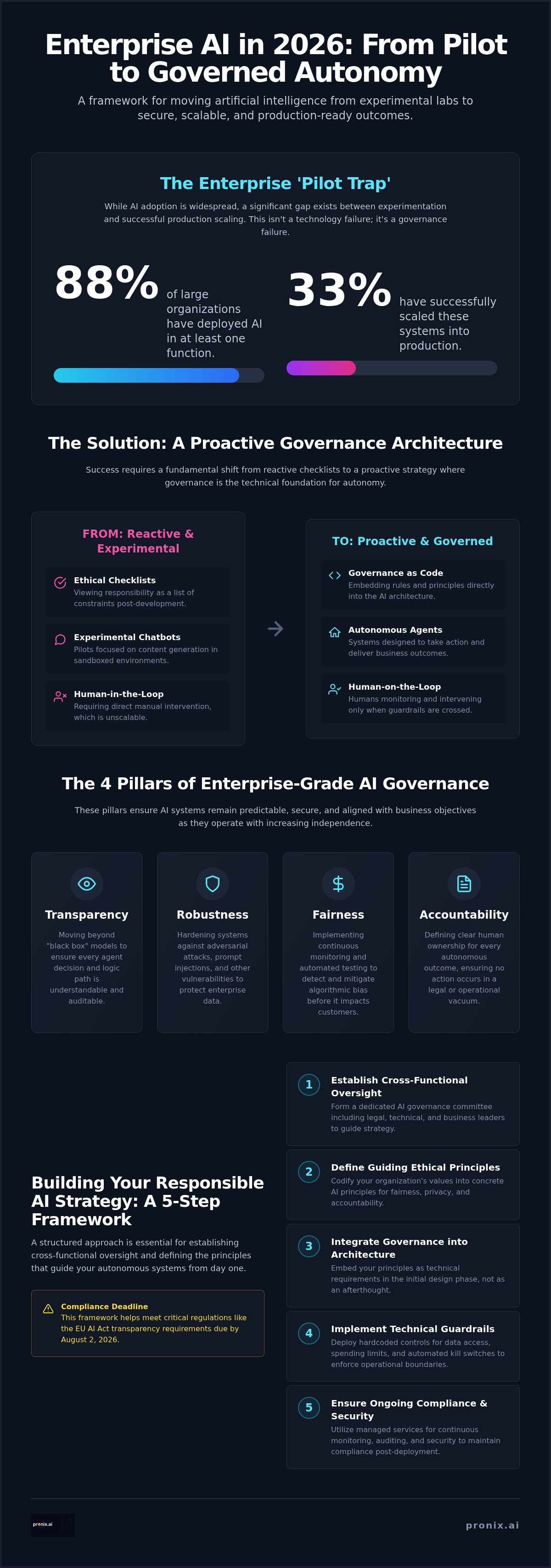
Building Your Responsible AI Adoption Strategy: A 5-Step Framework
A successful Responsible AI adoption strategy requires a methodical, multi-layered approach that prioritizes stability over hype. Organizations must move beyond theoretical ethics to implement a functional framework that supports autonomous action. This five-step process provides the roadmap for transitioning from experimental pilots to production-ready enterprise outcomes. It ensures that every deployment is backed by a rigorous governance structure.
- Step 1: Define Ethical Principles and Operational Guardrails. Establish the core values that will guide AI behavior. Principles define the "why," while guardrails provide the technical "how" for maintaining safety.
- Step 2: Establish a Cross-Functional AI Governance Committee. Bring together leaders from legal, IT, and business units. This group ensures that AI initiatives remain aligned with both regulatory requirements and commercial goals.
- Step 3: Build a Secure Enterprise Data Strategy for AI. Data is the foundation of agentic performance. A secure data architecture ensures that agents have access to high-quality, governed information without compromising privacy.
- Step 4: Implement Continuous Monitoring and Automated Auditing. Deploy tools that track agent performance in real time. Automated auditing identifies deviations from expected behavior before they escalate into systemic failures.
- Step 5: Cultivate an AI-Literate Culture Through Responsible Training. Empower your workforce to use AI safely. Training reduces the risk of "shadow AI" and ensures that employees understand their role in the governance lifecycle.
Defining Your North Star Principles
Principles must align with the corporate mission and brand reputation to be effective. This is not a static policy; it is a "Living Document" for AI ethics that evolves alongside technological advancements. In 2026, the standard for AI transparency in customer-facing roles requires explicit disclosure of AI interaction and real-time access to the agent's decision-making logic for auditors. This level of openness builds long-term trust with stakeholders and customers alike.
Automated Monitoring and Feedback Loops
Manual oversight cannot keep pace with 2026 automation volumes. Organizations need real-time alerts to detect model drift and bias in autonomous agents as soon as they occur. Implementing a "Factuality Score" for generative outputs in CX ensures that customer interactions remain grounded in verified enterprise data. User feedback mechanisms provide a final layer of safety. They allow customers to flag "Irresponsible" AI behavior, triggering immediate human intervention and system refinement. For organizations ready to operationalize these steps, Agentic AI Strategy & Consulting provides the expertise needed to build a governance-first foundation.
Operationalizing Ethics: The Role of Managed Services in AI Strategy
Developing a Responsible AI adoption strategy is an essential first step, but a strategy alone cannot govern a live production environment. High-level frameworks provide the vision. Managed services provide the execution. In the 2026 enterprise landscape, the complexity of AI orchestration requires ongoing technical oversight to ensure that ethical guardrails don't degrade after deployment. Relying solely on internal teams often leads to "governance fatigue," where maintenance takes a backseat to new feature development.
Maintaining enterprise-grade security and auditability post-deployment is a full-time operational requirement. Specialized talent is needed to manage the nuances of non-deterministic outputs and automated decision trails. This is where managed services for Agentic AI become a strategic necessity. They provide the "boots-on-the-ground" pragmatism required to keep autonomous agents aligned with brand values while maximizing speed and efficiency. pronix.ai bridges the gap between high-level vision and production outcomes, ensuring that every automated workflow remains secure, compliant, and results-oriented.
The Lifecycle of a Governed AI Agent
The operational journey starts with building enterprise AI agents, but it quickly moves into critical day-two operations. Governance is not a "set and forget" activity. It requires regular security patching and model fine-tuning to defend against emerging threats and prompt injections. Managed services proactively address "Agent Drift," a phenomenon where autonomous business workflows gradually deviate from their original parameters. Continuous monitoring ensures that agents remain within their authorized operational boundaries, preventing small errors from snowballing into systemic risks.
Partnering for Responsible Scale
Scaling AI across a global organization places a significant burden on internal IT resources. Managed governance allows these teams to focus on core business innovation while third-party practitioners handle the rigors of compliance and risk mitigation. Leveraging external expertise also provides the benefit of neutral AI auditing. This ensures that your responsibility metrics are evidence-based and defensible to external regulators. By partnering with a seasoned practitioner, you can transition from experimental AI pilots to a fully "Augmented Enterprise" with absolute confidence. This approach transforms governance from a cost center into a competitive advantage that enables faster, safer innovation.
Mastering the Transition to Governed Autonomy
Scaling AI in 2026 demands a shift from experimental curiosity to operational discipline. The Pilot Trap consumes initiatives that lack a technical foundation for ethics; however, your organization can avoid this by hardcoding guardrails and establishing cross-functional oversight. A mature Responsible AI adoption strategy ensures every agentic workflow remains auditable, secure, and aligned with your brand's mission. This transition moves your enterprise beyond "safe chat" into the high-stakes era of autonomous action.
Success requires more than high-level vision. It requires the pragmatism of specialized practitioners who manage the nuances of model drift and security patching. At pronix.ai, we provide expertise in secure Agentic AI implementation and enterprise-grade governance for CX modernization, specifically tailored for regulated industries. We bridge the gap between strategic frameworks and secure production outcomes.
The path to a fully augmented enterprise is open to leaders who prioritize stability and safety. Start building your production-ready future today.
Frequently Asked Questions
What is the difference between AI ethics and a Responsible AI adoption strategy?
AI ethics provide the philosophical "why," while a Responsible AI adoption strategy delivers the technical and operational "how." Ethics are high-level principles like fairness and transparency. The strategy translates these into hardcoded guardrails, auditable workflows, and governance committees. It's the difference between having a value system and having a functional architecture that enforces those values across an enterprise production environment.
How does a responsible AI strategy impact ROI and speed to market?
A responsible strategy accelerates time-to-market by reducing legal friction and compliance delays. By embedding governance into the initial design, organizations avoid the costly rework associated with failed pilots that can't pass security audits. ROI improves as systems move into production faster with lower risk. This disciplined approach ensures that AI initiatives deliver measurable financial impact rather than remaining trapped in experimental phases.
Can autonomous AI agents truly be governed without constant human intervention?
Governing autonomous agents in 2026 requires a "Human-on-the-loop" model supported by automated technical guardrails. Constant manual intervention isn't scalable. Instead, enterprises use real-time monitoring to trigger alerts only when agents exceed their authorized operational boundaries. This allows agents to act with governed autonomy while ensuring that human oversight is applied precisely where and when it is needed to maintain safety and compliance.
What are the biggest risks of scaling AI without a formal governance framework?
Scaling without a formal framework leads to the "Pilot Trap," where 80% of initiatives fail to reach production due to risk concerns. The biggest dangers include brand reputation damage from biased outputs and significant legal fines. Under the EU AI Act, non-compliance can reach 7% of global annual turnover. Without governance, non-deterministic AI outputs become impossible to audit, creating systemic vulnerabilities that threaten operational stability.
How do we ensure AI compliance in highly regulated sectors like healthcare?
Healthcare compliance requires hardcoding HIPAA protections and data residency rules into every agentic workflow. Every autonomous decision must have a complete, auditable trail to meet regulatory standards. Organizations should focus on "Audit-Ready" foundations that track prompt versions and data lineage in real time. Partnering with a specialized practitioner ensures that AI-driven CX modernization remains secure while handling sensitive patient information in high-stakes environments.
What role does data quality play in a responsible AI strategy?
Data quality is the bedrock of any Responsible AI adoption strategy. Non-deterministic agents rely on high-fidelity data to produce accurate, safe outcomes. Poor data foundations lead to hallucinations and biased decisions that undermine trust. A mature strategy prioritizes data architecture, ensuring that information is clean, governed, and anonymized before it reaches the model. Without quality data, even the most sophisticated governance framework will fail to deliver reliable results.
How often should an enterprise AI governance framework be updated?
Governance frameworks should be treated as living documents that require continuous monitoring. While real-time alerts track daily drift, major strategic reviews should occur at least quarterly to account for rapid technological and regulatory shifts. For instance, the August 2, 2026, EU AI Act transparency deadlines required immediate adjustments to existing frameworks. A disciplined update cycle ensures your strategy remains resilient against evolving adversarial attacks and new compliance mandates.
Does implementing responsible AI guardrails slow down the development of AI agents?
Technical guardrails may introduce minor friction during the initial design phase, but they ultimately accelerate the path to production. Without these controls, initiatives often stall indefinitely during the security review process. Hardcoding operational boundaries from day one prevents the re-engineering that occurs when pilots fail to meet enterprise-grade safety standards. Responsible governance is the engine that allows organizations to scale autonomous workflows with confidence and speed.