

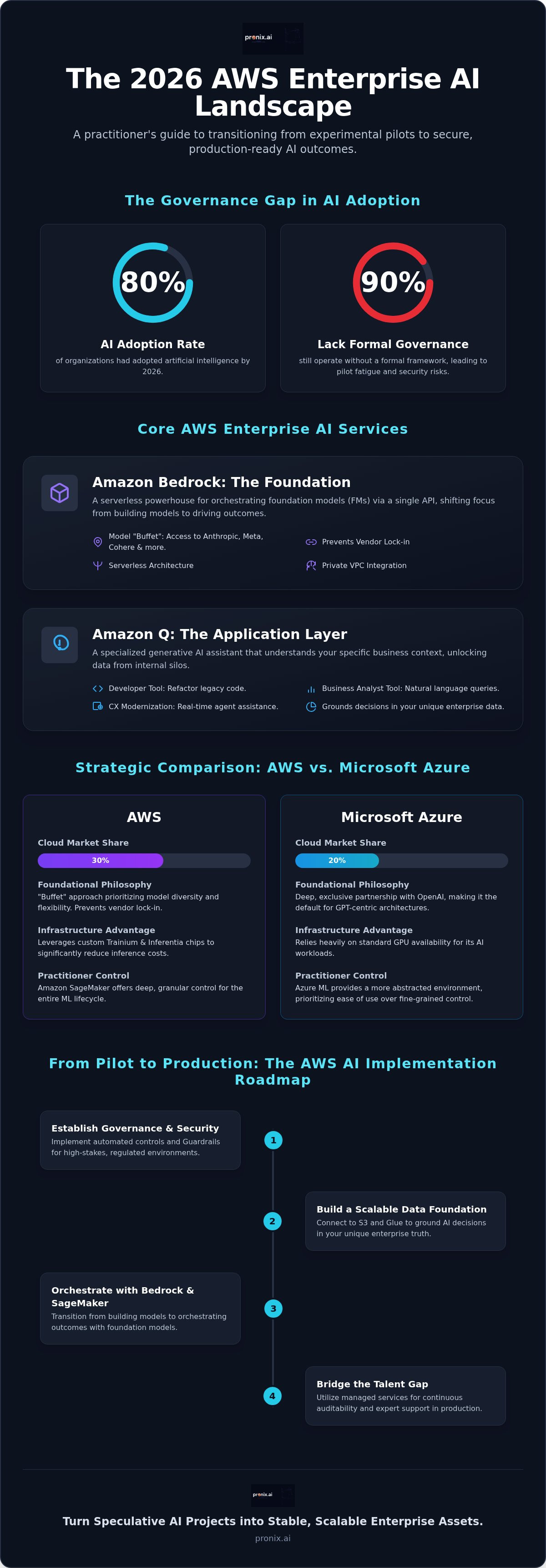
While 80% of organizations have adopted artificial intelligence in 2026, a staggering 90% still operate without a formal governance framework. This gap explains the widespread fatigue surrounding experimental pilots that fail to scale within AWS enterprise AI services. You've likely felt the friction of rising infrastructure costs and the persistent anxiety over data privacy in regulated markets. It's a common bottleneck where technical ambition hits the wall of operational maturity and security requirements.
This guide changes that trajectory. We move past the hype to deliver a practitioner-led framework for orchestrating production-ready outcomes. You'll learn how to transition from fragmented experiments to secure, governed deployments using the latest serverless architectures and Agentic AI workflows. We provide a clear roadmap for adoption, a strategic framework for comparing cloud providers, and the exact steps needed to bridge the talent gap through managed services. By the end, you'll have the blueprint to turn speculative AI projects into stable, scalable enterprise assets.
Key Takeaways
- Understand the 2026 AWS AI stack by mastering how Amazon Bedrock and SageMaker orchestrate foundation models for enterprise performance.
- Compare the strategic advantages of AWS model diversity against Microsoft Azure to maintain long-term architectural flexibility.
- Secure your AWS enterprise AI services with automated security controls and Guardrails designed for high-stakes, regulated environments.
- Follow a disciplined implementation roadmap that accelerates AI-driven CX modernization while building a scalable data foundation.
- Bridge the specialized talent gap through managed services that provide continuous auditability for your production AI outcomes.
The 2026 AWS Enterprise AI Landscape: Core Services and Capabilities
The 2026 ecosystem for AWS enterprise AI services has moved beyond the experimental phase into a standardized operational layer. Traditional machine learning workflows once required months of data engineering and custom model training. Today, foundation models (FMs) act as the pre-trained engine for the modern enterprise stack. These models allow organizations to shift their focus from building math to orchestrating outcomes. This shift is critical for building enterprise AI agents that can reason and execute tasks autonomously.
AWS provides a tiered approach to intelligence. While Amazon SageMaker remains the gold standard for practitioners who need deep control over model training and deployment, newer services prioritize speed and accessibility. The distinction is clear: SageMaker is for the lab, while Bedrock is for the factory floor. This architecture supports a serverless-first strategy, reducing the overhead typically associated with AI infrastructure.
Amazon Bedrock: The Foundation for Enterprise Generative AI
Amazon Bedrock has evolved into a serverless powerhouse. It eliminates the need to manage underlying infrastructure, allowing teams to call high-performing LLMs via a single API. In 2026, the Bedrock ecosystem offers an unprecedented "buffet" of models from providers like Anthropic, Meta, and Amazon's own Nova series. This diversity prevents vendor lock-in. Security remains paramount. Bedrock integrates natively with private VPC environments. This ensures your proprietary data never traverses the public internet, satisfying the strict requirements of regulated industries like healthcare and finance. Organizations are now leveraging these AWS enterprise AI services to deploy specialized guardrails that filter toxic content and prevent sensitive data leakage automatically.
Amazon Q: The Generative AI Assistant for Business and Developers
Amazon Q represents the application layer of the AWS AI strategy. It serves as a specialized assistant that understands your specific business context. Developers use it to refactor legacy code in minutes, while business analysts use it to query complex data silos using natural language. For leaders focused on CX modernization, Amazon Q integrates directly with Amazon Connect. It provides real-time agent assistance and automated post-call summaries. This capability transforms the contact center from a cost center into a source of actionable intelligence. By connecting Q to your internal S3 buckets and Glue crawlers, you unlock data that previously sat dormant in unindexed silos, ensuring that every AI-driven decision is grounded in your unique enterprise truth.
AWS vs. Microsoft Azure: Comparing Enterprise AI Services
Choosing between cloud giants in 2026 requires looking beyond feature lists. AWS currently holds 30% of the cloud infrastructure market, while Azure follows at 20%. The primary differentiator lies in foundational philosophy. Azure offers a deep, exclusive partnership with OpenAI, making it the default choice for GPT-centric architectures. In contrast, AWS enterprise AI services prioritize a "buffet" approach through Amazon Bedrock. This platform provides managed access to Anthropic, Meta, Cohere, and Amazon's Nova models. This flexibility is vital for AI-first business transformation, as it prevents vendor lock-in and allows enterprises to route specific tasks to the most cost-effective model.
Model Flexibility and Infrastructure Control
Bedrock's model diversity is supported by custom silicon. While Azure relies heavily on standard GPU availability, AWS leverages its own Trainium and Inferentia chips. These reduce inference costs significantly for high-volume production workloads. This economic advantage is a core finding in the Forrester report on the economic impact of AWS AI, which highlights how partners help maximize ROI through infrastructure optimization. Organizations requiring deep practitioner-led development often prefer SageMaker over Azure ML for its granular control. SageMaker instances typically cost 20 to 40% more than equivalent EC2 instances, but they offer specialized tools for the entire machine learning lifecycle that Azure's more abstracted environment sometimes lacks.
Ecosystem Synergies: CX and Automation
Ecosystem integration often dictates the final decision. Azure excels at internal business automation by weaving AI into Microsoft 365 and the Power Platform. However, AWS dominates the customer experience (CX) sector. By integrating AWS enterprise AI services with Amazon Connect, companies can build intelligent contact centers that handle complex reasoning in real-time. AWS also offers sophisticated pricing tiers like "Flex" and "Batch," which provide 50% discounts for workloads that can tolerate variable response times. This makes AWS a superior choice for asynchronous processing and high-scale background tasks. If your primary goal is external-facing automation and global scalability, the AWS roadmap offers a more robust path. If you're unsure which platform fits your data residency requirements, our team provides specialized AI consulting to guide your platform selection.
Governing the Machine: Security and Responsible AI on AWS
Data privacy becomes a high-stakes challenge as autonomous agents begin to process sensitive enterprise data. In June 2026, AWS Security Hub CSPM introduced 31 automated security controls specifically for Bedrock and SageMaker. These controls address network isolation and authorization, moving beyond the basic shared responsibility model. To manage these risks, leaders must implement a Responsible AI adoption strategy that prioritizes governed autonomy over unconstrained experimentation. This approach ensures that every AWS enterprise AI services deployment remains auditable and safe.
Risk Mitigation in Agentic Workflows
Autonomous agents require specialized guardrails to prevent prompt injection and model hallucinations. AWS Guardrails for Bedrock provides a critical safety layer by filtering toxic content and denying sensitive topics before they reach the model. As of August 2026, content filters cost approximately $0.15 per 1,000 text units, a small price for maintaining brand integrity. To ensure stability, developers should build "human-in-the-loop" checkpoints using AWS Step Functions. This architecture allows a human supervisor to approve high-value transactions or sensitive responses. Managing the lifecycle of these agents requires rigorous versioning and testing within your staging environments to prevent configuration drift in production.
Compliance Frameworks for Regulated Markets
Regulated industries like healthcare and finance face the strictest auditability requirements. AWS AI services are designed to map directly to HIPAA, SOC2, and GDPR standards, provided they are configured correctly within a Private VPC. Data sovereignty is handled through global AWS region deployments, ensuring that customer data never leaves its legal jurisdiction. However, technical configuration is only half the battle. Managed services play a vital role here by providing "auditability as a service." These partners maintain continuous compliance logs and monitor for drift, ensuring that your AWS enterprise AI services remain ready for a regulatory audit at any moment. This disciplined framework moves your organization from "hoping it's safe" to "proving it's secure."
By establishing these governance foundations early, you eliminate the friction that typically stalls AI projects at the pilot stage. Security is not a bottleneck. It is the prerequisite for scale.
From Pilot to Production: The AWS AI Implementation Roadmap
Moving from a proof-of-concept to a live environment requires a shift from experimentation to operational discipline. Many organizations stall because they treat AI as a standalone feature rather than a core architectural layer. The first step in a successful transition is identifying high-impact use cases for AI-driven CX modernization. This focus provides immediate, measurable ROI by automating complex customer interactions. Once the objective is clear, the roadmap follows a methodical path: establishing a data foundation with AWS Glue and Amazon S3, prototyping via Bedrock Playgrounds, and scaling through SageMaker Pipelines. The final stage involves operationalizing these AWS enterprise AI services with managed services to ensure long-term performance and auditability.
The Data Foundation: Fueling the AI Engine
Your AI strategy is only as effective as the data architecture supporting it. In 2026, 84% of organizations run production workloads on AWS, yet many struggle with data fragmentation. Implementing a vector database is non-negotiable for context-aware AI. While Amazon OpenSearch Serverless is a standard choice with a minimum monthly cost of approximately $350, the newer Amazon S3 Vectors (launched December 2025) can reduce these costs by up to 90%. This foundation allows for Retrieval-Augmented Generation (RAG), which grounds your models in proprietary enterprise truth. You must prioritize cleaning and labeling data within S3 to ensure that any fine-tuning of foundation models yields accurate, bias-free results.
Scaling and MLOps: Ensuring Production Reliability
Scaling across the enterprise requires automated MLOps to maintain reliability. SageMaker Pipelines allow you to automate the deployment of AI agents, ensuring consistency across different business units. Reliability also means managing costs. AWS offers SageMaker Machine Learning Savings Plans that provide up to 64% savings compared to on-demand pricing. However, technology alone won't bridge the talent gap. Monitoring model drift and performance latency in real-time requires specialized practitioners who understand the nuances of AWS enterprise AI services. If your internal team is overextended, our Agentic AI implementation services provide the "boots-on-the-ground" expertise needed to move your roadmap from a slide deck to a production reality.
Success in 2026 is defined by speed to value. By following this structured roadmap, you move past the friction of pilot fatigue and build a scalable infrastructure that grows with your business needs.
Partnering for Success: Managed Services for AWS AI
The primary hurdle for many organizations isn't the availability of tools but the scarcity of specialized talent. Finding practitioners who can master the full breadth of AWS enterprise AI services is a persistent challenge in 2026. This talent gap often leads to unoptimized infrastructure and high operational costs. Managed services solve this by providing "auditability as a service," ensuring that every AI-generated outcome is traceable and compliant. pronix.ai bridges the gap between raw technical capabilities and tangible business value by integrating deeply with your existing AWS environment. We don't just set up models; we orchestrate production-ready workflows that deliver results.
Accelerating Time-to-Value
Enterprises cannot afford long development cycles. Our approach reduces implementation timelines from months to weeks by leveraging pre-built frameworks for agentic orchestration. We focus on avoiding common pitfalls in AWS AI cost management, such as unoptimized inference endpoints that can consume 70 to 80% of an AI budget. By using model routing and prompt caching, we ensure your infrastructure scales efficiently. This speed allows your business to capture market opportunities before competitors can move past their pilot phases. Our expertise ensures that your technical investments translate into operational momentum immediately.
Long-Term Operational Maturity
Operational maturity requires continuous optimization. Large language model (LLM) costs and performance characteristics change rapidly; what worked in January might be inefficient by June. AI agents must evolve alongside your changing business logic and data patterns. This is why choosing an enterprise AI managed service provider is a critical decision for sustainable growth. A dedicated partner ensures your AWS enterprise AI services are always aligned with the latest security standards. This partnership transforms AI from a risky experiment into a disciplined, high-performing asset that powers your organization's future.
Securing Your Lead in the Autonomous Enterprise
Transitioning from fragmented pilots to a production-ready AI strategy requires more than just technical access; it demands architectural discipline and a focus on governed outcomes. Success in 2026 is defined by the ability to move beyond model experimentation and into the orchestration of stable, agentic workflows. By mastering the current landscape of AWS enterprise AI services, your organization can build a scalable infrastructure that balances rapid innovation with the strict security requirements of regulated markets. This shift transforms AI from a speculative project into a core operational asset.
The path to maturity involves establishing a robust data foundation and implementing rigorous MLOps to prevent model drift. Move your AWS AI pilots to production with pronix.ai to leverage decades of CX excellence via Pronix Inc. and our proven frameworks for Agentic AI implementation. We provide the enterprise-grade governance and risk mitigation strategies necessary to ensure your autonomous agents deliver reliable, auditable results. The era of AI experimentation is over. Now is the time to build the disciplined, high-performing intelligence that will define your competitive edge for the next decade.
Frequently Asked Questions
What are the core AWS enterprise AI services available in 2026?
Core AWS enterprise AI services in 2026 center on Amazon Bedrock for foundation models, Amazon SageMaker for custom ML builds, and Amazon Q for business intelligence. These are supported by serverless-first architectures and the Amazon Nova model family. This stack allows enterprises to orchestrate complex workflows without managing underlying hardware. Integration with AWS Glue and S3 ensures a robust data foundation for every AI-driven application.
How does Amazon Bedrock differ from Microsoft Azure OpenAI Service?
The primary difference is model flexibility. Amazon Bedrock provides a managed buffet of models from Anthropic, Meta, and Amazon Nova through a single API. Microsoft Azure OpenAI Service is limited primarily to the GPT family. Bedrock allows you to switch models based on cost and performance requirements without refactoring your entire code base. This variety prevents vendor lock-in and supports a more resilient long-term AI strategy.
Is AWS AI secure enough for highly regulated industries like healthcare?
AWS AI services meet the highest security standards for healthcare and finance. In June 2026, AWS Security Hub launched 31 automated controls specifically for Bedrock and SageMaker to ensure HIPAA and SOC2 compliance. These tools provide network isolation and encryption within your private VPC. Data remains within your control, and automated guardrails prevent the accidental leakage of sensitive patient or financial information during model inference.
Can I use AWS AI services to build autonomous agents for customer service?
You can build sophisticated autonomous agents by integrating AWS enterprise AI services with Amazon Connect. These agents use reasoning and planning capabilities to resolve complex customer issues without human intervention. By using AWS Step Functions, you can implement human-in-the-loop checkpoints for high-value transactions. This ensures that your AI-driven CX modernization remains safe while significantly reducing operational costs and improving service speed across your contact center.
What is the typical cost structure for AWS enterprise AI implementation?
Costs are typically split between serverless inference and dedicated infrastructure. Amazon Bedrock uses pay-as-you-go pricing with tiers like Standard, Priority, and Flex. The Flex tier offers a 50% discount for non-urgent workloads. Amazon SageMaker is billed per instance hour, though Savings Plans can reduce costs by up to 64%. Implementation also involves data storage fees for vector databases like Amazon OpenSearch, which usually starts around $350 monthly.
How do I prevent my proprietary enterprise data from training public AWS models?
You prevent data leakage by deploying models within a private VPC and using AWS PrivateLink. AWS explicitly states that customer data processed through Bedrock is never used to train their public foundation models. For added security, you should implement Guardrails for Bedrock to filter sensitive information. This ensures your proprietary enterprise truth remains encrypted and isolated from other users, maintaining your competitive advantage and regulatory compliance.
Do I need a specialized partner to implement AWS AI at scale?
Scaling AI across a global organization requires specialized expertise in governance and MLOps. While internal teams can manage pilots, a partner like pronix.ai provides the frameworks needed for long-term auditability and risk mitigation. We bridge the talent gap by offering managed services that monitor model drift and optimize costs. This support ensures that your AI investment transitions from an experimental cost center into a production-ready business asset.
What is the difference between Amazon SageMaker and Amazon Bedrock?
Amazon Bedrock is a serverless, API-driven platform designed for rapid deployment of existing foundation models. It's built for speed and ease of use. Amazon SageMaker is a comprehensive machine learning environment for practitioners who need to train, tune, and deploy custom models from scratch. Use Bedrock for generative AI applications and SageMaker when you require granular control over infrastructure or specialized model training workflows.