

Recent industry data confirms that 89% of AI agent pilots never reach a production environment. For enterprise leaders, this isn't just a technical setback; it's a significant drain on capital and strategic momentum. You've likely recognized the potential of AI-driven CX modernization, yet your organization remains trapped in "pilot purgatory" with tools that fail to scale. The challenge lies in bridging the gap between isolated experiments and a cohesive, governed system that actually reduces operational costs.
We recognize that true transformation requires more than just adding chatbots to legacy infrastructure. It demands a shift toward agentic workflows that deliver measurable ROI. This guide provides a direct, practitioner-led roadmap to transition from fragmented pilots to a fully modernized customer experience. You'll learn how to solve the specialized talent gap, accelerate service productivity, and implement the rigorous governance required for 2026. We'll move past the hype to focus on the stable, scalable frameworks that turn AI potential into production-ready outcomes.
Key Takeaways
- Identify the specific architectural flaws that cause 89% of AI pilots to fail; learn to bypass the "pilot purgatory" trap through strategic coordination.
- Shift from passive chatbots to autonomous agentic workflows that execute complex tasks within a comprehensive AI-driven CX modernization framework.
- Compare the 2026 enterprise features of Salesforce, Genesys, and AWS to select the platform that best supports your high-volume operational needs.
- Follow a disciplined 90-day blueprint to establish the governance and data foundations required for secure, scalable production outcomes.
- Leverage managed services to bridge the specialized talent gap and ensure long-term auditability of your autonomous customer experience ecosystem.
Why Most AI-Driven CX Modernization Initiatives Fail at the Pilot Phase
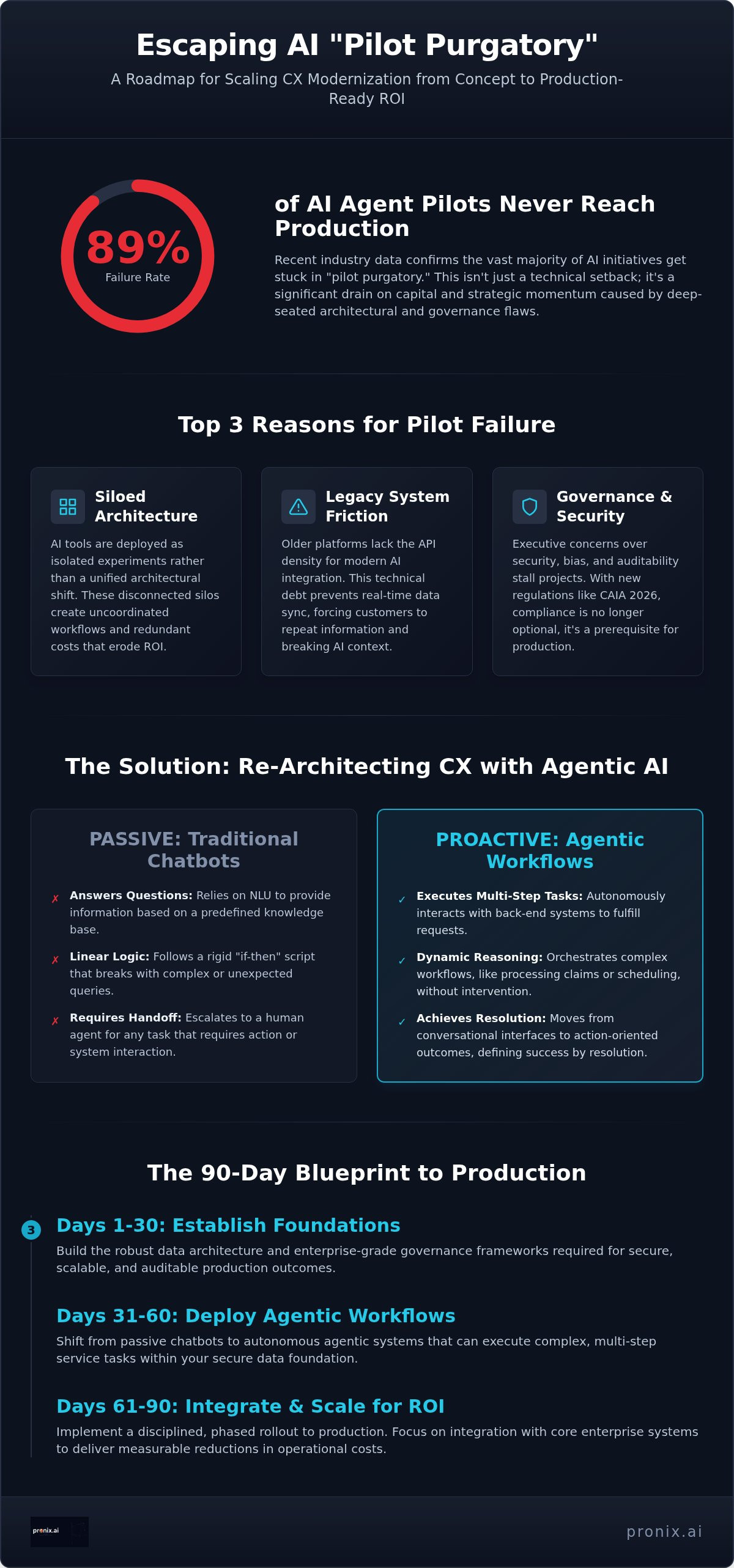
Enterprise leaders are finding that the gap between a successful proof-of-concept and a production-ready outcome is wider than anticipated. Verified data from August 2026 reveals that 89% of AI agent pilots do not reach production. This high failure rate stems from treating AI-driven CX modernization as a series of isolated experiments rather than a unified architectural shift. When AI tools are deployed in silos, organizations face uncoordinated workflows and redundant costs that erode the projected ROI within the first year. These silos create a hidden tax on the enterprise; each disconnected tool requires its own maintenance, data pipeline, and security review.
Success requires a move away from reactive chatbots toward proactive agentic workflows. These autonomous entities don't just answer questions. They execute multi-step tasks across the service lifecycle. To understand the evolution of these technologies, one can review a foundational overview of AI in CX. Without a robust data foundation, even the most advanced agentic models will fail. Poor data architecture prevents real-time synchronization, leading to hallucinations that compromise brand trust and operational stability.
The Friction Points of Legacy Contact Center Systems
Legacy platforms like older Genesys or NICE instances often lack the API density required for modern AI integration. This technical debt creates friction in real-time data synchronization. AI agents require instantaneous access to customer history to be effective. When journeys are fragmented across siloed channels, the AI cannot maintain context. This forces customers to repeat information, driving up the cost-per-interaction and defeating the purpose of AI-driven CX modernization. Modernizing these systems isn't just about adding a new layer; it's about re-architecting the core data flow.
Governance and Security: The Executive Barrier
Governance remains the primary hurdle for large-scale adoption. Executives often stall modernization projects due to concerns over security and auditability. With new regulations like the California AI Accountability Act (CAIA) taking effect as of June 30, 2026, compliance is no longer optional. Organizations in healthcare and finance must ensure every AI response is auditable and free from bias. Failure to implement enterprise-grade governance frameworks doesn't just risk a failed pilot. It risks significant legal exposure. Every innovation must be backed by a rigorous framework and a clear path to production that prioritizes safety and regulatory alignment.
Re-Architecting Customer Experience with Agentic AI
Agentic AI represents the next frontier in AI-driven CX modernization. Unlike standard chatbots that rely solely on Natural Language Understanding (NLU) to provide answers, agentic systems are autonomous entities capable of executing multi-step tasks. They don't just interpret a customer's request. They fulfill it by interacting with back-end systems, navigating business logic, and making decisions based on real-time data. This shift ensures that the customer experience is defined by resolution rather than just conversation.
Intelligent Workflows vs. Traditional Automation
Traditional automation follows a linear, "if-then" logic that often breaks when faced with complex customer needs. In contrast, agentic AI uses dynamic reasoning to orchestrate workflows. It can handle intricate processes such as insurance claims processing or multi-vendor scheduling without manual intervention. Agentic AI CX modernization is the move from conversational interfaces to action-oriented autonomous agents. This transition allows enterprises to scale complex service operations without a linear increase in headcount.
Integrating AI-Driven CX into the Data Foundation
A successful deployment relies on a sophisticated data architecture. Organizations should consult the Enterprise Agentic AI: 2026 Production Guide to establish the necessary scalability foundations. Real-time vector databases are essential here. They allow AI agents to retrieve contextually relevant information while maintaining strict security protocols for Personally Identifiable Information (PII). By grounding agents in enterprise data, companies can achieve high-level personalization safely. Insights from Microsoft's Guide to AI in Customer Experience highlight how this practical application of data transforms the end-user journey.
This modernization also addresses the crisis of agent burnout. By automating repetitive, high-friction tasks, AI augmentation allows human agents to focus on high-value, empathetic interactions. Human-in-the-Loop (HITL) frameworks ensure that agents oversee autonomous workflows, stepping in only when the AI identifies a case requiring human judgment. This synergy increases operational maturity and stabilizes the workforce. If you are ready to evaluate your current architecture, you can explore Agentic AI Strategy & Consulting to identify immediate implementation opportunities.
Comparing Platforms for CX Modernization: Salesforce, Genesys, and AWS
Platform selection is the most critical decision in your AI-driven CX modernization journey. Salesforce Agentforce is the premier choice for CRM-centric environments. It recently introduced a pay-per-resolution model at $2 per autonomous resolution, which directly addresses the difficulty of proving ROI. Conversely, Genesys Cloud remains the benchmark for high-volume, global contact centers. Its CX 4 tier, priced at $240 per user per month as of early 2026, provides a comprehensive suite for AI-powered enterprise operations. These platforms represent different philosophical approaches to automation: one focused on the record, the other on the interaction.
Amazon Connect offers a different path through a highly customizable, utility-based model. AWS recently restructured this service into four specialized agentic solutions, including Amazon Connect Customer and Amazon Connect Health. Specific features like Amazon Q in Connect are priced at $40 per agent per month. For organizations seeking specialized conversational AI, Kore.ai was named a leader in the Forrester Wave Q2 2026 report. NICE also remains a strong contender for those requiring deep integration with workforce management and analytics. Each ecosystem has distinct strengths; the right choice depends on your existing technical debt and desired operational maturity.
Selecting the Right Ecosystem for Your Enterprise
Choosing a platform involves navigating the "Build vs. Buy" dilemma. While out-of-the-box features accelerate deployment, they often lead to vendor lock-in. A resilient multi-cloud CX strategy allows you to leverage best-of-breed tools without being tethered to a single provider's roadmap. Scalability and integration ease are the primary benchmarks here. With the global CCaaS market growing at 18-21% annually, your chosen ecosystem must support rapid expansion without compromising data governance or auditability. You don't just need a vendor; you need a foundation that scales.
The Role of Implementation Partners in Platform Success
Platform licenses don't solve the modernization problem; execution does. The 89% failure rate of AI pilots highlights a severe specialized talent gap that exists in 2026. Technical integration and agentic strategy require a level of expertise that most internal teams haven't yet developed. Managed services act as a bridge, providing the practical support needed to handle complex data architectures and regulatory compliance. Success in AI-driven CX modernization depends on a partner who understands both the high-level strategic vision and the pragmatic requirements of technical execution. You need a team that moves from strategy to production without losing momentum.
The 90-Day Blueprint: Deploying Governed CX Solutions at Scale
Deploying AI-driven CX modernization at scale is a high-stakes endeavor that requires a rigorous, time-bound framework. Most organizations fail because they lack a structured roadmap to move beyond the experimental phase. This 90-day blueprint transitions your strategy from a vision into an operational reality. It prioritizes stability and risk mitigation while maintaining the momentum necessary for enterprise transformation. Each phase is designed to build on the previous one, ensuring that the final rollout is both secure and scalable.
Phase 1 focuses on the strategy, governance framework, and a comprehensive data audit during the first thirty days. We identify existing data silos and synchronization gaps that could lead to model hallucinations. This period defines the ethical boundaries and the brand persona that will guide every autonomous interaction. It's the stage where we align technical capabilities with specific business outcomes.
The middle thirty days involve technical integration and the design of agentic AI workflows. We move from simple conversational interfaces to action-oriented agents that can process claims, handle scheduling, or manage complex billing inquiries. This phase integrates your chosen platform into existing backend systems to ensure the AI has the context it needs to execute tasks without human intervention. It transforms the AI from a passive responder into an active problem-solver.
The final phase concludes with pilot testing, Human-in-the-Loop (HITL) calibration, and the production rollout. We run controlled tests to validate accuracy and refine the hand-off points between AI and human agents. This rigorous testing period addresses the common friction points that prevent pilots from reaching production. Continuous optimization follows the rollout, creating a feedback loop that uses real-world data to improve agent performance over time.
Establishing the Governance Guardrails
Real-time monitoring and automated audit trails are non-negotiable for modern enterprises. These tools provide the transparency required for compliance with international standards and emerging state-level AI laws. Governance is not an obstacle to AI speed, but the foundation that makes speed safe for the enterprise. By setting clear ethical boundaries, you ensure that your agents represent the brand accurately while mitigating the risk of hallucinations or biased responses.
Measuring ROI: Beyond Average Handle Time (AHT)
Modernized CX requires a new set of performance indicators. While AHT was the standard for legacy centers, it fails to capture the value of autonomous resolution. Success in AI-driven CX modernization is now measured by resolution accuracy, agent deflection rates, and positive sentiment shifts. We also quantify the productivity acceleration of the human workforce. When agents are augmented by AI, they handle higher-value cases with greater efficiency, leading to a significant reduction in long-term operational costs.
If you are ready to move from pilot to production, explore our Agentic AI Implementation services to ensure your deployment remains on track and fully governed.
Partnering for Performance: Pronix.ai’s Managed CX Modernization
Transitioning from a theoretical pilot to a production-ready outcome requires more than just a software license. It requires a partner who understands the friction points of modernizing legacy systems. pronix.ai specializes in moving global enterprises through the complexities of AI-driven CX modernization by providing a bridge between high-level vision and technical execution. We don't just advise on strategy. We handle the heavy lifting of implementation and long-term operational management.
Our end-to-end approach covers every phase of the modernization lifecycle. We start by building solid data foundations and move rapidly into technical integration and managed services. Because we maintain deep expertise across the AWS, Microsoft, Salesforce, and Genesys ecosystems, we remain platform-agnostic. Our focus is on your specific business outcomes rather than a single vendor's roadmap. This ensures that your agentic workflows are optimized for your unique data architecture and customer journey.
Governance is the core of our implementation philosophy. We prioritize stability and risk mitigation in every deployment. By integrating enterprise-grade audit trails and real-time monitoring, we enable responsible AI adoption. This approach allows your organization to maintain speed without sacrificing safety or regulatory compliance. We ensure that every innovation is backed by a rigorous framework that supports long-term scalability.
Why Enterprise Leaders Choose pronix.ai
Leaders in highly regulated sectors like healthcare and finance choose us for our practitioner-led methodology. We provide "boots-on-the-ground" results that move the needle on operational maturity. Our global consulting heritage through pronix.ai allows us to navigate the complexities of large-scale organizations with precision. We understand that modernization isn't just a technical change; it's a strategic evolution that requires disciplined execution and transparent reporting.
Next Steps for Your CX Transformation
The journey toward a fully modernized customer experience begins with an objective assessment of your current maturity level. We help you identify immediate friction points and customize a roadmap that aligns with your specific business goals. Whether you are stuck in a pilot phase or ready to scale agentic workflows, we provide the specialized talent and managed services required for success. Take the first step toward a more productive, governed, and autonomous service environment today.
Speak with a pronix.ai CX Modernization Expert to start your transition to production-ready outcomes.
Transitioning from Strategy to Scalable Execution
The window for experimentation is closing. Enterprise success in 2026 depends on moving beyond fragmented pilots toward stable, production-ready outcomes. We've defined how re-architecting your ecosystem with agentic workflows and a disciplined 90-day blueprint can bypass the common pitfalls of technical debt and uncoordinated silos. True AI-driven CX modernization isn't just about the technology itself. It's about the governance and operational maturity that make that technology safe for the enterprise at scale.
By choosing a partner with deep expertise in AWS, Genesys, and Salesforce, you ensure that your modernization efforts are backed by proven implementation experience. You can achieve production-ready AI outcomes in 90 days while maintaining enterprise-grade governance frameworks that protect your brand. The future of customer experience is autonomous, auditable, and ready for deployment. It's time to stop testing and start delivering measurable ROI. We are ready to help you lead this transformation with confidence.
Modernize your CX with Pronix.ai - Move from pilot to production today.
Frequently Asked Questions
What is the first step in AI-driven CX modernization for a large enterprise?
A comprehensive data audit and governance strategy is the necessary first step. Most organizations fail because they skip this phase and rush into technical pilots. You must identify siloed customer data and technical debt within your legacy systems. This audit ensures your data architecture can support the real-time synchronization required for autonomous agents. Establishing these foundations early prevents hallucinations and ensures long-term operational maturity.
How does Agentic AI differ from traditional chatbots in a contact center?
Agentic AI differs by its ability to execute autonomous, multi-step workflows rather than just answering questions. Traditional chatbots rely on linear, pre-defined scripts that often fail during complex interactions. Agentic systems use dynamic reasoning to navigate business logic, such as processing a refund or scheduling a technician. This shift moves the contact center from simple conversational interfaces to action-oriented agents that drive measurable resolution accuracy.
Can we modernize our CX without replacing our legacy contact center hardware?
Yes, you can modernize your CX by implementing an AI orchestration layer that integrates with your existing legacy hardware. You don't always need a full "rip and replace" of your infrastructure. By using API-first integrations, you can layer AI-driven CX modernization over older Genesys or NICE instances. This approach allows you to gain the benefits of automation while gradually retiring technical debt according to your own timeline and budget.
How do you ensure AI agents don’t provide inaccurate information to customers?
We prevent inaccuracies by grounding AI agents in enterprise data using Retrieval-Augmented Generation (RAG) and real-time vector databases. These systems ensure the AI only accesses verified information rather than generating speculative responses. Additionally, implementing "Human-in-the-Loop" calibration and automated audit trails provides a safety net. This rigorous governance framework maintains brand voice and ensures compliance with high-risk AI regulations like the California AI Accountability Act.
What are the typical cost savings associated with AI-driven CX modernization?
Enterprises typically see a significant reduction in cost-per-interaction and a sharp increase in agent productivity. By automating high-volume, repetitive tasks, you can deflect a substantial percentage of routine inquiries to autonomous agents. This allows your human workforce to focus on complex, high-value cases. The long-term savings stem from scaling your service capacity without a linear increase in headcount, effectively stabilizing operational costs as your business grows.
Which platform is better for CX modernization: Salesforce or Genesys?
The choice depends on whether your service environment is CRM-centric or interaction-centric. Salesforce Agentforce is the premier choice for organizations that prioritize deep CRM integration and a pay-per-resolution model. Genesys Cloud is the benchmark for high-volume, global contact centers requiring sophisticated voice and omnichannel capabilities. Both platforms support AI-driven CX modernization, but your existing technical architecture will determine which ecosystem offers the fastest path to production.
How long does it take to move an AI-driven CX pilot into full production?
A production-ready rollout typically takes 90 days when following a structured blueprint. The first 30 days are dedicated to strategy and data audits. The middle phase focuses on technical integration and agentic workflow design. The final 30 days involve pilot testing and calibration. This disciplined timeline ensures that you move past the "pilot purgatory" trap and achieve measurable ROI within a single fiscal quarter.
Is AI-driven CX modernization compliant with HIPAA and GDPR regulations?
Modernization is fully compliant when built on enterprise-grade governance frameworks that prioritize data privacy. Systems must include end-to-end encryption and strict access controls to meet HIPAA and GDPR requirements. With the EU AI Act compliance deadlines approaching, your architecture must also support rigorous auditability. Implementing these safeguards ensures that your autonomous workflows remain secure while navigating the complex regulatory landscape of 2026.