

The 2026 debate isn't about which platform has the better dialer. It's about which architecture can move your AI agents out of the lab and into the P&L. For years, the Salesforce vs Genesys for CX conversation focused on feature parity. Most enterprises still struggle with siloed data and skyrocketing operational costs despite these tools. You've likely felt the friction of maintaining dual platforms that don't speak the same language. This gap leaves your customer data trapped and your agents scrambling for context.
We know that moving AI from pilot to production is your biggest hurdle to ROI. This guide provides a clear roadmap for CX modernization, helping you determine whether Salesforce Agentforce, Genesys Cloud, or a unified architecture fits your enterprise scale. You'll learn how to bridge the gap between your CRM and customer interactions while deploying production-ready Agentic AI that reduces headcount costs and establishes a governed, high-output engine for 2026.
Key Takeaways
- Understand the convergence of CRM and CCaaS architectures as enterprises shift from transactional support to proactive, AI-led customer journeys.
- Compare the technical capabilities of Salesforce Agentforce and Genesys AI Studio to identify which reasoning engine best supports your specific autonomy requirements.
- Analyze the critical trade-offs between API-first and native integrations within the Salesforce vs Genesys for CX landscape to mitigate latency and security risks.
- Determine the right path for your organization using an ROI framework that balances the benefits of platform consolidation against best-of-breed performance.
- Access a practitioner-led 90-day blueprint designed to move governed Agentic AI from experimental pilots into scalable production environments.
The 2026 CX Landscape: Why Salesforce and Genesys are Converging
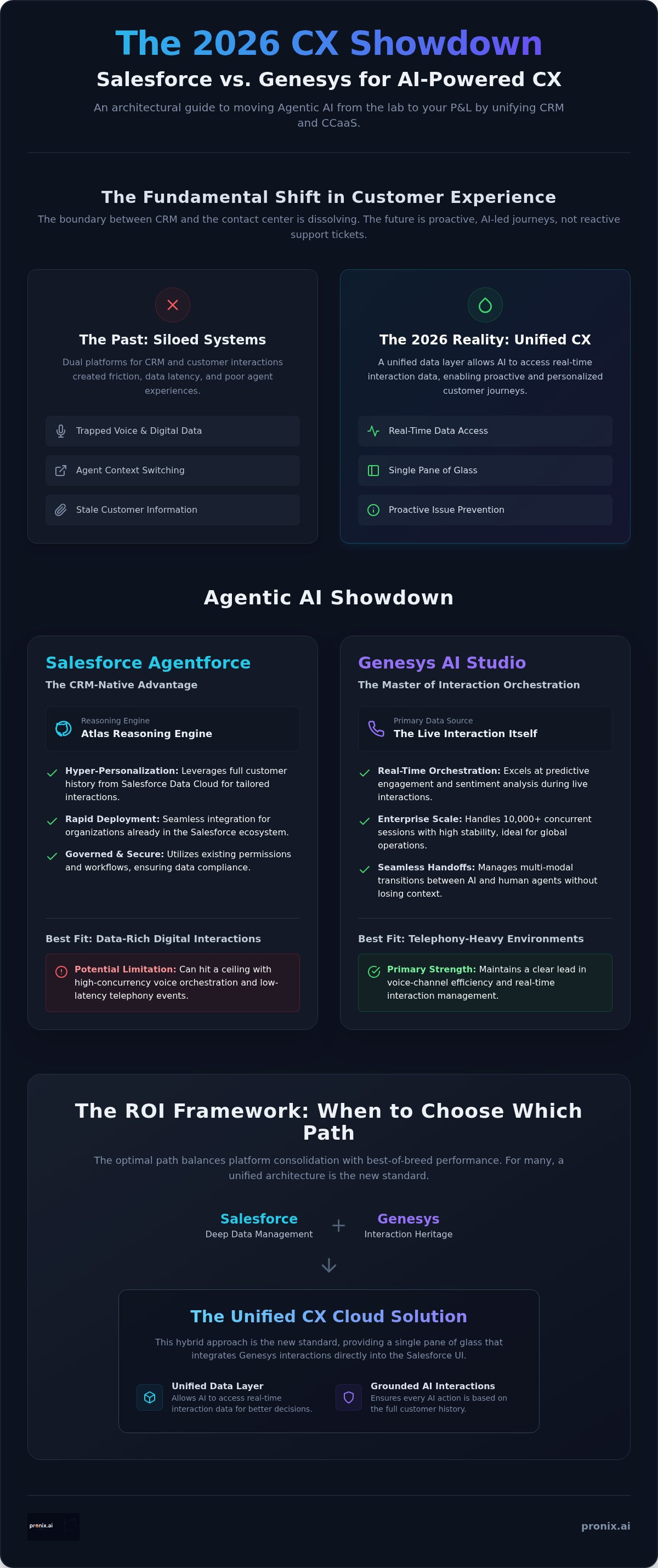
The enterprise CX environment is undergoing a fundamental structural shift. In 2026, the boundary between the CRM and the contact center has effectively dissolved. We're seeing a transition from transactional support to proactive, AI-led customer journeys. Organizations no longer want to react to tickets; they want to prevent them. This shift forces a merger between CRM-first architectures like Salesforce and interaction-first architectures like Genesys.
Agentic AI is the primary catalyst for this convergence. Traditional seat-based licensing models are under pressure as autonomous agents handle complex workflows without human intervention. This evolution requires a level of data integration that legacy silos cannot support. Platform selection now hinges on 2026 data sovereignty requirements. Enterprises must ensure that AI models operate within strict regional compliance frameworks while accessing real-time customer data. The choice between Salesforce vs Genesys for CX is no longer about isolated features but about which ecosystem can best orchestrate these high-stakes data flows.
Breaking Down the CRM vs. CCaaS Divide
Historically, Salesforce Service Cloud managed the customer record while Genesys Cloud CX handled the voice and digital traffic. This separation created friction. Data latency between systems often meant agents worked with stale information. Context switching forced employees to toggle between screens, degrading the customer experience. By modernizing legacy contact centers, enterprises eliminate these reporting gaps and create a continuous flow of information. This integration ensures that the "brain" of the AI has immediate access to the "voice" of the customer.
The Rise of the Unified CX Cloud
The Salesforce vs Genesys for CX debate has been reshaped by the CX Cloud joint venture. This collaboration provides a single pane of glass for agents, integrating Genesys interactions directly into the Salesforce interface. It enables a unified data layer for AI. This allows Salesforce's reasoning engines to use Genesys's real-time interaction data for more accurate decision-making. For many enterprises, this hybrid approach is the new standard. It combines the deep telephony heritage of Genesys with the robust data management of Salesforce. This architecture ensures that every AI-driven interaction is grounded in the full customer history, providing the stability and scale required for 2026 operations.
Agentic AI Showdown: Salesforce Agentforce vs. Genesys AI Studio
The transition from scripted bots to goal-oriented autonomous agents marks the next frontier in the Salesforce vs Genesys for CX competition. While previous iterations relied on rigid decision trees, 2026 demands agents that can reason through complex customer intent. This evolution shifts the focus from simple automation to true orchestration. The primary competition within the Salesforce vs Genesys for CX landscape often boils down to where the intelligence resides: in the customer record or in the interaction flow.
Salesforce Agentforce: The CRM-Native Advantage
Agentforce relies on the Atlas Reasoning Engine to drive its autonomy. It doesn't just follow a pre-defined script; it evaluates data from Salesforce Data Cloud to generate a logical path to resolution. For organizations already deep in the Salesforce ecosystem, deployment is rapid. The platform leverages existing permissions and workflows to ensure security. Its primary strength lies in hyper-personalization. It can reference a customer's entire purchase history, open cases, and loyalty status in milliseconds. However, it often hits a ceiling when managing high-concurrency voice orchestration or low-latency telephony events. If your strategy prioritizes data-rich digital interactions, this native integration is hard to beat.
Genesys AI: The Master of Interaction Orchestration
Genesys AI Studio excels where the rubber meets the road: the live interaction. It uses predictive engagement and real-time sentiment analysis to route and resolve issues as they happen. Genesys is built for multi-modal Agentic handoffs. This ensures a seamless transition between AI and human agents without losing context. By integrating agentic AI for contact center efficiency into the voice channel, Genesys maintains its lead in telephony-heavy environments. It handles 10,000+ concurrent sessions with the stability a global enterprise requires. It treats the interaction itself as the primary data source, allowing for immediate adjustments based on the customer's current emotional state or tone.
Choosing the right brain for your CX operations depends on your existing technical debt and future goals. Salesforce offers deeper reasoning based on historical data, while Genesys provides superior execution during the live event. Enterprises seeking a neutral perspective on these platforms often benefit from Agentic AI Strategy & Consulting to ensure their architecture supports long-term growth and operational maturity.
Technical Architecture and Implementation Realities
The success of your 2026 CX strategy depends on the integrity of your data pipes. Choosing between Salesforce vs Genesys for CX requires a deep dive into how information moves between the CRM and the interaction engine. Most "out-of-the-box" integrations fail at the enterprise level because they lack the flexibility to handle custom schemas or high-volume data streams. These rigid connectors often ignore the specific business logic that differentiates your service from competitors. Relying on basic synchronization tools leads to broken workflows and a fragmented view of the customer journey.
Security and compliance add another layer of complexity. Managing Personally Identifiable Information (PII) across two global cloud platforms requires a unified governance framework. You must ensure that data remains encrypted at rest and in transit while maintaining regional residency requirements. Architectural maturity means moving beyond simple connectivity. It requires a robust foundation that supports real-time reasoning without compromising data sovereignty or operational speed.
Data Synchronization and Latency
Latency is the silent killer of the AI-driven customer experience. When an agentic system relies on batched data, it makes decisions based on stale context. This creates a "Split Brain" problem where the CRM holds the historical truth, but the CCaaS platform holds the current interaction event. Resolving this requires a high-performance data layer that synchronizes intent in milliseconds. Establishing data foundations for generative AI is a non-negotiable step for 2026. Without this foundation, your AI agents will hallucinate or fail to recognize that a customer just closed a ticket in a different channel.
Governance and Responsible AI Adoption
Regulated industries cannot afford "black box" AI. Every decision an autonomous agent makes must be auditable and transparent. You need to track exactly which data points influenced a specific outcome to satisfy compliance requirements. Setting strict guardrails ensures that agents stay within their authorized scope. Implementing a "human-in-the-loop" protocol for high-stakes interactions mitigates risk while allowing the AI to handle routine tasks. This balanced approach protects your brand reputation while driving the efficiency gains promised by modern CX platforms. Stability comes from rigorous frameworks, not experimental features.
The ROI Framework: When to Choose Which Path
Determining the right investment path requires a departure from simple feature lists. In 2026, the ROI of Salesforce vs Genesys for CX is measured by how quickly you can achieve a unified data state and a reduction in operational friction. We categorize the decision-making process into three primary enterprise scenarios based on architectural maturity and business priorities.
Scenario A serves the Salesforce-Centric Organization. If your sales, marketing, and service teams already live in the Salesforce ecosystem, consolidation is often the most pragmatic path. It reduces vendor management overhead and leverages existing Data Cloud investments to power Agentforce. This path prioritizes a digital-first strategy where the CRM is the undisputed heart of the business.
Scenario B addresses the High-Volume Voice Enterprise. Organizations with massive telephony requirements and complex global routing needs often find that Genesys provides superior resilience. Its carrier-grade infrastructure handles the nuances of live voice that CRM-native tools can occasionally struggle to match. This best-of-breed approach ensures that interaction quality never wavers during peak loads.
Scenario C represents the Modern Hybrid Enterprise. This path utilizes the Unified CX Cloud architecture. It allows you to maintain Genesys for high-performance interaction orchestration while using Salesforce as the primary engagement layer. This hybrid model is frequently the most resilient choice for global organizations that require both deep data context and robust telephony. Calculating Total Cost of Ownership (TCO) must go beyond monthly license fees. You must factor in the long-term costs of API maintenance, data egress, and the specialized talent required to tune autonomous agents.
Assessing Your CX Maturity
Technical debt often dictates your pace of innovation. You must evaluate whether your legacy contact center constraints are preventing you from adopting modern automation. Mapping your business goals to platform strengths ensures that your technology supports your strategy rather than hindering it. We recommend using the AI-driven CX modernization guide to benchmark your current state against 2026 industry standards. This assessment clarifies whether you're ready for full consolidation or if a phased hybrid approach is safer for your specific risk profile.
The Cost of Inaction vs. Migration
Maintaining siloed platforms carries a heavy financial burden. Disconnected workflows increase average handle time and degrade agent morale. Migrating to a unified environment drives productivity by providing a single source of truth for both humans and AI. Agentic AI deflection can significantly reduce operational expenses by handling routine inquiries with high accuracy. However, you must also account for hidden costs like change management and staff retraining. Transitioning to these advanced architectures requires a disciplined framework. To ensure your migration delivers the promised ROI, consider engaging in Agentic AI Strategy & Consulting to build a production-ready roadmap.
Executing the Transition: From Strategy to Production
Strategy without execution is just overhead. Most enterprises stall during the move from experimental AI to live customer interactions. A practitioner-led approach outperforms traditional consulting by prioritizing functional outcomes over theoretical frameworks. We focus on the "boots-on-the-ground" realities of the Salesforce vs Genesys for CX landscape. This ensures your technical architecture supports your operational goals from day one. Traditional consulting often produces impressive slide decks that fail during technical implementation. Practitioners focus on the data schema, API latency, and the specific reasoning logic required to resolve a customer's intent without human intervention.
Speed is essential for maintaining momentum. Our 90-day blueprint for deploying governed Agentic AI provides a disciplined path to production. It mitigates risk by establishing clear milestones for security, compliance, and performance. You don't have to choose between speed and safety. A structured rollout protects your brand reputation while delivering immediate efficiency gains. This methodical approach allows your organization to move from pilot to production without the typical friction of legacy modernization projects.
The pronix.ai Implementation Methodology
Our methodology is designed to bridge the gap between high-level strategy and technical reality. We follow a three-phase lifecycle that ensures every innovation is backed by a rigorous framework. This process handles the complexities of the Salesforce vs Genesys for CX ecosystem while maintaining a fast pace.
- Phase 1: Strategy and CX architecture design. We define the definitive source of truth and map the data flows between the CRM and the interaction engine.
- Phase 2: Technical integration and Agentic AI configuration. We build the reasoning engines and orchestration layers that drive autonomous resolution.
- Phase 3: Governance, testing, and production rollout. We establish the auditability and guardrails necessary for safe, high-output enterprise operations.
Beyond the Go-Live: Managed CX Evolution
Go-live is the beginning of the journey, not the end. Managed services provide the long-term stability required for AI model tuning. We continuously optimize agents based on real-world outcomes to ensure accuracy remains high and hallucination risks are eliminated. Scaling Agentic AI implementation services across a global enterprise requires a partner who understands the friction points of modernizing legacy systems. This ongoing collaboration ensures your CX stack evolves alongside shifting market requirements. We prioritize evidence-based success, ensuring that every update to your AI agents is backed by data and a clear path to production.
Standardizing Your 2026 CX Architecture
The Salesforce vs Genesys for CX decision is no longer a binary choice between software vendors. It's a strategic commitment to an orchestration philosophy that defines your competitive edge. Whether you prioritize the data depth of Salesforce Agentforce or the interaction resilience of Genesys Cloud, success requires a unified architecture. You must move past fragmented pilots to establish a secure, governed foundation for autonomous agents.
Stability and speed don't have to conflict. We specialize in complex Salesforce and Genesys integrations, focusing on enterprise-grade AI governance that protects your brand. Our 90-day deployment blueprint moves your organization from strategy to production with disciplined precision. By prioritizing operational maturity over speculative hype, you can reduce costs while delivering a seamless customer journey.
The path to CX modernization is complex, but you don't have to navigate it alone. Transition your CX from pilot to production with pronix.ai and build the resilient architecture your enterprise deserves. Your future starts with a single, governed step toward production-ready AI.
Frequently Asked Questions
Is Salesforce Agentforce a replacement for Genesys Cloud CX in 2026?
Salesforce Agentforce isn't a direct replacement for Genesys Cloud CX for organizations requiring complex telephony and global interaction orchestration. While Agentforce excels at data-driven reasoning within the CRM, Genesys remains the leader in managing high-concurrency voice and multi-modal traffic. Most enterprises find success by integrating both platforms. This allows them to leverage their respective strengths in data management and real-time communication without compromising stability.
What are the main benefits of the CX Cloud from Genesys and Salesforce?
The primary benefits include a single pane of glass for agents and a unified data layer for AI reasoning. This integration eliminates the "Split Brain" problem by allowing Salesforce AI to access real-time interaction data from Genesys. It reduces agent context switching and ensures that every customer engagement is grounded in the full history of the CRM. This creates a more cohesive experience for both employees and customers.
How long does it typically take to integrate Salesforce and Genesys at scale?
A production-ready integration at the enterprise scale typically follows a 90-day blueprint for initial deployment. This timeframe accounts for strategy, technical configuration, and rigorous testing. While basic connectors can be established quickly, achieving a governed state with synchronized data flows requires a methodical approach. This ensures stability and compliance across all global regions while moving your AI agents from pilot to production.
Can I use Genesys voice with Salesforce Agentforce autonomous agents?
Yes, you can use Genesys voice services in conjunction with Salesforce Agentforce autonomous agents through the Unified CX Cloud architecture. This allows the Genesys interaction engine to handle the telephony while Agentforce provides the reasoning and customer context. It's a powerful way to resolve the Salesforce vs Genesys for CX debate by combining best-of-breed voice with CRM-native AI for superior outcomes.
What is the pricing difference between Salesforce-native CX and a Genesys hybrid model?
The pricing difference centers on Total Cost of Ownership (TCO) rather than simple license fees. Salesforce-native models often reduce vendor management costs through consolidation. Conversely, a Genesys hybrid model might involve higher integration maintenance but offers superior resilience for voice-heavy operations. Enterprises must evaluate the ROI of agent productivity gains against the costs of implementation, data egress, and ongoing AI model tuning.
How do I ensure AI governance when using both Salesforce and Genesys?
Ensuring AI governance requires establishing a robust data foundation and transparent audit trails for every decision an agent makes. You must implement guardrails that apply consistently across both platforms. This involves tracking reasoning paths and ensuring that PII handling meets your specific industry requirements. A disciplined framework prevents "black box" outcomes and maintains your brand reputation during autonomous interactions in a Salesforce vs Genesys for CX environment.
Does the Genesys and Salesforce integration support HIPAA and PCI compliance?
Both Salesforce and Genesys support HIPAA and PCI compliance, but the integration must be architected to maintain these standards. You're responsible for ensuring that data encryption and residency requirements are met during transit between the two clouds. Utilizing a governed implementation methodology ensures that your AI agents don't inadvertently expose sensitive data. This protects your organization from regulatory risks during the modernization process.
What is the role of an implementation partner in a Salesforce vs Genesys decision?
An implementation partner provides the neutral expertise needed to navigate the CX landscape without vendor bias. They focus on the technical realities of moving from pilot to production. A partner ensures that your architecture is scalable, secure, and aligned with your 2026 business goals. They manage the complexities of dual-platform governance, helping you choose the path that maximizes ROI and operational maturity.