

What if replacing a legacy contact center simply creates another disconnected technology layer? The search for an AWS Partner for contact center modernization is really about finding a safe path from platform change to better customer and employee experiences, without losing sight of service continuity, integration, or governance.
That concern is well-founded. A successful modernization takes more than moving contact flows to the cloud. It connects channels with CRM and ticketing systems, fits AI workflows into enterprise controls, and defines how teams will measure performance after launch. Without a clear operating model, agents may still switch between systems and leaders may lack evidence of business impact.
This guide outlines a practical route from current-state assessment to a production-ready contact center. You’ll learn how to plan migration, connect enterprise systems, govern AI adoption, and measure outcomes for customer experience, employee productivity, and ongoing operations. It also explains how pronix.ai brings strategy, implementation, and managed services together to support CX modernization using platforms such as Amazon Connect. The goal is a connected, governed solution built to operate, not just a new platform deployment.
Key Takeaways
- Assess modernization as coordinated change across technology, workflows, data, and operating practices, not simply a platform replacement.
- Use an AWS Partner for contact center modernization to connect Amazon Connect with enterprise systems and service workflows.
- Compare delivery approaches by integration scope, governance, change enablement, operational ownership, and outcome measurement.
- Build a phased roadmap with clear outputs and decision gates, starting with a baseline and prioritized customer journeys.
- See how Pronix.ai brings strategy, implementation, AI-enabled workflows, and managed services together for enterprise CX modernization.
Why AWS Contact Center Modernization Requires More Than a Platform Upgrade
Replacing a legacy contact center can address aging infrastructure, but it won’t automatically fix disconnected channels, duplicated data, or manual handoffs. Modernization coordinates technology, workflows, data, and operating practices so service journeys work across the systems employees and customers rely on, with a clear way for leaders to measure progress.
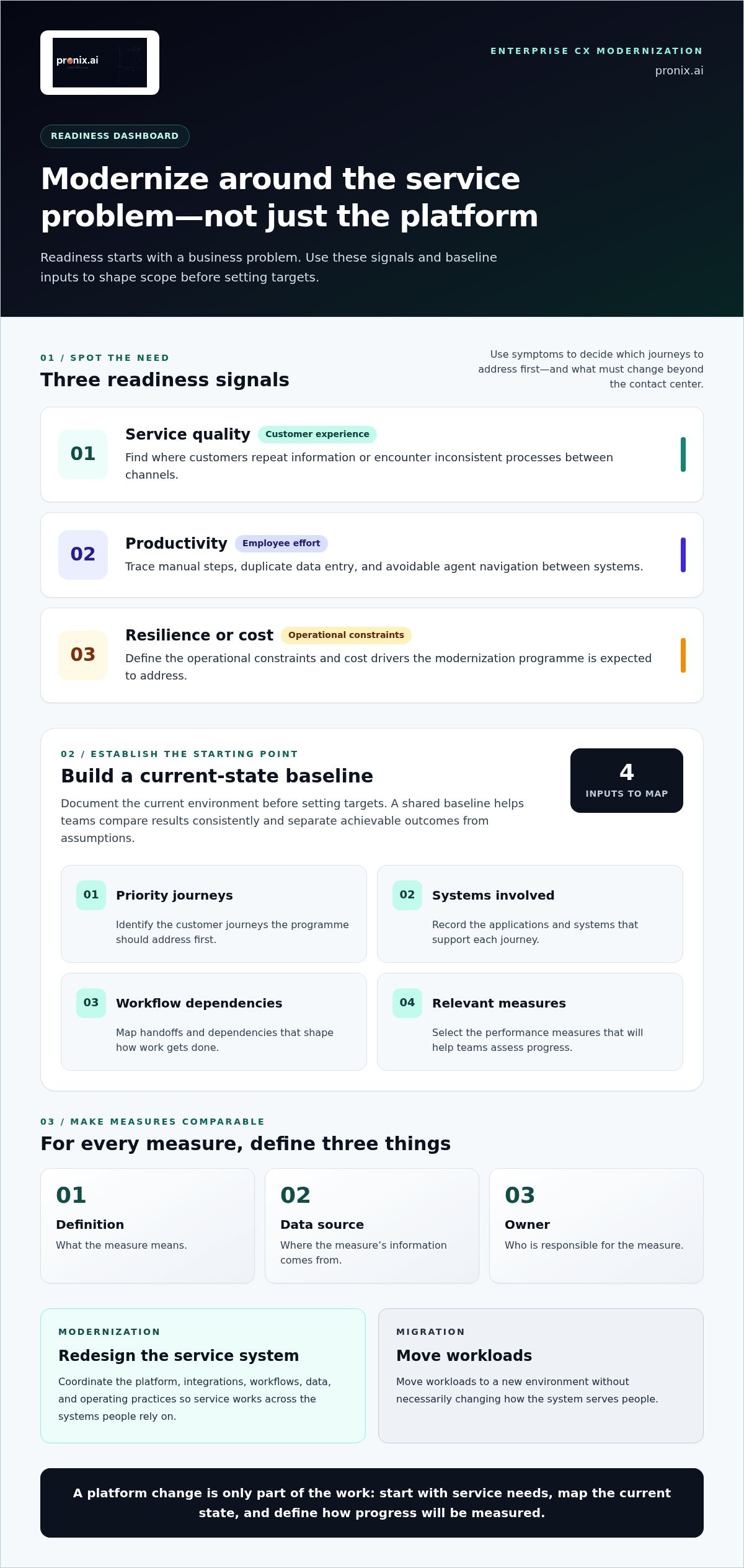
Contact center modernization redesigns the platform, integrations, workflows, data, and operating model as one service system. Migration moves workloads to a new environment without necessarily changing how that system serves people.
These distinctions matter when setting scope. Platform selection identifies the technology that fits the environment. Implementation translates requirements into architecture, configuration, integrations, testing, and adoption. Managed services provide ongoing operational support and improvement after deployment. An AWS Partner for contact center modernization should connect these stages to business priorities, rather than treat platform launch as the finish line.
What does AWS contact center modernization include?
Amazon Connect is one platform option within a wider enterprise CX environment. A modernization programme considers how channel workflows connect to customer records, knowledge resources, workforce processes, and data systems. It also examines what agents see and do during an interaction, including where information is missing or work must be repeated.
The platform supplies technology capabilities; enterprise design determines how those capabilities fit existing operations. Partner-led work can include solution design, configuration, integration planning, testing, and change management. For example, a service workflow may need to pass interaction context into an existing CRM process and make relevant information available to the agent. Map which system owns each record, what information the workflow needs, and how the agent handles missing or conflicting data. The evolution of call centers into contact centers reflects this broader shift from handling calls to coordinating service across channels and supporting technologies.
When is an enterprise ready to modernize?
Readiness starts with a business problem, not a platform decision. Signals may include inconsistent experiences between channels, fragmented systems that obscure customer context, or manual handoffs that slow resolution and increase employee effort. Use these symptoms to identify which journeys to address first and what must change beyond the contact center itself.
- Service quality: Identify where customers repeat information or encounter inconsistent processes.
- Productivity: Trace manual steps, duplicate entry, and avoidable agent navigation between systems.
- Resilience or cost: Define the operational constraints and cost drivers the programme is expected to address.
Before setting targets, establish a current-state baseline. Document priority journeys, systems involved, workflow dependencies, and relevant performance measures. For each measure, record its definition, data source, and owner so teams can compare results consistently. This shared starting point helps distinguish achievable outcomes from assumptions and supports decisions about scope and sequencing. Without a baseline, teams may deploy new technology yet struggle to show whether service or daily operations have improved.
How an AWS Modernization Partner Connects Amazon Connect to Enterprise Operations
Amazon Connect delivers value when its workflows align with the systems that hold customer, service, and workforce information. An AWS Partner for contact center modernization helps map those dependencies, shape the target design, and coordinate delivery from discovery through operational improvement. That means deciding what information moves, who owns it, how exceptions are handled, and how teams will know the workflow is working.
Designing the Amazon Connect and enterprise integration layer
Start with customer journeys, not an integration list. Trace how a request moves through channels and teams, then identify where CRM records, customer data, knowledge content, workforce processes, and service workflows inform the next action. This reveals which systems need to exchange information and where migration boundaries should sit.
Before implementation, document dependencies, data ownership, access needs, and resilience requirements. These shape the integration approach and surface decisions that might otherwise emerge late in testing. The target design should fit the organization’s existing systems and controls rather than assume one architecture works for every enterprise.
A disciplined engagement typically moves through connected stages:
- Discover: Map journeys, applications, current workflows, constraints, and desired outcomes with business and technical stakeholders.
- Design: Define the target architecture, integration responsibilities, data flows, migration boundaries, and operational ownership.
- Integrate and test: Configure workflows and connections, then validate end-to-end scenarios, including exceptions and handoffs between teams.
- Deploy and improve: Introduce the agreed changes with operational readiness in view, monitor results, and refine workflows based on evidence.
Test the full service path, not just whether an individual connection responds. For example, verify that customer context reaches the right workflow, agents can access relevant knowledge, and exceptions are routed to an appropriate person or team.
Adding AI and governance to service workflows
Assign AI a defined task and clear boundaries. Specify what it should do, what information it may use, how success will be measured, and when a person must take over. A workflow that helps with a routine request still needs a clear route for uncertainty, customer frustration, or requests outside its scope.
Build governance into implementation. Set access controls, establish monitoring and auditability, and define who reviews performance and handles exceptions. Human oversight is especially important where an automated interaction could affect the customer’s next step or an agent’s decision. These controls help teams manage risk while evaluating service quality and productivity. For broader enterprise context, explore Pronix’s AI-driven CX modernization guide.
A contact center platform becomes enterprise-ready through integration with business systems and operational controls that make its workflows accountable, supportable, and measurable. Organizations planning that work can explore Pronix’s CX modernization approach, which connects enterprise strategy, implementation, and ongoing managed services.
How to Evaluate an AWS Contact Center Modernization Approach
The right delivery model depends on your existing architecture, service priorities, internal capabilities, and tolerance for operational risk. A platform-only deployment can suit a tightly scoped need when internal delivery capacity is strong. Broader integration or managed modernization may be more appropriate when customer journeys cross multiple systems or teams need continuing operational support. Compare approaches against the work your environment requires, not just the platform being deployed.
Platform-only deployment
Integration scope: Primarily platform setup and configuration. Governance: Usually relies on existing internal controls. Change enablement: Often led internally. Operational ownership: Primarily the enterprise’s responsibility. Outcome measurement: Must be defined and tracked by the organization.
Systems integration
Integration scope: Connects the contact center with relevant enterprise systems and workflows. Governance: Includes design decisions for data access and workflow controls. Change enablement: Supports the transition into updated processes. Operational ownership: Typically shared during delivery, with ongoing responsibilities agreed by the enterprise. Outcome measurement: Can tie service measures to connected workflows.
Managed modernization
Integration scope: Supports the platform, integrations, and evolving service workflows. Governance: Builds operational controls into ongoing work. Change enablement: Can continue as processes and priorities evolve. Operational ownership: Includes continuing partner support alongside enterprise accountability. Outcome measurement: Uses agreed indicators to guide operational improvement.
What should an enterprise modernization partner deliver?
Expect a connected delivery scope: discovery, target-state design, implementation, integration, testing, and adoption support. Each stage should produce reviewable decisions and outputs, including documented requirements, architecture choices, validated workflows, and operational responsibilities. A capable AWS Partner for contact center modernization should connect AI-driven CX goals to secure, scalable production implementation rather than treat AI as a separate experiment.
Define programme indicators before launch. Resolution quality can show whether customer needs are being addressed; productivity measures can reveal how workflows affect employee effort; operating cost can help assess financial performance. Set the baseline, identify who owns each measure, and review results consistently. Targets should reflect the organization’s starting point and service objectives, not an assumed benchmark or promised saving.
How do platform, integrator, and managed-service roles differ?
The platform supplies the technology. An integrator designs and implements the solution, including connections to enterprise systems. Managed services support ongoing operations, monitoring, and continuous improvement after implementation. These roles can work together, but ownership and decision rights should be clear. For broader criteria on assessing ongoing service-provider capabilities, explore this enterprise AI managed service provider framework.
pronix.ai brings enterprise CX strategy, implementation, and managed services together, with a focus on governance and measurable business value. Organizations assessing how those responsibilities fit their needs can explore pronix.ai’s enterprise CX modernization approach.
A Phased Roadmap for Modernizing an Enterprise Contact Center on AWS
Modernization needs decision gates, not an assumed deadline. Move forward when evidence shows the next phase is ready, and pause when unresolved dependencies could affect service. An AWS Partner for contact center modernization can help coordinate delivery, while business owners and technical stakeholders agree on scope, risk, and operational responsibilities throughout.
From discovery to a production-ready first release
Begin with the current state. Document priority workflows, technical dependencies, service measures, and customer pain points. Align business, operations, security, and technology stakeholders on the journeys to improve. Select an initial use case with bounded scope, a named business owner, and a measurable outcome. Before launch, validate integrations, security controls, test criteria, and escalation paths.
- Baseline and align: Capture current performance and constraints. Gate: stakeholders agree on priority journeys and measures.
- Design the target: Define architecture, migration boundaries, dependencies, and operational ownership. Gate: affected teams approve the design and controls.
- Build and validate: Configure the first release and test end-to-end scenarios, including failure handling and human escalation. Gate: test results meet agreed acceptance criteria.
- Roll out with control: Release to a defined scope, monitor service quality and employee adoption, and confirm support readiness. Gate: owners approve expansion based on observed performance.
- Optimize and scale: Review measures, resolve recurring issues, and prioritize the next journey. Gate: improvements and remaining risks inform the next release decision.
Make accountability visible in the roadmap. Assign responsibilities by role, then confirm named owners within the programme.
| Phase | Owner | Deliverable | Success measure |
|---|---|---|---|
| Baseline | Business and operations leads | Journey map and agreed baseline | Priority and measures approved |
| Design | Architecture and security leads | Target design and control decisions | Dependencies and risks reviewed |
| Validate | Delivery and service owners | Tested first-release workflows | Acceptance criteria met |
| Roll out | Operations and change leads | Supported, monitored release | Service and adoption reviewed |
| Improve | Operational owners | Prioritized improvement backlog | Results guide next release |
Scaling without losing operational control
Expand through monitored rollout stages, not calendar pressure. Review service quality, adoption, open risks, and support readiness before increasing scope. Assign owners for incident response, platform changes, knowledge updates, and performance reviews so operational decisions remain clear after launch. For related production governance considerations, see this secure enterprise AI deployment guide.
pronix.ai connects enterprise CX strategy with implementation and ongoing managed services. Discuss a governed modernization roadmap with pronix.ai.
How Pronix Supports AWS Contact Center Modernization from Strategy to Managed Operations
Enterprise contact center modernization needs continuity from strategic decisions through day-to-day operations. pronix.ai, pronix.ai's AI and customer experience solutions division, supports enterprise CX programmes with strategy, implementation, and managed services. Its work includes Amazon Connect, Genesys, and NICE, giving organizations options to align platform choices with their current environment and business priorities rather than assume one platform fits every need.
For leaders evaluating an AWS Partner for contact center modernization, the central question is how technology, integrations, AI workflows, and operational ownership will work together in production. pronix.ai connects those decisions rather than simply configuring a platform. The scope can span discovery and architecture, implementation, workflow integration, responsible AI adoption, and ongoing operational support.
A delivery model built around enterprise outcomes
pronix.ai aligns CX priorities with architecture, integration requirements, governance, and operational measures. The work starts by understanding existing customer journeys and systems, then translating priorities into a delivery approach that accounts for security, scalability, and production readiness. An AI-enabled workflow, for example, must fit the service process, connect to relevant enterprise context, and include appropriate oversight and escalation.
Implementation connects the target design to working systems and updated processes. Teams can validate integrations, test workflows, prepare employees for changes, and establish how operational performance will be reviewed. The work continues beyond deployment: managed services support ongoing operations and improvement as business needs and service processes evolve. This continuity keeps ownership and governance in view after the initial release.
Cost reduction and productivity can be important programme objectives, but they are targets, not guaranteed outcomes. Relevant baseline measures help leaders assess progress in context. Depending on programme priorities, measures could include resolution quality, employee productivity, workflow effort, and operating cost. Agreed measures give stakeholders a basis for deciding what to refine or expand, without relying on generic benchmarks.
Define the next step for your modernization programme
A useful discovery conversation begins with the current operating picture: where journeys break down, which systems support them, what constraints shape change, and which outcomes matter most. Business, operations, and technology stakeholders can then establish scope, clarify decision priorities, and surface governance needs. This creates a practical starting point without assuming a fixed delivery timeline or predetermined architecture.
pronix.ai brings enterprise CX strategy, technical implementation, AI-enabled workflows, and managed operations into one modernization approach. Make the programme’s assumptions explicit, including the systems in scope, ownership of key decisions, and measures that will define progress. This helps leaders move from a broad ambition to a considered plan for production.
Explore pronix.ai's AI-driven CX modernization services to discuss your current-state constraints, target outcomes, systems, and governance priorities.
Turn Modernization Priorities into a Production Plan
Turn modernization goals into decisions your teams can act on. Identify the customer journeys that need attention, the systems and controls they depend on, and the outcomes leaders will use to guide investment. This gives the programme a clear starting point and a way to make progress visible as priorities evolve.
Pronix.ai supports enterprise AI and CX through strategy, implementation, and managed services. Its work spans Amazon Connect, Genesys, and NICE, with a focus on secure, scalable production outcomes and responsible AI adoption. Those capabilities support a practical path from modernization ambition to an operating solution shaped around your environment and business priorities.
Working with an AWS Partner for contact center modernization should help your organization make informed delivery and operating-model decisions, not simply select a platform. Start a focused discussion about the outcomes you need and the constraints your programme must address.
Explore Pronix’s AI-driven CX modernization services and take the next step toward a more connected, production-ready contact center.
Frequently Asked Questions
What does an AWS contact center modernization partner do?
A modernization partner helps translate service goals into a working technical and operational plan. An AWS Partner for contact center modernization may assess existing applications, identify dependencies, design integrations, configure workflows, and support testing and adoption. For example, a team might map how a billing question moves from customer contact to specialist review, then determine where customer context and escalation ownership should transfer. The enterprise retains responsibility for business priorities and decisions.
Is Amazon Connect enough to modernize an enterprise contact center?
Amazon Connect can provide a contact center platform, but the platform alone may not address every enterprise requirement. Consider an organization whose agents rely on separate tools for customer history, product guidance, and case tracking. The modernization effort must determine how those tools fit the service journey and how information moves between them. The right scope depends on existing architecture, channel needs, and the operating processes the organization intends to improve.
How long does AWS contact center modernization take?
There’s no reliable fixed duration for every modernization programme. Scope depends on factors such as the number of journeys included, integration complexity, migration boundaries, testing requirements, and stakeholder readiness. A focused initial release may involve fewer dependencies than a broad transformation across multiple teams and systems. Rather than set expectations around a generic timeline, define phases, decision gates, and acceptance criteria so leaders can track readiness and resolve blockers as they arise.
Can an enterprise modernize its contact center without replacing every existing system?
Yes. Modernization can retain existing systems when they continue to serve a clear business purpose and can support the target workflow. For instance, an enterprise might update customer interaction routing while keeping its established case-management system. The design should clarify which system owns each record, how relevant context is shared, and what happens if a connection is unavailable. Selective integration can reduce unnecessary replacement while addressing the journey’s key friction points.
What should an enterprise measure after modernizing its contact center?
Measure outcomes tied to the service priorities established before implementation. Useful indicators may include resolution quality, repeat contacts, transfer patterns, customer wait experience, agent effort, and the cost of operating a service workflow. Interpret each measure against its baseline and in context. For example, a change in average handling time alone doesn’t show whether customers received a complete resolution. Review multiple indicators together to identify trade-offs and guide further adjustments.
Does contact center modernization include AI and automation?
It can, but AI and automation should serve defined service tasks rather than be added simply because the technology is available. Suitable use cases might include helping agents locate relevant information or automating a predictable step in a request. Teams should decide what the system can access, when it must hand control to an employee, and how its performance will be reviewed. Human escalation and monitoring help keep automated workflows accountable.
How does managed service support an AWS contact center after launch?
Managed service can provide continuing operational support after a contact center enters production. Depending on the agreed scope, this may include monitoring service workflows, reviewing operational issues, coordinating changes, and identifying opportunities to improve performance. Clear ownership matters: teams should know who handles incidents, approves updates, maintains service knowledge, and reviews results. This ongoing discipline helps the contact center adapt as customer needs, internal processes, and business priorities change.