

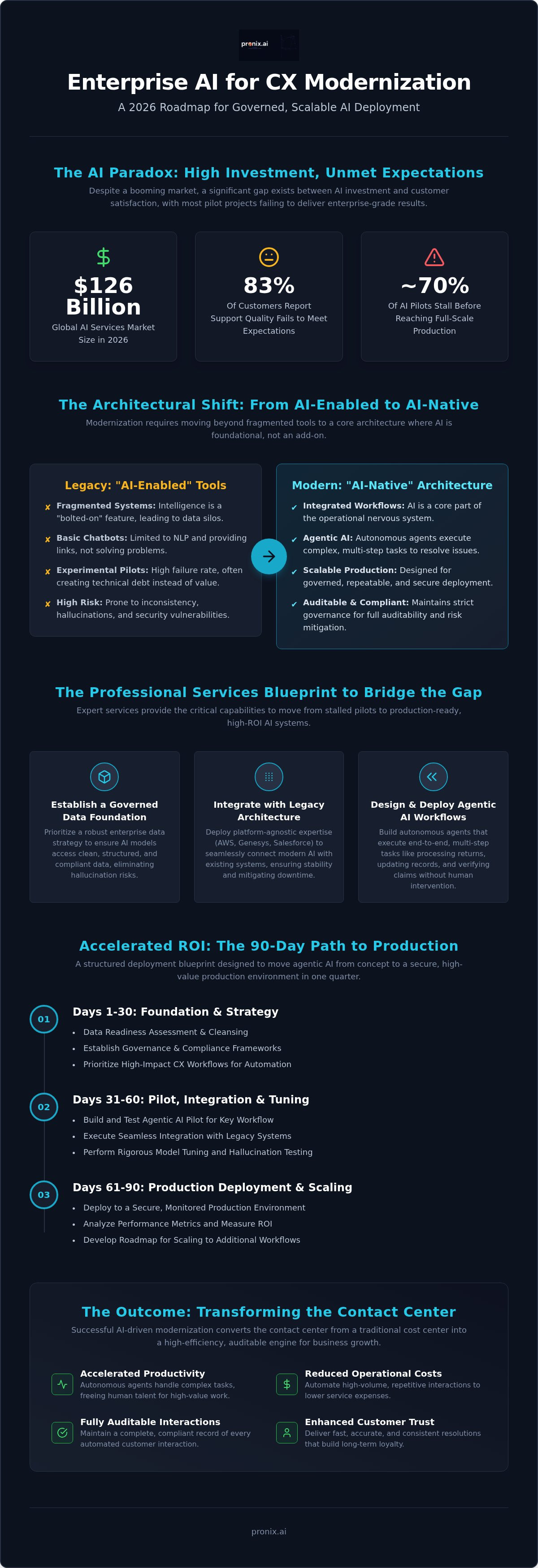
The global AI services market has surged to $126 billion in 2026, yet 83% of customers still report that support quality isn't meeting their expectations. Most enterprise leaders realize that a simple software license cannot fix legacy friction or the talent gaps holding back true innovation. You're likely facing the pressure to scale AI while managing new regulatory hurdles like the Illinois Artificial Intelligence Safety Measures Act or the EU AI Act's transparency mandates. It's a high-stakes environment where experimental pilots often fail to reach production maturity.
This guide explores how professional services for enterprise AI bridge the gap between isolated experiments and secure, scalable AI-driven CX modernization for enterprises. You'll discover how to move beyond basic chatbots toward autonomous agentic workflows that reduce operational costs and accelerate service productivity. We provide a clear, practitioner-led roadmap for governed deployment. This preview of the 2026 landscape covers everything from data foundations to the long-term stability of managed services. Learn how to transform your contact center into a high-output, auditable engine for growth.
Key Takeaways
- Shift from fragmented AI-enabled tools to integrated, AI-native architectures to ensure long-term scalability and operational maturity.
- Execute AI-driven CX modernization for enterprises by bridging the gap between experimental pilots and secure, production-ready workflows.
- Prioritize professional services partners who balance strategic vision with technical execution within highly regulated sectors like finance and healthcare.
- Establish rigorous governance frameworks that eliminate hallucination risks and maintain fully auditable, compliant customer interactions.
- Accelerate your return on investment with a 90-day deployment blueprint designed to move agentic AI from pilot to production.
Scaling CX Modernization: Why Enterprise AI Requires Professional Services
The year 2026 marks a definitive boundary in enterprise evolution. Organizations have moved past the era of "AI-enabled" tools where intelligence was merely a bolted-on feature. Today, the standard is AI-native CX. This transition requires a fundamental shift in how data flows and how systems interact. While many internal IT teams successfully launch experimental pilots, industry data suggests that nearly 70% of these projects stall before reaching full-scale production. The gap between a successful demo and a secure, auditable deployment is wider than most anticipate.
Bridging this gap requires specialized professional services for enterprise AI. Internal teams often lack the specific expertise needed to manage the nuances of model tuning, data privacy, and cross-platform orchestration. Professional services provide the necessary talent to transition from speculative experiments to evidence-based outcomes. This ensures that AI-driven CX modernization for enterprises delivers measurable productivity gains rather than technical debt. It moves the focus from "what is possible" to "what is repeatable and secure."
The Complexity of Legacy Integration
Most enterprises operate on a patchwork of legacy systems that weren't designed for real-time AI orchestration. Friction occurs when modern models attempt to pull data from siloed, decades-old databases. CX modernization is a holistic operational shift that reconfigures the entire service lifecycle rather than simply updating a single communication tool. It requires a deep understanding of the history and applications of AI in CX to avoid repeating past architectural mistakes.
Success demands platform-agnostic expertise across environments like AWS, Genesys, and Salesforce. A professional services partner ensures that new AI layers integrate seamlessly with existing stacks. They mitigate the risk of system downtime while accelerating the transformation process. This grounded approach prioritizes stability, ensuring that legacy constraints don't throttle modern innovation.
Beyond Chatbots: The Rise of Agentic AI
Basic Natural Language Processing (NLP) is no longer sufficient for high-stakes enterprise service. Customers expect more than a link to a FAQ page; they demand resolution. The industry has shifted toward agentic AI, where models act as autonomous agents capable of executing multi-step tasks across different software environments. These agents handle complex journeys that previously required human intervention.
Specialized Agentic AI implementation services focus on building these end-to-end workflows. These agents don't just talk; they perform. They process returns, update medical records, and verify insurance claims autonomously. This move toward autonomous resolution is the core of AI-driven CX modernization for enterprises, turning the contact center from a cost center into a high-efficiency production engine.
The Architecture of Modern CX: Moving Beyond Tools to Governed Workflows
Successful AI-driven CX modernization for enterprises requires more than a software subscription. It demands a sophisticated architectural blueprint that treats AI as a core component of the operational nervous system. In 2026, the focus has shifted from simply deploying tools to orchestrating governed workflows that ensure every interaction is secure, accurate, and useful. This architecture must support real-time decisioning while maintaining strict adherence to emerging transparency standards.
Professional services play a critical role in establishing these foundations. Most implementation failures stem from poor data readiness rather than model limitations. Before any deployment, experts must prioritize a robust enterprise data strategy for AI. This foundation ensures that Generative AI models access clean, structured, and compliant data. Without this groundwork, AI agents risk hallucinating or providing inconsistent answers that erode customer trust. Establishing a governed data architecture is the first step toward achieving a scalable, production-ready environment.
Designing Intelligent Workflows
Modern workflows map customer intent directly to specific agent capabilities. It's no longer enough for an AI to recognize a "return" request; the system must autonomously verify the purchase, check the warranty status, and initiate the logistics process. This level of resolution requires deep integration into backend systems. Professional services ensure these workflows include seamless handoffs. If a high-value customer displays frustration, the system transfers the entire interaction history to a human agent immediately. This preserves context across voice, chat, and social channels, creating a unified experience that respects the customer's time.
The Role of Platform Orchestration
Enterprises often operate in fragmented environments, leveraging Salesforce Agentforce for CRM data and Genesys Cloud for communication routing. Professional services manage this multi-platform orchestration to prevent data silos. They build the middleware and API layers necessary to maintain a single source of truth across the entire CX stack. This approach ensures that an AI agent on the website knows exactly what was discussed during a previous phone call. By unifying these platforms, organizations can execute a more cohesive omnichannel strategy that scales without increasing operational complexity. This disciplined integration is what separates elite performers from those stuck in perpetual pilot phases.
Evaluating Professional Services for Enterprise AI: Selection Criteria
Selecting a partner for AI-driven CX modernization for enterprises requires a balance of high-level strategic vision and boots-on-the-ground pragmatism. Technical execution alone is insufficient if it lacks a roadmap for long-term operational maturity. You need a partner who understands how to mitigate risks while maintaining the momentum of technological evolution. They must act as both a bold innovator and a disciplined practitioner, ensuring every deployment is backed by a rigorous framework and a clear path to production.
Experience in regulated sectors like healthcare and finance is a non-negotiable criterion in 2026. These industries face strict oversight from the EU AI Act and state-level laws such as the Colorado AI Act. A partner must demonstrate a track record of building auditable, compliant workflows that respect consumer privacy and avoid algorithmic discrimination. This evidence-based success is what separates elite consultants from those who merely follow the hype. Verification of safety frameworks is essential before committing to any large-scale transformation.
Internal talent gaps remain the primary reason enterprise projects stall at the pilot phase. Many organizations now utilize Enterprise AI talent as a service to inject specialized expertise directly into their operational teams. This model allows for rapid scaling without the long-term overhead of permanent hires. It provides the elite skills necessary to transition from experimental results to secure, scalable production outcomes. Treating talent as a long-term resource rather than a temporary fix ensures your AI capabilities evolve alongside the market.
Platform Expertise and Certifications
Deep proficiency in platforms like AWS Connect, NICE, and Salesforce is essential for successful integration. You should prioritize partners who don't just design the workflow but also possess the operational capability to run it. Look for "boon-to-production" track records in their portfolios. These success stories prove they can navigate the friction of legacy systems and deliver tangible productivity gains. A partner with multi-platform certifications ensures your architecture remains resilient and flexible as new tools emerge.
Managed Services vs. One-Time Implementation
AI-driven CX modernization for enterprises isn't a one-time event. It's a continuous lifecycle of tuning and optimization. Comparing the ROI of managed services for agentic AI reveals that ongoing support often yields higher long-term value than isolated implementations. Production environments demand 24/7 governance and real-time monitoring to mitigate hallucination risks. This constant vigilance ensures that your AI agents remain reliable and your workflows stay compliant with evolving global regulations.
Governance and Risk Mitigation in AI-Driven CX Modernization
The 2026 standard for enterprise-grade AI auditability centers on transparency and risk management. As of August 2, 2026, the EU AI Act's transparency requirements under Article 50 are fully applicable. This mandates clear disclosure whenever customers interact with an AI agent or emotion-recognition technology. Domestically, the Illinois Artificial Intelligence Safety Measures Act and the Colorado AI Act have established rigorous safety frameworks that both developers and deployers must follow. AI-driven CX modernization for enterprises cannot succeed without these foundational guardrails. Organizations must move beyond ethical platitudes toward evidence-based compliance to avoid significant regulatory penalties.
Mitigating hallucination risks is a primary concern for customer-facing agents. Hallucinations don't just frustrate users; they create legal liability and erode brand equity. Practitioner-led frameworks utilize retrieval-augmented generation (RAG) and strict prompt engineering to ground AI responses in verified company data. This prevents agents from inventing policies or unauthorized discounts. Protecting brand reputation requires a zero-tolerance approach to unverified outputs. Implementing AI-driven CX modernization for enterprises requires this disciplined approach to model monitoring and data sovereignty.
Security Architecture for CX
Security starts with a zero-trust data access model for every AI agent. This ensures that agents only access the specific datasets required for a task, maintaining HIPAA and SOC2 compliance in automated workflows even as they scale. Professional services implement comprehensive logging and version control to ensure every AI-generated response is fully auditable and traceable back to its source data. This level of oversight is mandatory for high-stakes industries like finance and healthcare where every interaction must be defensible during an audit.
Monitoring and Continuous Improvement
Governance doesn't end at deployment. Real-time sentiment analysis monitors every interaction for signs of frustration or misunderstanding. If a specific threshold is met, the system triggers a human-in-the-loop (HITL) intervention to resolve complex service issues before they escalate. Managed services play a vital role here by providing the infrastructure to patch and update AI models safely without disrupting production. This continuous feedback loop identifies bias and improves accuracy over time. You can secure your enterprise AI workflows by implementing a governed blueprint that prioritizes stability and risk mitigation. This proactive stance protects your brand while accelerating your modernization journey.
From Pilot to Production: Accelerating CX ROI with Managed AI Services
Transitioning from a proof-of-concept to a production-ready environment is the most critical hurdle for enterprise leadership. While many organizations experiment with basic automation, industry data shows that 70% of AI projects stall in pilot purgatory. This failure usually stems from a lack of clear operational milestones or fragmented data architectures. To avoid this, a 90-day blueprint provides a structured path toward governed deployment. This timeline ensures that momentum isn't lost and that results are measurable from the outset. AI-driven CX modernization for enterprises depends on this disciplined, time-bound approach to implementation.
Scaling from a single use case to full-scale modernization requires more than just technical integration. It demands a shift in how the organization perceives value. Success is no longer measured by the mere existence of a chatbot but by the volume of end-to-end resolutions. Aligning modernization goals with measuring ROI of enterprise AI ensures that every technical milestone translates into a financial outcome. This strategic framework moves the conversation from cost savings to service productivity and revenue protection.
Phase 1: Strategy and Foundation
Success starts by identifying high-impact, low-risk use cases for initial deployment. Automating routine account inquiries or warranty verifications allows the system to prove value without introducing excessive risk to the brand. During this phase, professional services focus on cleaning and structuring data for agentic consumption. This preparation ensures that AI agents have the necessary context to resolve issues autonomously. We define success through concrete metrics like Average Handle Time (AHT) and First Contact Resolution (FCR). These benchmarks provide the evidence needed to justify broader scaling efforts.
Phase 2: Managed Execution and Scale
Once the foundation is secure, the focus shifts to scaling AI-driven CX modernization across departments. This phase requires balancing technical resolution with employee experience (EX). Transformation often fails if human agents feel sidelined by the new technology. By deploying AI-driven employee experience tools, organizations empower their staff with real-time assistance and automated documentation. This support allows human agents to focus on high-emotion, high-stakes interactions while AI handles the routine volume. Scaling AI-driven CX modernization for enterprises involves creating this symbiotic relationship between human expertise and machine efficiency.
Transitioning to a Production-Ready CX Architecture
AI-driven CX modernization for enterprises has evolved from a speculative goal into a requirement for operational maturity. Success in 2026 demands a shift from fragmented, bolted-on tools toward integrated, governed workflows that prioritize robust data foundations. By bridging the gap between experimental pilots and production-ready outcomes, you ensure that every innovation translates directly into measurable ROI and accelerated productivity. Professional services provide the strategic vision and technical expertise necessary to navigate legacy system friction and complex regulatory landscapes like the EU AI Act.
Pronix.ai delivers the stability and speed required for high-stakes transformation. We offer end-to-end managed services for AWS, Salesforce, and Genesys, supported by specialized expertise in healthcare and finance compliance. Our 90-day governed deployment framework is engineered to eliminate pilot purgatory and provide a clear path to production excellence. Use our practitioner-led approach to turn your contact center into a resilient, autonomous engine for growth.
Move your AI pilot to production with pronix.ai's expert implementation services. Your journey toward a more efficient, secure customer experience begins with a disciplined, evidence-based roadmap.
Frequently Asked Questions
What are professional services for enterprise AI and why are they necessary?
Professional services for enterprise AI provide the strategic consulting and technical implementation required to transition from experimental pilots to secure, scalable production outcomes. These services are necessary because internal teams often lack the specialized talent to bridge the gap between simple chatbots and autonomous workflows. By leveraging outside expertise, organizations can navigate legacy system friction and ensure their AI initiatives meet rigorous enterprise-grade security and auditability standards.
How do professional services differ from buying an AI software license?
Buying a software license provides a tool, whereas professional services deliver a complete operational framework. Modernization isn't about owning software; it's about reconfiguring data flows and integrating AI into existing contact center stacks like AWS or Genesys. Professional services focus on the architecture, governance, and managed execution required to achieve measurable business value. This approach ensures the technology is implemented responsibly and scales effectively across the entire enterprise ecosystem.
How do you ensure security when using Generative AI in a contact center?
Security is established through robust data foundations and zero-trust access models. By implementing retrieval-augmented generation (RAG), AI agents are restricted to verified company data, which mitigates the risk of hallucinations. We ensure all automated workflows maintain HIPAA and SOC2 compliance, particularly in regulated sectors like healthcare and finance. This disciplined approach includes continuous monitoring and logging to ensure every AI-generated response is fully auditable and traceable back to its source.
Can AI-driven CX modernization integrate with our existing legacy systems?
Yes, AI-driven CX modernization for enterprises is specifically designed to integrate with legacy contact center stacks. Professional services utilize platform-agnostic expertise to build middleware and API layers that connect modern AI agents with decades-old databases. This process reconfigures the service lifecycle without requiring a total rip-and-replace of existing infrastructure. The goal is to eliminate siloes and maintain a single source of truth across voice, chat, and social channels.
How long does it typically take to see ROI from AI modernization?
Most enterprises begin seeing measurable ROI within 90 days when following a structured deployment blueprint. Initial returns typically come from automating high-volume, low-risk use cases such as account inquiries or warranty verifications. These early wins reduce operational costs and accelerate service productivity. As the implementation scales from a single use case to full-scale modernization, the financial impact grows through improved resolution rates and reduced average handle times across all departments.
What is the difference between a chatbot and an Agentic AI agent?
A traditional chatbot is limited to recognizing intent and providing pre-defined responses or links. In contrast, an Agentic AI agent is capable of autonomous resolution. These agents execute multi-step tasks across different software environments, such as processing returns, updating medical records, or verifying insurance claims. The shift toward agentic workflows is a core component of AI-driven CX modernization for enterprises, moving beyond simple conversation toward end-to-end task completion.
How do managed services help with AI governance and compliance?
Managed services provide the continuous oversight necessary to maintain 24/7 governance and compliance. AI models require ongoing tuning to mitigate hallucination risks and identify algorithmic bias as data evolves. Managed services ensure that models are patched and updated safely without disrupting production environments. This proactive approach helps organizations stay compliant with global regulations like the EU AI Act while ensuring that all AI interactions remain auditable and aligned with brand reputation.
What criteria should we use to select an AI implementation partner?
Prioritize partners with deep expertise in major platforms like AWS, Salesforce, and Genesys. A successful partner must demonstrate a track record of moving projects from pilot to production in regulated industries like finance and healthcare. Look for a Talent as a Service model that allows for rapid scaling. Finally, ensure the partner offers end-to-end managed services, as modernization requires long-term operational support rather than a one-time technical implementation.