

Gartner forecasts that 40% of enterprise applications will have integrated task-specific AI agents by the end of 2026. This surge in building enterprise AI agents has left many leaders stuck in "pilot purgatory," where impressive lab demos fail to translate into secure production environments. You've likely seen the potential of agentic workflows only to hit a wall when faced with legacy system integration or the risk of high-stakes hallucinations. It's a common friction point that stalls innovation and creates unnecessary risk in regulated industries.
We're here to change that trajectory. This guide helps you master the transition from experimental pilots to secure, governed, and scalable workflows that drive measurable value. You'll gain a clear roadmap for moving into production with confidence and a framework for choosing between custom builds and platform-native agents. We'll move from high-level strategy to the technical execution required for predictable, auditable, and stable outcomes that finally bridge the gap between innovation and operational maturity.
Key Takeaways
- Establish a mature governance framework to escape "pilot purgatory" and ensure AI outcomes remain stable and auditable in production.
- Implement the Orchestrator-Worker pattern to manage sophisticated multi-agent workflows and real-time data integration via RAG 2.0.
- Determine the optimal tech stack for building enterprise AI agents by weighing the speed of platform-native tools against the flexibility of custom builds.
- Follow a structured 90-day execution roadmap to move from initial data readiness assessment to production-ready guardrail calibration.
- Scale operations effectively by bridging the internal talent gap with practitioner-led strategies that prioritize long-term stability over experimental hype.
Building Enterprise AI Agents: Beyond the Pilot Purgatory
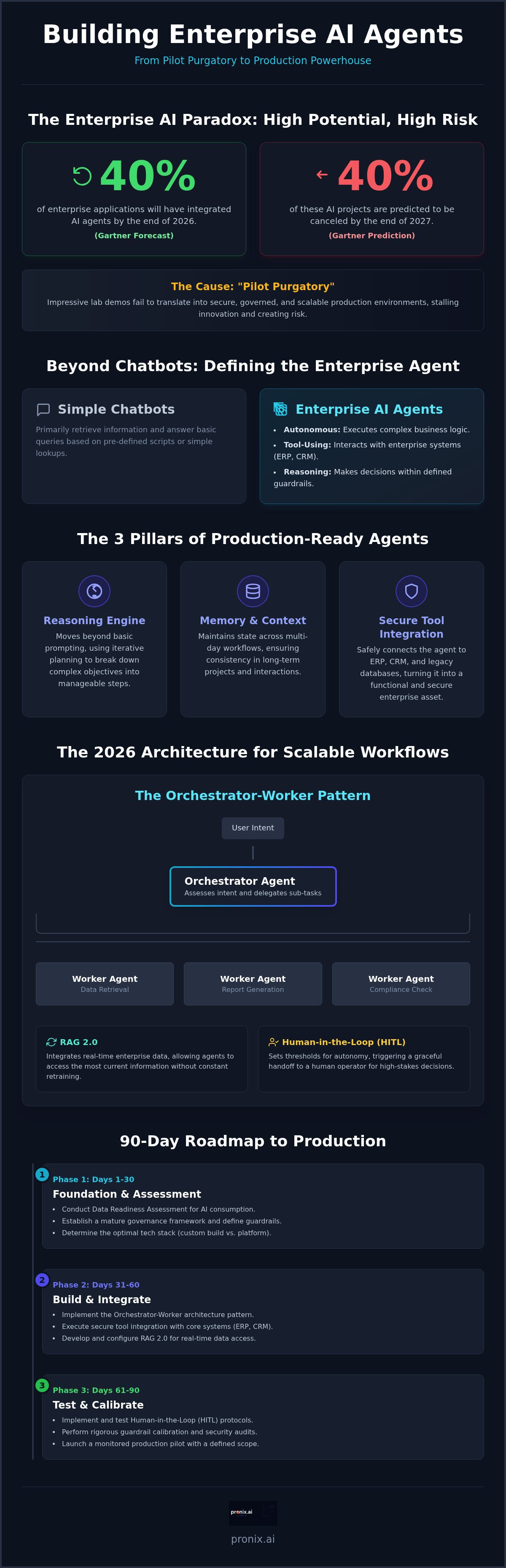
The 2026 reality is a wake-up call for executive leadership. While 61% of CEOs are actively adopting agentic technology, Gartner predicts that over 40% of these projects will be canceled by the end of 2027. This high failure rate is the direct result of "pilot purgatory." Organizations build impressive lab demos that fail to survive the rigors of security, governance, and real-world scale. Building enterprise AI agents requires more than technical curiosity; it demands a transition to practitioner-led maturity that prioritizes stability over hype.
Defining the 'Enterprise AI Agent' is the first step toward success. Unlike simple chatbots that merely retrieve information, an intelligent agent is designed for autonomy, tool-use, and reasoning under strict governance. It executes business logic and makes decisions within defined guardrails. This isn't just a software update. It's a fundamental mindset shift for IT architecture. You're no longer just managing code; you're orchestrating autonomous workers that interact with your entire professional service lifecycle.
The Core Components of an Enterprise-Grade Agent
Production readiness requires three pillars. First, a reasoning engine that moves beyond basic prompting. It uses iterative planning to break down complex objectives into manageable steps. Second, memory and context management allow the agent to maintain state across multi-day workflows, ensuring consistency in long-term projects. Finally, secure tool integration connects the model to ERP, CRM, and legacy databases. This turns a language model into a functional asset capable of pulling data and pushing actions safely across the enterprise.
Why Traditional AI Implementation Strategies Fall Short
Legacy approaches often treat agents as standard software updates. They aren't. One major hurdle is the 'Black Box' problem, where autonomous decisions lack transparency. Regulated industries can't accept unverified outcomes without a rigorous framework for auditability. Additionally, existing data stacks frequently lack the low-latency infrastructure needed for real-time agentic responses. Finally, the talent gap remains a significant barrier. Building enterprise AI agents demands a deep understanding of data architecture and operational governance, which extends far beyond the reach of simple prompt engineering.
The 2026 Architecture for Scalable Agentic Workflows
Scaling from a single pilot to a multi-agent ecosystem requires a shift from linear prompt chains to the Orchestrator-Worker pattern. In this model, a central orchestrator agent assesses the user intent and delegates sub-tasks to specialized worker agents. This architecture is essential for building enterprise AI agents that can handle complex, multi-stage business logic. A financial services agent, for instance, might delegate data retrieval to a compliance-focused worker while assigning report generation to another. This separation of concerns ensures that each component operates within its specific domain, significantly reducing the risk of systemic failure.
Modern architectures also leverage Retrieval-Augmented Generation (RAG) 2.0. This advanced framework integrates real-time enterprise data, allowing agents to access the most current information without constant retraining. While research into believable humanlike behavior continues to advance agent sophistication, enterprise utility relies on Human-in-the-loop (HITL) frameworks. HITL sets clear thresholds for autonomy. When an agent encounters a high-stakes decision or hits a logic wall, it must trigger a graceful failure protocol. This hands the process back to a human operator with a full context log, preventing the hallucinations that often plague unmonitored systems.
Data Foundations for Production Outcomes
Reliable agents are only as good as the data they consume. You must prioritize cleaning and structuring unstructured data to make it machine-readable. Implementing vector databases that scale with enterprise-level queries is no longer optional. These systems provide the semantic search capabilities required for agents to find relevant context instantly. Establishing a robust enterprise data strategy for AI ensures that your information architecture supports long-term scalability and accuracy. Without this foundation, building enterprise AI agents remains a purely academic exercise.
Security and Guardrail Engineering
Security is the primary barrier to production. Effective guardrail engineering includes input and output filtering to prevent prompt injection and data exfiltration. You must define hard constraints that dictate what an agent is never allowed to do or say. Every action must leave a comprehensive audit trail. This step-by-step log of an agent's "thought" process and subsequent actions is vital for compliance in regulated sectors like finance and healthcare. If you need assistance in establishing these rigorous standards, our Agentic AI Strategy & Consulting team can help align your architecture with industry-specific security requirements.
Buying Guide: Choosing the Right Agentic AI Tech Stack
Selecting the right tech stack is a high-stakes decision that dictates your long-term operational maturity. You aren't just buying software; you're choosing the foundation for your future workforce. The decision to build or buy hinges on your existing infrastructure and your specific business logic requirements. Building enterprise AI agents on a custom stack provides maximum control over data sovereignty, while platform-native solutions offer a faster path to deployment. You must evaluate whether your chosen stack can scale from 10 agents today to 1,000 next year without a complete architectural overhaul.
Total cost of ownership (TCO) extends far beyond initial license fees. While platform-native tools often carry recurring subscription costs, custom development requires significant upfront engineering hours and ongoing maintenance. Integration depth is equally critical. Your agentic stack must play well with existing CX tools, ERPs, and CRMs. If an agent can't access your legacy databases safely, its utility is severely limited. We recommend prioritizing stacks that offer deep integration with your current professional service lifecycle to ensure a seamless transition from pilot to production.
Platform Analysis: Salesforce Agentforce vs. Custom AWS Solutions
Salesforce Agentforce is designed for speed to value, particularly in CRM-heavy workflows. It's an excellent choice for organizations already embedded in the Salesforce ecosystem that need to modernize customer interactions quickly. For a deeper look at these capabilities, see our ai-driven CX modernization guide. Conversely, AWS Agentic Services offer maximum flexibility. This is the preferred route for bespoke manufacturing or finance logic where you need granular control over the model and the underlying infrastructure. AWS allows for highly specialized worker agents that can be tuned to unique regulatory or operational requirements.
Critical Evaluation Criteria for Enterprise Leaders
Security certifications are non-negotiable for production outcomes. Ensure your stack meets SOC 2, HIPAA, and GDPR compliance standards before moving past the prototyping phase. Ease of orchestration is another vital factor. Can non-technical users adjust agent parameters, or does every change require an engineering ticket? Finally, consider vendor lock-in risks. The 2026 market moves fast. Adopting a model-agnostic architecture ensures you can swap underlying LLMs as better technology emerges. This flexibility is essential for building enterprise AI agents that remain competitive and cost-effective over the long term.
The 90-Day Roadmap: Moving AI Agents to Production
Moving from a conceptual pilot to a production-ready asset requires a disciplined, time-bound approach. A 90-day execution framework ensures that momentum doesn't stall during the high-stakes transition from engineering to operations. Success in building enterprise AI agents depends on your ability to move through these phases without skipping the governance steps that ensure long-term stability. This structured timeline transforms experimental code into a reliable business asset.
- Phase 1: Days 1-30. Focus on Opportunity Discovery and Data Readiness Assessment. Identify high-impact use cases where agentic workflows provide immediate ROI while auditing your data architecture for real-time support.
- Phase 2: Days 31-60. Dedicate this period to Prototyping and Guardrail Calibration. Build core logic and define strict operational boundaries to handle edge cases and prevent logic drift.
- Phase 3: Days 61-90. Execute system integration, pilot testing, and the production launch. Connect the agent to live environments and monitor performance against real-world inputs.
Post-launch, the focus shifts to continuous monitoring and iterative "agent coaching." This process involves refining outcomes based on live feedback to maintain accuracy as business needs evolve. It's a cycle of constant improvement that ensures your agents remain aligned with organizational goals and security standards.
Establishing an Enterprise AI Governance Framework
Operationalizing AI requires clear oversight. You must define specific KPIs for agent performance, focusing on accuracy, latency, and task completion rates. Establishing an AI Center of Excellence (CoE) provides the centralized leadership needed to oversee cross-departmental deployments. AI governance is the bridge between innovation and risk management.
Auditability and Risk Mitigation Strategies
Production environments demand rigorous safety protocols. Implement automated regression testing to ensure that model updates don't break existing agent logic. Red-teaming your agents allows you to identify vulnerabilities and potential hallucination triggers before they reach your end users. If your internal team lacks the bandwidth for this level of oversight, review our guide on managed services for agentic AI to find the right operational partner. Ready to scale? Our Agentic AI Implementation services can help you execute this 90-day roadmap with precision.
Partnering for Success: Why an Agentic AI Consulting Firm is Essential
The "DIY" approach often underestimates the complexity of production scaling. Internal teams frequently struggle with the maintenance of "agentlakes" and the ongoing security requirements of high-risk systems. Building enterprise AI agents isn't just an engineering task; it's an operational commitment. Practitioner-led consulting bridges the gap between high-level strategy and technical execution. It ensures that your innovation doesn't stall at the prototype stage. You need a partner who has navigated the friction points of modernizing legacy systems at scale to ensure long-term stability.
Pronix.ai accelerates these outcomes through established intelligent workflows that have been tested in complex, high-stakes environments. We provide the stability and auditability required for regulated sectors like finance and healthcare. Our Enterprise AI Managed Services ensure that your agents remain secure and effective as underlying LLMs evolve. This ongoing management solves the internal talent gap by providing specialized expertise as a service. It moves your organization from a state of constant troubleshooting to proactive operational maturity. Our managed services provide the continuous oversight needed to maintain safety and compliance in an ever-shifting technological landscape.
The Pronix.ai Approach: From Strategy to Managed Outcomes
We offer end-to-end implementation across AWS, Salesforce, and Genesys ecosystems. This deep technical expertise allows us to augment your internal AI capabilities with specialized talent. Our focus remains on responsible AI adoption and delivering measurable business value. We don't just build tools; we implement governed operational assets that drive ROI. By integrating agentic workflows with your existing professional service lifecycle, we ensure that every deployment is backed by a rigorous framework and a clear path to production. We prioritize risk mitigation without sacrificing the speed of innovation.
Ready to Move from Pilot to Production?
Initiating an Agentic AI readiness assessment is the first step toward technological maturity. You need a partner who understands the intersection of CX modernization and deep data architecture. This dual expertise is critical for building enterprise AI agents that actually function in the real world. Stop settling for pilots that never launch. Don't let your transformation efforts get stuck in the lab. Schedule your Enterprise AI Strategy Consultation with Pronix.ai to secure your production-ready future and drive predictable enterprise outcomes.
Securing Your Competitive Edge in the Agentic Era
The transition from experimental pilots to production-ready outcomes requires more than technical skill. It demands a disciplined 90-day roadmap, a robust Orchestrator-Worker architecture, and a clear-eyed evaluation of your tech stack. Success in building enterprise AI agents hinges on your ability to implement rigorous governance and maintain auditability in regulated environments. You've seen the roadmap. Now it's time to execute with a partner who prioritizes stability and risk mitigation over speculative hype.
Pronix.ai provides the bridge between strategic vision and technical implementation. We offer production-ready frameworks for AWS and Salesforce, backed by deep expertise in the healthcare and finance sectors. Our comprehensive AI Managed Services ensure your workflows remain secure as the technological landscape shifts. Don't let your transformation stall in the lab. It's time to move toward a mature, scalable operational model that delivers measurable enterprise value. Scale your enterprise AI agents with Pronix.ai today and secure your position at the forefront of the agentic revolution. Your journey toward operational excellence starts now.
Frequently Asked Questions
What is the difference between a chatbot and an enterprise AI agent?
An enterprise AI agent is fundamentally different from a chatbot because it possesses autonomy and the ability to execute multi-step tasks. While chatbots primarily retrieve and summarize information, agents use a reasoning engine to interact with external tools and business logic. When building enterprise AI agents, the focus is on creating autonomous workers that can resolve complex issues independently within governed parameters, rather than just providing scripted conversational responses.
How do you ensure AI agents remain compliant with HIPAA or SOC 2?
Ensuring compliance with HIPAA or SOC 2 requires a multi-layered security architecture. You must implement strict data foundations that include end-to-end encryption, PII masking, and comprehensive audit trails. Every decision made by the agent must be logged and verifiable to meet regulatory standards. Our managed services provide continuous monitoring and security updates, ensuring that your agentic workflows remain compliant as both technology and legal requirements for high-risk systems evolve.
Can AI agents be integrated with legacy on-premise systems?
AI agents can be integrated with legacy on-premise systems through secure API gateways and specialized middleware. This allows modern agentic workflows to pull data from or push actions to older ERP or CRM databases without compromising security. By using a hybrid architecture, you can leverage the power of cloud-based reasoning engines while maintaining the integrity of your on-premise data infrastructure, ensuring that legacy systems don't become a bottleneck for innovation.
What is the typical ROI timeline for an enterprise AI agent implementation?
The typical ROI timeline for an enterprise AI agent implementation ranges from three to six months after the production launch. Initial value often comes from cost reductions in customer service and accelerated employee productivity. As you scale from a single pilot to a multi-agent ecosystem, the returns compound through broader operational efficiencies. Success depends on following a structured 90-day roadmap that moves from opportunity discovery to governed, production-ready outcomes.
How do you prevent hallucinations in customer-facing AI agents?
Preventing hallucinations in customer-facing agents requires a combination of Retrieval-Augmented Generation (RAG 2.0) and strict guardrail engineering. RAG ensures the agent only uses verified enterprise data as its source of truth. Additionally, you must implement input and output filters that detect and block off-script responses. Setting clear thresholds for uncertainty allows the agent to trigger a graceful failure, handing the interaction to a human before an inaccurate claim is made.
What role does a human-in-the-loop play in autonomous agentic workflows?
Human-in-the-loop (HITL) serves as the primary risk management layer in autonomous workflows. Humans handle high-stakes exceptions and provide oversight for tasks that exceed the agent's confidence threshold. Beyond immediate intervention, HITL is essential for agent coaching, where human feedback is used to refine the agent's reasoning over time. This partnership ensures that autonomous actions remain aligned with brand reputation and complex business logic in regulated industries like finance and healthcare.
How often do AI agents need to be retrained or updated?
Agents don't require constant retraining of the underlying model, but their reasoning logic and data foundations need continuous monitoring. You should update an agent's knowledge base in real-time through RAG 2.0. Logic updates typically occur when business processes change or new regulatory requirements emerge. Our managed services facilitate this iterative process, ensuring that your agents remain effective and secure as the professional service lifecycle and technological landscape evolve.
Is it better to build custom agents or use platform-native tools like Agentforce?
Choosing between custom agents and platform-native tools like Salesforce Agentforce depends on your specific use case. Agentforce offers rapid speed-to-value for organizations with CRM-heavy workflows and existing Salesforce data. However, building enterprise AI agents on a custom stack provides maximum flexibility for bespoke manufacturing or finance logic. We often recommend a hybrid approach where platform-native tools handle standard interactions while custom worker agents manage highly specialized business processes.