

In 2026, the gap between an AI experiment and a production-ready outcome isn't a technical hurdle; it's an operational chasm. Most global enterprises have spent the last two years trapped in pilot purgatory, watching promising prototypes stall because they lack the internal talent and governance frameworks to scale. It's frustrating to invest heavily in innovation only to be held back by security risks and fragmented infrastructure. This is where enterprise AI automation managed services shift from being a luxury to a strategic necessity for the modern C-suite.
You can finally move past the friction of manual oversight and fragmented workflows to achieve true operational maturity. This article outlines the 2026 strategy for transitioning to autonomous agentic environments that prioritize measurable ROI, rigorous auditability, and infrastructure that scales without increasing headcount. We'll explore how next-generation managed services bridge the talent gap and provide the governed foundation required for production-ready AI. From CX modernization to agentic implementation, discover how to turn your AI vision into a stable, high-performance reality.
Key Takeaways
- Transition from fragmented AI pilots to stable, production-ready environments by prioritizing operational maturity over experimental speed.
- Bridge the internal talent gap using enterprise AI automation managed services designed to orchestrate complex Agentic AI workflows and data foundations.
- Evaluate the strategic shift from rule-based RPA to cognitive agents capable of managing unstructured data and high-value business processes.
- Implement rigorous governance and "Responsible AI" frameworks to maintain continuous auditability in highly regulated markets like finance and healthcare.
- Build a scalable infrastructure that supports autonomous agents while ensuring measurable ROI through evidence-based implementation and cost reduction.
The 2026 Shift: Why Traditional Managed Services Fail Enterprise AI
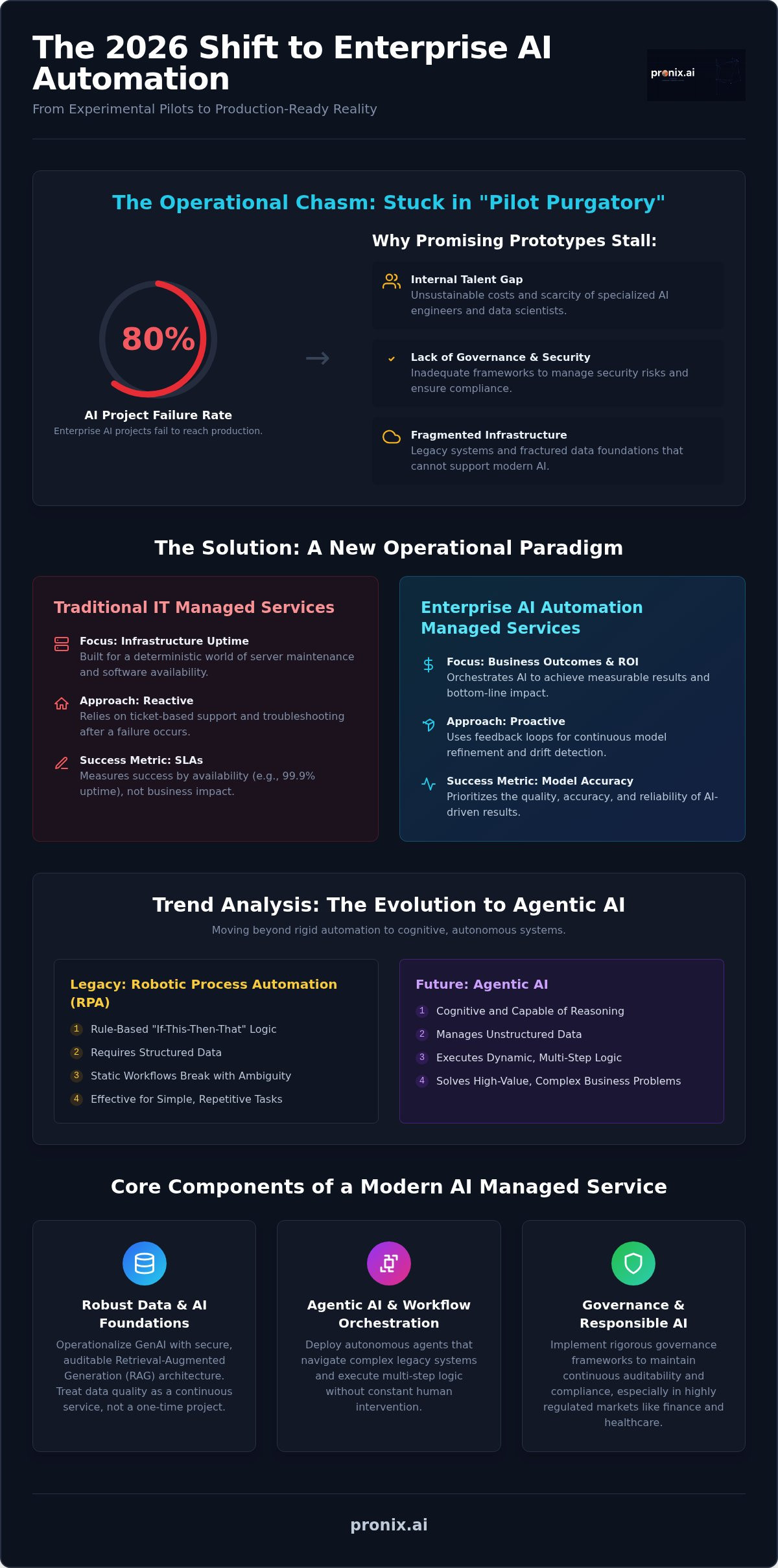
Industry analysts report that nearly 80% of enterprise AI projects fail to reach a production environment. This "pilot purgatory" isn't a failure of imagination; it's a failure of operations. Traditional IT managed services are built for the deterministic world of software uptime and server maintenance. They aren't equipped for the non-deterministic reality of Large Language Models (LLMs) and autonomous agents. By 2026, the definition of enterprise AI automation managed services has shifted. It's no longer about keeping the lights on. It's about orchestrating business outcomes through continuous model refinement and rigorous data governance.
Legacy Robotic Process Automation (RPA) relies on static, "if-this-then-that" logic. While effective for structured data, RPA breaks when faced with the ambiguity of modern business processes. Today's dynamic, LLM-driven agents require a data-first delivery model. If the underlying data foundation is fractured, the AI's output becomes a liability rather than an asset. A data-first approach in 2026 means treating data quality as a continuous service rather than a one-time project. Managed services now incorporate automated pipelines that clean, label, and secure data specifically for agentic consumption.
From Infrastructure Support to Outcome Orchestration
Traditional MSPs measure success through Service Level Agreements (SLAs) focused on availability. In the era of Agentic AI, these metrics are obsolete. An AI system can be "up" while providing inaccurate, drifted, or biased results. Modern enterprise AI automation managed services prioritize model accuracy and drift detection. This proactive stance replaces reactive troubleshooting. Practitioners use real-world feedback loops to retrain models in near real-time, ensuring that autonomous workflows remain aligned with shifting regulatory requirements and market conditions. The move from ticket-based support to proactive agent optimization is the new standard for operational maturity.
The Talent Gap: Bridging the Expertise Deficit
The cost of hiring in-house AI engineers and data scientists has reached unsustainable levels for many organizations. Managed services offer "Talent as a Service," providing immediate access to specialized expertise without the overhead of recruitment and retention. This isn't just about technical staff; it's about accessing practitioners who understand the friction points of modernizing legacy systems. Successful implementation requires more than just technical deployment. It demands strategic consulting to align AI workflows with specific business objectives. This partnership ensures that every automated process contributes directly to the bottom line while maintaining the stability and security that global enterprises demand.
Core Components of Enterprise AI Automation Managed Services
Successful production environments in 2026 rely on a unified architecture that integrates high-level strategy with technical execution. You cannot scale AI by simply purchasing more licenses. True enterprise AI automation managed services provide the operational backbone required to manage data, autonomous agents, and governance in a single, cohesive ecosystem. This approach ensures that every model deployment is backed by a rigorous framework that prioritizes stability over hype.
Building Robust Data and AI Foundations
Operationalizing Generative AI requires more than just an LLM connection. It demands a sophisticated Retrieval-Augmented Generation (RAG) architecture. RAG allows your AI to access real-time, proprietary data without the risks of frequent retraining; it effectively grounds outputs in your specific business context. Managed services ensure these data pipelines remain secure and auditable. By leveraging scalable infrastructure on AWS or Microsoft Azure, enterprises maintain high availability while strictly controlling data residency. If you're struggling to organize your underlying architecture, consider an assessment of your data and AI foundations to identify existing bottlenecks.
Agentic AI and Intelligent Workflow Design
The most significant leap in 2026 is the shift toward autonomous agents. Unlike traditional bots, these agents can navigate complex legacy systems and execute multi-step business logic without constant human intervention. Effective enterprise AI automation managed services focus on agent orchestration. This involves managing how multiple agents interact to solve a single problem, such as processing a complex insurance claim or modernizing a customer service journey. For a deeper look at implementation, refer to our Enterprise Agentic AI: 2026 Production Guide.
CX Modernization and Continuous Governance
Modernizing Customer Experience (CX) involves deep integration with platforms like Salesforce, Genesys, and AWS Connect. AI agents now handle unstructured inquiries that once required manual intervention. However, this level of autonomy requires continuous governance. Managed service providers monitor for bias, hallucinations, and compliance drift in real-time. This is particularly critical in regulated markets like healthcare and finance. Continuous auditability ensures that every AI-driven decision is transparent and defensible. It protects your brand from the reputational risks associated with unmanaged AI deployments.
Trend Analysis: RPA vs. Agentic AI Managed Services
In 2026, the distinction between legacy automation and cognitive intelligence is clear. Traditional Robotic Process Automation (RPA) served its purpose for structured, repetitive tasks. However, its reliance on "if-this-then-that" logic makes it fragile when faced with unstructured data. Agentic AI represents a paradigm shift. It moves beyond simple execution to autonomous reasoning. This is the core value proposition of modern enterprise AI automation managed services: bridging the gap between rigid legacy systems and flexible, AI-driven workflows.
While RPA often depends on screen scraping, which breaks with every UI update, Agentic AI prioritizes an API-first approach. These agents don't just follow a path; they understand the goal. They navigate ambiguity, making decisions based on context rather than just pre-programmed rules. This transition ensures that your automation remains resilient even as your underlying business processes evolve. Managed services act as the essential bridge, allowing organizations to layer cognitive agents over existing RPA investments without the risk of a full "rip-and-replace" strategy.
Evaluating MSPs for Production-Readiness
Selecting a partner in 2026 requires looking past marketing hype to find pragmatic practitioners. Generalists often lack the deep technical knowledge required for specialized platforms like Kore.ai or Salesforce. You need an MSP that demonstrates evidence-based success in high-scale, global deployments. Assess their ability to manage complex integrations and maintain model accuracy across diverse geographic markets. A partner who understands the friction points of legacy modernization is more valuable than one who only offers speculative visions. Operational stability and auditability must be the primary benchmarks for any enterprise AI automation managed services engagement.
The ROI of Modern CX Modernization
The financial impact of AI-driven contact center workflows is measurable and immediate. By offloading repetitive, high-volume inquiries to autonomous agents, enterprises significantly reduce operational costs. But the benefits extend beyond the balance sheet. Improving the Employee Experience (EX) is a critical outcome. When agents handle the mundane, your human talent can focus on high-value, empathetic problem-solving. This reduces burnout and turnover in high-pressure environments. For a detailed roadmap on these outcomes, see our AI-Driven CX Modernization: 2026 Guide. Modernizing your CX isn't just a technology upgrade; it's a strategic move toward a more efficient and engaged workforce.
Governance and Compliance in Regulated AI Environments
In highly regulated sectors, the primary barrier to AI adoption isn't technical capability; it's the burden of proof. Global enterprises in healthcare and finance face a complex web of HIPAA and SEC requirements that traditional pilot programs often ignore. Transitioning to production requires a "Responsible AI" framework that prioritizes safety and transparency. High-quality enterprise AI automation managed services provide the necessary guardrails to ensure that autonomous agents operate within strict legal and ethical boundaries. This isn't just about avoiding fines. It's about protecting your brand's reputation in an era of increased scrutiny.
Risk mitigation in 2026 involves more than just periodic reviews. It requires continuous monitoring of data privacy across multi-tenant environments. Managed services ensure that sensitive information is never leaked into public LLMs or across internal departmental silos. By implementing rigorous security protocols, organizations can deploy large-scale agents with the confidence that their data remains sovereign and protected.
AI Governance for Healthcare and Finance
Navigating the regulatory landscape of 2026 demands intelligent automation of the compliance process itself. Managed AI workflows now include automated reporting tools that generate audit-ready documentation in real-time. For high-stakes environments, the "Human-in-the-Loop" (HITL) requirement remains a non-negotiable standard. Managed services define these intervention points, ensuring that AI handles the data processing while human experts retain authority over critical decisions. This balance allows for rapid scaling without compromising the integrity of patient care or financial advice.
Auditability and Model Risk Management
Regulators now expect to see the "reasoning" steps behind every autonomous decision. "Black box" AI is no longer acceptable for enterprise-grade deployments. Effective enterprise AI automation managed services track the logic path of every agent, providing a clear trail for regulatory review. This level of transparency is coupled with robust model versioning and rollback capabilities. If a model begins to drift or exhibit bias, practitioners can immediately revert to a previous, verified state. This disciplined approach to model risk management ensures long-term operational stability. To secure your infrastructure, partner with an expert in enterprise AI managed services who understands the nuances of regulated markets.
Scaling Success: The Pronix.ai Managed Service Model
Moving from a visionary strategy to a stable production environment requires more than just technical skill. It demands a partner who understands the operational burden of large-scale modernization. Pronix.ai, a division of Pronix Inc., leverages a 15 plus year legacy in enterprise technology consulting to deliver enterprise AI automation managed services that prioritize measurable business value. Our practitioner-led approach ensures that your transition to Agentic AI and modernized CX workflows is backed by real-world implementation experience rather than speculative marketing. We don't just deploy models; we orchestrate the entire service lifecycle to ensure long term stability and auditability.
The complexity of 2026 enterprise environments means that a "set it and forget it" mentality leads to immediate failure. Models drift, data pipelines break, and regulatory requirements shift. Our model addresses these friction points by providing end-to-end support, from the initial strategy and consulting phase to ongoing operational management. We act as your production partner, handling the technical heavy lifting so your internal teams can focus on core business objectives. This partnership model is designed to bridge the talent gap, giving you immediate access to specialized expertise in healthcare, finance, and complex automation frameworks.
The Transition from Pilot to Production
We utilize a rigorous 90-day blueprint to move enterprises from fragmented prototypes to governed, scalable environments. This methodical process starts with a deep dive into your Data & AI Foundations, ensuring that the underlying architecture can support autonomous reasoning. We integrate seamlessly with your existing investments in AWS, Microsoft, Salesforce, and Genesys to create a unified ecosystem. By the end of this 90-day cycle, your organization isn't just running a pilot; it's managing a production-ready environment where AI agents execute multi-step business logic with enterprise-grade security. Our commitment is to outcomes that are secure, defensible, and fully aligned with your broader digital transformation goals.
Next Steps: Partnering for Enterprise Transformation
Scaling success starts with a clear understanding of your current state. Our strategy team works with you to assess your AI maturity level and identify the specific friction points in your legacy systems. We don't offer one-size-fits-all solutions. Instead, we customize a managed services package tailored to the unique regulatory and operational needs of your industry. Whether you're modernizing a contact center or automating complex financial workflows, we provide the disciplined framework required for success. Ready to stabilize your AI roadmap and achieve measurable ROI? Contact pronix.ai for an AI Readiness Assessment and begin your journey toward a managed, autonomous future.
Securing the Path to AI Maturity
The transition from experimental pilots to production-ready outcomes requires a fundamental change in operational strategy. You've seen how the limitations of legacy RPA and the complexities of Agentic AI demand a data-first foundation and rigorous governance. In 2026, the competitive advantage belongs to organizations that can stabilize their AI workflows while maintaining strict compliance in regulated markets like healthcare and finance. Implementing enterprise AI automation managed services is the most efficient way to bridge the talent gap and ensure your infrastructure scales alongside your business objectives.
Pronix.ai brings 15 plus years of enterprise tech excellence to your transformation journey. As an AWS and Salesforce Certified Partner, we provide the pragmatic expertise needed to move beyond prototypes. We focus on risk mitigation and measurable ROI, ensuring your autonomous agents deliver consistent value. It's time to stop experimenting and start executing. Scale your enterprise AI from pilot to production with pronix.ai today and build a future defined by stability and innovation.
Frequently Asked Questions
What is the difference between AI consulting and AI managed services?
AI consulting defines the strategic roadmap and vision for your transformation. In contrast, enterprise AI automation managed services handle the day to day execution and operational stability of production environments. Consulting identifies the "what," while managed services deliver the "how" through continuous model optimization and infrastructure maintenance. This ensures your initiatives don't stall after the initial strategy phase but instead evolve into high performance business assets.
How do AI managed services handle data security and privacy?
Managed services secure your environment by building robust data foundations that prevent leakage into public LLMs. Practitioners implement multi-tenant isolation and encrypted data pipelines to maintain strict sovereignty over proprietary information. Every interaction is logged and monitored to ensure that sensitive enterprise data remains within governed boundaries. This disciplined approach mitigates the risks associated with scaling autonomous agents in high stakes environments.
Can AI managed services help with compliance in regulated industries like healthcare?
Yes, managed services are essential for navigating HIPAA and SEC regulations. They automate the generation of audit trails and provide transparent "reasoning" logs for every AI decision. By implementing Responsible AI frameworks, providers ensure that your automated workflows meet the latest 2026 governance standards. This allows healthcare and finance leaders to scale innovation without compromising their regulatory standing or patient data privacy.
What platforms do enterprise AI managed services typically support?
Enterprise grade services focus on leading cloud and CRM ecosystems like AWS, Microsoft Azure, and Salesforce. They also provide deep integration for CX platforms such as Genesys and AWS Connect. This cross platform support ensures that AI agents can navigate legacy systems and modern cloud environments simultaneously. A unified approach prevents fragmented silos and allows for a cohesive automation strategy across the entire global organization.
How do you measure the ROI of enterprise AI automation?
ROI is measured through direct cost reduction, increased throughput, and improved model accuracy. Organizations track the delta between manual processing times and autonomous execution to quantify productivity gains. Additionally, enterprise AI automation managed services monitor for model drift; preventing inaccurate outputs that could lead to financial or reputational loss. These evidence based metrics provide a clear picture of how AI investments translate into measurable bottom line impact.
What is 'Agentic AI' and why is it important for managed services in 2026?
Agentic AI refers to autonomous agents capable of reasoning and executing multi-step business logic without constant human oversight. Unlike rule based bots, these agents handle unstructured data and adapt to changing contexts. In 2026, managed services are critical for orchestrating these agents. They ensure that autonomous workflows remain aligned with business objectives while maintaining the stability and safety required for production environments.
How does a managed service provider help bridge the AI talent gap?
A managed service provider offers "Talent as a Service," giving you immediate access to specialized engineers and data scientists. This eliminates the high cost and time required for internal recruitment in a hyper competitive market. Providers bring seasoned practitioners who have already navigated the friction points of modernizing legacy systems. This partnership allows your internal leadership to focus on high level strategy while experts handle the technical execution.