

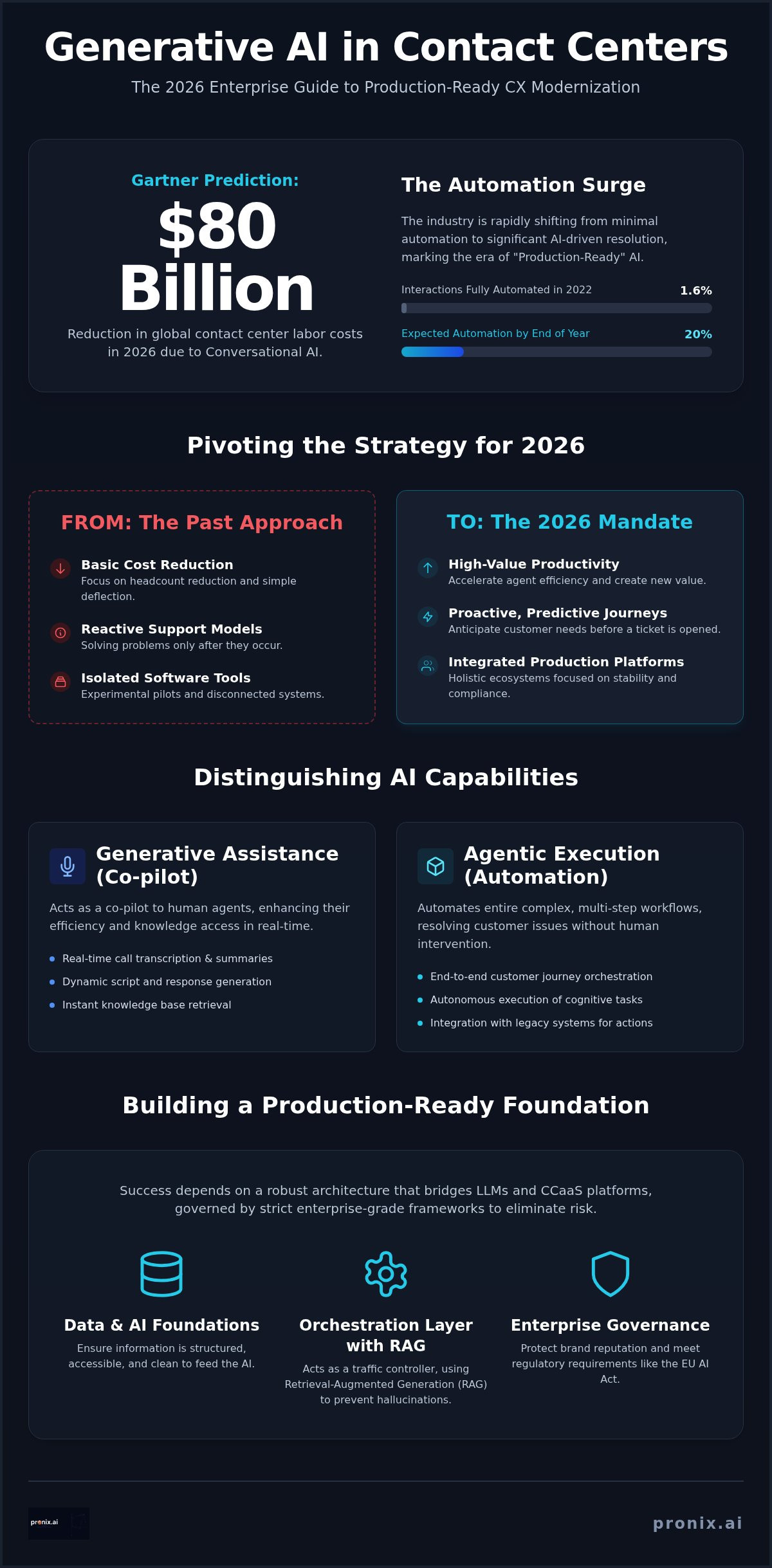
Gartner predicts that conversational AI will reduce global contact center labor costs by $80 billion in 2026. This isn't just an optimistic forecast. It's a clear mandate for enterprise leaders to move beyond experimental pilots and deploy Generative AI in contact centers at a production scale. While the financial incentives are undeniable, many organizations remain stuck in the trial phase, paralyzed by concerns over AI hallucinations and the complexity of legacy system integration.
You understand that the gap between a successful pilot and a secure, scalable solution is wide. Balancing the urgency for innovation with the necessity for risk mitigation is the primary challenge of the current fiscal year. This guide provides the strategic roadmap required to bridge that gap, helping you master the transition from isolated AI tests to agentic, production-ready outcomes.
We will detail how to build the necessary Data and AI Foundations to ensure operational stability. You'll learn to navigate 2026 regulatory requirements like the EU AI Act while accelerating agent productivity. We conclude with a framework for implementing agentic AI that transforms customer journeys into personalized, predictive experiences without compromising brand integrity.
Key Takeaways
- Pivot your 2026 strategy from basic cost reduction toward high-value productivity acceleration and value creation.
- Establish the data foundations and orchestration layers necessary for deploying secure Generative AI in contact centers.
- Distinguish between generative assistance and agentic execution to automate complex, multi-step customer workflows effectively.
- Apply enterprise-grade governance frameworks to eliminate hallucinations and protect your brand reputation in regulated sectors.
- Follow a structured roadmap to bridge the gap between experimental pilots and production-ready CX modernization.
Beyond Chatbots: The Strategic Value of Generative AI in 2026
In 2026, Generative AI in contact centers is no longer defined by simple text generation or basic auto-responses. It has matured into a sophisticated orchestration engine that synthesizes vast amounts of unstructured data into real-time operational intelligence. Leading enterprises have moved past the "cost-cutting" narrative of the early 2020s. They now view AI as a primary driver for value creation and productivity acceleration. This shift marks the transition from reactive support models to proactive, predictive customer journeys where the system anticipates needs before a ticket is even opened.
Adopting AI-driven CX modernization is now a holistic enterprise strategy. It integrates data architecture, governance, and human capital into a single, high-performance ecosystem. This approach ensures that every interaction isn't just resolved, but leveraged to improve the overall business lifecycle. Success in this landscape requires a move away from isolated software tools toward integrated, production-ready platforms that prioritize stability and compliance.
The Evolution of AI in Customer Experience
The journey from rigid, menu-driven IVRs to modern intelligent contact center solutions has reached a critical inflection point. Early automation focused on deflection; 2026 focus is on resolution. While only 1.6% of interactions were fully automated in 2022, that figure is expected to reach 20% by the end of this year. This growth is driven by the ability of Large Language Models (LLMs) to transform unstructured data, like call transcripts and email threads, into actionable insights for both agents and leadership.
2026 is the year of "Production-Ready" AI because the industry has finally established clear guardrails. Regulations like the EU AI Act provide the necessary framework for transparency and human escalation. Enterprises now have the maturity to move Generative AI in contact centers out of the sandbox and into high-stakes, customer-facing roles with confidence.
Measurable ROI: Productivity vs. Customer Satisfaction
The financial impact of this evolution is staggering. Gartner predicts conversational AI will reduce global contact center labor costs by $80 billion this year. These savings aren't just from headcount reduction. They stem from a massive leap in agent efficiency. By automating real-time summaries and knowledge retrieval, organizations are seeing a sharp decline in Average Handle Time (AHT) while simultaneously increasing First Call Resolution (FCR) rates.
Enterprise contact centers in 2026 are achieving unprecedented operational velocity by utilizing autonomous systems to handle routine cognitive tasks. This transition directly addresses employee burnout. When AI manages the repetitive, low-value queries, human agents focus on complex, high-empathy cases. This specialized focus reduces agent attrition and ensures that human capital is deployed where it delivers the highest impact. The result is a leaner, more resilient operation that delivers superior customer satisfaction at a fraction of the traditional cost.
Key Architecture: How Generative AI Orchestrates CX Journeys
Successful implementation of Generative AI in contact centers depends entirely on the integrity of your underlying architecture. You can't simply connect an LLM to your telephony and expect enterprise-grade results. Instead, you must build a robust orchestration layer that bridges the gap between large-scale models and specialized CCaaS platforms like Amazon Connect or Genesys Cloud. This layer acts as a traffic controller, directing the flow of intent, context, and real-time data to ensure every interaction is relevant and accurate.
A primary component of this architecture is Retrieval-Augmented Generation (RAG). RAG prevents the hallucinations that plague generic AI models by forcing the system to retrieve information from your specific enterprise datasets before generating a response. This ensures that every answer is grounded in your actual policies and product specs. To achieve this level of precision, organizations must prioritize their Data & AI Foundations to ensure that information is structured, accessible, and clean.
Real-Time Agent Assistance and Copilots
Operational velocity increases when AI acts as a co-pilot rather than a standalone tool. In 2026, real-time agent assistance has moved beyond simple suggestions. Systems now provide live transcription and dynamic script generation that adapts instantly to a customer's emotional state. If sentiment analysis detects rising frustration, the AI suggests a more empathetic tone or a specific retention offer. This capability is essential when modernizing legacy contact centers where siloed data often slows down human response times.
Automated call summarization is another critical efficiency gain. By generating structured post-call summaries in seconds, AI eliminates the manual after-call work that traditionally eats into agent productivity. This allows your team to transition immediately to the next interaction, reducing queue times across the board.
Automated Knowledge Creation and Management
The most advanced implementations of Generative AI in contact centers use interaction data to feed their own knowledge ecosystems. Instead of waiting for a human manager to update documentation, the AI identifies gaps in real-time. If multiple customers ask a question that the current knowledge base can't answer, the system flags the trend and drafts a suggested article based on the best-resolved call recordings. This creates a Single Source of Truth that stays current without constant manual intervention. It ensures that both your digital self-service bots and your human voice agents are working from the exact same playbook.
Generative vs. Agentic AI: Navigating the New CX Standard
The distinction between Generative and Agentic AI is the most critical strategic decision for CX leaders in 2026. While Generative AI excels at synthesizing information and drafting responses, it remains a tool of assistance. Agentic AI, however, represents a fundamental shift in operational logic. It doesn't just suggest a resolution; it executes the workflow. This evolution is why enterprises are moving toward "Agentic Orchestration," where complex business logic is handled by autonomous systems that can navigate multiple software environments to achieve a specific outcome.
Integrating Generative AI in contact centers now requires a focus on these execution-based models. Organizations are finding that the "Human-in-the-loop" (HITL) model is essential for maintaining oversight while allowing AI to handle high-volume tasks. By leveraging agentic ai for contact center efficiency, businesses can ensure that autonomous agents operate within strict governance boundaries, escalating only the most nuanced exceptions to human experts. This setup prevents the common trap of treating AI as a mere chatbot feature rather than a core infrastructure upgrade.
Autonomous Problem Solving in Contact Centers
True automation moves beyond simple intent recognition to goal-oriented task completion. Consider the refund process in a retail environment. An agentic system doesn't just tell the customer how to get a refund; it manages the entire lifecycle. The AI verifies the purchase, checks the return policy, initiates the logistics label, and processes the credit through the financial gateway. By handling these multi-step workflows without human intervention, enterprises significantly reduce operational costs while providing customers with instant, 24/7 resolution. This autonomy is the benchmark for production-ready AI in 2026.
Scaling Human Expertise with AI Agents
AI agents act as "Expert Assistants" for high-value customer inquiries that require a blend of data precision and human empathy. When a complex case reaches a human agent, the AI has already gathered the context, retrieved the relevant policy documents, and drafted a proposed solution. This allows the human to focus on brand loyalty and emotional connection rather than data entry. Agentic AI serves as the fundamental architecture that allows an organization to transition from siloed automation to a fully integrated Agentic Enterprise where every department operates with autonomous precision. This balance ensures that efficiency gains never come at the expense of the "Human Touch" that defines elite customer experiences.
Production Readiness: Solving for Governance and Brand Risk
The primary hurdle for deploying Generative AI in contact centers isn't technical feasibility. It's the risk of the model saying something wrong. For enterprise leaders, a single hallucinated policy or a leaked data point can lead to catastrophic brand damage. Production readiness requires moving beyond best-effort responses toward a framework of absolute auditability and control. This shift is mandatory for organizations operating in regulated sectors where compliance is a prerequisite for innovation.
Governance isn't just about accuracy. It's about brand preservation. Implementing enterprise-grade frameworks ensures that every AI interaction aligns with corporate values and legal requirements. As of August 2, 2026, the EU AI Act has codified these requirements, mandating clear AI disclosure and a guaranteed path to human escalation. Organizations failing to meet these standards face fines up to €35 million or 7% of global annual turnover. Secure implementation demands a partner who understands these high stakes and prioritizes risk mitigation over mere speed to market.
Risk Mitigation and Hallucination Control
Technical strategies for grounding AI responses in verified enterprise data are the first line of defense. While grounding provides the foundation, real-time monitoring acts as the digital safety net. "Kill switches" allow human supervisors to instantly disable customer-facing AI agents if they deviate from defined parameters. Auditability ensures every AI decision is logged and traceable. This level of transparency is essential for quality assurance and provides a clear record for legal defense if an interaction is ever contested. By treating every response as a record of truth, you eliminate the unpredictability that often stalls AI adoption.
Security and Compliance in Regulated Markets
In regulated markets like healthcare and finance, handling PII is a non-negotiable requirement. Compliance with HIPAA, GDPR, and SOC2 must be baked into the architecture from day one. California’s AB 2013, effective January 1, 2026, now requires developers to publish high-level summaries of training data, adding another layer of transparency to the ecosystem. Responsible AI adoption means prioritizing these ethical and legal guardrails to maintain brand reputation. Managed services provide the long-term oversight needed to manage model drift and ensure your systems remain compliant as new regulations emerge.
Ensure your implementation meets these rigorous standards by leveraging Enterprise AI Managed Services to bridge the gap between strategy and secure production.
Modernizing CX: Transitioning from Pilots to Managed Outcomes
Scaling Generative AI in contact centers requires moving beyond "pilot purgatory." Many enterprises successfully test isolated use cases but fail to achieve production-level maturity. This failure usually stems from a lack of integrated data foundations or an inability to manage the long-term operational drift of LLMs. Transitioning to managed outcomes means shifting your focus from the technology itself to the measurable business value it generates: reduced operational costs, accelerated productivity, and improved retention.
The choice of platform is a critical component of this transition. Evaluating Salesforce vs Genesys for CX involves weighing the benefits of Salesforce's unified Einstein 1 ecosystem against the robust omnichannel orchestration of Genesys Cloud. Both platforms have matured significantly in 2026, offering low-code AI development tools that simplify the path to production. However, technology alone isn't enough. You need specialized talent and managed services to bridge the gap between initial setup and long-term stability.
The 90-Day Blueprint for Production Outcomes
A structured approach is the only way to ensure AI-driven CX modernization doesn't stall. This blueprint breaks the process into three distinct phases:
- Phase 1: Strategy and Data Foundation. Audit your existing data architecture. Clean and structure the datasets required for RAG and agentic workflows.
- Phase 2: Technical Integration and Governance. Connect your chosen LLMs to your CCaaS platform. Implement the guardrails, kill switches, and compliance monitors discussed in previous sections.
- Phase 3: Managed Operations. Move to production. Use managed services to continuously optimize model performance and resolve hallucinations before they impact customers.
Choosing a Strategic Implementation Partner
Pragmatism beats high-level consulting every time. You need a partner with "boots-on-the-ground" experience navigating the friction points of legacy modernization. This partner should prioritize evidence over hype, ensuring every automation is backed by a rigorous framework. The goal is to move from a visionary concept to a secure, scalable reality that delivers measurable ROI. By aligning AI outcomes with specific business milestones, you transform your contact center from a cost center into a high-performance value engine.
Achieving Operational Maturity in the Agentic Era
The transition from experimental pilots to production-ready outcomes is the defining challenge for enterprise CX leaders this year. Success requires more than just deploying a model. It demands a robust orchestration layer and a disciplined approach to governance. By shifting your focus toward agentic execution and grounded data foundations, you can finally unlock the massive labor cost reductions available in 2026. Implementing Generative AI in contact centers is no longer a matter of technical possibility; it's a matter of strategic implementation and long-term operational maturity.
Navigating this complexity doesn't have to be a solo endeavor. Pronix.ai provides the specialized expertise and managed services needed to bridge the implementation gap in regulated industries like healthcare and finance. Through our strategic partnerships with AWS, Microsoft, and Genesys, we ensure your AI evolution is both rapid and compliant. Transition your AI pilot to a production-ready reality with pronix.ai to secure your competitive advantage. The future of customer experience is autonomous, and your organization is ready to lead it.
Frequently Asked Questions
What is the difference between traditional chatbots and Generative AI in contact centers?
Traditional chatbots rely on rigid decision trees and predefined scripts. Generative AI in contact centers utilizes Large Language Models to understand nuance and generate fluid, context-aware responses. While old bots often hit a "dead end," GenAI synthesizes information from your entire knowledge base to resolve complex queries. This shift moves the interaction from simple deflection to genuine resolution, providing a more sophisticated experience for high-value customers.
How does Generative AI improve agent productivity in 2026?
In 2026, productivity gains are driven by the elimination of manual cognitive tasks. AI copilots provide live transcription and instant knowledge retrieval, allowing agents to focus on the conversation rather than searching for data. Automated call summarization reduces after-call work by several minutes per interaction. These efficiencies contribute to the $80 billion in global labor cost reductions predicted by Gartner for this year, directly addressing agent burnout and high attrition rates.
Is Generative AI secure enough for healthcare and financial service contact centers?
Enterprise-grade implementations are secure when built on "Data and AI Foundations" that prioritize PII masking and encryption. Compliance with HIPAA and GDPR is achieved through private VPC deployments and strict governance layers. The EU AI Act now mandates transparency, ensuring that AI systems in regulated markets are auditable and safe. By using managed services to oversee model drift, healthcare and finance organizations can leverage Generative AI in contact centers without compromising data integrity.
What are the most common use cases for Generative AI in customer service?
Beyond simple text generation, the most impactful use cases include real-time sentiment analysis and automated knowledge base updates. Organizations use GenAI to turn call recordings into structured documentation and to provide agents with dynamic scripts that adapt to a customer's emotional state. Another common application is "Agent Assist," where the AI retrieves relevant policy details instantly. These use cases transform the contact center from a reactive support hub into a proactive value engine.
How do I prevent AI hallucinations when interacting with customers?
Hallucinations are prevented through Retrieval-Augmented Generation (RAG). This technique forces the model to retrieve facts from your verified enterprise data before generating a response. You should also implement real-time monitoring and "kill switches" to intervene if a model deviates from its grounding. By keeping the AI's knowledge restricted to your specific product manuals and policy documents, you ensure that the outputs remain accurate, safe, and aligned with your brand voice.
Can Generative AI integrate with my existing legacy contact center platform?
Most modern AI orchestration layers are designed to bridge the gap with legacy stacks through robust APIs. You don't need a total "rip and replace" strategy to see results. Instead, you can layer AI-driven modernization over your existing telephony or CRM systems. This approach allows you to modernize legacy contact centers by adding intelligent agent assistance and automated workflows while maintaining the stability of your core infrastructure during the transition period.
What is Agentic AI and why is it important for CX modernization?
Agentic AI is a system that can complete end-to-end tasks autonomously rather than just providing information. While Generative AI assists a human, Agentic AI executes multi-step workflows like resolving billing disputes or updating account details. It's the prerequisite for the "Agentic Enterprise" because it enables true autonomous problem-solving. This capability is essential for CX modernization, allowing organizations to automate 20% of all customer interactions by the end of 2026.
How do I measure the ROI of a Generative AI implementation?
ROI is measured through a combination of operational efficiency and customer satisfaction metrics. Key indicators include a significant reduction in Average Handle Time (AHT) and a measurable increase in First Call Resolution (FCR). You should also track the decrease in agent attrition and the cost-per-resolution. AI-self-service resolutions typically cost between $1.50 and $2.85, compared to $13.50 for human-assisted calls, providing a clear financial justification for production-ready AI investments.