

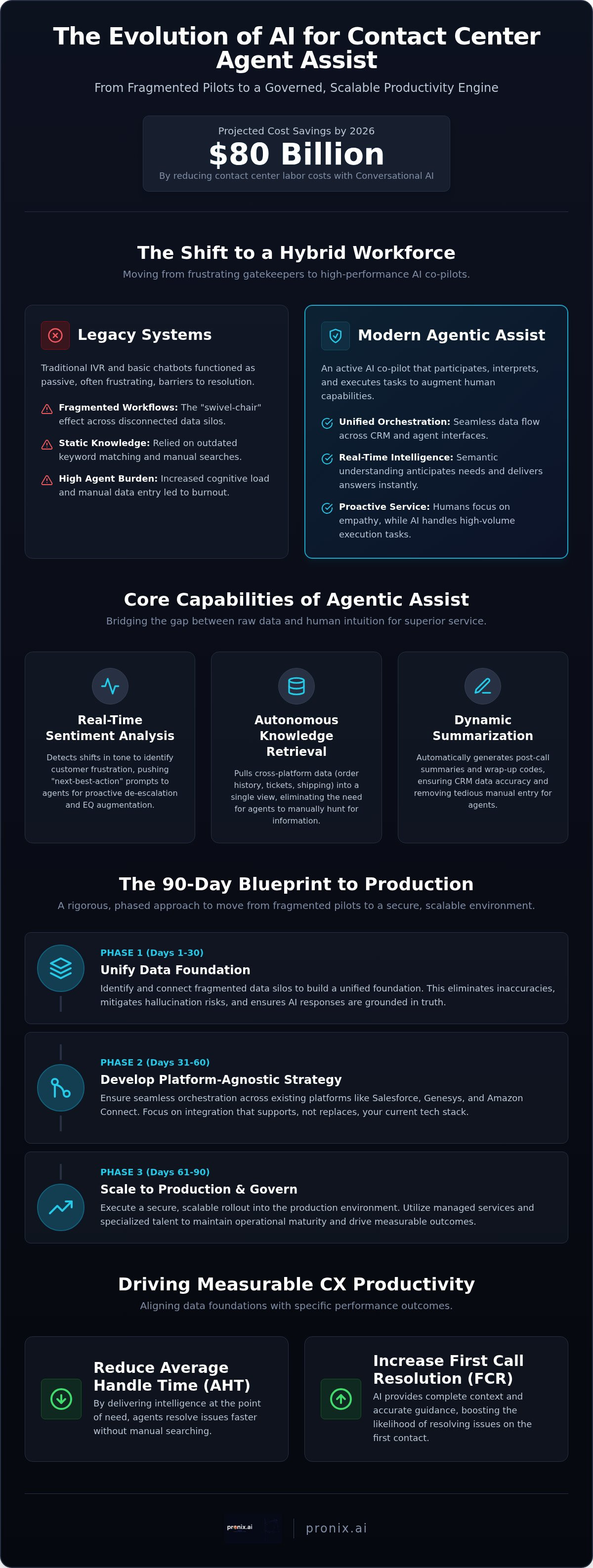
Conversational AI is projected to reduce contact center labor costs by $80 billion in 2026. Despite this massive financial incentive, many enterprise leaders remain trapped in a cycle of disconnected pilots. You likely recognize the friction. Fragmented data silos prevent accurate responses. The fear of AI hallucinations in customer-facing environments creates hesitation. These legacy bottlenecks keep operational costs high while your competitors move toward automation maturity.
It's time to shift from experimentation to execution. This guide demonstrates how to transition from fragmented pilots to a governed, scalable strategy for AI for contact center agent assist. You'll learn how to build a unified data foundation that eliminates inaccuracies and mitigates risk. We provide a clear roadmap to move your operations into production, focusing on reducing average handle time (AHT) and increasing first-call resolution (FCR). By following this practitioner-led approach, you can transform your contact center from a cost center into a high-performance productivity engine.
Key Takeaways
- Identify the shift from legacy IVR systems to agentic assistance that automates CRM updates and provides real-time guidance to human representatives.
- Develop a platform-agnostic strategy for AI for contact center agent assist to ensure seamless orchestration across Salesforce, Genesys, and Amazon Connect.
- Execute a rigorous 90-day implementation blueprint to move from fragmented pilots to secure, scalable production environments.
- Utilize managed services and specialized talent models to maintain operational maturity and mitigate risks associated with rapid technological evolution.
- Drive measurable CX productivity by aligning your data foundations with specific performance outcomes like reduced handle times and increased resolution rates.
Beyond Basic Chatbots: The Evolution of AI for Contact Center Agent Assist
The enterprise contact center has moved past the era of the "helpful" chatbot. In 2026, the standard for AI for contact center agent assist is defined by agentic intelligence. This isn't a passive tool. It's an active participant in every interaction. Traditional IVR systems and basic chatbots functioned as gatekeepers. They often frustrated customers before they ever reached a human. Modern agentic assistance acts as a high-performance co-pilot. It listens, interprets, and executes tasks in the background while the agent remains focused on the caller.
We are seeing the definitive rise of the Hybrid Workforce. In this model, AI manages high-volume, low-complexity execution tasks. Humans focus on high-stakes empathy and complex problem-solving. This shift moves the agent's role from reactive troubleshooting to proactive service. AI now coaches agents in real-time. It suggests the next best action before the agent even identifies a friction point. This isn't just about answering questions; it's about anticipating needs through a governed, scalable framework.
From Static Knowledge Bases to Real-Time Intelligence
Keyword matching is a legacy approach that no longer meets customer expectations. Modern AI for contact center agent assist utilizes semantic understanding to grasp the underlying intent of a query. Large Language Models (LLMs) now distill thousands of pages of technical manuals into concise, actionable scripts. This happens in milliseconds. By providing real-time context, these systems eliminate the need for agents to manually search for information. The result is a direct reduction in Average Handle Time (AHT) and a significant boost in First Call Resolution (FCR). Intelligence is now delivered at the point of need, not buried in a static wiki.
The Operational Cost of Fragmented Agent Workflows
Legacy contact centers suffer from the "swivel-chair" effect. Agents jump between multiple different applications to resolve a single ticket. These disconnected data silos cause massive productivity leaks and increase the likelihood of errors. In 2026, enterprise leaders are abandoning single-point tools. They're prioritizing workflow orchestration instead. Orchestration ensures that data flows seamlessly from the CRM to the agent's interface. This eliminates manual data entry and reduces the cognitive load on the representative. Transitioning to a production-ready AI strategy solves these fragmentation issues. It turns a collection of disconnected tools into a unified, evidence-based service lifecycle.
Core Capabilities of Agentic Assist: Bridging the Human-AI Gap
The true value of AI for contact center agent assist lies in its ability to operate as an invisible, high-speed analyst. It doesn't wait for the agent to ask for help. Instead, it monitors the live stream of data to trigger specific workflows. This bridges the gap between raw data and human intuition. It allows agents to focus on the customer while the AI handles the mechanical administrative burden. By integrating AI for contact center agent assist into the core workflow, organizations can quantify productivity gains through improved data integrity and faster cycle times.
Real-Time Sentiment Analysis and Guided Coaching
Modern engines detect micro-shifts in vocal tone or chat syntax to identify customer frustration before a call reaches a boiling point. The system then pushes "next-best-action" prompts directly to the agent's dashboard. These prompts might include specific loyalty offers or compliance-checked rebuttals. Real-time sentiment coaching is a tool for EQ augmentation. By surfacing these emotional cues, the AI ensures that agents maintain a professional demeanor even in high-stress scenarios. This proactive guidance prevents escalations and keeps the conversation on track toward a resolution.
Autonomous Knowledge Retrieval and Dynamic Summarization
Efficiency is often lost when agents leave their active screen to hunt for information across different platforms. Agentic systems perform autonomous knowledge retrieval by pulling cross-platform data into a single pane of glass. This includes order history, previous ticket resolutions, and real-time shipping updates. Once the call concludes, the AI generates automated post-call summaries and wrap-up codes. This ensures data accuracy in the CRM and removes the tedious manual entry that often leads to agent burnout.
Implementing these capabilities requires more than just a software plug-in; it demands a rigorous agentic AI strategy to ensure every automation aligns with business goals. High-stakes decisions still require a human-in-the-loop. The AI provides the evidence, but the human representative makes the final call on complex exceptions. This collaborative approach reduces cognitive load. It allows your team to perform at an elite level without the friction of legacy systems.
Evaluating Enterprise AI Platforms: Integration vs. Orchestration
Selecting the right platform for AI for contact center agent assist requires a shift in perspective. It is no longer about which vendor has the best underlying Large Language Model (LLM). In 2026, LLMs have become a commodity. The real differentiator is orchestration. Orchestration is the strategic layer that connects AI to your specific business logic, security protocols, and data architecture. Without it, you are simply buying a sophisticated chatbot that lacks the context to be useful.
Enterprise leaders face a critical choice between three dominant ecosystems. Salesforce Agentforce is the logical choice for organizations where the CRM is the undisputed source of truth. Genesys Cloud offers deep, native omnichannel capabilities for complex, high-volume environments. Amazon Connect provides unmatched flexibility for teams that want to build bespoke, developer-led solutions. However, a platform-agnostic implementation strategy is often the safest path. It prevents vendor lock-in and allows you to swap underlying models as the technology evolves.
The "Build vs. Buy" dilemma has also evolved. You don't need to build the AI itself, but you must build the orchestration logic. Buying a platform provides the infrastructure. Building the workflows ensures that the AI for contact center agent assist actually solves your specific operational friction points. This hybrid approach balances speed to market with long-term control over your customer experience.
Modernizing Legacy Contact Centers: AWS, Genesys, and NICE
Modernization doesn't require a "rip and replace" of your entire infrastructure. You can layer agentic capabilities over existing Amazon Connect or Genesys environments. This modular approach allows for incremental improvements without the risk of massive service disruptions. By focusing on AI-driven CX modernization, you can upgrade specific high-impact workflows first. This strategy delivers immediate ROI while you gradually retire legacy technical debt. It's a pragmatic way to reach production-ready outcomes without the typical enterprise migration headaches.
Agentic AI Orchestration for Complex Business Logic
True agentic assist goes beyond answering questions; it executes tasks. Orchestration coordinates multi-agent workflows across different departments. For example, an AI might simultaneously verify a customer's identity, check inventory in an ERP, and update a shipping status in the CRM. Managing these moving parts requires a centralized governance framework. This ensures that even as different agents handle different tasks, the brand voice remains consistent across every touchpoint. Consistency builds trust, especially in high-stakes industries like finance or healthcare where accuracy is non-negotiable.
The Roadmap to Production: Moving Beyond AI Pilots
The transition from an experimental pilot to a governed production environment is where most enterprise initiatives stall. Success requires a 90-day blueprint that prioritizes operational maturity over speculative features. In the first 30 days, you must audit your existing data architecture and security protocols. Days 31 through 60 involve orchestrating AI for contact center agent assist within your specific business logic. The final 30 days are dedicated to scaling the solution across your representative base while maintaining a human-in-the-loop for quality assurance.
Common failure points often stem from a "features-first" mindset. Leaders frequently buy software before they've secured their data foundations. Without a structured data layer, AI responses become unreliable. This leads to hallucinations that damage brand reputation and increase operational risk. A successful rollout treats AI for contact center agent assist as a core business strategy. It's an evolution of your service delivery model, not just another tool in the stack.
Establishing Data Foundations and Governance
Effective Retrieval-Augmented Generation (RAG) is impossible without clean, structured data. Legacy silos must be dismantled to ensure the AI has a unified view of the customer journey. This requires implementing a robust enterprise data strategy for AI that includes strict auditability protocols. Governance isn't just about compliance; it's about reliability. You need a framework that tracks every AI-generated suggestion back to a verified source. This level of transparency is mandatory for highly regulated sectors where every word carries legal weight.
Measuring Success: CX Metrics That Matter in 2026
Traditional metrics like Average Handle Time (AHT) are becoming secondary. In 2026, the focus has shifted to First-Contact Resolution (FCR) and Sentiment Shift. These provide a more accurate picture of how AI actually impacts the customer experience. You should also track the rate of productivity acceleration. Productivity acceleration is the measurable rate at which AI reduces human effort per resolution while increasing total output volume. By focusing on these outcomes, you move beyond vanity metrics and toward evidence-based success. If you're ready to move from pilot to production, our team provides the Agentic AI Implementation services needed to scale with confidence.
Partnering for Scale: Why Managed Services Drive AI Outcomes
Deployment is only the first phase of a successful transformation. Scaling AI for contact center agent assist requires a level of specialized expertise that most internal IT departments simply don't possess. While the global AI customer service market is projected to reach $15.12 billion in 2026, many organizations struggle to move from initial implementation to continuous optimization. A managed service provider ensures that your models don't just exist; they evolve alongside your business objectives. This ongoing refinement is what separates a static tool from a dynamic productivity engine.
Managed services provide the stability needed to navigate the high-stakes nature of enterprise transformation. You need a partner that values speed but prioritizes safety and compliance. By outsourcing the technical management of your AI stack, you can focus on high-level strategic vision while we handle the "boots-on-the-ground" pragmatism of daily operations. This approach turns a complex technological hurdle into a reliable professional service lifecycle.
Bridging the AI Talent Gap with Specialized Managed Services
Enterprises face a severe shortage of AI engineering talent. Hiring a full team of data scientists and prompt engineers is often cost-prohibitive and slow. The "Talent as a Service" model solves this by providing immediate access to seasoned practitioners who understand the friction points of modernizing legacy systems. These experts focus on ongoing model tuning and workflow adjustment. This ensures that your AI for contact center agent assist strategy remains effective as customer behaviors change. Choosing a partner-led strategy allows you to maintain operational momentum without the overhead of permanent headcount. For a deeper look at these frameworks, see our guide on managed services for agentic AI.
Responsible AI Adoption: Security, Compliance, and Auditability
Security and compliance are no longer optional in 2026. The Colorado AI Act, effective June 30, 2026, and the Illinois Artificial Intelligence Safety Measures Act, enacted in July 2026, mandate strict transparency and risk management for consequential decisions. You need more than just a software license; you need an auditable governance framework. pronix.ai implements rigorous ethical guardrails to prevent hallucinations and ensure data privacy. Every AI-generated outcome is traceable and compliant with industry-specific standards. We bridge the gap between innovation and auditability. This provides the stability required for high-stakes environments in finance and healthcare. Our practitioner-led approach ensures that every innovation is backed by a rigorous framework and a clear path to production.
Scaling Your Contact Center for the Agentic Era
The evolution of the contact center is no longer a speculative future; it is a present operational necessity. Moving beyond basic chatbots requires a disciplined approach to orchestration and a data-first foundation. You've seen how real-time intelligence and autonomous retrieval bridge the human-AI gap. Now, the focus must shift toward scaling these capabilities through a governed, production-ready framework. Organizations that prioritize workflow orchestration over single-point tools will define the next era of CX productivity.
Successfully implementing AI for contact center agent assist demands a partner who understands the friction points of legacy modernization. We specialize in delivering production-ready outcomes in 90 days. Our team provides deep expertise across AWS, Genesys, and Salesforce platforms. We prioritize enterprise-grade governance, ensuring your intelligent workflows meet the strict auditability standards of regulated markets. This practitioner-led approach ensures that every innovation is backed by a rigorous framework and a clear path to production.
It's time to stop experimenting and start executing. Move your AI agents from pilot to production with pronix.ai. Your path to a high-performance, intelligent workforce is ready for activation.
Frequently Asked Questions
What is the difference between a chatbot and an AI agent assist tool?
A chatbot is a standalone interface for direct customer interaction, whereas AI for contact center agent assist is an internal intelligence layer. Chatbots typically handle low-complexity, repetitive queries to deflect calls. Agent assist tools monitor live conversations to provide real-time coaching, data retrieval, and background task automation. This allows the human representative to maintain focus on the customer while the AI handles the technical workload.
How does AI for agent assist improve customer satisfaction scores (CSAT)?
These tools improve CSAT by increasing the speed and accuracy of every resolution. When agents don't have to put customers on hold to search for answers, the perceived quality of service rises. AI provides the evidence-based data needed for first-contact success. This reduces customer effort and allows representatives to provide a more empathetic, personalized experience that directly correlates with higher satisfaction scores.
Can agent assist AI work with our existing legacy contact center software?
Modern agentic solutions are designed for modular integration with legacy platforms like Amazon Connect, Genesys Cloud, and Salesforce. You don't need a total "rip and replace" strategy. Instead, you can layer AI over your existing infrastructure to modernize specific high-impact workflows. This pragmatism allows for a faster path to production while gradually retiring technical debt and avoiding the risks of massive service disruptions.
What are the security risks of using Generative AI in a contact center?
The primary risks involve data privacy, regulatory compliance, and potential hallucinations. In 2026, regulations like the Colorado AI Act mandate strict transparency and impact assessments. Secure implementations mitigate these risks through enterprise-grade governance, private data foundations, and complete audit trails. Every AI outcome must be traceable to a verified source to ensure compliance in highly regulated industries like healthcare and finance.
How long does it typically take to move an AI agent from pilot to production?
Moving from an initial pilot to a governed production environment typically takes 90 days. This timeline is divided into three 30-day phases: establishing data foundations, technical orchestration of business logic, and scaling across the agent base. This structured approach ensures that the implementation is stable, secure, and ready for the high-stakes demands of a live, national enterprise contact center environment.
Do we need to hire a specialized team to manage our AI agents?
Most organizations bridge the skill gap through a managed services model rather than permanent hiring. This "Talent as a Service" approach provides access to specialized experts in AI for contact center agent assist who handle ongoing model optimization and technical governance. It allows your internal team to focus on high-level strategy while professional practitioners manage the daily complexity of your agentic AI infrastructure.
How do you prevent AI from giving incorrect or "hallucinated" information to agents?
Accuracy is maintained through Retrieval-Augmented Generation (RAG), which grounds the AI in your specific, verified data foundations. This prevents the model from drawing on external, unverified information. Keeping a human-in-the-loop ensures that agents review and approve AI-generated suggestions before they reach the customer. This collaborative workflow maintains brand safety and prevents the risk of hallucinations even in highly complex service scenarios.
What is the expected ROI for an enterprise AI agent assist implementation?
ROI is driven by measurable productivity acceleration and reduced operational costs. By automating post-call summarization and CRM updates, agents can handle higher volumes with less effort. This reduces Average Handle Time (AHT) and increases First Call Resolution (FCR). When implemented at scale, these efficiencies can lead to significant labor cost reductions, with some conversational AI models projected to save billions across the global industry in 2026.