

Traditional journey maps can take 4-8 weeks to build for a single customer segment, leaving teams with a snapshot of behavior that may already be changing. AI for customer journey mapping can analyze interactions at scale, surface shifting patterns, and help teams respond with timely triggers and more relevant experiences. Its insights still need validation from people who understand the customer.
That’s the central limitation of traditional journey mapping: it can clarify what customers did, but manual analysis makes it harder to keep pace with what they’re doing now. AI can help close that gap, especially when teams connect its insights to reliable data, human judgment, and clear business goals.
This article explains how AI supports journey analysis, scenario testing, and ongoing optimization, and where human oversight remains essential. You’ll learn how dynamic triggers and personalization can turn customer insight into action without treating an AI-generated map as the final word.
Key Takeaways
- Use AI-generated journey maps as working drafts, then refine them with people who understand customer needs and business context.
- Connect behavioral signals to relevant triggers so experiences can adapt as customer needs change.
- Compare AI-supported mapping with traditional methods to see where faster analysis can improve testing and optimization.
- Strengthen data quality and governance before relying on AI insights to guide customer interactions.
- Turn insights into operational change by aligning journey improvements with the systems and teams that deliver customer experiences.
What do you see as the limits of traditional approaches marketers have used to understand their customers’ purchase journeys?
Traditional journey mapping can give teams a useful view of customer decisions, but manual analysis is slow and often static. AI can generate initial drafts from customer interactions faster, while people still need to validate the map and make it useful.
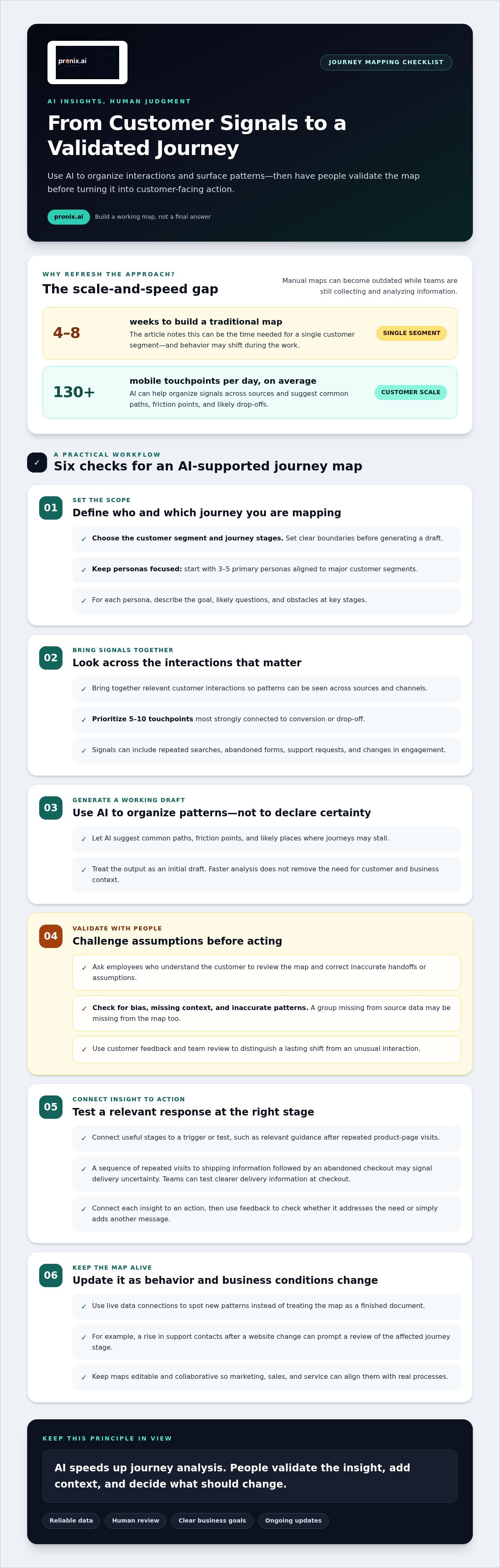
Building a conventional map may take 4-8 weeks for one customer segment, as teams collect data, interview stakeholders, and analyze findings. During that work, customer behavior can shift. A map based on last quarter’s assumptions may miss a new service issue, a changed buying preference, or a channel customers now use.
Scale adds another challenge. Consumers interact with an average of over 130 mobile touchpoints per day. A team reviewing only a small set of interviews may not see how those interactions connect across channels. AI can organize signals from multiple sources and suggest common paths, friction points, and likely drop-offs.
Keeping Journey Maps Up to Date
Keeping a journey map current means revising it as customer behavior, feedback, and business circumstances change. Live data connections can help teams spot new patterns instead of treating the map as a finished document. For example, a rise in support contacts after a website change can prompt a review of the affected journey stage.
Updates matter because a stale map can steer teams toward yesterday’s friction. AI-generated changes still need review by employees who understand the customer and can distinguish a lasting shift from an unusual interaction.
Some teams also turn journey maps into interactive flows. A flow connects stages, customer actions, and operational responses, making it easier to see what happens after a customer abandons a cart or requests help. Teams can then test a trigger, such as sending relevant guidance after repeated product-page visits, and observe how the journey changes.
Editable, collaborative maps make this work practical across marketing, sales, and service. For example, a support lead can correct an inaccurate handoff while a marketer adjusts the message at that stage. Shared ownership helps teams align the map with actual processes rather than preserve a polished but impractical diagram.
Influence maps extend the view beyond a customer’s direct actions to include people and signals that may shape a purchase. Teams can identify trusted voices, content, and interactions that influence a decision. Generative AI can help marketers generate thousands of creative assets for influence-map campaigns, but each asset still needs a clear audience and purpose.
Creating Maps and Recognizing Limitations
To create an AI-powered map, define the customer segment and journey stages, bring together relevant interactions, generate a draft, and validate it with people who understand the customer. Then connect useful stages to triggers or tests. Risks include biased patterns, missing context, and inaccurate assumptions, so teams must question and adjust the draft before acting on it.
AI for customer journey mapping speeds up analysis; it doesn’t remove the need for judgment. If source data overlooks a customer group, the map may overlook its needs too. Human review helps teams tailor the map to their business model and avoid treating a plausible pattern as a proven conclusion.
Personalized customer experiences
Personalization works when each interaction reflects a customer’s context, not just a stored name or past purchase. AI can combine signals across a journey to tailor the next message, offer, or service response.
Personalized Journey Frameworks
A personalized journey framework connects customer segments, needs, journey stages, and relevant experiences. It helps teams tailor actions to a customer’s situation without creating a separate process for every individual.
Start with 3-5 primary personas aligned to major customer segments. For each persona, define the goal, likely questions, and obstacles at key stages. A first-time buyer comparing plans, for example, may need clear product differences, while an existing customer seeking support may need a direct route to resolution.
Next, identify the 5-10 touchpoints most strongly connected to conversion or drop-off. A retailer might focus on product-page visits, comparison activity, cart creation, and checkout. AI can group interactions across these stages, helping teams see where one relevant intervention could improve the customer experience.
Keep the framework usable. Connect each insight to an action, such as explaining a confusing feature or offering help after repeated searches. Customer feedback can reveal whether the change addresses the underlying need or merely adds another message.
Pain Points and Journey Drop-Offs
AI identifies pain points by detecting recurring friction in customer interactions, then estimating where similar journeys may stall. This helps teams investigate a specific stage before broader drop-off patterns become harder to diagnose.
For example, repeated visits to a shipping-information page followed by an abandoned checkout may indicate uncertainty about delivery. A model can flag that sequence and compare it with other journeys. Teams can then test clearer delivery information at checkout and measure whether customers continue.
How can AI identify customer pain points and predict journey drop-offs? It can analyze patterns such as repeated searches, abandoned forms, support requests, and changes in engagement. These signals help estimate which journey stages may need attention, while customer feedback and team review help explain why.
Predictive personalization uses these signals to select a relevant next step. A returning visitor comparing the same products might receive a comparison guide, while a customer reporting a service issue should receive a support-focused response. The distinction matters: the same trigger should not produce identical experiences for customers with different needs.
Predictions depend on the quality of the underlying customer record. Organizations should aim for at least 90% completeness on critical customer data fields before relying on AI predictions. Missing preferences or inconsistent interaction histories can lead to irrelevant recommendations, especially when a model treats incomplete data as a complete picture.
Finally, test one change against a defined journey outcome, such as form completion or fewer repeated support requests. For teams connecting these insights to service workflows, AI-driven customer experience modernization can help align personalization with operational execution.
AI-based versus traditional journey mapping
Traditional journey mapping gives teams a structured view of customer decisions, often built from interviews, surveys, and workshops. AI-based mapping adds the ability to analyze larger volumes of interactions, surface patterns, and update insights as new signals arrive. The strongest approach combines both: data identifies points to investigate, and human judgment explains why they matter.
In a traditional process, a team might interview customers, compare responses, and document stages such as research, purchase, and support. This method can capture motivations that interaction logs miss. However, manual analysis makes it harder to connect behavior across channels or detect subtle changes between customer groups. A workshop may identify checkout confusion, for example, while overlooking customers who leave after comparing product details.
AI can process interactions across segments and highlight patterns for teams to examine. It might reveal that customers who revisit a pricing page often contact sales before converting. That pattern suggests an opportunity to clarify plan differences or improve sales follow-up, but it doesn’t explain customers’ reasons on its own. Teams need interviews, feedback, or operational context to interpret the signal accurately.
The practical difference is how each method supports iteration. A traditional map can become a reference document that teams revisit during planning. An AI-supported map can inform tests as behavior changes, such as comparing a revised onboarding message with the existing version. Teams can track outcomes at each point, learn which intervention helps, and adjust the journey instead of relying on assumptions.
Reported results offer context, not a universal forecast. Some organizations implementing AI-driven customer journey mapping have reported conversion rates up to 40% higher and lead execution that is 30% faster within months of deployment. These outcomes depend on how teams connect insight to action. A model that flags a likely drop-off creates little value unless an owner can test a response and assess the result.
AI also changes the scale of analysis. It can process large volumes of customer interactions across segments, while a manual review typically focuses on selected records and interview findings. That breadth can expose overlooked opportunities, but poor data or inconsistent stage definitions can distort comparisons. Before assessing results, define what counts as a qualified lead, an abandoned journey, or a completed purchase.
Use AI for customer journey mapping when teams need to find patterns, prioritize friction points, or test changes across complex journeys. Retain traditional research when customer motivation and emotional context are central. A combined approach gives decision-makers evidence to act on and a disciplined way to assess whether changes improve customer and business outcomes.
AI support for customer journey mapping
AI supports journey mapping by turning customer interactions into patterns teams can investigate and act on. Its value comes from connecting analysis to a clear decision, such as improving a handoff or testing a new response.
What are the best AI tools for customer journey mapping in 2026? Choose tools that connect relevant customer data, visualize journey stages, surface patterns, and support scenario testing. The right fit depends on your organization’s data environment and the actions teams need to take.
How do these tools work, and what data do they use? They combine signals such as website activity, purchase records, service conversations, and customer feedback, then group interactions into journeys. Teams can review where customers pause, repeat steps, or switch channels and use those findings to form testable hypotheses.
For example, a subscription business could compare journeys that renew with those that end after a support contact. AI may reveal a recurring sequence, such as unresolved questions followed by reduced engagement. Analysts can then inspect the underlying conversations and determine whether a process change or clearer information addresses the pattern.
What privacy and regulatory requirements apply in the United States? Organizations should establish robust cybersecurity measures and transparent data-use policies to maintain customer trust. They should also limit access to customer information, define appropriate uses, and design data handling around applicable obligations.
How much do AI journey mapping platforms cost in the United States? Platform pricing depends on deployment scope, data volume, integrations, and support needs, and is given after a quote request. Those factors shape the overall requirements; a single figure would not represent every implementation.
How can organizations measure return on investment? Set a baseline, connect a specific journey change to a measurable outcome, and compare results after implementation. For example, track conversion, repeat contacts, task completion, or cost to serve against the same measure before the change.
Separate the effect of the intervention from other changes. A controlled comparison between customers who receive a revised journey and a comparable group following the existing flow can clarify whether outcomes changed alongside the intervention. Record the measurement period, segment, and operational effort involved so decision-makers can assess results consistently.
AI support becomes operational when an insight leads to an owned action. For example, a flagged service handoff can prompt a team to review routing, update a process, and monitor completion. Organizations connecting approved journey signals to workflow execution can use AI Business Automation to support the shift from analysis to action.
What is AI-powered customer journey mapping?
AI-powered customer journey mapping uses customer data and machine learning to understand how people move between interactions, decisions, and outcomes. Unlike a static diagram, it can help teams identify behavior patterns, explore possible journey changes, and connect insights to operational decisions. For example, an online retailer could examine how customers move from product discovery to checkout, then investigate where journeys diverge.
The map depends on three connected elements: a clear journey model, relevant data, and a defined business question. A team might examine onboarding, using account activity, service conversations, and customer feedback to understand where new users need help. AI can organize those signals into patterns, but the team decides which patterns matter and what response to test.
- Define the journey. Set the customer goal, stages, and outcomes. A bank might map a customer’s path from researching an account to completing an application.
- Connect relevant interactions. Bring together useful records, such as application events, support contacts, and feedback, while maintaining appropriate data controls.
- Analyze patterns and scenarios. Use AI to surface recurring paths or examine a proposed change, such as launching a new product or entering a new market.
- Review and act. Validate the map with employees familiar with customers, then connect a selected insight to a test or process change.
This process turns a map into a decision tool. If a new-product scenario suggests customers need more information before comparing options, a team can test clearer explanations at that stage. The map helps frame the test, while observed results show whether the change improves the journey.
AI can also make journey analysis more responsive to new signals. When customer feedback changes after a service update, the team can compare it with relevant interactions and reconsider its assumptions. The aim isn’t to automate every decision. It’s to give teams structured evidence to decide where human attention and operational changes can add the most value.
Good implementation also depends on governance. Organizations need clear data-use policies, cybersecurity measures, and defined ownership for reviewing AI-generated insights. A map should distinguish observed behavior from model-generated interpretations. This helps teams explain why an action was chosen and prevents an inferred pattern from being treated as a verified customer need.
Use AI-powered mapping when teams need to connect customer behavior with decisions across a complex journey. To translate journey insights into operational workflows, discuss your AI implementation approach.
Organizations implementing AI-powered customer experience capabilities report reductions of 20-30% in cost to serve. For journey teams, that reported efficiency can help prioritize where to investigate and test changes, while outcomes are still checked against customer needs. Cost savings are a possible operational benefit, not a substitute for validating the map’s interpretations and decisions.
Pronix.ai: Agentic AI Implementation
pronix.ai helps enterprises move from customer journey insight to AI capabilities that can operate in production. Turn to its Agentic AI Implementation when you need to translate a defined use case into an integrated workflow with appropriate oversight. For broader customer experience change, AI-Driven CX Modernization can align journey improvements with the systems and processes that support customer interactions. AI Business Automation can connect insights to repeatable operational tasks, while Data & AI Foundations can support the data readiness behind reliable analysis. The right starting point depends on your journey priorities, existing data, and operational requirements. To discuss how these capabilities fit your customer journey goals, contact pronix.ai or visit pronix.ai.
Make the Next Journey Decision Count
The next step is to choose a customer decision that matters and give it clear ownership. Define what action should change, who will act on the insight, and how the team will judge whether the change helped. This turns AI for customer journey mapping into an operating discipline, not another analysis exercise. It also gives leaders a practical basis for deciding where to expand, refine, or pause their efforts.
That work may involve implementing an AI workflow, modernizing customer experience operations, or automating a repeatable business process. pronix.ai offers Agentic AI Implementation, AI-Driven CX Modernization, and AI Business Automation to help enterprises connect these priorities to execution. The right starting point is the customer outcome your team needs to improve and the operational change required to support it.
Contact pronix.ai to discuss your needs and identify a grounded next step for your customer journey work. Build from a clear decision, learn from each action, and keep progress tied to customer and business needs.
Frequently Asked Questions
How is AI-based journey mapping different from traditional journey mapping?
AI-based mapping can identify relationships across customer records that manual research may not surface. Traditional mapping often relies on interviews, workshops, and analyst interpretation to build the journey. For example, AI could flag that customers who change a delivery preference later contact support, prompting a team to investigate that handoff. The distinction is how insights are generated, not whether human judgment is needed: teams still interpret findings and decide what to change.
How do AI journey mapping tools compare with traditional customer journey mapping software?
Traditional journey mapping software typically helps teams document stages, touchpoints, roles, and pain points in a visual workspace. AI-enabled tools may add customer-data analysis, pattern detection, or draft recommendations, depending on their capabilities. For example, a team can use a mapping workspace to assign an owner to a checkout issue, while an AI feature may help identify which interactions commonly precede it. The key distinction is documenting a journey versus analyzing evidence about it.