

The right AI implementation partner demonstrates its capabilities in healthcare, not just in demos. Questions to ask an AI implementation vendor should establish how your data is protected and used, how models are trained and monitored, how the solution performs, and how it connects with your systems. Ask for evidence of experience in comparable care or payer environments, rather than broad claims of healthcare expertise.
It’s reasonable to focus on security first, especially when sensitive information and clinical workflows are involved. But a thorough evaluation also tests whether the vendor can explain model behavior, demonstrate performance, fit your existing technology, and support healthcare operations. This guide covers practical questions about data safeguards, training and bias, reliability, integrations, implementation, and healthcare experience. Use them to separate clear, evidence-based answers from assurances that don’t explain how a solution will work in your environment.
Key Takeaways
- Define what happens to your data, records, and connected systems when an AI engagement ends, including how information is returned or deleted.
- Clarify what models are trained on, how bias is assessed, and what training your team needs to use the system responsibly.
- Set measurable success criteria and establish how accuracy, errors, and model changes will be monitored after deployment.
- Map required integrations, technical preparation, and ownership before implementation begins to reduce workflow disruption.
- Choose use cases by weighing business value, data readiness, operational risk, and the people responsible for oversight.
1. How will my data be used, and what safeguards are in place?
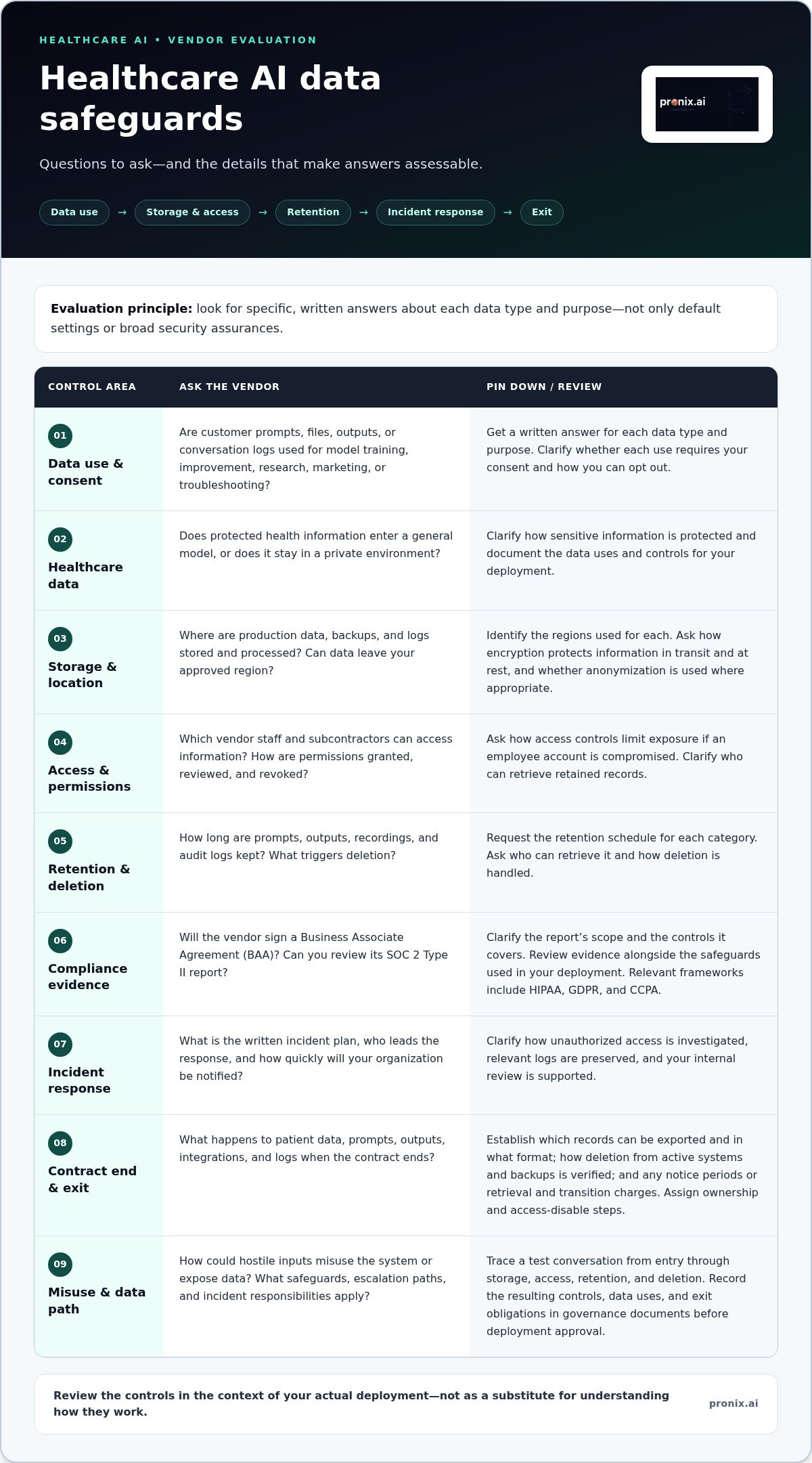
When evaluating providers like pronix.ai, ask whether customer prompts, files, outputs, and conversation logs are used to train the vendor’s models. Get a written answer covering model improvement, research, marketing, and troubleshooting. Ask whether each use requires your consent and how you can opt out. For healthcare data, clarify whether protected health information enters a general model or stays in a private environment. Transparency should cover every data type and purpose, not just default settings.
Next, map where information is stored and processed. Ask which regions host production data, backups, and logs, and whether data can leave your approved region. Identify every role that can access it, including vendor staff and subcontractors, and how permissions are granted, reviewed, and revoked. Ask how encryption protects information in transit and at rest, and whether anonymization is used where appropriate. According to the U.S. Department of Health and Human Services, HIPAA, the General Data Protection Regulation (GDPR), and the California Consumer Privacy Act (CCPA) are relevant to healthcare AI tools.
Request the retention schedule for prompts, outputs, recordings, and audit logs. Ask how long each category remains available, who can retrieve it, and what triggers deletion. For healthcare use, ask whether the vendor will sign a Business Associate Agreement (BAA). Ask for its SOC 2 Type II report and clarify the scope it covers. A certification or report is evidence to review, not a substitute for understanding the actual controls used in your deployment.
Security safeguards must include a response process. Ask for the written incident plan, who leads the response, and how quickly your organization receives notice of a security incident. Clarify how the vendor investigates unauthorized access, preserves relevant logs, and supports your internal review. Ask how access controls limit exposure if an employee account is compromised. These details turn security statements into operational steps your security and compliance teams can assess.
Plan the exit before production. Ask what happens to patient data, prompts, outputs, integrations, and logs when the contract ends. Establish which records you can export, the format provided, and how the vendor verifies deletion from active systems and backups. Clarify contractual notice periods and any charges for data retrieval or transition. Document who owns each step and when access is disabled. A defined exit process reduces vendor dependence and supports continuity.
Ask how the system could be misused through hostile inputs or exposed data. Require an explanation of safeguards for sensitive information, escalation paths, and responsibilities when an incident occurs. For example, trace a test conversation from entry through storage, access, retention, and deletion. This practical review can reveal gaps that policy summaries miss. Record the resulting controls, data uses, and exit obligations in governance documents before approving deployment.
2. Question #2: What Data Do You Use to Train and Run Your Models, and How Do You Prevent Bias?
Ask which models power the solution, where they come from, and how they’re adapted to your use case. Request details about training-data sources, quality, representativeness, and potential copyright concerns. Clarify whether customer inputs or outputs contribute to model training, research, or other purposes. Ask for a clear commitment that your data won’t train the vendor’s models, and establish how that commitment is documented. For healthcare workflows, ask how the vendor tests whether training data reflects the populations and situations the system will encounter.
Bias controls need evidence, not general assurances. Ask whether the vendor conducts bias audits, how often results are reviewed, and what happens when testing identifies a problem. Find out whether an internal ethics board or another governance group reviews high-impact use cases. Request examples of how teams investigate uneven outcomes across relevant groups. Then establish who can pause or adjust a model when monitored results raise concerns.
Assess the team behind implementation. Ask which roles will work on your project, such as data, integration, security, and workflow specialists, and how responsibilities are divided. Clarify how administrators and everyday users are trained. Ask whether onboarding includes hands-on practice, operating guidance, and a process for reporting inaccurate outputs. Define what ongoing maintenance, model updates, and support include after launch, and who owns each activity.
References reveal whether the vendor can support your operating environment over time. Request case studies from comparable healthcare settings, such as health systems, payers, or federally qualified health centers. Ask what outcomes were measured, what changed after deployment, and what implementation challenges arose. Discuss the vendor’s roadmap and how it communicates changes that could affect workflows. A reference conversation should focus on delivered capabilities and the vendor’s follow-through, not just a polished demonstration.
For AI agents, ask which tasks they can complete, which require human approval, and when they hand work to staff. Confirm which channels the solution supports for your use case, such as voice or chat, and whether the workflow behaves consistently across them. If multilingual interactions matter, ask how medical terminology is validated and whether native speakers review localized content. For example, test a common patient request in each priority language and assess accuracy, tone, and escalation.
AI implementation pricing depends on scope, data readiness, integrations, model usage, and support; project-specific fees are provided after a quote request. Pricing structures may separate implementation from recurring usage or managed support, so compare what each includes. Ask whether training, maintenance, and ongoing support cover onboarding, documentation, issue reporting, model updates, and performance review, or are billed separately. Finally, connect these commitments to defined customer outcomes, such as reduced manual work or faster handling, with an owner and review process for each measure.
3. Model performance, reliability, and bias monitoring
Define performance before deployment, then test it against representative tasks from your workflow. Ask how accuracy is measured, which errors occur, and how teams report and correct them. For a routine document workflow, compare the model’s extraction with reviewed human decisions. Set acceptance criteria for accuracy, response time, escalation, and exceptions. Ask for documented validation results and audit logs that link each recommendation to its timestamp, user, and source interaction.
Reliability also depends on what happens when the model cannot answer. Ask how it detects uncertainty, rejects unsupported requests, and transfers conversations to a person. Test these behaviors with incomplete records, ambiguous instructions, and out-of-scope questions. For generative models, ask how the system limits hallucinations and how staff can review or override recommendations. Build human oversight into the workflow rather than adding it only after an error.
Who owns the AI solution, custom code, data, and intellectual property? The agreement should distinguish your data and project-specific deliverables from the vendor’s pre-existing platform, models, and tools. It should also define rights to custom code, outputs, configuration, and documentation, along with permitted use after the engagement ends.
Discuss risks using evidence from testing. Ask for bias audit methods and findings, known limitations, copyright controls for training material, and the process for investigating inaccurate outputs. Establish who reviews each incident, corrects the issue, and documents the resolution. A production test should include realistic edge cases, such as conflicting fields in a record, to show how the model responds under pressure.
For enterprise deployment, ask how performance holds as volume grows and what service levels apply to availability, response times, and incident handling. Clarify how backups support recovery and how often recovery procedures are tested. Request an update roadmap explaining how model changes are evaluated, communicated, and rolled back if performance declines. Define who approves updates and how each change is recorded for governance and audit review.
Monitoring must continue after launch. Ask which signals detect drift, such as changing input patterns, rising correction rates, or more frequent human overrides. Require a review cadence, named owners, and an escalation path when results move outside agreed thresholds. Build trust through transparent evaluation, usable logs, and clear human control. For ongoing operational oversight, managed AI operations can support monitoring and model updates.
4. Implementation requirements and system integrations
Start with the workflow, then map every system the AI solution must touch. Ask what information, access, and configuration your team must provide. Identify who owns data preparation, interface development, testing, and sign-off. For example, a claims workflow may connect intake, document processing, policy administration, and case review. The vendor should explain how each connection works and where staff intervene when information is missing.
For healthcare integrations, ask whether the solution supports FHIR-based APIs and HL7 interfaces. Confirm which EHR data it reads or writes, how patient identity is matched, and how updates appear in the clinical workflow. Clinicians and staff should be able to accept, modify, or reject AI suggestions. Test a realistic scenario, such as routing a referral, and verify that the AI’s answers reach the right work queue without creating duplicate records.
Insurance teams should trace a real submission from intake through decision or escalation. Ask how the system connects with claims, policy, and document workflows, and whether it can return structured outputs to existing applications. Define how exceptions are handled, who reviews extracted information, and how staff correct inaccurate results. A practical integration test should include incomplete paperwork and conflicting fields, not just clean sample documents.
Ask which models, platforms, and cloud providers the implementation supports, and how each component fits your architecture. Supported platforms include AWS, Microsoft, Salesforce, Kore.ai, and Genesys. Clarify whether the proposed design uses APIs, a graphical interface, or both. Establish which party maintains each connection, how access is controlled, and how changes to an existing system could affect the integration.
For timing, request a milestone-based plan covering discovery, data preparation, configuration, integration, testing, training, and launch. A 30-day implementation plan is a useful planning request, not a universal delivery promise. The actual schedule depends on data readiness, system access, integration complexity, review cycles, and stakeholder availability. Ask which prerequisites could delay each milestone and what evidence marks completion.
Before launch, run end-to-end tests with the people who will use the workflow. Check that source data arrives accurately, outputs appear in the right system, and exceptions reach the correct team. Record acceptance criteria and assign an owner for each issue. Confirm the rollback or fallback process if an integration fails in production. This makes technical readiness measurable rather than dependent on a successful demonstration.
Use AI implementation planning to align architecture, workflows, integrations, and launch milestones before production begins. The result should be a documented integration map, named owners, tested user paths, and clear go-live criteria.
5. How does the vendor assess business needs and choose AI use cases?
Start with the business problem, not a preferred model or technology. Ask how the vendor learns your goals, operational constraints, and existing workflows. A useful discovery process includes interviews with process owners, frontline staff, IT, and risk teams. For example, a claims team may identify slow document intake, while staff clarify which exceptions require human judgment. The assessment should produce a shared problem statement before anyone selects an AI use case.
Next, require a baseline for the current process. Ask which data will show the existing workload, error patterns, cycle time, and customer impact. If the proposed use case automates document classification, compare its results with the team’s current review process. Define the target outcome, measurement method, and person accountable for tracking it. Without a baseline, a later claim of improvement has no reliable point of comparison.
Ask how candidate use cases are ranked. A disciplined evaluation weighs expected business value, data readiness, integration effort, operational risk, and staff adoption. It also identifies where a conventional workflow change may solve the problem without AI. For instance, inconsistent intake forms may need standardization before an AI system can process them reliably. The vendor should explain why the selected use case outranks alternatives and what evidence supports that choice. These are essential questions to ask an AI implementation vendor before committing to a solution.
Healthcare and insurance teams should include users who understand the consequences of errors. Ask how clinicians, claims staff, or service agents shape requirements and review proposed workflows. Identify decisions that must stay with qualified employees, such as handling an ambiguous patient request or escalating a complex claim. Map approval points before development. This makes human oversight a design requirement, not a late-stage safeguard.
Ask what must be in place before a use case moves from pilot to production. Readiness criteria should cover data quality, integration access, governance ownership, user training, and a plan for monitoring outcomes. Ask how the team will handle exceptions and measure adoption after launch. The business case should connect operational results to a review schedule, with clear thresholds for continuing, revising, or stopping the work. These criteria make the questions to ask an AI implementation vendor specific to your priorities.
Set a time horizon that reflects the scale of change. Ask which milestones demonstrate progress toward that outcome and what assumptions affect the timeline. If there’s no practical path from the initial use case to production value, narrow the scope or choose a more feasible workflow. That decision protects focus and supports investment discipline.
Use a structured AI use-case assessment to connect business priorities with feasible workflows, data, and measurable outcomes.
Pronix.ai: Agentic AI Implementation
pronix.ai helps enterprises move from AI plans and pilots toward secure, scalable production workflows. Its Agentic AI Implementation service suits organizations ready to operationalize agents with defined tasks, human oversight, and integration requirements. If the priority is customer interactions, AI-Driven CX Modernization can address contact center workflows. AI Business Automation focuses on operational processes, while Data & AI Foundations supports the underlying data and architecture needs.
The right starting point depends on the business problem, the readiness of existing systems, and the controls required for deployment. Use these questions to clarify priorities, identify risks, and define success before implementation. For a practical next step, visit pronix.ai to discuss your AI implementation needs.
Turn vendor answers into an implementation decision
The next step is to turn your evaluation into a decision your leadership team can stand behind. Use questions to ask an AI implementation vendor to expose assumptions, clarify ownership, and align the project with an operational priority. Document the decision criteria, assign internal owners, and agree on what evidence will support moving from planning into delivery.
When your organization is ready to advance, pronix.ai can support that work through Agentic AI Implementation, AI-Driven CX Modernization, and AI Business Automation. The right path depends on the workflow you want to improve and the foundations needed to put AI into production. A focused discussion can shape the next step around your goals and operating environment.
Contact pronix.ai to discuss your AI project. A disciplined decision today can create a clearer path from AI ambition to practical execution.
Frequently Asked Questions
1. How will my data be used, and what safeguards are in place?
Require a clear account of how the system handles prompts, uploaded files, generated responses, and logs. Ask whether each data type supports service delivery, troubleshooting, or model improvement, and who can access it. For example, test a sample workflow using synthetic records, then trace its inputs and outputs through the system. Your review should also cover data export and deletion if the relationship ends.
2. What five questions should I ask when someone is selling me a new AI product?
Ask what business problem the product solves, what data it uses, how success is measured, how it connects to existing systems, and where people retain control. Request a demonstration using a representative workflow, not just a prepared script. Then ask what happens when the tool produces an incomplete or incorrect result. These questions reveal whether the product fits your operation or simply showcases technology.
3. How do you protect PHI and ensure security and compliance?
Ask how protected health information is handled, what access controls apply, and whether the vendor will provide a signed Business Associate Agreement. Request documentation of security controls and incident response procedures, then map those controls to the specific workflow. The U.S. Department of Health and Human Services identifies HIPAA among regulations relevant to healthcare AI tools. Establish who within your organization reviews the vendor’s evidence.
4. What data do you use to train and run your models, and how do you prevent bias?
Ask the vendor to distinguish model training data from information used at runtime. Clarify whether your organization’s inputs or outputs can be reused, and whether consent or opt-out controls apply. For bias, request examples of how the vendor tests outcomes across relevant populations and responds to uneven results. A practical review can compare model recommendations with qualified staff assessments on representative, appropriately governed cases.
5. How do you support human oversight, governance, and auditability?
Establish which decisions require human review and who can override an AI recommendation. Ask for records showing what the system recommended, when it acted, and which user reviewed the result. For example, a sensitive workflow might require approval before an agent sends a response or changes a record. Assign governance owners to review exceptions, approve workflow changes, and document decisions that affect operations.
6. What business outcomes should this deliver?
Expected outcomes should connect directly to a defined operational problem. Choose measures your team can observe, such as processing time, manual review volume, completion rates, or customer effort. Set a baseline before launch and identify who owns measurement after deployment. For example, assess an AI workflow that routes service requests by routing accuracy and how it handles exceptions, not just by the number of interactions processed.
7. What does it cost in total?
The price depends on the case and is provided after a quote request. Scope, data preparation, integration work, model usage, training, and ongoing support can affect the total. Ask for a breakdown that distinguishes implementation from recurring charges and explains how usage changes billing. Confirm which activities are included, such as maintenance or workflow updates, so your financial plan reflects the full operating model.
8. What AI implementation services does a vendor provide?
Services can cover strategy, technical implementation, workflow integration, and ongoing management. Match the work to your need: agent deployment for autonomous workflows, AI-driven CX modernization for customer interactions, business automation for operational processes, or Data & AI Foundations for underlying readiness. pronix.ai provides these services for enterprise environments. Clarify which workstreams support your goal and how they connect to the systems your teams already use.