

A model can outperform every benchmark and still fail to deliver a business return. Calculating ROI for AI projects means showing that a real workflow changed, the change produced measurable value, and that value exceeded the full cost of delivering and operating the system.
That’s a demanding standard, and for good reason. Expected benefits such as time saved or improved customer experience can be difficult to translate into financial measures. Development is only part of the investment, and changes in business performance can be hard to attribute to AI alone.
This guide explains how to build a transparent, defensible ROI case. Define a baseline, connect AI outcomes to business measures, account for implementation and ongoing costs, and test assumptions against results after deployment. It also shows how to distinguish model performance from operational impact, so finance and business leaders can assess what the initiative actually delivered.
The goal is not just a confident forecast. It’s an evidence-based measurement approach that connects production implementation, governance, and operational ownership to business value.
Key Takeaways
- Calculating ROI for AI projects starts with a defined scope and baseline, then separates projected benefits from results verified in operations.
- Use a consistent ROI formula: net benefits divided by total costs, multiplied by 100. Include the full investment over a stated period.
- Track savings, released capacity, quality gains, and risk reduction as distinct benefits, with evidence sources, owners, and confidence levels.
- Set a post-launch review cadence, accountable business owner, and escalation threshold to check whether expected benefits are sustained.
- Before scaling a pilot, assess evidence quality, full costs, risk controls, ownership, and the conditions required to justify broader deployment.
What Does Calculating ROI for AI Projects Actually Measure?
Calculating ROI for AI projects means comparing the business benefits reasonably attributable to an initiative with its total investment over a defined period. The word “attributable” matters: a change in results counts only when evidence connects it to the AI-enabled workflow, rather than to unrelated changes in demand, staffing, or policy.
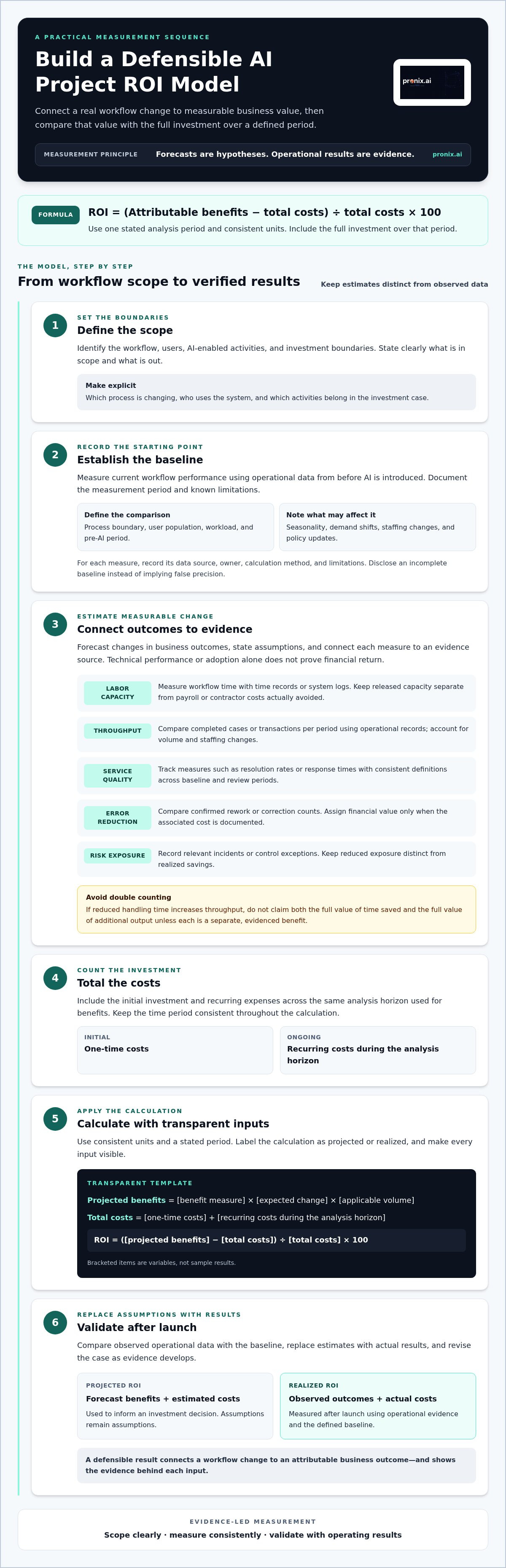
AI project ROI is the net business benefits attributable to the initiative, divided by total project costs, multiplied by 100, measured over a stated period. This follows the basic purpose of Return on Investment (ROI): compare returns with the investment required to achieve them. Set the measurement window before calculating, and state which benefits and costs it includes.
Keep two views separate. Projected ROI uses forecast benefits and estimated costs to inform an investment decision. Realized ROI uses observed outcomes and actual costs after launch. Label assumptions, estimates, and measured results distinctly. A forecast is a hypothesis to test, not proof of performance.
How is AI project ROI different from model performance?
Accuracy, latency, and adoption show how a system performs or is used. They don’t establish financial return on their own. Connect each technical measure to a workflow effect, then to a business outcome with a clear evidence source. For example, compare handling time before and after deployment using timestamped workflow records. If shorter handling time releases capacity, document how that capacity is used. Don’t automatically report it as cash savings.
Which outcomes can an enterprise AI project create?
Assess potential outcomes separately, using a defined measurement method and evidence source for each:
- Labor capacity: Measure staff time spent on the workflow using time records or system logs. Report capacity released separately from payroll or contractor costs actually avoided.
- Throughput: Compare completed cases or transactions per period using operational system records, while accounting for changes in volume and staffing.
- Service quality: Track measures such as resolution rates or response times in customer service records, using consistent definitions across the baseline and review periods.
- Error reduction: Compare confirmed rework or correction counts in quality records. Translate them into financial value only when the associated cost is documented.
- Risk exposure: Record relevant incidents or control exceptions. Treat reduced exposure as a distinct benefit, and avoid presenting an assumed avoided loss as realized savings.
Prevent double counting. If reduced handling time increases throughput, don’t claim both the full value of time saved and the full value of additional output unless each is a separate, evidenced benefit. This discipline turns technical improvement into an auditable business case.
Build a Defensible AI Project ROI Model Step by Step
A credible model makes its assumptions visible. When calculating ROI for AI projects, use one measurement period, distinguish estimates from observed results, and assign an owner, evidence source, time period, and confidence level to every input. This gives finance a model to challenge and the operating team a clear way to update it.
- 1. Define the scope. Identify the workflow, users, AI-enabled activities, and boundaries of the investment. Specify what is in and out of scope.
- 2. Establish the baseline. Record current performance using operational data from the process before AI is introduced. Document the measurement period and any known limitations.
- 3. Estimate benefits. Forecast changes in measurable outcomes, such as handling time or rework. State the assumptions behind each forecast and avoid counting one improvement twice.
- 4. Total the costs. Include initial investment and recurring expenses over the same analysis horizon used for benefits.
- 5. Calculate ROI. Apply the formula below, using consistent units and time periods.
- 6. Validate the model. After launch, replace estimates with observed data, compare actual results with the baseline, and revise the case as evidence develops.
ROI = (net benefits ÷ total costs) × 100, where net benefits equal attributable benefits minus total costs. For a transparent template, use: projected benefits = [benefit measure] × [expected change] × [applicable volume]; total costs = [one-time costs] + [recurring costs during the analysis horizon]; ROI = ([projected benefits] − [total costs]) ÷ [total costs] × 100. These are variables, not sample results. Keep projected and realized calculations clearly labeled.
How should teams establish a credible baseline?
Define the process boundary, user population, workload, and pre-AI measurement period before deployment. Use representative operational records, and note seasonality, demand shifts, staffing changes, or policy updates that could affect comparisons. For each measure, record its data source, accountable owner, calculation method, and limitations. If the baseline is incomplete, disclose that uncertainty instead of presenting a precise-looking estimate.
Which costs belong in an AI project ROI calculation?
Count more than development. Include discovery, data preparation, implementation, integration, testing, and change management, as well as infrastructure, licensing, human review, security, governance, and ongoing operations. Separate one-time costs from recurring costs, then state the analysis horizon so benefits and investment are compared over the same period. Integration, governance, and operational ownership belong in the business case, not in side assumptions.
Enterprises building a measurable path from pilot to production can connect AI strategy and implementation with clear outcome measures and accountable operations.
Compare AI Project Benefits, Costs, and Payback Without Double Counting
A benefits register makes assumptions reviewable. For each outcome, record the metric, baseline, evidence source, accountable owner, and confidence. The sample categories below provide a structure, not claims of achieved results.
| Benefit | Metric | Baseline | Evidence source | Owner | Confidence |
|---|---|---|---|---|---|
| Direct savings | Documented expense avoided | Comparable pre-AI expense | Finance records | Finance lead | High, medium, or low with rationale |
| Capacity released | Time returned to other work | Pre-AI effort per task | Workflow logs or time records | Operations lead | Based on data coverage |
| Quality improvement | Rework or error rate | Pre-AI rate using the same definition | Quality or case records | Process owner | Based on consistency of records |
| Risk reduction | Incidents or control exceptions | Pre-AI frequency and severity | Incident or control records | Risk owner | Based on evidence and attribution |
Keep categories distinct. A lower processing cost is a direct saving only if spending falls or an expense is avoided. Time freed for other work is capacity, not cash savings, unless it replaces a documented cost or produces separately measured output. Quality gains should reflect recorded rework or errors. Keep risk reduction in its own line unless a defensible method supports valuing the avoided loss.
A benefit belongs in an AI ROI case only when evidence links it to the AI-enabled change and a defined measurement period.
How can teams attribute value to AI rather than other changes?
Compare post-launch results with the established baseline, while recording changes in staffing, policies, workload, or process design. Where practical, use a comparable control group or phase deployment across teams to help isolate the AI effect. Document the attribution method and its limitations. If concurrent changes make the cause uncertain, lower the confidence rating rather than assigning the full improvement to AI.
How should uncertainty and non-financial value appear in the model?
Show conservative, expected, and upside scenarios, with the assumptions behind each visible to reviewers. Present customer experience and risk outcomes separately when monetization is uncertain. Don’t roll hypothetical value into realized savings. Keep proposed financial estimates labeled as forecasts until operational evidence supports them.
For time-sensitive cash flows, estimate payback as the time until cumulative net cash benefits recover the initial investment. When timing and the value of future cash flows affect the decision, calculate net present value: discount each period’s net cash flow using the organization’s approved rate, then subtract the initial investment. These measures complement ROI; they don’t replace clear attribution or complete cost accounting.
Validate AI ROI After Launch and Address the Hardest Measurement Objections
A projected benefit is a hypothesis, not proof. Realized ROI depends on measuring change against a pre-launch baseline and checking whether it is sustained. Before deployment, document the baseline, data sources, review cadence, accountable business owner, and escalation threshold. Set the threshold in advance, such as a defined variance from an agreed outcome or an unacceptable rise in exceptions. This gives the team a clear trigger to investigate rather than rationalize a miss.
Review financial outcomes alongside the operating signals that explain them. Track adoption, exceptions, human intervention, service quality, and the cost of running and supporting the system. Rising usage alone doesn’t demonstrate value; increased manual review or lower service quality may offset expected gains. Clear governance controls help make those measures traceable. See this enterprise AI governance framework for considerations that support accountable, auditable measurement.
What if the AI project misses its projected ROI?
Start with the assumptions, not the headline ROI. Compare actual adoption, workflow changes, data quality, integration performance, costs, and benefits with the original case. Identify where the gap emerged, then recalculate using observed results rather than carrying forward the forecast. Define decision gates for remediation, scope adjustment, continued operation, or retirement. Each gate should specify the evidence required to proceed and who approves the decision.
Who should own AI benefits realization?
The operational leader accountable for the workflow should own the business outcome. Finance validates financial definitions and calculations; technology monitors system performance and operating costs; data teams maintain fit-for-purpose inputs; risk teams oversee relevant controls; and frontline teams surface friction and workarounds. One accountable owner keeps these contributions connected to the outcome. Production monitoring also depends on reliable data definitions and quality controls, supported by an enterprise AI data strategy.
For calculating ROI for AI projects, this discipline closes the gap between a forecast and a defensible operating result. It also makes performance issues actionable: teams can identify whether value is slipping because of adoption, workflow design, data, or cost, then respond through a governed process.
To connect AI implementation with accountable production measurement, explore pronix.ai’s enterprise AI implementation and managed services.
Turn AI Project ROI Evidence Into a Production-Ready Investment Decision
A positive pilot result is a reason to investigate, not automatic approval to scale. Executives need evidence that the outcome is repeatable, the full operating model is accounted for, and controls can support deployment in the live workflow. A pilot business case should state what must be proven before broader deployment, how success will be measured, and what conditions would pause or change the investment.
Use this decision checklist before approving the next phase:
- Evidence quality: Are outcomes based on a defined baseline, representative cases, and traceable sources?
- Full costs: Does the case account for implementation, integration, human oversight, governance, security, and ongoing operations?
- Risk controls: Are monitoring, escalation, access, and exception-handling processes designed for production use?
- Ownership: Is a business leader accountable for the workflow outcome, with clear responsibilities across finance, technology, data, risk, and operations?
- Scale conditions: Are the performance thresholds and operating conditions for expansion explicit?
ROI assumptions must reflect how the solution will actually run. Secure implementation, integration into the target workflow, governance, and managed operations all affect whether projected benefits can be sustained. For autonomous agent use cases, define which actions require human review, how exceptions are handled, and what monitoring will reveal when performance changes.
When is an AI project ready to scale?
Scale when evidence is repeatable across representative users, cases, and operating conditions, not just a carefully selected pilot group. Confirm that operational ownership, performance monitoring, exception handling, and governance are ready to support wider use. A promising pilot demonstrates potential; sustained production performance shows whether the workflow can deliver it reliably at broader scope.
How can an enterprise improve ROI over the AI lifecycle?
Set review intervals for usage, workflow design, model performance, operating costs, and measured benefits. Use the findings to identify friction, such as low adoption, unnecessary review steps, or changes in the underlying process. Prioritize adjustments by demonstrated operational impact, not novelty. Reassess the business case as costs and outcomes change, and keep scale decisions tied to evidence.
Calculating ROI for AI projects is an ongoing discipline, not a one-time approval exercise. To discuss enterprise AI strategy or implementation and advance your business case, connect with pronix.ai.
Make the Business Case Ready for Production
Strong AI investment decisions rest on evidence, not model scores or optimistic forecasts. Define the workflow baseline, connect benefits to documented operational changes, and include the full lifecycle costs. Then revisit assumptions after launch, using actual results to guide decisions about remediation, continued operation, or scale.
That’s the discipline behind calculating ROI for AI projects: distinguish projected value from realized returns, prevent double counting, and assign clear ownership for measurement. A pilot should also make its proof points explicit, including the conditions that must hold before wider deployment. Integration, governance, security, and ongoing operations belong in the investment case because they shape whether value can be sustained.
pronix.ai supports enterprises across AI strategy, implementation, and managed operations, with platform experience spanning AWS, Microsoft, Salesforce, Kore.ai, and Genesys. Its focus on measurable business value, governance, security, and auditability connects the case for investment to the realities of production.
Build a measurable path from AI strategy to production with pronix.ai. With clear evidence and accountable ownership, your next AI decision can move forward with confidence.
Frequently Asked Questions
What is the formula for calculating ROI for AI projects?
A common formula is ROI = (net benefits ÷ total project costs) × 100, where net benefits equal attributable benefits minus total costs over a stated period. Include implementation and ongoing operating costs within that period. Label each input as a forecast or observed result so readers can distinguish a projected case from realized performance. The calculation is only as reliable as its baseline, supporting evidence, and documented assumptions.
How do you measure the ROI of an AI project?
Start by defining the workflow and recording a pre-AI baseline. Select business outcomes such as throughput, service quality, error rates, or operating costs, then measure the same indicators after deployment. Track full lifecycle costs and document other changes, such as staffing or policy updates, that could affect results. Assign a business owner to review actual outcomes against the original assumptions and investigate gaps. This makes calculating ROI for AI projects an ongoing measurement process, not a one-time forecast.
Which costs should be included when calculating AI project ROI?
Include discovery, data preparation, implementation, system integration, testing, and change management. Account for infrastructure, software, security, governance, human review, training, and ongoing operations where applicable. Separate one-time investment from recurring expenses, then state the analysis horizon. This shows decision-makers what the calculation covers and makes comparisons more consistent. Excluding run costs or supporting work can make the expected return appear stronger than the full investment justifies.
Can an AI project have positive ROI without reducing headcount?
Yes. An AI initiative can create value by increasing capacity, improving service quality, reducing errors, or allowing employees to focus on more complex work. But released capacity isn’t automatically a cash saving. Define how it’s measured, show how the additional capacity affects business outcomes, and distinguish it from expenditure directly avoided, such as a documented cost that no longer needs to be incurred. This prevents productivity gains from being overstated as savings.
How do you calculate AI ROI when benefits are difficult to quantify?
Separate measurable financial outcomes from operational or strategic benefits that lack a reliable monetary value. Track non-financial outcomes with defined indicators, such as service quality, response time, or risk exposure, and state the evidence source. Make uncertainty visible through scenarios and documented assumptions. Don’t present estimated or intangible value as realized financial return. This approach preserves useful evidence for decision-makers without forcing every potential benefit into a dollar figure.
What happens if an AI project does not achieve its projected ROI?
Compare actual results with the original baseline and assumptions, then investigate adoption, workflow fit, data quality, integration, and ongoing costs. Recalculate the business case using observed benefits and expenses rather than preserving the forecast. Set a decision gate to determine whether to remediate, adjust scope, continue, or retire the initiative. A missed projection is evidence for a better decision. Reporting it accurately helps teams identify what needs to change and strengthens future investment cases.
How long does it take to see ROI from an AI project?
There’s no universal timeline. The measurement period depends on project scope, adoption, baseline availability, integration work, and how quickly the intended outcomes can be observed. State the evaluation horizon in the business case, then distinguish early indicators, such as usage or workflow activity, from sustained business results. Review outcomes after deployment and account for ongoing costs. A short-term technical or performance improvement alone doesn’t establish a long-term financial return.