

A service team can’t prevent an escalation if its first signal arrives in the complaint. AI-powered predictive customer service helps enterprise teams detect patterns that may point to friction, then decide whether to act before a small issue becomes a repeat contact or a more serious service failure.
The challenge is turning signals into useful action. Customer history, interaction data, product events, and operational records often sit across disconnected systems. Even when teams identify risk, they still need to choose an appropriate response, determine when a human should step in, and protect customer trust.
This guide explains how to identify practical use cases and the signals they depend on. You’ll compare predictive analytics, rules, generative AI, and agentic workflows, then see how to move from an initial application to governed production operations. The goal isn’t prediction for its own sake. It’s a measured approach that connects enterprise data foundations and CX modernization to timely, human-aware service actions.
Key Takeaways
- Identify the customer-service decisions where acting earlier could prevent repeat contacts or escalation.
- Map permitted customer and operational signals to the specific service actions they can support.
- Choose between rules, predictive models, generative AI, and agentic workflows based on the task, explainability, autonomy, and oversight required.
- Evaluate AI-powered predictive customer service against a clear baseline, using measures such as repeat contacts, escalation rates, and agent adoption.
- Build a governed path to production with security, auditability, workflow integration, clear ownership, and ongoing monitoring.
What Is AI-Powered Predictive Customer Service, and What Can It Anticipate?
Traditional support often starts after a customer reports a problem. Predictive service shifts the starting point: teams use available signals to recognize a possible need earlier and decide whether to act. The aim isn’t to assume what every customer wants. It’s to make a better-informed service decision before friction leads to another contact or an escalation.
AI-powered predictive customer service uses relevant customer and operational signals to estimate a possible service need or risk before it occurs or is reported. An estimate is not a certainty, and a prediction is not an automated response. The model identifies a possible outcome; a workflow, policy, or employee determines what happens next.
Which customer service needs can predictive AI anticipate?
Useful signals can include a recent unresolved interaction, repeated contacts about the same issue, a service event, or a change in an account or order status. Together, these may indicate that a customer journey is at risk of stalling, another contact is likely, or an issue could escalate. The value comes from connecting the signal to a specific service decision, not from flagging risk without a clear next step.
Proactive outreach is one possible action, but it should fit the evidence and the customer’s context. For example, a system might recommend that an agent review an unresolved case before the customer contacts support again. That’s different from sales personalization or broad customer segmentation, which groups people or tailors offers. Predictive service focuses on anticipating and resolving a support need.
How does predictive service differ from reactive support?
Reactive support places a customer request into a queue, then responds based on the issue reported. Predictive service uses earlier signals to surface a possible need before a new request arrives. Customer relationship management (CRM) provides useful context for those decisions by organizing customer interactions and data; see this overview of Customer relationship management (CRM).
Earlier visibility doesn’t replace accurate policies or service expertise. It helps teams decide where to look and when to intervene. Illustrative example, not a client result: a customer contacts support twice about an unresolved delivery issue. A predictive signal highlights the open journey for review. An agent checks the current status and applicable policy, then decides whether to contact the customer or wait for more information. The prediction informs the decision; it doesn’t determine the answer.
How Predictive Customer Service Turns Enterprise Data into Service Actions
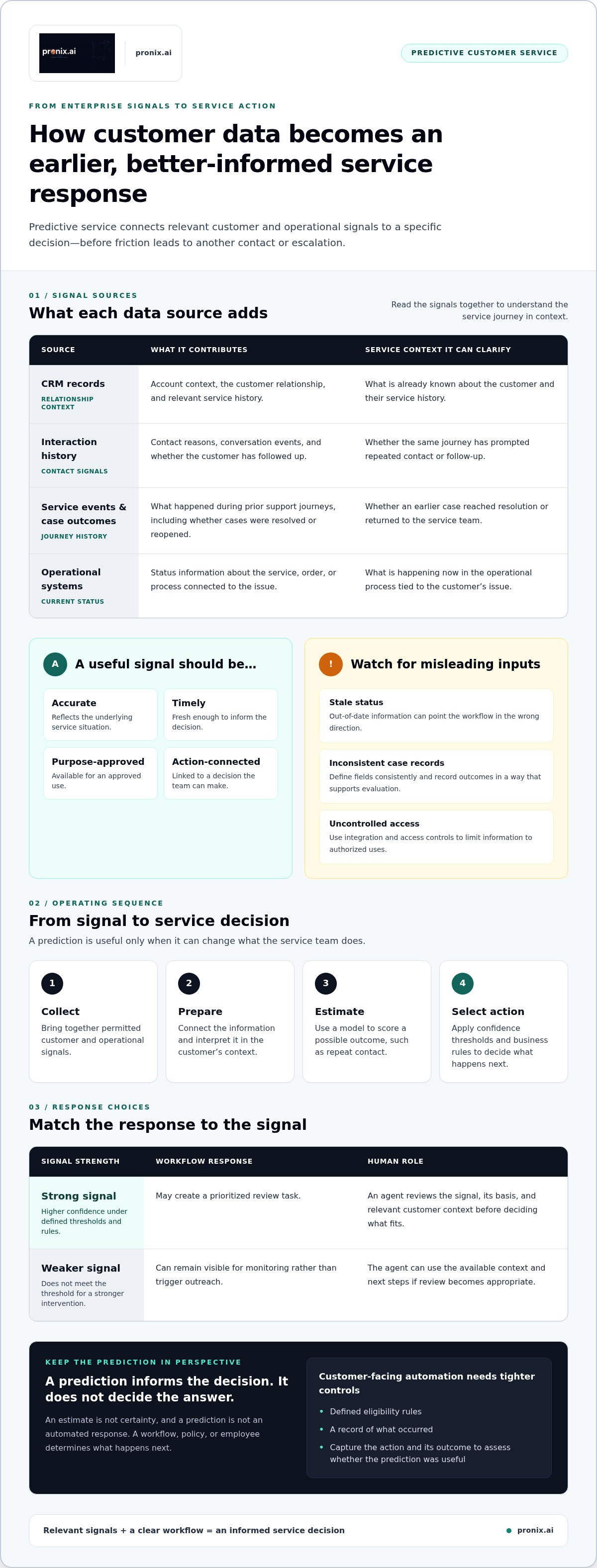
A prediction becomes useful only when it can change a service decision. The operating sequence is straightforward: collect permitted signals, prepare them in context, estimate a likely outcome, and select an appropriate action. This supports a future of customer experience built around anticipating needs rather than relying solely on feedback after an issue.
Useful predictions require both relevant data and an actionable workflow. More data alone doesn’t guarantee a better estimate. Information must be accurate, timely, available for an approved purpose, and connected to a decision the service team can make.
What data does predictive customer service need?
Each source contributes a different part of the picture:
- CRM records provide account context, including the customer relationship and relevant service history.
- Interaction history captures contact reasons, conversation events, and whether the customer has followed up.
- Service events and case outcomes show what happened during prior support journeys, including whether cases were resolved or reopened.
- Operational systems can add status information about the service, order, or process connected to the issue.
Integration helps teams interpret these signals together, while access controls limit information to authorized uses. Data quality and freshness matter: a stale status or inconsistent case record can point the workflow in the wrong direction. Before using fields as dependable inputs, define them consistently and confirm that teams record outcomes in a way that can support evaluation.
How does a prediction become a customer-facing action?
Consider an illustrative scenario: a service event appears in an operational system, and recent interaction history shows that a customer has already contacted support about the same journey. A model scores the case for possible repeat contact. The workflow then applies confidence thresholds and business rules. A strong signal might create a prioritized review task; a weaker one could remain visible for monitoring rather than trigger outreach.
From there, the workflow routes the case and gives the agent relevant context, including the signal, its basis, and the available next steps. The agent can decide whether a suggestion fits the customer’s situation. By contrast, an automated customer-facing action, such as sending a message or changing an account state, needs tighter controls, defined eligibility rules, and a record of what occurred. Capture the action and its outcome so teams can assess whether the prediction was useful.
Connected service workflows are a key part of AI-Driven CX Modernization: The 2026 Enterprise Guide to Production-Ready Outcomes. Pronix.ai’s enterprise AI implementation services connect predictive use cases with operational workflows, data foundations, and governance.
Predictive Models, Rules, Generative AI, or Agents: Which Approach Fits?
These approaches solve different parts of a service problem. Rules apply known conditions. Predictive models estimate likely outcomes. Generative AI creates or summarizes language. Workflows govern what actions follow, including whether a human must review a case. A sound design selects the simplest approach that supports the decision and its risk level.
For AI-powered predictive customer service, the key distinction is that a model’s estimate doesn’t authorize an intervention. Prediction can support service judgment, but it can also misclassify a case or prompt an irrelevant action. Set decision thresholds, define human review, and provide a way to correct or stop actions that don’t fit the customer’s circumstances.
| Approach | Suitable task | Input needs | Explainability | Autonomy and oversight |
|---|---|---|---|---|
| Rules | Apply explicit policies, thresholds, or stable conditions. | Defined fields and clear conditions. | Usually direct: teams can inspect the rule that fired. | Can trigger bounded actions; owners must maintain rules and exceptions. |
| Predictive models | Estimate a likelihood, such as repeat contact or escalation risk. | Relevant, representative historical data with dependable outcomes. | Varies by model; teams should make the decision basis reviewable. | Best used to inform routing or review, with thresholds and monitoring. |
| Generative AI | Summarize case context or draft an agent response. | Relevant conversation, case, and knowledge context. | Generated content needs review against source information and policy. | Useful as assistance; human review is appropriate for consequential replies. |
| Agentic workflows | Coordinate steps across systems in a bounded service process. | Connected data, defined permissions, and workflow state. | Actions and decisions need logs that support review. | Can execute approved steps; require monitoring and escalation paths. |
When are rules or predictive models the better fit?
Use a rule when the condition is explicit, such as routing a case after a defined status change. Choose a predictive model when historical patterns can inform a probabilistic decision that a rule can’t capture reliably. Model suitability depends on representative data and a measurable outcome. If the team can’t define what a correct prediction means, it can’t evaluate whether the model helps.
When should generative AI or agents participate?
Generative AI can make a prediction easier to use by summarizing the case or drafting agent assistance. It doesn’t prove the underlying prediction is accurate. Agentic actions should stay within defined permissions, with monitoring and escalation when a case falls outside those boundaries. Data readiness matters; the related guide, Enterprise AI Data Strategy: 2026 Production Foundation, explores the foundations behind dependable AI use.
In practice, combine methods deliberately: a model flags potential risk, rules apply eligibility and confidence thresholds, generative AI prepares context, and a governed workflow routes the case or carries out an approved step. Keep human judgment in the loop wherever uncertainty or customer impact warrants it.
How to Evaluate Predictive Customer Service Before Scaling
Start with one service decision where earlier action can be measured, such as which unresolved cases should receive agent review before another customer contact. Define the eligible cases, workflow, and measurement period before deployment. Without a baseline, a change in outcomes may reflect a shift in case volume or process rather than the predictive approach.
A pilot should measure prediction performance and operational impact together, including correct risk identification, repeat contacts, escalation rates, resolution time, agent adoption, customer impact, and the costs of false positives, missed cases, and unnecessary outreach. A model that identifies risk accurately but creates unhelpful work for agents may not improve the service journey.
What should an enterprise pilot measure?
Set use-case-specific acceptance criteria rather than applying a universal accuracy threshold. Track whether flagged cases are genuinely at risk and whether relevant cases are missed. Then connect those results to service outcomes. Review override patterns, too: frequent agent corrections may point to weak signals, unclear recommendations, or missing context.
- Prediction quality: Compare flagged risks and missed cases with the outcomes that actually occurred.
- Service performance: Track repeat contacts, escalations, and resolution time against the baseline.
- Operational fit: Monitor agent adoption, overrides, and the effort required to act on recommendations.
- Customer impact: Assess whether interventions were relevant and whether outreach created avoidable friction.
Keep the measurement design consistent throughout the pilot. Record changes to the model, workflow, or eligible population so the team can interpret results and make a grounded decision about whether to refine, expand, or stop.
How can teams manage trust, governance, and adoption?
Assign clear ownership before launch. Name who governs data access, approves model changes, sets workflow decisions, reviews performance, and handles incidents. Frontline teams need usable context for each prediction, plus a straightforward way to correct or override it. Their feedback can expose mismatches between model signals and service realities.
Oversight should include traceable inputs and actions, review of overrides and errors, and a defined path to pause or adjust the workflow when it behaves unexpectedly. The guide Enterprise AI Auditability and Risk Mitigation covers how auditability and risk controls support responsible operation.
A contained pilot can establish an evidence-based path to production. Enterprise AI implementation brings governance, integration, and operational ownership into predictive service workflow planning.
From Predictive Service Pilot to Governed Enterprise Operations
A successful pilot is a starting point, not a production plan. Moving AI-powered predictive customer service into enterprise operations requires a disciplined path: prioritize a service use case, assess data and technology foundations, design controls, integrate the workflow, then operate and refine it. Each phase should have clear owners and decision criteria.
Production readiness depends on more than a model. Teams need secure access to relevant data, auditable decisions and actions, reliable integration with service systems, accountable ownership, and ongoing monitoring. These elements help ensure that predictions remain useful as customer journeys, data, and operational conditions change.
What belongs in a production-ready predictive service workflow?
Document the end-to-end workflow before deployment. Specify which data the system can access, where signals and recommendations will appear, what actions are permitted, and when a case must go to a human. Define monitoring for prediction quality, exceptions, and workflow failures. Establish change management so updates to data, models, or decision logic are reviewed and recorded.
Contact center platforms such as Amazon Connect or Genesys can form part of the wider workflow, alongside enterprise data and operational systems. Platform choices should fit the organization’s existing architecture and service requirements. The objective is a connected, supportable process, not an isolated prediction tool.
How can enterprises sustain performance after launch?
Set a regular review cadence for prediction quality, service outcomes, exceptions, and frontline feedback. Look for shifts in repeat contacts or escalations, but also investigate overrides and cases where an expected intervention wasn’t useful. When customer journeys or operating conditions change, reassess the data and decision logic rather than assuming the original design will remain effective.
Ongoing ownership may involve internal teams, managed operations, or both. The Enterprise AI Managed Service Provider Selection Framework offers a lens for considering responsibilities after launch, including monitoring, refinement, and operational continuity.
Pronix.ai supports this lifecycle through enterprise AI strategy, implementation, CX modernization, and managed services. Its work connects defined use cases to data foundations, service workflows, governance controls, and the operating model needed for production, without treating deployment as the finish line.
What is the next step for an enterprise team?
Document one service problem, the signals that may reveal it earlier, the current baseline, and the operational outcome you want to improve. Then align CX, data, security, and operations stakeholders around the use case, its controls, and how success will be assessed. A focused brief gives the team a practical basis for planning.
Discuss an enterprise predictive service roadmap to map the path from a defined customer-service need to governed production operations.
Turn Predictive Signals into Governed Service
AI-powered predictive customer service creates value when relevant signals lead to timely, appropriate action. The right approach depends on the decision: rules enforce clear conditions, predictive models estimate risk, generative AI supports communication, and governed workflows determine what happens next. Start with one measurable service need, then evaluate prediction quality alongside customer and operational impact.
Scaling requires more than a capable model. Secure data access, integration, clear ownership, human escalation, auditability, and ongoing monitoring make predictive service manageable in production. Pronix.ai supports the enterprise AI lifecycle through strategy, implementation, and managed services, connecting CX modernization with operational needs across platforms such as Amazon Connect, Genesys, and NICE. The focus is on secure, scalable, measurable production outcomes.
Bring CX, data, security, and operations leaders together around one service problem, its signals, and the result you want to measure. Discuss an enterprise predictive service roadmap to turn that use case into a governed path to production.
Frequently Asked Questions
What is AI-powered predictive customer service?
AI-powered predictive customer service uses relevant customer and operational signals to estimate a possible service need or risk before it’s reported. For example, repeated contacts about an unresolved case could indicate a higher chance of another contact. The estimate helps teams decide what to review or do next. It doesn’t guarantee an outcome or automatically justify outreach; workflows, policies, and human judgment shape the response.
How is predictive customer service different from proactive customer service?
Predictive service uses data and analytical methods to estimate which need or issue may arise. Proactive service describes acting before a customer initiates contact. Prediction can inform a proactive action, such as prompting an agent to review an at-risk case, but the terms aren’t interchangeable. A team can take proactive steps using known events or rules without predictive AI, and a prediction may simply inform a decision without triggering outreach.
What data is needed for predictive customer service?
Useful inputs may include service histories, interaction events, case outcomes, relevant CRM records, and operational events tied to the customer’s journey. The right data depends on the decision being supported. Accuracy, timeliness, consistent definitions, appropriate access controls, and integration matter more than data volume alone. Stale statuses or incomplete case outcomes can weaken the signal, so teams should assess data quality and permitted use before building a prediction.
Can predictive AI reduce customer service escalations?
It may help teams identify cases at risk of escalation early enough to review them or route them to the right support. Whether that reduces escalations depends on signal quality, the action taken, and whether the intervention fits the customer’s situation. Measure escalation rates against a defined baseline, alongside repeat contacts and customer impact. A prediction that flags too many low-risk cases can add work without improving service.
How accurate is predictive customer service AI?
There’s no single accuracy figure that applies to every predictive service use case. Performance depends on the quality and representativeness of the data, the outcome being estimated, and how conditions change over time. Evaluate whether the system correctly flags relevant cases and how often it misses them. Then assess operational impact, including agent overrides, unnecessary outreach, and service outcomes. Set acceptance criteria for the specific decision, not a universal threshold.
Does predictive customer service replace human agents?
No. Predictive tools can help agents prioritize cases, surface relevant context, or identify a possible service risk. They don’t replace the judgment needed to interpret policy, resolve unusual situations, or respond with empathy. A practical design makes the prediction understandable, gives staff a way to correct or override it, and defines when a case should be escalated to a person. The goal is better-informed service, not removing human expertise.
How should an enterprise start implementing predictive customer service?
Choose one service decision where earlier action can be measured. Document the problem, available signals, current baseline, desired outcome, and workflow owners. Assess data quality, access, integration, security, and human review before piloting; then measure prediction performance and service impact together. Use the evidence to refine the approach before expanding. Enterprise teams can align strategy, implementation, CX modernization, and managed operations to support a governed path to production.