

AI personalization should make service more relevant, not less human. Personalizing customer experience with AI lets organizations use customer data and current interaction signals to tailor commerce, anticipate needs, and automate routine support. Human agents remain essential for complex questions, sensitive situations, and decisions that require judgment.
That balance matters. Customers expect interactions to reflect their needs, but irrelevant recommendations or automation that blocks access to a person can erode trust. The value comes from applying useful context at the right moment, with clear data boundaries and a straightforward way to reach human support.
This article explains what AI personalization means, how it works across shopping and customer service, and where predictive analytics can help anticipate what customers need next. You’ll also learn how organizations can connect automation with human support, use customer data responsibly, and build the foundations for a more coherent experience across channels.
Key Takeaways
- Connect customer identity and real-time interaction signals so predictions reflect what people need now, not just past behavior.
- Use recommendations to make shopping more relevant, while measuring whether they improve outcomes across the customer journey.
- Build personalization on relevant, permission-aware data and give customers clear choices about how their information is used.
- Automate routine support with approved knowledge and clear escalation paths, keeping human agents available for complex or sensitive needs.
Customer data collection and predictive analytics
AI personalization analyzes thousands of customer interactions to detect patterns and predict preferences. Those insights can guide relevant recommendations, service, and outreach. A disciplined approach to personalizing customer experience with AI starts with a clear service goal.
Customer Data Inputs and Analysis
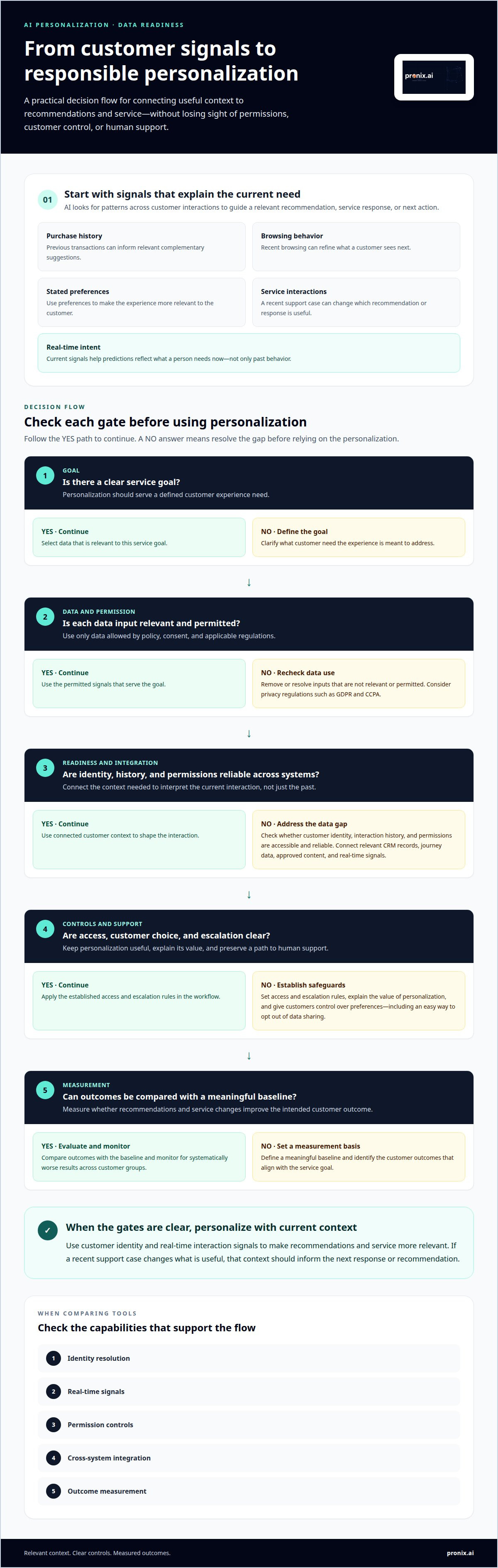
Useful inputs include purchase history, browsing behavior, stated preferences, service interactions, and real-time intent. Analytics connects these signals to identify patterns, such as repeated searches for a product category, and inform product recommendations or a relevant next action.
Use only data relevant to the service goal and permitted by policy, consent, and applicable regulations. GDPR and CCPA are privacy regulations to consider, according to the European Union and California Privacy Protection Agency.
Data Readiness and Integration
Data readiness means customer identity, interaction history, and permissions are accessible and reliable across the systems supporting an experience. Integration connects CRM records, journey data, approved content, and real-time signals so models can interpret the current interaction, not just past behavior.
For example, a recent support case can change which recommendation or response is useful. Set access and escalation rules, explain the value of personalization, and give customers control over preferences, including an easy way to opt out of data sharing. Measure outcomes against a meaningful baseline and monitor for systematically worse results across groups. Teams personalizing customer experience with AI should connect these controls to the data and workflows shaping each interaction.
Which AI personalization platforms and tools are available, and how do they compare? Options include customer data platforms, CRM systems, recommendation engines, analytics, and decisioning tools. Compare them by identity resolution, real-time signals, permission controls, cross-system integration, and outcome measurement.
How much does AI customer personalization software cost? Costs depend on platform scope, data volume, integrations, and deployment needs. Pricing depends on the case and is provided after a quote request.
What are the steps to implement AI-powered personalization? Define a service goal, select relevant, permitted data, connect identity and interaction signals, then set access and escalation rules. Test recommendations against a baseline and monitor outcomes, including differences across customer groups.
What measurable benefits and ROI can businesses expect from AI personalization? Personalization can increase revenue by as much as 15%. Track revenue and customer outcomes against a meaningful baseline to determine whether the results support continued investment.
What is AI-driven customer experience?
AI-driven customer experience uses customer context to tailor recommendations, service, and interactions across a journey. Product recommendations show how models can turn observed behavior into relevant next actions.
Product and Content Recommendations
AI recommendations use signals such as browsing, purchase history, and current intent to select products or content for each customer. This matters because a shopper exploring running shoes needs different suggestions than someone comparing kitchen appliances.
Models can also adapt recommendations as customers take new actions. A viewed product might prompt complementary items, while a guide or comparison article can support a customer still researching. In McKinsey's survey, 67% of customers said they felt frustrated when business interactions were not tailored to their needs. Useful recommendations make relevance visible without treating every customer alike.
Purchase Data and Cross-Channel Recommendations
Recommendations based on purchase data use previous transactions to shape relevant suggestions and upselling. For example, an earlier purchase can inform complementary product suggestions, while recent browsing can refine what appears next.
Across channels, companies can apply those signals in a website, email, or customer service interaction. The experience is more coherent when a customer’s recent actions inform the next recommendation, rather than each channel acting independently. Companies use AI across channels by combining customer context with current intent, then adapting content or service guidance to the interaction. Yves Rocher increased its purchase rate by 11 times compared with a top-seller recommendation.
Recommendation Accuracy and Success Measures
Recommendation accuracy depends on whether the data reflects current preferences and whether the model selects useful options. A more engaging suggestion is not an improvement if it is less accurate, so teams should compare recommendations with a meaningful baseline.
How effective are AI recommendations? Track outcomes such as purchases, conversions, and cross-sells, then assess whether changes align with the experience goal. Compare results against a baseline and monitor whether some groups receive systematically worse outcomes. This connects analytics to customer value, not just clicks. When these measures reveal gaps between channels or workflows, AI-driven CX modernization can help connect recommendations with service processes and customer context.
AI-powered personalized commerce
AI-powered commerce adapts marketing and shopping interactions to customer intent. Segmentation, ad targeting, and chatbots can reduce irrelevant messages and effort.
For example, a shopper browsing home office furniture may see related offers, while another customer receives different content based on their history. The goal is relevant engagement, not simply more messages.
AI-Powered Customer Segmentation
AI-powered segmentation groups customers by shared patterns in behavior, preferences, and interactions. It helps teams tailor campaigns to meaningful needs instead of relying on broad demographic assumptions.
A retailer could distinguish customers researching a first purchase from repeat buyers exploring a new category. Marketing teams can then adjust the message, timing, or offer for each group. Segments should reflect useful signals and stay connected to current customer actions, so past behavior doesn’t dictate every interaction.
AI-powered ad targeting uses customer signals to select which audience sees an advertisement and what message appears. For example, a customer who viewed a product category could receive a relevant campaign, while existing purchase history can help suppress mismatched promotions. Teams can assess revenue and engagement together, then refine audience rules when clicks rise but purchases do not. This keeps targeting tied to commercial outcomes, not impressions alone.
AI-Powered Chatbots
AI-powered chatbots use customer context to answer questions and guide shopping interactions. A shopper comparing two products, for example, can receive information relevant to the current choice rather than a generic catalogue response.
For commerce teams, a chatbot can handle routine questions and help customers find suitable products. Clear escalation rules let agents take over when a request needs judgment or specialist support. This reduces repetitive effort while preserving human assistance for complex decisions. The chatbot’s guidance should draw on approved product information so personalized answers remain accurate and consistent.
Effective commerce connects segmentation, targeting, and service around the customer’s purpose. A campaign can attract attention, a recommendation can support evaluation, and a chatbot can resolve a product question. Reviewing these interactions together helps teams identify where the journey loses momentum and where changes can improve relevance and revenue.
Customer experience automation and human support
Effective automation resolves routine needs while preserving access to people for complex decisions. The design challenge is not choosing between AI and agents, but assigning each interaction to the right path.
AI can answer routine questions using approved knowledge, recognize customer intent, and route requests to the right queue. For example, a customer asking about an order can receive a relevant status response, while a billing dispute can go to a human agent. Clear eligibility and escalation rules prevent automation from trapping customers in workflows that cannot resolve their needs.
Consumers still value human judgment. In the research cited by Qualtrics, 75% of consumers prefer talking to people for customer service, especially for complex issues or important decisions. AI can support agents by surfacing customer context and recommending next-best actions, leaving people more capacity for cases that require empathy or complex decision-making.
Self-service can also provide support around the clock through AI-powered chatbots. Answers should draw on approved knowledge, and chatbot capabilities should match the tasks they’re allowed to complete. If an issue falls outside those boundaries, the system can escalate the interaction with its context intact. That reduces repeated explanations and helps specialists see what the customer has already tried.
Automation can also trigger proactive outreach when a customer or system event signals a need. For example, a service disruption could prompt a timely update, while an unresolved case could trigger follow-up. Teams should assess customer satisfaction, resolution quality, and escalation patterns together. Rising engagement alone is not enough if customers still struggle to reach a person or receive an accurate answer.
Map each interaction point to an owner, an approved response, and an escalation path before expanding automation. To connect those workflows across customer service operations, design AI-powered service workflows around both automated resolution and human support.
Pronix.ai: Agentic AI Implementation
pronix.ai helps enterprises move from AI personalization concepts to secure, scalable production workflows. Its Agentic AI Implementation service is suited to customer-facing systems that need to act on context while following defined access, eligibility, and escalation rules. For fragmented journeys or disconnected service channels, AI-Driven CX Modernization can address the wider experience; AI Business Automation can support workflows beyond customer service. Data & AI Foundations help establish the underlying data capabilities these systems rely on.
The next step is to align the business goal, customer data, existing systems, and human handoffs before expanding automation. This gives teams a practical basis for deciding where AI should respond, recommend, or route a customer to an agent. Visit pronix.ai to explore how its implementation and modernization services can support your customer experience priorities.
Turn Personalization Into an Operational Capability
Choose a customer journey where better context could improve the experience. Define the decision AI should support, the data it can use, and when a person should take over. This gives teams a clear starting scope and a way to assess whether personalization is improving the customer’s path.
Personalizing customer experience with AI becomes sustainable when treated as an operating capability, not an isolated feature. It requires coordination across customer data, workflows, and service teams. pronix.ai supports this work through Agentic AI Implementation, AI-Driven CX Modernization, and AI Business Automation, connecting implementation priorities with customer-facing operations.
Bring your current journey, systems, and objectives into the discussion. Discuss AI personalization with pronix.ai and identify a practical path from strategy to execution. A focused starting point can help your organization make progress with clarity and keep the customer experience at the center.
Frequently Asked Questions
What Is AI Personalization?
AI personalization uses customer information and machine learning to adapt an interaction to an individual’s context. A retailer could tailor a product page to a shopper’s current interests, while a service team could surface details relevant to an open issue. The system should respond to useful signals, not assume that one past action defines every future preference.
What’s the best way to balance automation and human input when personalizing CX with AI?
Automate predictable, low-risk tasks and give customers a clear route to a person when judgment matters. A bot might explain an order status, while an agent handles a disputed charge or an exception requiring discretion. Set escalation criteria before deployment, and review conversations where automation failed to resolve the need. Those cases show where human involvement should begin.
What does AI-powered customer experience personalization mean?
It means adapting content, guidance, or service to a customer’s needs during an interaction. If someone reports a delivery delay, for instance, the system can prioritize information about that shipment rather than present a generic promotion. By using the conversation’s immediate purpose as context, each response can support the customer’s task instead of interrupting it.
What customer data is needed to personalize experiences with AI?
Start with data tied directly to the experience goal: customer identity, relevant purchase or browsing history, stated preferences, and current interaction context. A service team responding to an open case may need the case details and recent customer actions, not unrelated personal attributes. Limit access to permitted information, keep records reliable, and explain how customer data supports the experience.
What privacy laws and regulations apply to AI-driven customer personalization in the United States?
Applicable privacy obligations depend on the customer, organization, data, and operating context. The European Union and California Privacy Protection Agency identify GDPR and CCPA as privacy regulations organizations should consider when implementing personalization. Businesses should assess which requirements apply to their activities, use only relevant data with appropriate permissions, and give customers meaningful transparency and control over data sharing.
What are the risks and ethical concerns of personalizing customer experiences with AI?
Key risks include using irrelevant or sensitive data, opaque personalization, inaccurate recommendations, and outcomes that disadvantage certain groups. Customers may lose trust if a system makes a consequential assumption without explanation or control. Reduce these risks by clarifying the value of data use, limiting inputs to the service goal, offering preference controls, and monitoring results across customer groups for consistent performance.