

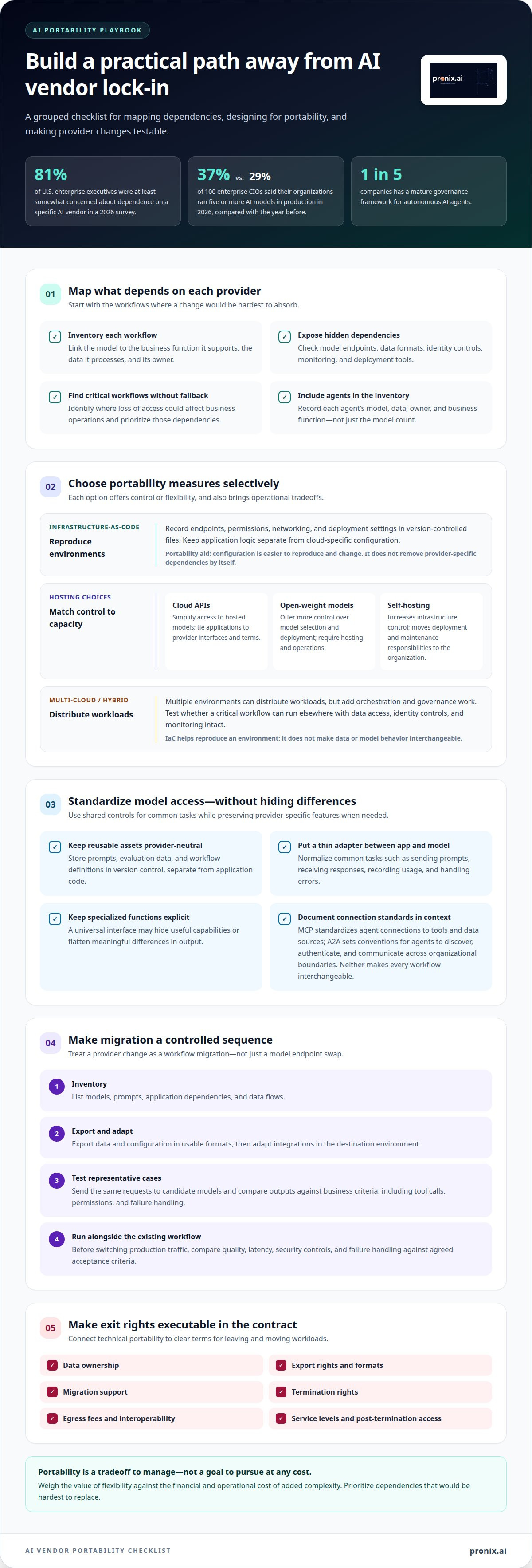
81% of U.S. enterprise executives were at least somewhat concerned about dependence on a specific AI vendor in a 2026 survey. Avoiding AI vendor lock-in matters because a provider change can affect critical business functions, limit options as costs or capabilities shift, and make migration more difficult. Flexibility is not an abstract architecture goal; it protects operational choices.
That concern is understandable. A model or platform may work well today, but its pricing, performance, or fit can change as AI needs evolve. Avoiding AI vendor lock-in does not mean making every system interchangeable at any cost. It means weighing the value of flexibility against the financial and operational risks of depending too heavily on one provider. Infrastructure choices, multi-cloud design, API abstraction, and contract terms all shape that tradeoff. Assess migration costs and build a practical path to greater control without adding unnecessary complexity.
Key Takeaways
- Map which business functions depend on each AI provider, then prioritize the dependencies that would be hardest to replace.
- Use infrastructure-as-code and multi-cloud architecture selectively, weighing added portability against the cost and complexity of operating across environments.
- Standardize model access through API layers and test fallback routes so applications can adapt when provider capabilities or costs change.
- Assess migration effort alongside ongoing operating costs; pronix.ai’s Agentic AI Implementation can help enterprises turn AI workflows into more controlled, production-ready systems.
1. Why Does AI Vendor Lock-In Matter Now?
AI dependency is growing as enterprises put more models into production. In a 2026 survey of 100 enterprise CIOs, 37% said their organizations ran five or more AI models in production, compared with 29% the year before the 2026 survey. More models can expand capability, but each one adds integration and oversight decisions. Map which model supports each workflow, what data it processes, and what happens if access changes.
Infrastructure choices can deepen dependency. An application built around one vendor’s model endpoint may also rely on its data formats, identity controls, monitoring, or deployment tools. Moving a customer-service workflow, for example, may involve more than routing requests to another model. Teams may need to adapt prompts, test output quality, preserve audit records, and reconnect data. Treat export rights and migration steps as architecture requirements, not tasks to leave until exit day.
Compliance can narrow options, too. Emerging AI requirements may favor large vendors able to absorb greater legal and regulatory overhead, making competition harder for smaller providers. The EU Data Act is increasing pressure on providers to support switching and remove barriers to portability. In U.S. defense procurement, an acquisition directive requires contractors to maintain at least two qualified sources for critical program content. These examples show why procurement, compliance, and technical teams need to assess dependency together.
Concentration risk extends beyond infrastructure. A business may use several models but still depend on one platform to govern its agents. Only one in five companies has a mature governance framework for autonomous AI agents. Create an inventory linking each agent to its model, data, owner, and business function. Then identify critical workflows without a viable fallback. This gives leaders a basis for deciding where to diversify, where to standardize controls, and which dependencies need stronger exit provisions.
2. Infrastructure-as-Code and multi-cloud architecture
Infrastructure-as-Code (IaC) records infrastructure configuration as reusable code, making environments easier to reproduce and change. Define model endpoints, permissions, networking, and deployment settings in version-controlled files. This supports portability, but provider-specific services can still create dependency. Keep application logic separate from cloud-specific configuration, then test deployments in another environment before treating the architecture as portable.
Hosting choices involve different tradeoffs. Cloud APIs simplify access to hosted models but tie applications to provider interfaces and terms. Open-weight models offer more control over model selection and deployment, while requiring teams to manage hosting and operations. Self-hosting can increase infrastructure control, but also transfers deployment and maintenance responsibilities to the organization.
Multi-cloud and hybrid architectures distribute workloads across multiple environments, but add orchestration and governance work. The Department of Defense’s Joint Warfighting Cloud Capability, established in 2022, provides a framework for multi-vendor cloud use. For an enterprise, the practical test is whether a critical workflow can run elsewhere with its data access, identity controls, and monitoring intact. IaC helps reproduce that environment; it doesn’t automatically make data or model behavior interchangeable.
Plan migration as a controlled sequence. Inventory models, prompts, application dependencies, and data flows. Export data and configuration in usable formats, then adapt integrations and test outputs in the destination environment. Run the new workflow alongside the existing one before switching production traffic. Compare quality, latency, security controls, and failure handling against agreed acceptance criteria.
Contract terms should define data ownership, export rights and formats, migration support, termination rights, egress fees, interoperability, service levels, and post-termination access. These provisions connect technical portability to an executable exit plan. Teams shaping an architecture and migration approach can explore AI architecture planning as a next step.
3. API standardization and abstraction layers
Keep prompts, evaluation data, and workflow definitions in version-controlled, provider-neutral formats. Separate them from application code so teams can reuse them across AI providers. Place a thin adapter between the application and each model API, then run shared evaluation tests before switching workloads. This makes differences visible without assuming models will produce identical results.
An abstraction layer can normalize common tasks, such as sending a prompt, receiving a response, recording usage, and handling errors. It gives teams one control point for routing workloads by capability, cost, or operational need. Keep provider-specific features behind explicit adapters, though. A universal interface can hide useful model capabilities or flatten meaningful differences in output, so preserve access to specialized functions when the application needs them.
Standards can support connections beyond model APIs. The Model Context Protocol (MCP) standardizes how AI agents connect to tools and data sources. The A2A Protocol establishes conventions for agents to discover, authenticate, and communicate across organizational boundaries. These protocols address different integration needs; they don’t make every platform or workflow interchangeable. Document which protocol supports each connection and test permissions and failure handling in context.
Build a repeatable portability test. Store prompts and evaluation cases in source control, send the same representative requests to candidate models, and compare outputs against business criteria. Include tool calls, structured responses, and exceptions in the tests. A multimodel AI strategy should route workloads deliberately across models and vendors, test local fallbacks, and govern platforms through one layer. Gartner projected that most organizations using generative AI would deploy an AI gateway within the next few years. Treat the gateway as a governed switching point with logging and access controls, not as a guarantee of portability.
4. Financial and operational costs of vendor lock-in
Lock-in creates costs before migration begins. A provider-specific AI model may require custom prompts, monitoring, data pipelines, and staff expertise. Those dependencies increase switching effort when performance changes or renewal terms shift. Document costs by workflow, including usage, integration maintenance, security reviews, and the work required to validate another model’s outputs.
Multiple providers can reduce concentration risk, but they add operational overhead. Teams must manage separate access controls, billing, service monitoring, and output evaluations. A model gateway can centralize routing and governance, but it also needs deployment, maintenance, and failure testing. Use a gateway when centralized control and workload routing justify the overhead, not simply to add another layer.
Compare total operating costs, not just provider usage charges. Include integration work, data transfer, engineering time, duplicated controls, and the cost of keeping fallback deployments ready. Routing a customer-support workflow across two models, for example, may offer more choice but requires consistent evaluation criteria and escalation behavior. The benefit depends on whether added flexibility offsets the cost of operating both routes.
Migration also consumes budget and staff capacity. The figure makes exit planning a financial decision, not just a technical one. Estimate the work involved in data conversion, prompt adaptation, application changes, validation, and parallel deployment. Separate one-time migration effort from recurring governance and infrastructure costs, then compare those totals with the cost of continued dependency.
Set a review trigger before renewal: document model performance, provider spend, export readiness, and the operational impact of switching. Reassess when a workflow changes or an AI model no longer meets business needs. To make that cost picture actionable, assess your AI operating costs across workloads, deployment, and governance.
Pronix.ai: Agentic AI Implementation
pronix.ai helps enterprises implement agentic AI workflows, moving from pilots toward secure, scalable production. Its Agentic AI Implementation service connects agents to business processes and establishes an operational path for deployment. For broader data readiness, Data & AI Foundations supports the groundwork. AI Business Automation and AI-Driven CX Modernization align implementation with specific workflow and customer experience priorities.
These services help teams translate portability goals into architecture and delivery decisions, including how workflows, data foundations, and governance fit together. The right starting point depends on the business process and the systems it needs to support.
Contact pronix.ai to discuss your enterprise AI implementation needs.
Make flexibility an operating discipline
A durable approach to avoiding AI vendor lock-in starts with ownership, not another technology layer. Assign a business and technical owner to each critical AI workflow. Give them responsibility for reviewing dependencies, portability, and exit readiness as the workflow or business requirements change.
Make those reviews part of existing architecture and procurement decisions. When a team proposes a new AI capability, record what the organization needs to preserve if its provider changes. That creates a practical test for future investments: does the design meet the business need while keeping meaningful options open?
For organizations ready to turn that discipline into implementation, pronix.ai can help connect AI initiatives to operational priorities. Discuss AI flexibility with pronix.ai and identify a practical next step for your enterprise.
Frequently Asked Questions
Why Does AI Vendor Lock-In Matter Now?
AI vendor dependency matters because provider changes can affect business continuity, product quality, and teams’ ability to adapt. A customer-support process, for example, may rely on a model’s response format and tool connections, not just its answers. If those functions change, service teams may need to adjust workflows and oversight. Treat dependency as an operational risk with clear ownership, not only as a procurement concern.
How often should organizations review their AI vendor dependency?
Review dependencies during procurement and renewal, and whenever a major model, workflow, or business requirement changes. A new data source or AI capability can introduce reliance that was absent from the original assessment. Assign an owner to track critical use cases and document material changes. Reviews triggered by real architectural or business shifts keep assessments relevant without relying on an arbitrary calendar interval.
What Are Best Practices for Managing AI Vendor Risk?
Start with a clear inventory of AI use cases, accountable owners, business impact, and the data each process handles. Set approval criteria for new deployments, including testing, access controls, incident escalation, and records needed for audit. For example, a team adding an AI assistant to employee operations can define when human review is required and who responds if the assistant behaves unexpectedly.
What Does Single-Vendor AI Dependency Actually Put at Risk?
It can put service continuity, negotiating leverage, and institutional knowledge at risk. If a key vendor changes a feature or discontinues a capability, a business process may need to be redesigned. Staff may also build expertise around one platform’s tools, making alternatives harder to evaluate. Identify the business owner, affected users, and manual fallback for each critical use case to clarify the practical exposure.
What is platform dependence?
Platform dependence occurs when an organization’s applications or processes rely on features, data structures, or operating practices specific to one technology platform. A workflow, for example, may depend on a platform’s built-in agent tools or proprietary configuration. The more business logic sits within those features, the more work teams may face when adapting the workflow to another environment.
What is AI vendor lock-in and how does it happen?
AI vendor lock-in is a condition in which changing providers becomes difficult, costly, or disruptive because important systems and processes depend on one vendor. It can develop gradually as teams adopt provider-specific tools, store configurations in proprietary formats, or tightly connect essential workflows to a single service. Avoiding AI vendor lock-in means designing and governing these dependencies deliberately, rather than assuming a future switch will be simple.