

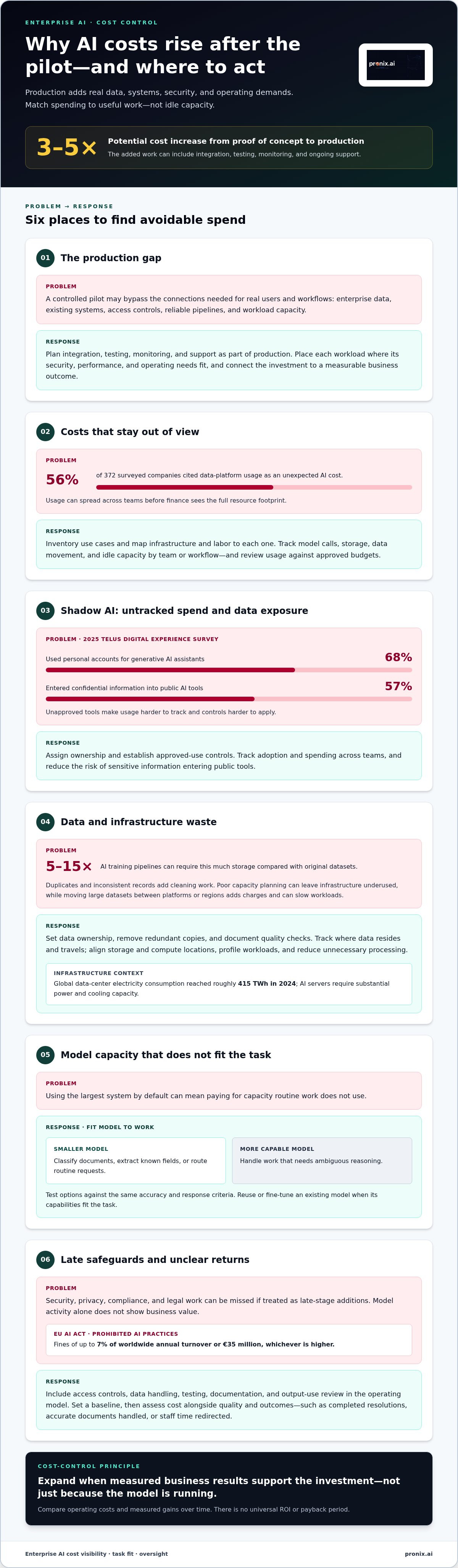
The hidden costs of enterprise AI often emerge after a pilot: moving an AI project from proof of concept to production can cost 3-5 times more. The biggest savings usually come from matching model capacity to each task and reducing waste in integration, data pipelines, and day-to-day operations, not from lowering model quality.
That cost jump is easy to explain. A pilot runs in a controlled setting; production must work with enterprise data, existing systems, security controls, and real workloads. When teams overlook these connections and operating demands, infrastructure and labor costs rise while performance can stall.
This article breaks down where those expenses hide and how to manage them without compromising results. You’ll see why integration and operational inefficiencies matter, when a smaller model may be enough, and how oversight keeps AI use aligned with business needs. The goal is a clearer path from promising pilot to reliable production, with spending tied to measurable work rather than idle capacity.
Key Takeaways
- Map AI costs across infrastructure, integration, data, and ongoing operations to find where spending grows after a pilot.
- Use smaller models for routine tasks and reserve more capable models for work that needs them; task fit is key to controlling spend without sacrificing quality.
- Track approved AI use and establish oversight to reduce shadow spending and limit the risk of sensitive data entering public tools.
- The EU AI Act provides for fines of up to 7% of worldwide annual turnover or €35 million, whichever is higher, for prohibited AI practices, according to the European Union.
Proof-of-concept-to-production cost increases
Production requires integration, oversight, and operating controls that a proof of concept may bypass. Cost visibility improves when organizations connect those investments to measurable business outcomes.
Scaling Beyond the Proof of Concept
Scaling means converting a limited concept into a dependable service that handles real users, data, and workflows. That transition can make an AI initiative 3-5 times more expensive because production requires integration, testing, monitoring, and ongoing support. For example, a prototype that answers sample questions may need access controls, reliable data pipelines, and workload capacity before employees can use it. Hybrid cloud management adds another decision: place each workload where its security, performance, and operating requirements fit, then track costs across environments.
Governance and Cost Visibility
AI governance assigns ownership and controls for model use, data access, risk, and spending. It matters because adoption can spread across teams before finance sees the full resource footprint. Organizations can estimate and control costs by inventorying use cases, mapping infrastructure and labor to each initiative, and reviewing usage against approved budgets. Track model calls, storage, data movement, and idle capacity by team or workflow. A survey of 372 companies found that 56% cited data platform usage as an unexpected AI cost, making platform-level visibility important.
Cost per Business Outcome
Cost per business outcome measures the resources required to deliver a defined result, rather than treating model activity as value in itself. This helps leaders compare investments consistently. For a customer-support workflow, track the cost of completed resolutions alongside quality and escalation rates. For document processing, compare spending with the number of accurate documents handled and staff time redirected. Set a baseline before adoption, then review performance and cost together: lower infrastructure use matters only if the business result holds.
Security Costs and Return on Investment
Security, privacy, compliance, and legal costs include access controls, data handling, testing, documentation, and review of how AI outputs are used. The European Union says the EU AI Act provides for fines of up to 7% of worldwide annual turnover or €35 million, whichever is higher, for prohibited AI practices. Include these safeguards in the operating model, not as late-stage additions.
There’s no universal ROI or payback period: both depend on implementation effort, ongoing operating costs, adoption, and the value of the business outcome. Compare those costs with measured gains over time, and expand only when the evidence supports the investment.
Shadow AI spending and data-leakage risks
Shadow AI creates costs outside approved budgets and can expose sensitive information through personal accounts. In a 2025 TELUS Digital Experience survey, 68% of employees reported using personal accounts to access generative AI assistants, while 57% said they had entered confidential information into public AI tools. Unapproved platforms also make it harder to track usage, apply controls, and understand the full AI cost.
Enterprise AI costs don’t compare neatly with traditional software or in-house development. Traditional systems concentrate spending on software, implementation, and maintenance. AI also brings variable model usage, data preparation, infrastructure, and ongoing oversight. The economics depend on workload volume, integration needs, and how much work remains manual.
Physical infrastructure adds another layer. Global data-center electricity consumption reached roughly 415 TWh in 2024, while AI servers require substantial power and cooling capacity. Poor capacity planning can leave infrastructure underused or constrain growth. Cloud costs also include data transfer: moving large datasets between platforms or regions adds charges and can slow workloads. Track where data resides and travels, then align storage and compute locations to reduce unnecessary movement.
Data preparation affects both spend and output quality. AI training pipelines can require 5-15 times more storage than original datasets, and inconsistent or duplicated records create extra cleaning work. Establish data ownership, remove redundant copies, and document quality checks before expanding a use case. This makes budgets easier to forecast and prevents teams from repeatedly preparing the same information.
Efficient coding and data-center design can improve resource use without changing the model. Profile workloads to identify idle compute, reduce unnecessary processing, and optimize data pipelines so infrastructure stays productive. For ongoing oversight of approved platforms, usage, and operating controls, Enterprise AI Managed Services can support a more disciplined operating model.
Choosing smaller models for suitable tasks
Choose a model based on task complexity, not a default preference for the largest system. A smaller model may classify documents, extract known fields, or route routine requests, while a more capable model handles ambiguous reasoning. Test each option against the same accuracy and response criteria before deployment. This keeps spending aligned with application requirements instead of paying for capacity that routine work doesn’t use.
Reusing or fine-tuning an existing model can also reduce costs when its capabilities fit the task. Start with a defined evaluation set, compare the adapted model with the current approach, and measure errors that matter to the business. A document-classification workflow, for example, may need consistent category assignment, not broad conversational ability. Record the model choice, task, quality results, and usage in a governance report so teams can explain the decision later.
Smaller models don’t eliminate ongoing maintenance. Annual AI model maintenance runs 15-30% of infrastructure costs, and maintenance can reach 50% annually in highly regulated industries. Up to 75% of the resources invested in building an AI system may need to support it over time. Model drift can emerge within weeks or months, depending on the domain. Monitor output quality against production data, then review changes when accuracy or input patterns shift.
Multimodal applications may combine text, images, audio, or structured data, but not every step needs one large model. Route each input to a model suited to its task, and reserve a larger model for complex synthesis. For instance, an image-recognition component can extract details before a language model summarizes them. This multi-model deployment requires version tracking, evaluation, and clear ownership for each component. Regular reviews help teams spot redundant models, retire unused deployments, and keep models aligned with application needs.
Integration, operations, and labor
AI workloads bring integration and operating demands that affect financial forecasts after launch. Track consumption, system performance, and staff effort to make those demands visible across projects.
Operating Enterprise AI Systems
Operating enterprise AI means maintaining the connections, data flows, and computing resources that keep models useful in production. That work matters because legacy integration can cost 2-3 times more than a greenfield deployment. Data silos add friction: 84% of organizations encounter them during AI integration. Teams must align access, pipelines, and application interfaces, then monitor failures and workload changes as systems run.
Performance bottlenecks can waste expensive compute even when infrastructure is available. Input pipeline stalls can consume more than 50% of training time when storage or CPU preprocessing cannot keep pace with GPU demand. Communication-heavy steps can consume 40-60% of training time in multi-node clusters. Track utilization alongside output quality, then tune storage, preprocessing, and network configuration to address the constraint rather than simply adding capacity.
Labor Requirements for Enterprise AI
AI labor includes the people who prepare data, integrate systems, evaluate outputs, and manage production incidents. This matters because projects require coordinated skills beyond model development. Data scientists, platform engineers, security specialists, and business owners each address different operational risks. The U.S. Bureau of Labor Statistics projects data scientist employment to grow 34% from 2024 to 2034, reinforcing the need to plan staffing and knowledge transfer.
Make labor visible by assigning owners to each workload and recording time spent on data fixes, releases, and reviews. A finance team automating document review, for example, still needs staff to resolve exceptions and assess output quality. Compare those hours with the process baseline; consumption metrics alone can hide the human effort behind the result.
For organizations that need sustained operational oversight, use Enterprise AI Managed Services to support production workloads and ongoing management.
Pronix.ai: Agentic AI Implementation
pronix.ai helps enterprises move AI initiatives toward secure, scalable production through Agentic AI Implementation. Turn to the team when a pilot needs clearer controls, reliable integration, and an operating model built around business needs. For organizations addressing customer experience or workflow bottlenecks, AI-Driven CX Modernization and AI Business Automation connect implementation choices to practical use cases. Data & AI Foundations address the underlying data and architecture that production systems depend on.
Start by defining the workflow, expected business outcome, and operational requirements. This gives implementation a clear basis for model selection, oversight, and ongoing management, rather than treating deployment as a standalone technical task.
Contact pronix.ai to discuss your enterprise AI priorities.
Make the Next AI Investment Deliberate
The next advantage won’t come from deploying AI everywhere. It will come from choosing where AI belongs, defining what success means, and building the operational discipline to sustain it. Treat each initiative as a decision about business value, risk, and readiness, not simply a technology purchase. This mindset helps leadership focus on work that can be measured and maintained.
When your roadmap needs execution support, pronix.ai offers Agentic AI Implementation, AI-Driven CX Modernization, and AI Business Automation. These services help connect AI plans to enterprise workflows and customer experiences. A focused conversation can clarify which priorities deserve attention and how to move forward with appropriate oversight. It can also help identify the hidden costs of enterprise AI before they become barriers to adoption.
Discuss AI costs with pronix.ai and take a considered next step toward responsible, scalable AI.
Frequently Asked Questions
How can organizations reduce generative AI infrastructure costs without impacting model quality?
Protect quality by testing infrastructure changes against representative workloads before broad rollout. Compare response accuracy, latency, and failure rates under normal and peak demand. Then adjust capacity, caching, and request routing while monitoring those same measures. For example, keep a fallback path for complex queries while directing routine requests through a more efficient route. This makes cost changes evidence-based rather than a blind reduction.
How much does an AI project cost?
There’s no single cost for an AI project because scope and operating requirements vary. A contained internal assistant has different needs from a system connected to customer records, business applications, and approval workflows. Build an estimate around data access, integration, security review, evaluation, user support, and ongoing operation. Define the intended outcome and workload first, then estimate implementation and lifecycle needs against that scope.
How to Control the Cost of Generative AI Without Slowing Teams Down?
Give teams a governed way to use AI instead of routing every request through a separate approval process. Provide approved tools, reusable prompt patterns, and clear data-handling rules. Add usage dashboards and alerts so owners can respond early to unusual consumption. For example, a product team can test in a shared environment and request expanded capacity when its use case meets agreed quality and business criteria.
What are the biggest hidden costs of deploying generative AI in an enterprise?
The hidden costs of enterprise AI often include evaluation, exception handling, security reviews, and the work required to update applications as models change. A customer-support assistant, for example, may need human review for ambiguous cases and regression tests after a model or prompt update. Include these activities in the operating plan. Otherwise, a deployment can appear inexpensive while relying on unbudgeted staff effort to maintain quality.
What financial risks do AI agents introduce that traditional AI tools do not?
AI agents can take actions, not just make recommendations, so mistakes may trigger transactions, duplicate requests, or unnecessary calls to connected services. Risk increases when an agent has broad permissions or can pass tasks to other tools without clear limits. Restrict access to necessary actions, set approval points for consequential steps, and keep auditable records of actions, inputs, and outcomes.
What percentage of AI projects go over budget?
A reported figure for projects that specifically go over budget isn’t established here. A related finding is that 85% of organizations misestimate AI project costs by more than 10%, but that includes estimates that may be too high or too low. To limit overruns, compare forecast consumption with actual usage, record scope changes, and update the forecast when data, integrations, or workloads change.