

Scaling AI is not just a hardware problem. AI infrastructure is the connected foundation of compute, storage, networking, data pipelines, models, and operational controls that enables AI systems to train and run. Scalable AI infrastructure management coordinates these layers across cloud and edge environments, allowing capacity, workflows, and governance to grow together.
Adding compute won’t resolve fragmented data, manual handoffs, or unclear controls. Reliable scaling depends on how the components work together, from data ingestion and model deployment to monitoring, security, and oversight.
This guide explains what AI infrastructure includes and how it scales across data, models, compute, workflows, and governance. It covers how cloud and edge choices affect performance, why lifecycle management matters, and how governance can support responsible operations without slowing useful AI work.
Key Takeaways
- Match cloud and edge placement to each workload’s latency, data, and capacity needs.
- Scale data pipelines, models, compute, and operations as connected parts of one system.
- Use modular infrastructure and observability to surface bottlenecks before they disrupt performance.
- Build governance into AI workflows with clear controls for data use, output quality, and access.
- Identify where implementation support can move AI initiatives from pilots into managed production workflows.
Cloud and edge infrastructure
Cloud, on-premises, and edge environments offer different ways to run AI workloads. The right mix depends on latency, control, capacity, and operating costs.
Cloud and On-Premises Infrastructure
Cloud infrastructure provides computing resources through remote services, while on-premises systems run on equipment an organization operates locally. This choice affects how quickly teams can expand capacity, where data is processed, and how infrastructure is managed.
In the United States, cloud, on-premises, and hybrid costs depend on utilization, hardware ownership, staffing, storage, and network requirements. Cloud offers on-demand resources that can scale up or down; on-premises costs center on equipment and ongoing operations. Hybrid approaches combine these factors, placing workloads according to performance and control needs.
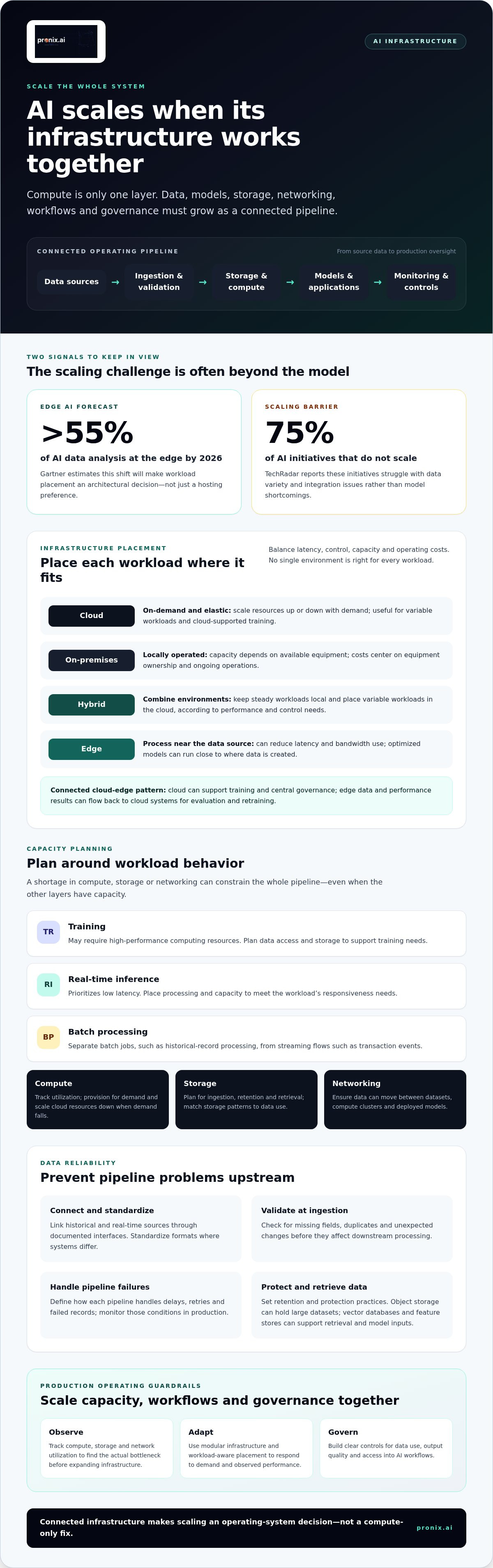
Edge computing processes data closer to its source, which can reduce latency and bandwidth use. Gartner estimates that more than 55% of AI data analysis will happen at the edge by 2026. That shift makes placement an architectural decision, not simply a hosting preference.
AI Compute, Storage, and Networking Capacity
Capacity planning estimates the compute, storage, and network resources needed to train and run AI workloads. It matters because a shortage in any layer can constrain the entire pipeline, even when other resources are available.
Start by separating training, real-time inference, and batch processing. Training may require high-performance computing resources, while real-time applications prioritize low latency. Cloud resources can scale with demand; on-premises capacity depends on available equipment. Plan storage for data ingestion, retention, and retrieval, and ensure networking can move data between datasets, compute clusters, and deployed models.
Provision resources according to workload demand. Teams can allocate cloud compute for peaks, then scale it down when demand falls. For on-premises systems, capacity planning must account for growth and available resources. Track utilization across compute, storage, and network layers to identify the actual constraint before expanding infrastructure.
Cloud-Based Managed AI Services
Cloud-based managed AI services provide access to infrastructure and capabilities operated through cloud platforms. They can help when an organization lacks the resources or skills to build AI infrastructure and models from scratch.
Managed services can reduce the operational work of provisioning and maintaining infrastructure. Teams can use cloud capabilities for model development, deployment, and supporting workflows, while matching service choices to data and governance requirements. Their practical value depends on how well they fit existing systems and the skills available to operate them.
Comparing Infrastructure Costs
Infrastructure cost comparisons weigh ongoing usage against equipment ownership and operations. This matters because the lowest initial commitment may not mean the lowest cost over a workload’s full operating cycle.
Cloud uses pay-as-you-go pricing and elastic compute scaling, which can suit variable demand. On-premises infrastructure requires organizations to operate local equipment, making utilization and operational needs central to its cost profile. Hybrid infrastructure can keep steady workloads local and place variable workloads in the cloud. Compare expected demand, storage, networking, and management effort, not compute alone.
A unified cloud-edge pipeline assigns work to the environment best suited to it. Cloud can support training and central governance, while optimized, containerized models run closer to data sources. Edge data and performance results can flow back to cloud systems for evaluation and retraining. This approach helps balance responsiveness with centralized oversight. It also connects deployment decisions to observed workload performance, allowing capacity and model operations to adapt as conditions change.
Data, model, infrastructure, and operational scaling
AI systems scale only when data, models, infrastructure, and operations advance together. A model may perform well in testing but struggle in production if data ingestion is inconsistent, storage slows retrieval, or applications cannot handle changing demand. Treat each layer as part of one operating pipeline, with clear ownership from source data through the deployed model.
Real-time and high-throughput pipelines must move information reliably from sources to processing systems and applications. Separate streaming flows, such as transaction events, from batch jobs that process historical records. This lets teams prioritize latency-sensitive work without forcing every task through the same pathway. Define how each pipeline handles delays, retries, and failed records, then monitor those conditions in production.
Data quality and integration often determine whether models can move beyond pilots. TechRadar reports that 75% of AI initiatives that do not scale struggle with data variety and integration issues rather than model shortcomings. Connect historical and real-time sources through documented interfaces, and standardize formats where systems differ. Add validation at ingestion to catch missing fields, duplicates, and unexpected changes before they affect downstream processing.
High-performance storage needs to support both training and inference. Efficient retrieval affects how models are trained and deployed, so match storage patterns to the data’s use. S3-compatible object storage can hold large datasets and pipeline outputs; vector databases and feature stores can support retrieval and model inputs. Set retention and protection practices alongside ingestion, so teams know which data is available, controlled, and appropriate for each application.
Scaling infrastructure means keeping compute, storage, and networking aligned with workload growth. A pipeline can stall when data transfer or retrieval becomes the bottleneck, even if model compute is available. Track CPU and GPU use, memory, network activity, pipeline retries, model latency, and accuracy. These signals help teams distinguish capacity constraints from data or model issues, then adjust resources or investigate the affected stage.
Governance must travel with the data. Apply access controls and encryption to protect sensitive information, and define retention and permitted-use rules for datasets and model inputs. Data management should account for GDPR and relevant industry-specific mandates. Document data lineage and quality checks so teams can trace how information shaped model outputs. For organizations aligning these controls with ongoing operations, Enterprise AI Managed Services can support the work of managing AI environments and workflows.
AI infrastructure components
An enterprise AI platform combines compute, storage, networking, software, and operational controls. Its design determines how well AI workloads meet changing performance demands.
Composable, Hybrid, and Multicloud Platforms
A composable platform assembles modular infrastructure components, while hybrid and multicloud designs distribute workloads across environments. This flexibility matters when applications have different performance, data, or operational needs. For example, an enterprise can keep a data-sensitive workload in its existing environment while using cloud resources for variable demand. Consistent interfaces and policies help teams manage these components as one platform.
Compute starts with matching processors to the task. GPUs, TPUs, and NPUs can support large-scale training and low-latency inference, while CPUs handle general processing and orchestration. Single-node GPU workloads commonly use 1-8 GPUs per node. The right configuration depends on model size, concurrency, and whether the workload trains models or serves predictions.
Storage and networking connect data to compute. Object storage can hold training datasets, while shared filesystems support access across distributed workloads. Dense GPU clusters generate substantial east-west network traffic, so bandwidth and routing affect how efficiently processors exchange data. High-concurrency inference can also strain networking before compute reaches capacity.
Containerized, modular applications are easier to package and move. Docker containers can bundle application dependencies, while Kubernetes coordinates deployment across available resources. Modular designs also make components easier to upgrade as technologies and enterprise demands change, reducing the risk of tying an entire platform to one fixed configuration.
Orchestrating AI Workloads
Orchestration platforms assign workloads to available compute and coordinate their lifecycle. Automated scheduling helps allocate resources consistently as demand changes. Kubernetes can manage containerized training or inference services, scaling deployments as workload requirements shift. Slurm can schedule distributed training jobs, while NCCL supports communication between GPUs across a training cluster.
Scaling takes more than adding nodes. Teams define resource requests, scheduling rules, and workload priorities so critical inference services don’t compete unpredictably with training jobs. Monitoring queue times, GPU utilization, and network performance helps show whether the constraint lies in scheduling, compute, or data movement. These signals guide targeted changes rather than blanket expansion.
A composable platform also needs shared operational controls across cloud, on-premises, and edge environments. Standardized deployment patterns, access controls, and monitoring make workloads easier to govern across locations. Scalable AI infrastructure management connects these components while preserving the ability to update them independently.
Scalable AI workflows and governance
Build an AI infrastructure strategy by identifying priority workloads, defining success measures, assessing data readiness, and aligning architecture with operational controls. This sequence connects deployment choices to business outcomes and makes governance part of delivery, not a final review.
Building an Infrastructure Strategy
An infrastructure strategy aligns AI workloads, technical capacity, and operating rules with production needs. It matters because a mismatch between workload requirements and platform design can stall deployment, even when a model performs well in testing.
Start with the applications and users the system must support. A fraud detection workflow may prioritize low latency, while document summarization may run as a batch process. Define measures for response time, output quality, availability, and resource use. These criteria give teams a practical basis for comparing architecture options and prioritizing trade-offs.
Map data sources, integrations, and approval steps across the existing technology stack. Identify where ingestion, processing, or human review could delay the workflow, then align deployment patterns and capacity with those bottlenecks. The strategy should also assign owners for model releases, monitoring, incident response, and ongoing updates.
Set a production path before expanding a pilot. Define entry criteria, such as successful integration with required systems, documented operational ownership, and performance under representative workloads. Review production evidence at planned checkpoints. If latency rises or output quality falls, identify the affected stage, adjust the design, and assess the change before widening access.
Governance for Scalable Workflows
AI governance sets the standards, responsibilities, and controls that guide system use. It matters because scaling a workflow can also increase the impact of poor outputs or inappropriate data use.
Establish clear rules for acceptable use, data access, human review, and escalation. For a customer-facing assistant, define which requests it can handle and when it must hand a conversation to a person. Include safeguards for data use and bias mitigation, and specify how teams assess transparency and ethical standards. Clear boundaries help developers translate policy into workflow behavior.
Apply controls at every stage. Restrict access to datasets and model endpoints, encrypt sensitive information, and record changes to prompts, models, and configurations. Assign owners to review performance and exceptions. Maintain records of model versions, data lineage, evaluations, and approvals so teams can trace decisions and respond consistently as applications and workflows expand.
What is scalable AI infrastructure management?
Scalable AI infrastructure management is the coordinated operation of the resources, data flows, models, and controls that support AI as usage grows. It involves more than adding compute. It aligns deployment, monitoring, security, and capacity decisions with real application behavior. For example, a customer-service assistant needs reliable access to current knowledge, predictable response times, and controls for escalating sensitive requests. Managing these dependencies together helps teams expand usage without treating each new workload as an isolated system.
The difference between a pilot and an operational system is lifecycle ownership. A pilot may use a fixed dataset and manual model release; a production system needs repeatable ingestion, testing, deployment, and ongoing performance review. MLOps supports this lifecycle by connecting resource provisioning with model testing, deployment, and monitoring. A model registry can track approved versions, while release workflows record which model serves each application and when it changed.
Operational management also connects technical signals to decisions. For a document-processing application, teams can monitor queue depth, processing failures, response latency, and output accuracy. A rise in failed jobs may indicate a data-format change, while slower responses can point to a capacity or integration bottleneck. Observability across pipeline stages helps isolate causes before teams scale the wrong resource or deploy an unnecessary model update.
Scalability depends on policies that remain effective as workloads change. Define how teams approve model releases, respond to degraded performance, and roll back changes that affect users. For a customer-facing workflow, a human review path can handle cases outside the model’s intended scope. Track model drift and output quality alongside infrastructure signals so operational decisions account for both system health and user-facing results.
A mature operating model assigns owners to data pipelines, model releases, infrastructure, and governance. It also establishes a review cycle: examine production evidence, identify the limiting component, make a targeted change, then assess its effect. This connects business priorities to measurable operational work, rather than treating scale as a hardware target alone. If your team needs help moving AI systems into managed operations, plan your managed AI operations.
Pronix.ai: Agentic AI Implementation
pronix.ai helps enterprises move AI initiatives into secure, scalable production workflows. Its Agentic AI Implementation service connects AI capabilities with business processes, operational controls, and existing systems.
Turn to this work when pilots need a production path, workflows require automation, or customer experience platforms need modernization. Data & AI Foundations can support underlying data and architecture needs, while AI Business Automation and AI-Driven CX Modernization address specific operational priorities. The right starting point depends on the use case, integration needs, and governance requirements.
For a practical next step, identify the workflow you want to scale and the operational constraints it must meet. Contact pronix.ai to discuss your AI implementation needs.
Make the Next AI Initiative Operational
Choose one AI initiative and define what operational readiness means for it. Set a clear business objective, identify who owns the workflow, and agree on how teams will evaluate performance and governance. This gives technical decisions a practical reference point and helps keep infrastructure work aligned with business needs.
A scalable AI infrastructure management approach connects these decisions to an execution path. pronix.ai supports that path through Agentic AI Implementation, AI-Driven CX Modernization, and AI Business Automation. The right focus depends on whether your priority is deploying agentic workflows, modernizing customer interactions, or automating business processes.
Bring your target use case and the operational constraints it must meet into the discussion. Discuss AI infrastructure with pronix.ai and identify a practical way to move your next initiative forward. Start with a clear objective, then build toward AI operations your organization can govern and sustain.
Frequently Asked Questions
What Is AI infrastructure?
AI infrastructure is the technical and operational foundation that lets AI applications use data, run models, and deliver outputs. It includes processors, storage, networks, software platforms, and tools for deploying and monitoring models. For example, a document-processing system depends on storage for source files, compute for model execution, and an application layer to return results. Teams also need access controls and operational ownership to manage these connected components.
What leads AI pilots to stall before scaling to production?
Integration gaps, unclear ownership, and operational constraints often keep pilots from reaching production. IDC reports that only 4 of every 33 AI prototypes make it into production. A prototype may work with prepared data but fail when it meets live systems, changing inputs, user traffic, or governance reviews. Before expanding a pilot, define its production use case, connect required data sources, assign operational owners, and test how it behaves under real workflow conditions.
How does networking impact scalable inference?
Networking affects how quickly inference requests reach models and how reliably outputs return to applications. High-concurrency traffic can overwhelm traditional networking stacks before compute capacity is exhausted. For example, a customer-service application may experience delays when requests queue behind large data transfers. Assess routing, network activity, and latency alongside processor use. Separating inference traffic from less time-sensitive transfers can help teams locate congestion and prioritize requests that need faster responses.
How should organizations think about cloud vs on-premises?
Choose placement according to workload variability, data handling needs, operating capacity, and performance requirements. Cloud resources can scale up or down as demand changes, while on-premises infrastructure relies on equipment the organization operates locally. A hybrid approach can combine both, placing predictable workloads on owned infrastructure and using cloud capacity for variable demand. Compare total operating needs, including storage, networking, maintenance, and the skills required to manage each environment.
What is scalable AI?
Scalable AI can support growing workloads by expanding data pipelines, deployed models, compute, and operational processes without creating new bottlenecks. Scalable AI infrastructure management connects those elements to the application’s changing demand. For example, a service handling seasonal request spikes needs a plan for added inference capacity and a way to maintain output quality. Scalable pipelines can help organizations deploy models 3-5 times faster than manual handoffs and siloed systems.
What components make up scalable AI infrastructure?
Scalable AI infrastructure combines compute, storage, networking, data services, model operations, and security controls. Compute may include GPUs for model workloads, while storage holds datasets and application inputs. Networking moves data between services and users. A model registry tracks approved versions, and deployment tools manage releases. These components must work together: a fast processor cannot compensate for slow data retrieval, and a deployed model still needs monitoring and controlled access.
How can teams monitor and optimize AI infrastructure performance and utilization?
Track infrastructure and model signals together to identify the actual constraint. Monitor CPU and GPU utilization, memory, network activity, pipeline retries, model latency, and output accuracy. For example, rising response times alongside low GPU use may point to network congestion rather than insufficient compute. Review trends across workloads, remove underused resources, and adjust capacity or investigate data issues. Model drift monitoring can also flag degraded results as inputs change.
What security, privacy, and compliance rules apply to AI infrastructure in the United States?
Applicable requirements depend on the data, industry, and use case, so organizations should map obligations to each AI workflow. Security practices include restricting access to datasets and model endpoints, encrypting data in transit and at rest, managing secrets, and securing container images. Data governance should also define permitted use, retention, and accountability. Where GDPR or industry-specific mandates apply, incorporate their requirements into data handling and infrastructure controls.