

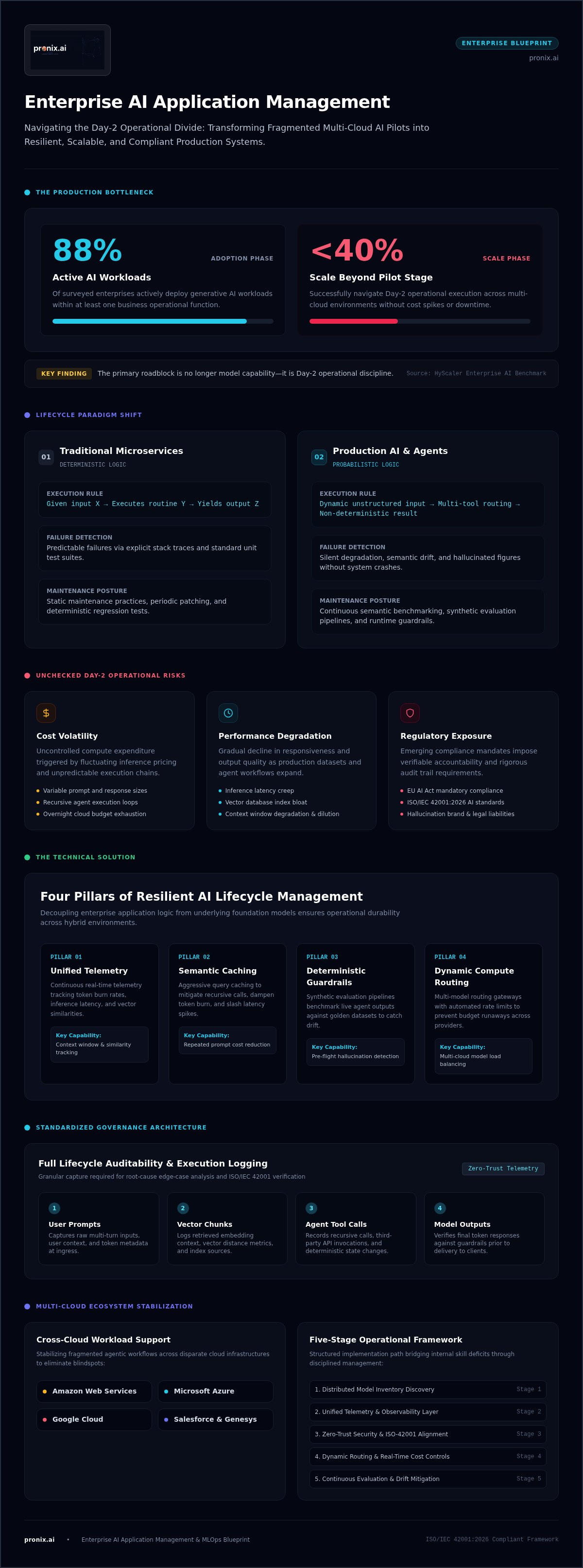
While 88% of organizations now run AI workloads in at least one business function, fewer than 40% successfully scale beyond initial pilots. The bottleneck is no longer model capability; it is day-2 operational execution. When fragmented agentic workloads scatter across AWS, Azure, and Google Cloud, they inevitably trigger observability blindspots, model drift, and volatile inference bills. True enterprise AI application management requires shifting focus from raw experimentation to resilient, multi-cloud operational discipline.
You already know that keeping pace with evolving compliance mandates while preventing latency spikes feels like an uphill battle. This operational blueprint shows you how to operationalize, govern, and scale production AI applications across multi-cloud enterprise architectures without runaway costs or operational downtime. Ahead, we break down standardized governance telemetry, real-time cost controls, and specialized managed services frameworks designed to bridge internal talent shortages and harden enterprise systems for the long haul.
Key Takeaways
- Mastering enterprise AI application management requires shifting focus from initial model deployment to continuous day-2 orchestration and non-deterministic risk mitigation.
- Building a unified telemetry layer provides instant visibility into token burn rates, inference latency, and contextual accuracy across disparate cloud stacks.
- Assessing total cost of ownership across internal hiring, cloud-native tools, and external partners uncovers hidden operational friction before margins erode.
- Executing a structured five-stage implementation framework aligns distributed model inventories with zero-trust security and ISO-compliant governance standards.
- Bridging internal skill deficits through specialized managed services stabilizes mission-critical agentic workflows across AWS, Azure, Salesforce, and Genesys.
What Is Enterprise AI Application Management and Why Does Day-2 Operations Matter?
Enterprise AI application management is the continuous orchestration, observability, and governance of production-grade intelligence workflows. Moving past day-1 deployment introduces severe operational friction. Traditional software relies on deterministic logic: given input X, code executes routine Y, yielding output Z. Generative models and autonomous agents, however, operate probabilistically. They interpret shifting unstructured data, invoke third-party tools, and produce non-deterministic results that static maintenance practices cannot handle.
According to an analysis by HyScaler in May 2026, while 87% of enterprises run AI in production, fewer than 40% successfully scale beyond early deployments. Post-launch breakdowns occur when platform teams treat intelligent agents like traditional microservices. Stabilizing these workloads requires an operational shift toward an advanced MLOps paradigm that unites IT operations, data engineering, and line-of-business stakeholders under a shared operational rhythm.
- Cost volatility: Variable prompt sizes, recursive agent execution loops, and fluctuating inference pricing cause uncontrolled compute consumption.
- Performance degradation: Latency creep, vector database index bloat, and context degradation degrade real-time responsiveness.
- Regulatory exposure: Shifting compliance standards, including the EU AI Act and ISO/IEC 42001:2026, require verifiable audit trails and operational accountability.
The Non-Deterministic Challenge: Software vs. AI Application Lifecycles
Static code bases break predictably through stack traces or failed unit tests. Probabilistic AI systems fail silently. A customer service agent might process requests smoothly today, but subtle semantic drift in upstream data pipelines can trigger hallucinations tomorrow. Standard regression suites verify syntax, but they cannot evaluate contextual alignment. Maintaining production integrity requires continuous semantic evaluation alongside traditional system health checks.
The True Cost of Neglected Day-2 AI Operations
Unmonitored runtime environments carry severe downstream consequences. Without aggressive rate limits and multi-model routing gateways, recursive agent loops burn through token allowances rapidly, generating astronomical cloud invoices overnight. Even worse, unchecked model drift exposes enterprises to catastrophic brand damage when hallucinated figures reach customers. Neglecting ongoing compliance audits creates massive legal liability under emerging governance frameworks, turning unmanaged artificial intelligence from a competitive edge into a major corporate vulnerability.
The Architectural Core: Key Pillars of Production AI Application Lifecycle Management
Operational stability requires decoupling application logic from underlying foundation models. Hyperscaler tooling focuses on initial sandbox provisioning, but production durability demands robust platform engineering. Resilient enterprise AI application management rests on four technical pillars: unified telemetry, semantic caching, deterministic guardrails, and dynamic compute orchestration. Sustaining this runtime environment requires a mature enterprise data strategy for AI that ensures clean data pipelines feed retrieval systems without silent corruption.
Every operational stack must enforce comprehensive auditability. Production environments should log the full execution lifecycle: initial user prompts, vector retrieval chunks, intermediate agent tool calls, and model outputs. This granular record enables precise root-cause analysis when agents hit edge cases or deviate from expected behavior.
Continuous Observability, Monitoring, and Model Drift Mitigation
Dynamic telemetry sits at the foundation of operational health. Organizations must monitor token generation speeds, inference latencies, context window utilization, and vector similarity metrics in real time. Deploying synthetic evaluation pipelines allows platform teams to benchmark live agent outputs against golden evaluation datasets, detecting semantic drift and accuracy degradation before users notice performance drops.
Guardrails, Security Protocols, and Enterprise Compliance
Production reliability collapses without deterministic controls. High-performance AI gateways must sanitize inbound prompts to intercept adversarial jailbreaks, prompt injections, and sensitive data leakage. Establishing enterprise governance means aligning platform telemetry directly with the NIST AI Risk Management Framework and ISO/IEC 42001:2026 standards, enforcing role-based access control (RBAC) across multi-cloud vector indices and internal APIs.
Cost Optimization and FinOps for Generative AI Workloads
Inference expenses escalate quickly without active traffic routing. Multi-cloud architectures avoid cost traps by deploying intelligent gateways that inspect prompt complexity before selecting a model tier:
- Intelligent semantic caching: Store high-frequency queries and embeddings in distributed cache stores to eliminate redundant foundation model calls.
- Dynamic model routing: Route routine extraction tasks to compact, fine-tuned models while reserving frontier reasoning engines for multi-step agent planning.
- Granular FinOps attribution: Tag every API interaction to establish clear departmental chargeback models across lines of business.
Operationalizing these architectural pillars across multi-cloud footprints requires deep platform engineering expertise. Forward-thinking teams often partner with pronix.ai to design resilient day-2 management frameworks that secure runtime operations while safeguarding infrastructure budgets.
Evaluating Enterprise AI Management: In-House vs. Native Cloud vs. Managed Services
Selecting an operational delivery model dictates long-term software resilience and infrastructure spend. Hyperscalers argue that proprietary cloud consoles solve every operational hurdle. In reality, large enterprises rarely run on a single platform. Most modern environments span AWS, Azure, Google Cloud, Salesforce, and Genesys. Evaluating your operational framework requires balancing engineering overhead, multi-vendor agility, and overall execution velocity. Rigorous vetting starts with the criteria in choosing an enterprise AI managed service provider to match operational capabilities with organizational readiness.
| Dimension | Internal Platform Engineering | Hyperscaler Native Stack | Specialized Managed Services |
|---|---|---|---|
| Multi-Cloud Visibility | Custom-built; high maintenance | Siloed to proprietary cloud console | Unified across cloud and SaaS systems |
| Time to Market | Slow; constrained by hiring cycles | Fast for single-vendor sandboxes | Immediate; pre-built day-2 frameworks |
| Talent Overhead | High ongoing recruitment and retention | Moderate internal platform administration | Fully offloaded to experienced teams |
In-House Engineering: Capabilities, Limitations, and Overhead
Building dedicated internal platform teams provides total architectural control. If proprietary IP centers entirely on customized internal algorithms, in-house management makes strategic sense. However, the engineering drag is steep. Sourcing and retaining specialized MLOps and LLMOps professionals demands substantial payroll capital. Diverting core software engineers to build telemetry pipelines and monitor runtime drift stalls strategic product roadmaps.
Hyperscaler Native Tooling: Benefits and Lock-In Trade-Offs
Native tools offer simple one-click provisioning inside existing cloud agreements. Running an isolated pilot inside Azure AI Foundry or AWS Bedrock delivers immediate speed. The friction surfaces across hybrid environments. A native console cannot track agent latency across a Salesforce Service Cloud deployment or monitor an external contact center workflow, producing critical blindspots and expensive ecosystem lock-in.
Specialized Enterprise Managed Services: Scale, Velocity, and Governance
Partnering with a specialized provider eliminates operational overhead instantly. Rather than spending quarters building telemetry pipelines, enterprises gain proven frameworks on day one. A seasoned partner provides cross-disciplinary experts spanning data architecture, security compliance, and dynamic orchestration. This approach establishes resilient enterprise AI application management backed by strict service level agreements that guarantee uptime, enforce regulatory guardrails, and control operational expenditures.
Step-by-Step Implementation: Building a Resilient AI Operations Framework
Operationalizing intelligent systems requires a phased engineering methodology rather than ad-hoc administration. Moving from isolated prototypes to enterprise AI application management demands clear governance stages, measurable performance baselines, and structured integration paths. Teams deploying autonomous architectures should follow proven patterns for building enterprise AI agents to ensure every tool-calling workflow remains auditable and resilient under production loads.
- Audit and classify: Catalog every shadow deployment, third-party API integration, and internal model endpoint across business units.
- Benchmark performance: Establish definitive target baselines for end-to-end token latency, accuracy, and monthly operational spend.
- Implement runtime telemetry: Inject distributed tracing across API gateways, vector databases, and execution runtimes.
- Harden security guardrails: Embed deterministic policy checks and automated content filters into active execution paths.
- Govern and iterate: Run ongoing FinOps evaluations and SLA reviews to prevent operational degradation.
Phase 1 & 2: Workload Discovery, Risk Classification, and Architecture Baselines
Execution begins with a comprehensive audit of all active AI workloads. Catalog every ungoverned endpoint, background batch job, and API integration. Next, categorize workloads by risk exposure, regulatory sensitivity, and business value. Establish concrete baseline metrics for average inference latency, token expenditure per query, and baseline semantic accuracy to measure future system degradation accurately.
Phase 3 & 4: Telemetry Deployment, Guardrail Hardening, and Orchestration
Deploy unified tracing agents across the application layer. Telemetry spans must capture user inputs, retrieval-augmented generation (RAG) chunk scores, and final responses. Next, harden security guardrails to intercept prompt injections, PII leakage, and non-deterministic logic failures before execution completes. Integrating these stages with structured enterprise AI automation managed services ensures orchestration layers communicate cleanly with core enterprise systems without introducing operational bottlenecks.
Phase 5: Continuous Operational Optimization and SLA Governance
Production reliability rests on proactive day-2 management. Configure automated alert escalations when semantic drift exceeds predetermined thresholds or API latencies breach contract SLAs. Platform engineers must conduct monthly FinOps reviews to refine model routing, prune outdated vector indices, and optimize system prompts. Continuous governance guarantees that production applications maintain strict compliance standards while maximizing ROI.
Ready to harden your operational foundation across multi-cloud environments? Partner with pronix.ai to operationalize your enterprise AI infrastructure with guaranteed reliability and enterprise governance.
Transforming AI Operations into Enterprise Value: The Managed Path Forward
Operational maturity transforms AI from an unpredictable cost center into a compounding revenue driver. Without rigorous runtime oversight, autonomous workflows degrade under shifting real-world data distributions and spiraling token usage. Achieving sustainable velocity requires comprehensive enterprise AI application management that bridges fragmented corporate architectures. Drawing on a proven systems integration heritage, as detailed in our review of Pronix Inc, organizations can eliminate operational friction across AWS, Microsoft Azure, Salesforce, Genesys, and Kore.ai platforms.
Multi-Cloud Operational Mastery Across Leading Enterprise Platforms
Modern enterprises can't afford platform silos. When an AI-driven CX modernization effort connects Genesys voice pipelines with Salesforce customer profiles and Azure cloud infrastructure, an unhandled failure in one layer quickly breaks the entire user journey. Unified managed operations dissolve these architectural silos. Instead of forcing internal teams to monitor disconnected vendor dashboards, a dedicated operational framework delivers synchronized telemetry across back-office automations, agent runtimes, and multi-cloud data estates. This vendor-agnostic approach protects your infrastructure from proprietary lock-in while preserving enterprise stability.
Predictable Performance, Rigorous Governance, and Managed Velocity
Talent shortages shouldn't stall operational expansion. Partnering with a specialized managed services provider gives your organization immediate access to seasoned engineers across data architecture, model telemetry, and regulatory compliance. This model offloads the heavy burden of ongoing agent maintenance, regression testing, and FinOps reconciliation. Strict service level agreements guarantee system availability, enforce deterministic safety boundaries, and continuously align runtime resource consumption with strategic business objectives.
Reliable day-2 execution separates market leaders from stalled enterprise experiments. Robust enterprise AI application management ensures your deployed systems scale securely, run cost-effectively, and deliver measurable ROI. Contact pronix.ai today to harden your multi-cloud intelligence architecture and establish production-ready operational stability across your entire enterprise.
Mastering Day-2 Operations Across the Multi-Cloud Enterprise
Scaling generative workloads and autonomous systems requires moving past sandbox experimentation. Lasting business value demands disciplined enterprise AI application management that treats non-deterministic models with the same operational rigor as mission-critical software. Standardizing your telemetry, deploying deterministic guardrails, and actively routing inference requests across hybrid environments turns unpredictable cost centers into high-performing enterprise assets.
You don't have to carry the operational burden alone. Backed by Pronix Inc.'s enterprise systems integration and CX modernization heritage, our engineering teams deliver end-to-end managed services across AWS, Microsoft Azure, Salesforce, Genesys, and Kore.ai ecosystems. We help you enforce enterprise-grade auditability, ensure continuous security, and bridge internal talent gaps without slowing innovation.
Secure your competitive edge with an operational framework built for enterprise scale. Schedule a Consultation with pronix.ai to stabilize your production intelligence and achieve predictable business outcomes.
Frequently Asked Questions
What is the difference between MLOps, LLMOps, and enterprise AI application management?
MLOps standardizes training and deployment pipelines for predictive machine learning models. LLMOps focuses on foundation model tuning, prompt templates, and context window optimization. Enterprise AI application management encompasses both disciplines while extending across the entire software operational lifecycle. It unifies non-deterministic agent orchestration, legacy system integrations, multi-cloud runtime telemetry, and corporate compliance frameworks to ensure deployed intelligence drives measurable business outcomes.
How do enterprises effectively control and optimize inference costs in production AI systems?
Organizations curb inference expenses by deploying intelligent semantic caching and dynamic model routing gateways. Semantic caching resolves repeated queries without querying foundation models, cutting compute consumption immediately. Dynamic routing directs routine data extraction to fast, lightweight models while reserving expensive reasoning engines for complex workflows. Pairing these architectural controls with departmental FinOps chargeback models prevents runaway token consumption across distributed business units.
What are the most common security risks in managing production enterprise AI applications?
The primary security threats include indirect prompt injection, sensitive data exfiltration, and unauthorized tool execution. Malicious inputs can hijack autonomous agent logic, triggering unintended database queries or leaking confidential corporate records. Managing production workloads requires real-time gateway guardrails, strict role-based access control across vector stores, and zero-trust execution sandboxes that isolate agent actions from core operational systems.
How can organizations prevent model drift and hallucination in deployed generative applications?
Teams prevent drift and hallucinations by enforcing continuous semantic evaluations against golden benchmark datasets instead of relying solely on static software tests. Grounding retrieval-augmented generation pipelines in clean enterprise data ensures models generate answers from verified records. When an agent's retrieval confidence drops below established baselines, deterministic guardrails automatically intercept the output or route the transaction to human supervisors.
Can enterprise AI application management frameworks support multi-cloud architectures?
Yes. Modern enterprise AI application management frameworks decouple application logic from individual hyperscaler ecosystems. By deploying vendor-neutral AI gateways and unified telemetry layers, organizations can orchestrate models running across AWS and Microsoft Azure while bridging enterprise workflows across Salesforce and Genesys. This hybrid approach eliminates single-vendor lock-in, optimizes compute pricing, and ensures continuous operational visibility across all deployed workloads.
When should an enterprise transition from internal AI operations to a managed service provider?
Enterprises should transition when day-2 operational maintenance diverts core engineering teams from strategic product roadmaps. If internal teams face talent shortages, struggle to manage volatile inference costs, or lack multi-cloud governance capabilities across disparate platforms, an experienced managed services partner provides immediate stability. External specialists deliver proven telemetry frameworks, deep architectural expertise, and strict SLAs without costly hiring delays.