

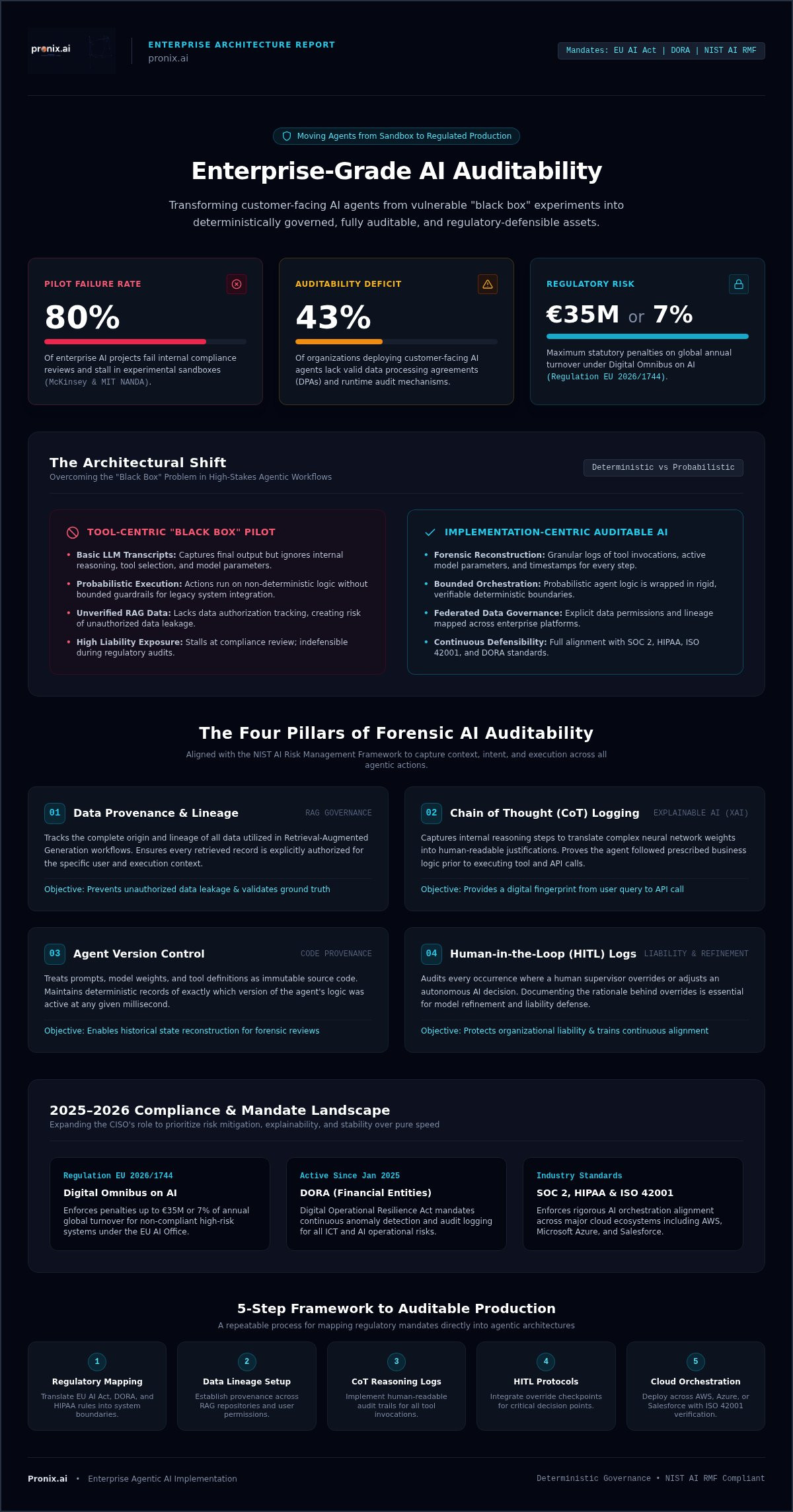
As of mid-2026, 43% of organizations deploying customer-facing AI agents still lack valid data processing agreements and runtime audit mechanisms. This oversight leaves significant global turnover exposed to the enforcement powers of the EU AI Office and national regulators. Enterprise-grade AI auditability isn't a post-deployment checkbox; it's the fundamental architecture of the Agentic Enterprise. You've likely seen high-potential pilots stall because your legal team can't verify how a model reached a specific decision. It's a common friction point that prevents true scale.
We agree that the "black box" era of AI must end for regulated production to survive. This article outlines the definitive framework for moving agents from experimental sandboxes to fully auditable environments. You'll master the architectural requirements for forensic proof, including identity provenance and data lineage. We'll preview a repeatable process for aligning your AI orchestration with SOC 2, HIPAA, and the latest EU AI Act mandates to ensure your deployment is both bold and defensible.
Key Takeaways
- Identify the core reasons why 80% of AI pilots fail compliance reviews and how to bridge the gap to high-stakes production.
- Master the four pillars of Enterprise-grade AI auditability to ensure every agentic decision is reconstructible and defensible for regulators.
- Distinguish between tool-centric governance and implementation-centric architecture to avoid the common pitfalls of "black box" AI.
- Execute a repeatable 5-step framework for mapping regulatory requirements directly to your data foundation and lineage architecture.
- Learn how professional implementation strategies align AI agents with SOC 2, HIPAA, and ISO 42001 standards across AWS, Azure, and Salesforce.
The Auditability Deficit: Why Enterprise AI Pilots Stall
Enterprise-grade AI auditability is the technical capability to forensically reconstruct every step of an AI decision-making process. It moves beyond simple chat transcripts. True auditability requires a granular record of tool invocations, data retrieval contexts, and the specific model parameters active at the timestamp of inference. Without this level of detail, AI remains a liability rather than a production asset.
The "Pilot-to-Production" gap remains the primary hurdle for the modern enterprise. Research from McKinsey and MIT NANDA indicates that approximately 80% of AI projects fail to pass internal compliance reviews. These initiatives often die in the sandbox because they don't have a deterministic governance framework. In 2026, the cost of this deficit isn't theoretical. Under the Digital Omnibus on AI (Regulation EU 2026/1744), non-compliance for high-risk systems can trigger fines up to €35,000,000 or 7% of global annual turnover. Reputational damage from ungoverned hallucinations often exceeds the statutory penalty.
The Black Box Problem in Agentic AI
Standard LLM transcripts are insufficient for enterprise oversight. They capture the output but fail to explain the internal reasoning or the specific data lineage used in RAG workflows. Agentic AI introduces non-deterministic behavior where autonomous tools might execute actions based on probabilistic logic. This creates friction points when integrating with legacy systems that require rigid, rule-based execution. Moving to production requires shifting from these probabilistic "guesses" to a framework where every action is logged, bounded, and verifiable.
Regulatory Pressures in 2026
Current mandates in finance and healthcare have turned explainable artificial intelligence from a luxury into a prerequisite. Since January 2025, the Digital Operational Resilience Act (DORA) has required financial entities to maintain continuous anomaly detection and audit logging for all ICT risks, including AI. The CISO's role has expanded to govern these autonomous agents. They now prioritize stability and risk mitigation over pure speed. Enterprise-grade AI auditability provides the evidence-based success these leaders need to authorize full-scale deployment.
The Four Pillars of Forensic AI Auditability
Transitioning from experimental pilots to regulated production requires a rigorous architectural shift. You can't rely on basic logs. Enterprise-grade AI auditability demands a forensic approach that captures the context, intent, and execution of every autonomous action. This framework aligns with the NIST AI Risk Management Framework, providing the evidence needed to satisfy internal risk committees and global regulators alike.
Four distinct pillars form the foundation of this auditable architecture:
- Data Provenance: You must track the origin and lineage of all data utilized in Retrieval-Augmented Generation (RAG) workflows. This ensures every piece of information retrieved was authorized for the specific user and context.
- Chain of Thought (CoT) Logging: Capture the internal reasoning steps of the agent. This record proves the agent followed prescribed logic before executing a tool call.
- Version Control for Agents: Treat prompts, model weights, and tool definitions as source code. You need to know exactly which version of the "brain" was active at any given millisecond.
- Human-in-the-Loop (HITL) Interventions: Audit every instance where a human overrode an AI decision. Understanding the "why" behind these overrides is critical for model refinement and liability protection.
Explainable AI (XAI) and Chain of Thought
Standard observability tools often miss the "why" behind an agent's behavior. Implementing CoT logging provides a step-by-step audit trail that translates complex neural network weights into human-readable justifications. This is vital for high-stakes environments like healthcare or finance. Forensic explainability is the digital fingerprint of an autonomous decision. It allows auditors to trace a path from the initial query to the final API call, ensuring no "black box" logic remains. If you're struggling to map these workflows, our Agentic AI Implementation teams can help architect these forensic layers.
Data Lineage and RAG Governance
In a RAG environment, the "Ground Truth" must be auditable. You need to manage data permissions across federated enterprise systems to prevent unauthorized data leakage into model responses. Linking your execution logs to a robust enterprise data strategy for AI ensures that foundational requirements for data quality and access control are met before the agent ever goes live. This structured logic moves your AI from a probabilistic experiment to a deterministic business tool.
Evaluating Auditability: Tool-Centric vs. Implementation-Centric
Purchasing a governance dashboard is only 20% of the solution. Many executives mistake software licensing for compliance readiness. While a tool provides the interface, Enterprise-grade AI auditability requires a strategy built into the application’s core logic. You can't bolt auditability onto a finished product. It must be an architectural constraint from day one. Relying solely on third-party software creates a "governance gap" where the tool monitors the system, but the underlying workflows remain opaque and non-deterministic.
Professional services play a critical role here. They bridge the space between raw model outputs and defensible business records. A practitioner-led implementation ensures that your audit layers aren't just capturing data, but are capturing the *right* data to satisfy specific regulatory mandates. When evaluating a partner, look for those who prioritize evidence-based success over speculative pilots. Your implementation partner should be able to demonstrate how they map technical telemetry to the GAO Artificial Intelligence Accountability Framework, ensuring your governance, data, and performance metrics meet federal auditing standards.
The Limitations of Native Model Observability
Native logs from providers like AWS Bedrock or Azure AI are a necessary starting point, but they're insufficient for regulated production. These logs typically focus on system health and token usage rather than business logic or decision provenance. Relying exclusively on proprietary vendor tools also risks significant lock-in. If you move from one model provider to another, your audit history shouldn't stay behind. A cross-platform strategy allows you to build a unified audit layer that functions across multi-model environments, providing a single source of truth regardless of the underlying LLM.
The Implementation-First Advantage
Designing workflows with auditability as a core constraint transforms AI from a liability into a strategic asset. Implementation-first teams don't just deploy agents; they build the guardrails and event stores required for forensic reconstruction. Choosing the right managed services for agentic AI ensures that your compliance posture evolves alongside changing 2026 mandates. This proactive approach focuses on building immutable event logs and verifiable data lineage. It replaces the "black box" with a transparent execution pipeline that your legal and risk teams can actually sign off on. Practitioners who have navigated legacy modernization understand these friction points, ensuring that your AI automation integrates seamlessly with existing enterprise governance frameworks.
Roadmap to Auditable Production: A 5-Step Framework
Moving from a sandbox to a regulated environment requires a methodical implementation lifecycle. Enterprise-grade AI auditability is not a static feature. It is an operational discipline that ensures your agents remain compliant as they scale. Successful deployment follows a structured, five-phase progression that prioritizes evidence over hype.
- Phase 1: Governance Assessment and Regulatory Mapping. You must identify which specific mandates, such as the EU AI Act or DORA, apply to your use case. Define your "Four Pillars of Proof" before writing code.
- Phase 2: Data Foundation and Lineage Architecture. Establish the bedrock. Every retrieval from your RAG stores must have a verifiable path back to its source document and authorization level.
- Phase 3: Pilot with "Glass Box" Reasoning Layers. Deploy your pilot with active Chain of Thought logging. This ensures that internal logic is visible to your risk committee during initial testing.
- Phase 4: Stress Testing and Red Teaming for Compliance. Use adversarial simulations to find failure points. Verify that your guardrails prevent tool misuse and goal hijacking.
- Phase 5: Managed Production with Real-Time Observability. Launch with continuous evidence logging. Maintain an immutable record of every tool call, model version, and user interaction.
Architecting for High-Stakes Environments
Regulated industries like healthcare and finance have no margin for error. In healthcare, you need HIPAA-compliant data redaction layers that scrub PII before it reaches the model. Finance requires SEC and FINRA-level immutable event stores to track every transactional recommendation. We implement "circuit breakers" within the orchestration layer. These are deterministic logic gates that kill an agent's session if it attempts an unauthorized tool call or exceeds a risk threshold. Integrating these agents with your existing SIEM or SOAR platforms ensures that AI security events are treated with the same urgency as any other enterprise breach.
The Role of Managed Services in 2026
Models drift. Regulations change. A production agent that is compliant in January might fail an audit by June due to "Compliance Drift." Continuous monitoring is now a mandatory requirement for maintaining Enterprise-grade AI auditability. Managed production ensures that your compliance posture evolves alongside the shifting landscape of 2026 mandates. This marks the transition from a one-off "AI Project" to a permanent AI Operations (AIOps) model. Leveraging Agentic AI implementation services allows your team to focus on business logic while we handle the underlying governance architecture and runtime evidence logging. Partner with Pronix.ai to bridge your pilot-to-production gap.
Pronix.ai: Your Partner for Governed Agentic AI
Bridging the gap between a successful pilot and a secure production outcome requires more than a software license. Most enterprises possess the tools but lack the specialized data engineering and governance expertise to satisfy 2026 regulatory standards. Pronix.ai serves as the strategic partner that operationalizes Enterprise-grade AI auditability across your entire tech stack. We specialize in transitioning complex AI agents from experimental sandboxes to fully auditable, high-scale production environments. Our teams bring deep technical proficiency in AWS, Microsoft Azure, Salesforce, and Genesys to ensure your AI orchestration layer integrates seamlessly with your existing enterprise architecture.
The pronix.ai advantage is rooted in over 15 years of experience. As a division of pronix.ai, founded in 2010, we've spent decades navigating the friction points of legacy system modernization and CX transformation. We understand that in regulated industries like healthcare and finance, stability and risk mitigation are non-negotiable. Our approach moves away from speculative hype, focusing instead on evidence-based success and operational maturity.
From Strategy to Managed Outcomes
We provide an end-to-end lifecycle that encompasses strategy, implementation, and long-term managed services. This isn't just about deploying a model. It's about building the "Data & AI Foundations" required for forensic traceability. For example, when modernizing CX for global clients, we don't just automate responses. We implement the runtime guardrails and immutable event stores that regulators now demand. Global enterprises trust pronix.ai because we treat AI as a core business operation rather than a side project. Our managed services ensure your agents remain efficient, auditable, and compliant as your business scales.
Next Steps for Your Agentic Journey
Every organization sits at a different point on the AI maturity curve. Your roadmap must reflect your specific industry mandates and technical debt. We recommend starting with a formal AI Maturity Assessment led by our senior practitioners. During this evaluation, we map your current architecture against the Four Pillars of Proof, identifying gaps in data lineage or execution provenance. We then customize a governance framework that aligns with your specific risk profile. Don't let compliance hurdles stall your innovation. Schedule your 2026 AI Strategy Consultation today to secure your path to auditable production.
Scaling Regulated AI with Operational Maturity
The transition from experimental AI to regulated production requires a shift from probabilistic outputs to forensic certainty. Enterprise-grade AI auditability is an architectural requirement, not a software feature. By prioritizing data provenance and Chain of Thought logging, you build a defensible foundation that satisfies global regulators and internal risk committees. Success in 2026 depends on implementation-first strategies that bridge the gap between high-level vision and managed outcomes.
Pronix.ai brings over 15 years of enterprise systems experience to this challenge. We specialize in deploying Agentic AI for Finance, Healthcare, and Manufacturing. Our practitioners provide the end-to-end managed services needed to move your agents into production safely. We focus on stability and risk mitigation to ensure your automation delivers measurable impact without compromising compliance. The path to auditable AI is clear. Schedule a consultation with our AI implementation experts to assess your maturity and secure your production roadmap. Your journey toward a governed, autonomous enterprise starts here.
Frequently Asked Questions
What is the difference between AI monitoring and AI auditability?
AI monitoring tracks real-time performance, health, and latency. It's an operational necessity to ensure the system stays online. In contrast, auditability provides the forensic evidence needed to reconstruct a decision after it occurs. Monitoring tells you if the system is functioning, but auditability tells you exactly why it took a specific action. For regulated production, you need both. Monitoring handles the "how," while auditability satisfies the "why" for legal and compliance teams.
How does Agentic AI auditability impact system latency?
Implementing forensic logging layers can introduce minor overhead. This typically adds 50 to 150 milliseconds per request depending on the depth of the logging. We mitigate this by using asynchronous pipelines and dedicated event stores. This ensures that capturing enterprise-grade AI auditability data doesn't degrade the end-user experience. High-performance architectures prioritize parallelizing the audit trail creation with the model's inference cycle to maintain speed without sacrificing oversight.
Can I achieve enterprise-grade auditability with open-source models?
Yes, open-source models often provide superior auditability because you have full control over the weights and inference environment. Unlike closed-box proprietary APIs, open-source deployments allow you to inspect the entire execution stack. You can implement custom telemetry and immutable event stores directly into your private cloud. This level of transparency is essential for industries where data residency and model explainability are core regulatory constraints that proprietary vendors can't always satisfy.
What are the specific audit requirements for AI in healthcare?
Healthcare audits focus on HIPAA compliance, PII redaction, and clinical decision provenance. You must prove that no protected health information was used to train or prompt the model without explicit authorization. Every clinical recommendation made by an agent requires a clear "Ground Truth" reference. Auditors look for evidence that the agent's logic aligns with established medical protocols and that a human-in-the-loop reviewed any high-risk diagnostic or treatment outputs.
How do I handle auditability for agents that use external tools and APIs?
You must log the exact parameters sent to every external tool and the raw response received. This creates a transactional lineage for every API call. We recommend using dedicated service identities for each agent to track authorization levels. Capturing the state of the external system at the time of the call is critical. It prevents "black box" gaps where an agent's decision was influenced by external data you can't verify later.
What is Chain of Thought logging, and why is it critical for compliance?
Chain of Thought (CoT) logging records the intermediate reasoning steps an agent takes before reaching a final conclusion. It's critical because it transforms a probabilistic output into a deterministic, step-by-step logic trail. Regulators in 2026 require this level of transparency to ensure agents aren't hallucinating justifications. CoT logs provide the "why" behind the "what." This makes it possible for auditors to verify that the agent followed internal business rules and safety guardrails.
How often should AI agents be audited for compliance drift?
Continuous monitoring is the standard for 2026, but formal compliance reviews should occur at least quarterly. Compliance drift happens when a model's behavior shifts due to new data patterns or updated mandates. We recommend automated daily checks for guardrail violations and monthly deep-dives into decision provenance. This proactive cadence ensures that your enterprise-grade AI auditability framework remains effective as both the underlying technology and the legal landscape evolve.
Who is responsible for AI auditability: the developer or the CISO?
The CISO owns the governance framework and risk posture, while the developer is responsible for the technical implementation of the audit layers. It's a shared responsibility model. The CISO defines the "Four Pillars of Proof" required for compliance, and the development team builds the immutable event stores and telemetry pipelines to meet those standards. In the Agentic Enterprise, this collaboration is essential for moving any AI project into a regulated production environment.