

By 2026, the grace period for unmanaged AI experimentation will be officially over. For enterprise leaders, the focus has shifted from whether a model works to whether it can be audited. Maintaining AI compliance for regulated industries is no longer a legal checkbox; it's the foundational architecture required to move Agentic AI out of the lab and into the market. You've likely seen the technical debt that accumulates when pilots bypass traditional governance. It's a risk that no high-stakes organization can afford as the EU AI Act and updated SEC guidelines move into full enforcement.
This guide delivers a practitioner-led roadmap to transition your AI initiatives from fragile prototypes to stable, production-ready workflows. You'll learn how to architect for transparency, satisfy rigorous audit requirements, and bridge the talent gap currently stalling enterprise automation. We'll break down the specific frameworks needed to ensure your autonomous agents remain compliant, scalable, and secure. By the end of this article, you'll have the blueprint to turn regulatory pressure into a strategic engine for growth and operational maturity.
Key Takeaways
- Learn why 2026 standards require a fundamental shift from experimental pilots to governed Agentic AI architectures.
- Identify the critical SEC and FDA mandates necessary for maintaining AI compliance for regulated industries.
- Address the "Black Box" problem by implementing Model Explainability (XAI) and robust data foundations.
- Establish a cross-functional governance framework to manage autonomous agent boundaries and operational ethics.
- Discover how Enterprise AI Managed Services provide the specialized talent needed to ensure long-term auditability.
The Shift to Governed Agentic AI in 2026
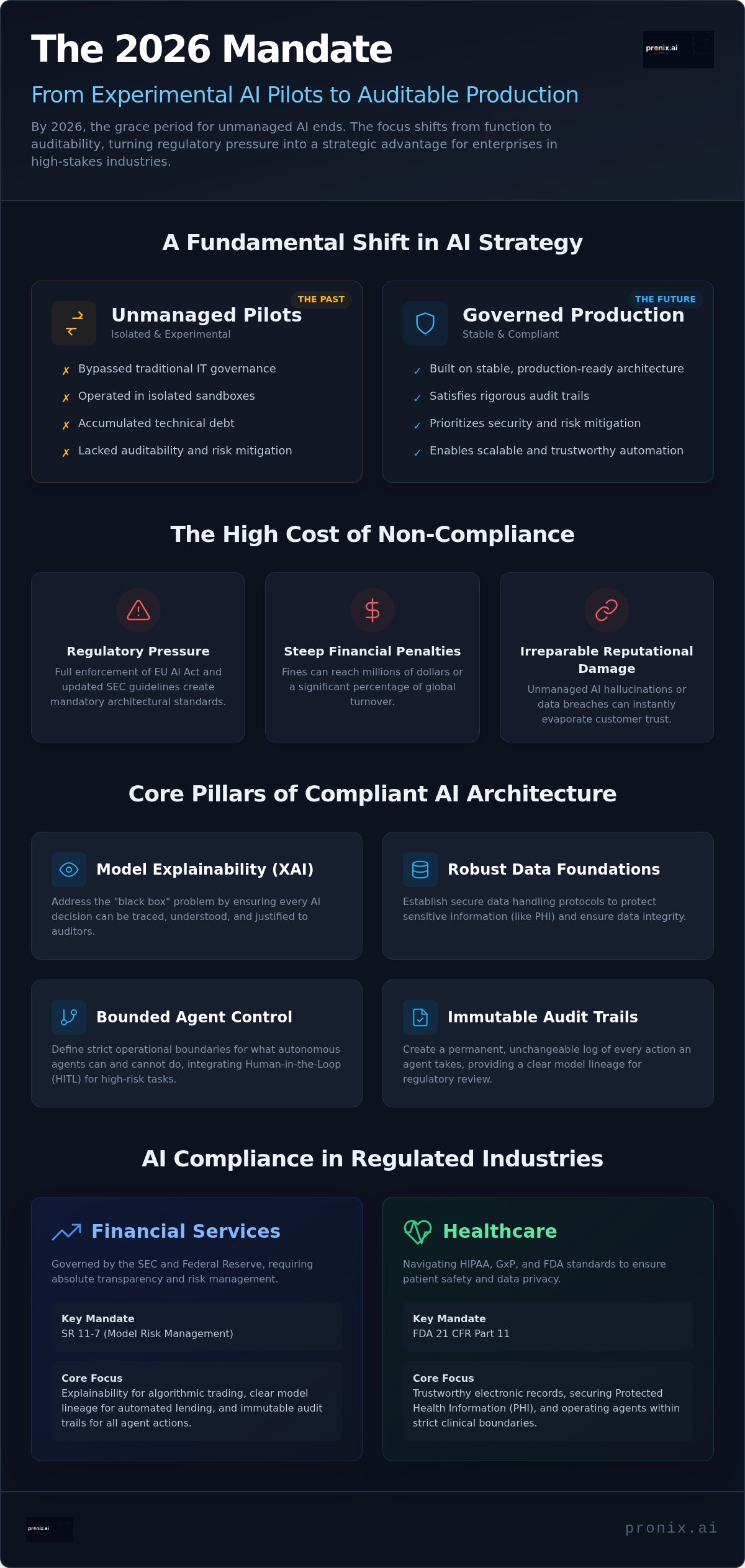
By 2026, enterprise AI compliance has evolved into a mandatory architectural standard. It's no longer a passive list of data privacy rules. Instead, it's an active requirement for every model deployed in a live environment. For organizations in healthcare and finance, the stakes are at an all-time high. Achieving AI compliance for regulated industries means moving beyond experimental sandboxes and unmanaged pilots. You need a framework that handles the complexities of production-grade systems while satisfying rigorous audit trails.
The primary challenge in 2026 is the transition from "AI pilots" to "governed production." Many organizations have spent years testing Large Language Models (LLMs) in isolated environments. These pilots often bypass traditional IT governance to favor speed. However, production environments demand stability, risk mitigation, and operational maturity. We view Responsible AI Adoption not as a bottleneck, but as a strategic advantage. Organizations that master governance early scale their automation faster because they have built-in trust with regulators and stakeholders.
Why Agentic AI Requires New Governance Models
Early AI implementations focused on static models that summarized text or answered queries. Agentic AI is a different beast. These systems don't just talk; they act. They interface with APIs, modify databases, and interact with customers autonomously. This autonomy introduces new compliance vectors. If an agent executes an unauthorized financial transaction or misinterprets a medical directive, the liability falls squarely on the enterprise. Managing these agents requires a shift from monitoring outputs to governing the underlying logic and permissions of the agents themselves.
Control is maintained through "bounded contexts." You must define exactly what an agent can and cannot do. Integrating a human-in-the-loop (HITL) protocol is essential for high-risk workflows. This ensures that while the agent provides the speed of automation, a qualified professional provides the final validation for sensitive outcomes. Agentic AI compliance is the orchestration of secure, traceable, and bounded autonomous actions.
The Cost of Non-Compliance in Regulated Markets
The financial implications of failure are steep. Global regulations coming into full force in 2026 carry penalties that can reach millions of dollars or a significant percentage of global turnover. Beyond the fines, the reputational damage from unmanaged AI hallucinations in customer-facing roles is often irreparable. If an agent provides incorrect financial advice or violates patient confidentiality, trust evaporates instantly. Transitioning to a mature model requires more than just technical skill. It requires a partner who understands the intersection of automation and auditability. Learn more about scaling these systems in our Enterprise Agentic AI: 2026 Production Guide.
Sector-Specific AI Regulations: Finance, Healthcare, and Beyond
Compliance isn't a one-size-fits-all framework. In 2026, the regulatory landscape has fractured into highly specialized mandates that vary by industry. For enterprise leaders, the challenge is no longer just "being compliant" in a general sense. It's about meeting the granular technical requirements of the SEC, FDA, and global bodies like the European Commission. Achieving AI compliance for regulated industries requires a deep understanding of how these specific rules impact your model architecture and data handling protocols.
Financial Services: Auditability and Model Lineage
Financial institutions operate under the strict gaze of the SEC and the Federal Reserve. Guidance like SR 11-7 (Model Risk Management) remains the cornerstone of banking compliance. It's not enough for an AI to be accurate; it must be explainable. You need a clear model lineage that proves exactly how a decision was reached in algorithmic trading or automated lending. Every autonomous agent action requires an immutable audit trail. This level of oversight ensures that "black box" algorithms don't introduce systemic risk or discriminatory bias into the financial system. If your team is struggling to maintain these rigorous standards, Enterprise AI Managed Services can provide the specialized oversight needed to mitigate long-term risk.
Healthcare: Data Foundations and Patient Privacy
In healthcare, the focus shifts to patient safety and data integrity. Navigating HIPAA and GxP standards requires specialized technical controls that many legacy systems lack. FDA 21 CFR Part 11 mandates that electronic records and signatures remain trustworthy and reliable. When you deploy Agentic AI in clinical settings, securing Protected Health Information (PHI) is the absolute priority. Agents must operate within strict clinical boundaries to avoid unauthorized data access or incorrect medical outputs. Building a compliant system starts with a robust Enterprise AI Data Strategy: 2026 Production Foundation. This ensures that the data fueling your agents is clean, governed, and audit-ready from day one.
Global Reach: The EU AI Act and Public Sector Sovereignty
The EU AI Act reaches full enforcement in 2026, and its impact is global. Any US-based enterprise with European operations must comply or face massive financial penalties. The Act categorizes AI systems by risk level, with "high-risk" applications requiring extensive documentation and human-in-the-loop oversight. Similarly, public sector projects often necessitate FedRAMP authorization and strict data sovereignty. You must ensure that data remains within specific sovereign boundaries to protect national security and intellectual property. These overlapping regulations demand a proactive approach to AI compliance for regulated industries. Waiting for an audit to identify gaps is no longer a viable strategy for growth.
Architectural Requirements for Compliant AI Systems
Architecture is the ultimate enforcer of policy. While legal teams define the rules, the engineering stack must execute them. Transitioning to production requires an infrastructure that treats auditability as a core service, not an afterthought. For high-stakes sectors, this begins with a unified data foundation. Clean, governed data is the silent engine of compliance. Without a traceable data lineage, AI compliance for regulated industries becomes an exercise in guesswork. You must ensure that every input used to train or prompt an agent is categorized, secured, and stored with clear provenance.
Observability is your first line of defense against operational failure. It's not enough to monitor uptime. You must monitor for model drift, bias, and hallucination in real-time. Production environments generate massive amounts of telemetry data. Use this data to trigger automated safeguards. If an agent's confidence score drops or its output deviates from established guardrails, the system should automatically revert to a human-in-the-loop (HITL) protocol. This level of oversight ensures that minor technical glitches don't escalate into major regulatory breaches.
Explainability vs. Performance: Striking the Balance
Auditors don't reward models for being "black box" geniuses. They require transparency. In 2026, a highly accurate model that cannot explain its reasoning is a non-compliant model. You must implement techniques like SHAP (SHapley Additive exPlanations) or LIME to deconstruct complex neural decisions into human-readable logic. This allows your legal and compliance teams to defend the model's actions during an audit. Explainability is a mandatory feature, not a technical trade-off, for regulated AI.
Secure Orchestration of AI Agents
Orchestration is where the most significant security gaps occur. When agents interact with platforms like AWS Connect, Genesys, or Salesforce Agentforce, they cross multiple security boundaries. You must secure these handoffs. Implement enterprise-grade identity and access management (IAM) specifically for your AI agents. Treat an agent like a privileged user with restricted permissions. Every API call and data transit point must be encrypted and logged. By securing the orchestration layer, you ensure that autonomous workflows remain within their intended bounded contexts without risking unauthorized data exposure. This proactive approach is the only way to maintain AI compliance for regulated industries as models become more complex.
The 2026 Enterprise AI Governance Framework
Governance is no longer a theoretical exercise. It is an operational discipline required to scale automation without inviting catastrophe. To achieve AI compliance for regulated industries, your organization must transition from ad-hoc oversight to a structured, repeatable framework. This process ensures that every autonomous agent operates within a defined legal and ethical perimeter. By following a methodical five-step approach, you can bridge the gap between high-level strategy and production-ready execution.
- Step 1: Establish a Cross-Functional AI Ethics and Compliance Board. This body must include representatives from legal, IT, security, and business units. Their role is to approve model use cases and set the risk appetite for autonomous actions.
- Step 2: Define Clear Bounded Contexts. You must restrict agents to specific domains. An agent designed for CX modernization should never have the permissions to access core financial ledgers or sensitive patient records unless explicitly required and audited.
- Step 3: Implement Automated Guardrails and 'Kill Switches'. Real-time monitoring must be backed by automated enforcement. If an agent deviates from its programmed logic or violates a compliance threshold, a "kill switch" should immediately terminate the session and alert human supervisors.
- Step 4: Continuous Auditing and Lifecycle Management. Compliance is a lifecycle, not a one-time event. Regularly review model performance, data usage, and agent interactions to ensure they remain aligned with evolving 2026 standards.
- Step 5: Training and Talent Alignment. Your engineering and operations teams need specialized training in responsible AI. Aligning talent with governance goals ensures that compliance is built into the code, not just added as a layer on top.
From Strategy to Implementation Plan
Successful governance requires aligning your AI goals with existing enterprise risk management (ERM) frameworks. This integration prevents "compliance silos" where AI teams operate independently of corporate standards. You must foster a 'Compliance-by-Design' culture where engineers view regulatory requirements as technical specifications. For a detailed roadmap on these processes, see our Enterprise AI Governance Framework: The 2026 Implementation Plan.
Risk Mitigation and Auditability
Auditability is the evidence of your governance. You need systems that generate automated compliance reports for regulatory bodies on demand. This includes managing a strict 'Chain of Custody' for all data used in Retrieval-Augmented Generation (RAG). You must be able to prove exactly which document an agent used to generate a specific response. Rigorous testing and validation protocols are mandatory before any production release. If you're ready to build an audit-ready infrastructure, our Agentic AI Strategy & Consulting team can help you design a framework that meets 2026 mandates while driving operational value.
Managed Services: Ensuring Long-Term AI Compliance
Internal teams often hit a wall after the initial deployment phase. Maintaining AI compliance for regulated industries isn't a one-time project; it's an ongoing operational marathon. Regulators in 2026 don't just scrutinize how a model was built. They demand proof of how it behaves in real-time. Most internal IT departments lack the specialized talent to monitor for model drift, bias, or emerging security vulnerabilities 24/7. This expertise gap creates a liability that high-stakes organizations can't ignore.
Enterprise AI Managed Services act as the bridge between innovation and stability. We provide "Talent as a Service" to ensure your systems remain audit-ready without draining your internal resources. At pronix.ai, we focus on securing production outcomes by integrating deep architectural knowledge with rigorous risk mitigation. We've navigated the friction points of modernizing legacy systems for healthcare and finance. Our team ensures your Agentic AI workflows remain compliant while you focus on your core business objectives.
The Managed Services Advantage for Regulated Firms
A managed approach delivers maturity that internal teams struggle to replicate. We implement proactive monitoring that detects bias or hallucinations before they reach a customer or an auditor. This isn't just about technical support. It's about ongoing strategy. As 2026 regulations evolve, your workflows must adapt. Our consultants provide the foresight needed to pivot your architecture ahead of new mandates. This disciplined oversight reduces long-term operational costs. It eliminates the technical debt that accumulates from unmanaged AI pilots and ensures your automation remains a scalable asset.
Conclusion: Moving Forward with Confidence
The path to production-ready AI is clear but demanding. It requires a strategic vision, a solid data foundation, and a robust governance framework. Management is the final, critical step in this lifecycle. It's the mechanism that preserves your brand reputation and ensures your autonomous agents operate within their bounded contexts. Transitioning from experimental pilots to governed production is no longer optional for leaders in regulated sectors. It's the prerequisite for growth in a high-stakes market. Ready to secure your AI future? Contact pronix.ai for a Governed AI Strategy Assessment and move your initiatives into production with absolute confidence.
Scaling Governed AI in a Post-Pilot Economy
The transition from AI experimentation to production-grade automation is the defining challenge for 2026. Success requires more than just high-performing models; it demands a rigorous architectural foundation and a governance framework that satisfies the most stringent auditors. By prioritizing explainability and secure orchestration, your organization can turn regulatory pressure into a competitive moat. Achieving AI compliance for regulated industries is a continuous process that relies on specialized talent and real-time observability.
You don't have to choose between innovation and auditability. We've developed a proven methodology for moving AI from pilot to production using established compliance architectures like AWS, Microsoft, and Genesys. Our focus remains on securing outcomes for the high-stakes healthcare and finance sectors. It's time to move your Agentic AI initiatives into a governed production environment. Secure your enterprise AI future with a pronix.ai strategy consultation. Let's build a foundation that's stable, scalable, and audit-ready. Your path to production starts today.
Frequently Asked Questions
What are the primary AI compliance regulations for financial services in 2026?
Financial institutions must adhere to SEC guidelines for AI in financial reporting and the Federal Reserve's SR 11-7 Model Risk Management standards. These rules require rigorous documentation of model lineage and validation of automated decisions. By 2026, regulators expect a higher level of auditability for autonomous trading and lending systems. AI compliance for regulated industries in finance centers on preventing systemic risk and ensuring every algorithmic outcome is traceable to a specific data input.
How does Agentic AI differ from standard Generative AI in terms of compliance?
Standard Generative AI focuses on content creation, while Agentic AI takes autonomous actions within enterprise systems. This difference introduces new risks like unauthorized transactions or data exposure. Compliance for agents requires defining strict bounded contexts and implementing kill switches to terminate non-compliant sessions. While standard LLMs require output filtering, Agentic AI necessitates deep integration with identity management and secure orchestration layers to maintain control over automated workflows.
Can we use open-source LLMs in a regulated industry environment?
You can use open-source models, but they must be deployed within a private, secure infrastructure to satisfy data sovereignty requirements. Many regulated firms choose to self-host models on AWS or Microsoft Azure to ensure that sensitive data never leaves their perimeter. This approach provides greater control over model weights and training data. However, the burden of security and maintenance falls on your team, making managed services a practical choice for long-term auditability.
What is 'Explainable AI' and why is it mandatory for auditors?
Explainable AI (XAI) refers to the technical methods used to make the internal logic of a model understandable to human auditors. It's mandatory because regulators in healthcare and finance refuse to accept black box decisions that lack a clear rationale. Techniques like SHAP or LIME help deconstruct how specific variables influenced a model's output. XAI ensures that your automated decisions are fair, transparent, and defensible during a regulatory review or legal challenge.
How do I ensure my AI contact center modernization is HIPAA compliant?
Ensuring HIPAA compliance requires securing Protected Health Information (PHI) through end-to-end encryption and strict access controls. You must integrate your AI agents with compliant platforms like AWS Connect or Genesys Cloud that offer Business Associate Agreements (BAAs). Your data foundations must also prevent PHI from being used in model training without proper de-identification. Regular audits of agent logs and interaction transcripts are essential to verify that no unauthorized data exposure occurred during customer interactions.
What role does the EU AI Act play for US-based companies in 2026?
The EU AI Act impacts any US-based company that provides AI services within the European Union or processes the data of EU residents. In 2026, the Act's full enforcement means that high-risk AI systems must meet stringent documentation and human oversight standards. Failure to comply can result in massive fines, often calculated as a percentage of global turnover. US enterprises must align their global AI compliance for regulated industries with these European standards to avoid market exclusion.
What are the first steps to building an AI governance framework?
The first step is establishing a cross-functional AI Ethics and Compliance Board that includes legal, security, and technical leads. This group defines the organization's risk appetite and approves specific AI use cases. Following this, you must conduct a thorough risk assessment of your current data foundations. Clear boundaries for autonomous agents must be established early to prevent scope creep. This structured approach ensures that governance is built into your technical architecture from the start.
How can managed services help reduce the risk of AI hallucinations?
Managed services provide the 24/7 monitoring and specialized talent needed to detect and mitigate model hallucinations before they impact production. These teams use advanced Retrieval-Augmented Generation (RAG) verification to ensure that agent outputs are grounded in factual, approved documentation. By outsourcing the operational burden of AI oversight, you reduce the risk of brand damage. Managed services provide a disciplined layer of human-in-the-loop validation that internal teams often lack the capacity to maintain.