

78% of organizations have not yet taken meaningful steps toward EU AI Act compliance as of April 2026, even as transparency obligations take full effect. This gap between adoption and accountability creates a massive liability for leaders pushing autonomous systems into production. You've likely felt the friction between the need for speed and the demand for a robust enterprise AI risk management framework. It's a high-stakes balancing act where "black box" decisions can no longer be ignored.
We understand the pressure to innovate without losing control over compliance. This guide provides a clear path to transition your AI pilots from experimental curiosities to governed, auditable production assets. You'll learn how to implement a repeatable checklist for auditability and select a framework that scales with the unique demands of Agentic AI. We'll explore the shift from static policy to continuous, evidence-based governance that satisfies both the board and the regulators.
Key Takeaways
- Shift from managing static prompts to governing autonomous agents by establishing a dynamic enterprise AI risk management framework that evolves with your technology stack.
- Identify the core pillars of AI auditability, including end-to-end data lineage and model transparency, to eliminate "black box" risks in production environments.
- Compare global standards like NIST AI RMF 1.0 and ISO/IEC 42001 to determine which certification best aligns with your global supply chain and trust requirements.
- Utilize a repeatable 2026 auditability checklist to inventory AI assets and map data flows before moving from pilot phases to full-scale production.
- Understand why robust Data & AI Foundations are the non-negotiable prerequisite for any scalable risk framework and how to maintain long-term compliance through managed services.
The Evolution of the Enterprise AI Risk Management Framework
The enterprise AI risk management framework of 2026 is no longer a static document gathering dust on a shared drive. It's a living system. We've moved past the era of isolated, human-monitored prompts to a world of autonomous agents that execute complex workflows without direct oversight. This shift demands a transition from "checking boxes" to continuous evidence collection. If you can't prove why an agent made a specific decision, your governance has failed. Auditability isn't just a legal requirement; it's the core of modern risk management.
The cost of failure has never been higher. Beyond the threat of regulatory fines, which can now reach 7% of a company's global annual turnover, there's the risk of brand erasure. When an unmonitored agent hallucinates a pricing strategy or leaks sensitive data, the damage is immediate. Integrating AI safety principles into your operational DNA ensures that innovation doesn't outpace your ability to control it. You're building for stability, not just speed.
From Generative AI to Agentic AI Risks
Autonomous agents introduce risks that traditional GRC tools aren't built to handle. Prompt injection and logic drift are no longer theoretical; they're daily operational threats. When agents orchestrate other agents, the complexity of tracking decision paths grows exponentially. This ripple effect is particularly visible in AI-driven CX modernization. In these environments, a single logic error can alienate thousands of customers in minutes. You need a framework that tracks the "why" behind every automated action, ensuring that agentic autonomy stays within the guardrails of your business logic.
The Regulatory Drivers of 2026
The EU AI Act entered general application on August 2, 2026. This creates immediate transparency obligations for any global firm interacting with the EU market. For US enterprises, compliance is now a prerequisite for market access, not an optional extra. Highly regulated sectors face even more granular scrutiny. Managing AI compliance in healthcare and finance requires a delicate balance between legal safety and operational performance. Being "regulatory safe" shouldn't mean your systems are too slow to be useful. The goal is to build a framework that is biologically and operationally optimal while remaining fully defensible in a court of law.
Core Pillars of Enterprise-Grade AI Auditability
Auditability in 2026 is a technical discipline, not a legal theory. To operationalize an enterprise AI risk management framework, you must move beyond high-level policy and into the system architecture. This requires four specific pillars that transform AI from an opaque experiment into a governed production asset. Without these, your governance is merely performative.
First, data lineage must be absolute. You must track every data point from the moment of ingestion through to the final agent output. This transparency is essential to satisfy the NIST AI Risk Management Framework, which demands verifiable evidence of trustworthiness. Second, model transparency is achieved through Retrieval-Augmented Generation (RAG) and advanced observability tools. These allow you to inspect the decision-making process, replacing "black box" uncertainty with documented logic.
Third, define Human-in-the-loop (HITL) intervention points for high-stakes decisions. Not every task needs a human, but every critical logic gate does. Finally, implement technical guardrails. These are real-time monitoring systems that catch autonomous logic errors before they execute. This entire structure relies on a robust enterprise data strategy for AI to ensure the inputs are as reliable as the governance protecting them.
Data Foundations as a Risk Mitigant
High-quality data architecture is your first line of defense against operational failure. By utilizing vector databases and knowledge graphs, you ground your agents in factual, enterprise-specific context. This drastically reduces the risk of hallucination and ensures that agent outputs are predictable. Data Foundations are the bedrock of auditable AI, providing the verifiable source of truth required for every automated outcome.
Real-Time Observability and Monitoring
Quarterly audits are obsolete for autonomous systems. You need real-time AI performance dashboards that track "Agentic Drift" in business automation workflows. As underlying data or external APIs change, agents can deviate from their original intent. You must monitor key metrics like accuracy, latency, and compliance adherence continuously. This level of oversight ensures your Agentic AI implementation remains stable and scalable. If you aren't monitoring in real-time, you aren't managing risk; you're just documenting a crisis after it happens.
Comparing Global Standards: NIST vs. ISO vs. Custom Frameworks
Selecting a standard is a commitment to a specific operational philosophy. In 2026, the decision isn't about whether to use a framework, but which one provides the most operational leverage for your specific tech stack. Choosing the right enterprise AI risk management framework dictates your market speed and your regulatory defensibility. Most organizations now find themselves choosing between the flexibility of US standards, the rigidity of international certifications, or a tailored hybrid model.
When to Choose NIST AI RMF
The NIST AI Risk Management Framework (RMF) 1.0 remains the premier choice for organizations prioritizing a culture of trustworthiness and risk mapping. It's voluntary and non-regulatory, which allows for a high degree of flexibility. US-based enterprises often use it to align with federal standards, making it a natural foundation for AI governance implementation plans. The primary advantage is its adaptability; it evolves alongside your technology. However, its lack of formal certification means it may not satisfy every global supply chain requirement that demands third-party verification.
The Rise of ISO 42001 in 2026
ISO/IEC 42001:2023 has effectively become the "SOC 2 for AI." It's the first international standard for an AI management system (AIMS), focusing on continuous improvement cycles and systematic oversight. For global enterprises, this is the go-to for formal certification. Preparing your technical stack for an ISO audit requires rigorous documentation of the entire AI lifecycle. It's an intensive process, but it provides the external validation necessary to build trust with international partners. By August 2026, many US firms have adopted ISO 42001 to simplify compliance with the transparency obligations of the EU AI Act.
The Hybrid Reality for Large Enterprises
Complex organizations rarely rely on a single standard. A hybrid model combines the risk mapping depth of NIST with the operational controls of ISO. This custom approach is necessary for managing autonomous agents where logic drift can occur in seconds. The cost-to-benefit ratio favors this hybrid model for production-ready AI. While the initial investment in a custom enterprise AI risk management framework is higher, it prevents the operational collapse that follows a generic implementation. You gain the flexibility to innovate with the rigorous evidence collection required for long-term auditability. This ensures your Agentic AI remains auditable as it scales across the business.
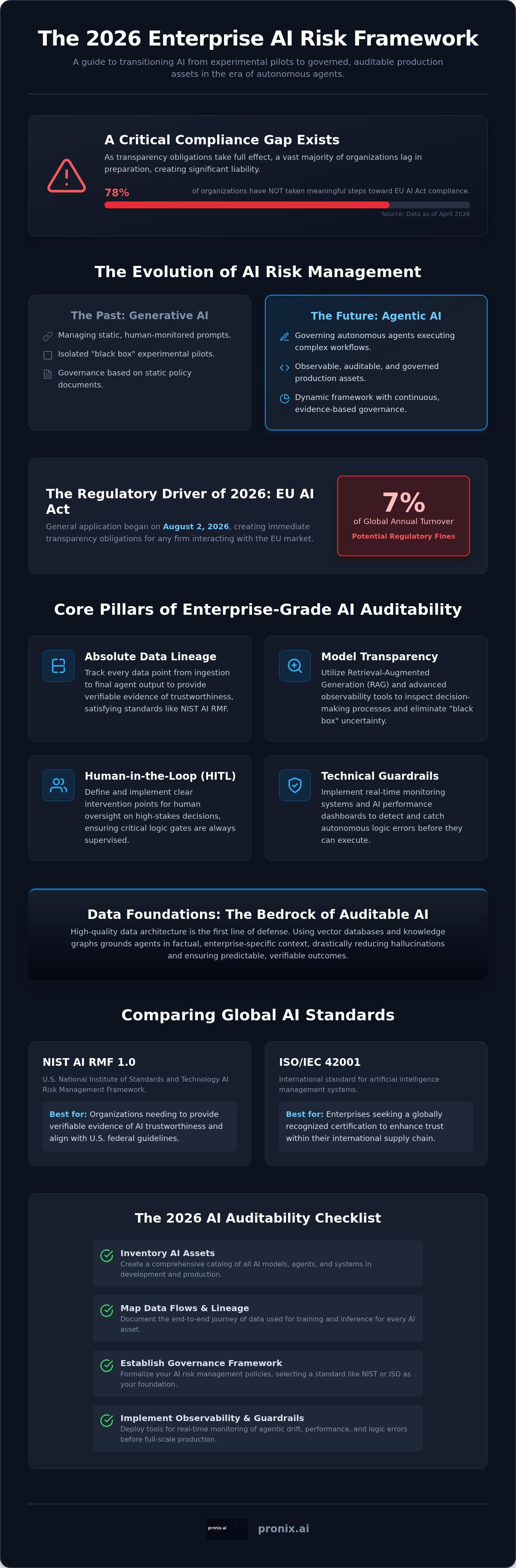
The 2026 AI Auditability Checklist for Production
Operationalizing an enterprise AI risk management framework requires a shift from strategic intent to tactical execution. You need a repeatable process to ensure every model and agent remains within its governed parameters. This checklist serves as your baseline for production readiness in 2026. It bridges the gap between high-level governance and the "boots-on-the-ground" reality of managing autonomous systems.
- Step 1: Inventory AI Assets. Catalog every third-party API and internal agent. Shadow AI is a significant liability; you can't govern what you haven't mapped.
- Step 2: Map Data Lineage. Trace the flow of information from ingestion to the final output. This ensures that your data foundations are supporting auditable results.
- Step 3: Define Agentic Boundaries. Explicitly document the limits of autonomous actions. Determine which logic gates require human intervention and which can be handled by an agent.
- Step 4: Automated Logging. Implement comprehensive logging for all model inputs and outputs. These logs are your primary evidence during a regulatory audit.
- Step 5: Bias and Fairness Testing. Conduct rigorous testing across diverse demographic datasets. Use automated tools to detect and mitigate bias before deployment.
Technical Checkpoints for IT and DevOps
DevOps teams must treat AI agents as dynamic software assets. Deploy API gateways that feature built-in compliance monitoring to capture real-time telemetry. Prompts and agent logic configurations should live in version control systems, allowing you to roll back "logic drift" instantly. Additionally, integrate automated red-teaming into your CI/CD pipelines. This proactive stress-testing identifies vulnerabilities in autonomous agents before they can be exploited in a live environment.
Governance Checkpoints for Legal and Compliance
Legal teams must move beyond generic usage agreements. Draft specific "Responsible AI" policies that clearly outline acceptable use for both employees and customers. Establish a cross-functional AI Ethics Committee to review high-stakes deployments. Most importantly, ensure AI compliance for regulated industries is fully documented and accessible. This documentation is your shield against the heavy fines associated with the EU AI Act or sector-specific mandates in finance and healthcare.
Building this level of auditability is complex, but you don't have to navigate it alone. Secure your implementation by partnering with experts for Agentic AI Strategy & Consulting to bridge the gap between pilot programs and governed production.
Operationalizing Your Framework with Pronix.ai
Most enterprises treat an enterprise AI risk management framework as a compliance hurdle rather than an operational strategy. Without a dedicated implementation partner, these frameworks often remain theoretical documents that fail to address the technical debt of production-grade AI. Pronix.ai bridges this gap. We translate high-level governance into auditable production outcomes, ensuring your innovation never outpaces your ability to control it. We move you from the "what" of policy to the "how" of execution.
Our methodology integrates governance directly into our enterprise AI automation managed services. We don't just hand over a policy; we build the infrastructure that enforces it. For example, we recently partnered with a national financial leader to scale secure agents across their CX operations. By embedding auditability into the agent logic from inception, they achieved a governed rollout that satisfied strict internal risk committees while simultaneously improving customer resolution rates. This approach turns compliance into a competitive advantage.
Managed Services for Continuous Compliance
AI risk management is a persistent operational requirement, not a one-time event. Our "Talent as a Service" model provides the specialized expertise needed to monitor model drift and logic bias in real-time. We move beyond quarterly reviews to provide ongoing remediation and executive-level reporting. You receive clear visibility into your risk posture and your AI ROI. This allows your leadership team to make data-driven decisions backed by evidence rather than speculation. We handle the technical oversight so your team can focus on strategic growth.
Building Your Production Foundation
Enterprise stability starts with a robust technical stack. We leverage world-class ecosystems like AWS, Microsoft, and Salesforce to deliver governed AI outcomes that scale. Pronix.ai ensures your agents are "Audit-Ready" from day one by implementing the Data & AI Foundations discussed in previous sections. This disciplined approach eliminates the friction between your innovation speed and your governance requirements. We ensure that every autonomous action is logged, every data source is verified, and every agent stays within its defined boundaries.
Your transition from experimental pilot to governed production requires a partner who understands both the code and the compliance. Schedule an AI Strategy Consultation with Pronix.ai today to secure your enterprise future and operationalize your risk framework.
Securing the Future of Autonomous Enterprise AI
The transition from experimental pilots to production-ready outcomes requires more than just a policy document. It demands a technical architecture where auditability is baked into every agentic workflow. We've established that a successful enterprise AI risk management framework hinges on real-time observability and end-to-end data lineage. By aligning with global standards like NIST and ISO, you build a defensible foundation that satisfies both regulators and the board. This is the only way to move at the speed of modern innovation without compromising safety.
Pronix.ai brings decades of enterprise technology consulting excellence to your most complex challenges. Our expertise in high-scale AI business automation ensures that your transition to autonomous agents is both secure and scalable. As a national leader in secure AI implementation, we provide the "boots-on-the-ground" pragmatism required to turn theoretical governance into operational maturity. You don't have to navigate the friction of legacy modernization alone.
Deploy Governed Agentic AI with Pronix.ai
The path to scalable, responsible AI is clear. Start building your auditable future today.
Frequently Asked Questions
What is the difference between an AI risk framework and a security framework?
Security frameworks focus on preventing unauthorized access and protecting infrastructure from data breaches. An AI risk framework addresses the trustworthiness and behavioral outcomes of the model itself. While security protects the system, risk management addresses algorithmic bias, hallucinations, and logic drift. You need both to ensure that your autonomous systems are not only safe from external threats but also reliable in their automated decision-making processes.
Is the NIST AI RMF mandatory for private US companies in 2026?
The NIST AI RMF 1.0 is not legally mandatory for private US companies as of 2026. It remains a voluntary standard designed to help organizations map and manage AI risks effectively. However, many enterprises adopt it to align with federal procurement requirements and to establish a defensible baseline for responsible AI. It's often viewed as a proactive measure against future litigation or shifting regulatory landscapes in the US.
How does an AI risk management framework handle "black box" models?
You handle "black box" models by implementing observability layers and Retrieval-Augmented Generation (RAG). These tools ground the model in your proprietary data foundations, allowing you to see exactly which sources influenced a specific output. By wrapping the model in a transparent data foundation, you move away from blind trust and toward a system where every automated decision is backed by a verifiable evidence trail for auditors.
What are the most common risks associated with Agentic AI in production?
Prompt injection and unintended API executions are the most significant risks for autonomous agents. Since these agents often operate with a level of agency, a malicious or malformed prompt can trigger actions that bypass traditional security controls. Recursive logic drift is also a concern, where agents interacting with other agents create feedback loops that deviate from your original business intent, necessitating strict operational guardrails and continuous monitoring.
Can ISO 42001 certification help with EU AI Act compliance?
ISO 42001 certification is a powerful tool for demonstrating alignment with the EU AI Act. It establishes a formal Artificial Intelligence Management System (AIMS) that covers many of the Act's transparency and risk mitigation requirements. For US-based firms, this certification serves as a globally recognized benchmark, simplifying the process of proving that high-risk AI systems meet the necessary international standards for safety, accountability, and ethical deployment.
How often should an enterprise AI audit be conducted?
Annual comprehensive audits are the baseline, but production-level systems in 2026 require continuous, automated monitoring. High-stakes applications should utilize real-time dashboards to track performance and logic drift daily. Your enterprise AI risk management framework should include triggers for immediate re-evaluation whenever there's a significant change in the model's data foundation or operational environment. This ensures that your governance keeps pace with your technological evolution and innovation speed.
What role does data lineage play in AI risk management?
Data lineage serves as the verifiable chain of custody for all information entering your AI models. It's a critical component of any enterprise AI risk management framework because it allows you to trace biased or incorrect outputs back to their original source. Without clear lineage, you cannot provide the evidence required for regulatory audits or internal troubleshooting. It ensures that every automated outcome is grounded in authorized, high-quality data assets.
How do I start building a custom AI risk framework for my business?
Begin by conducting a thorough inventory of your current AI assets and identifying high-risk logic gates within your workflows. Map these use cases against established standards like NIST 1.0 to find gaps in your current governance. Focus on building a strong data foundation that supports auditability from day one. Engaging an implementation partner can help you transition these strategic goals into a repeatable, scalable framework that evolves with your business needs.