

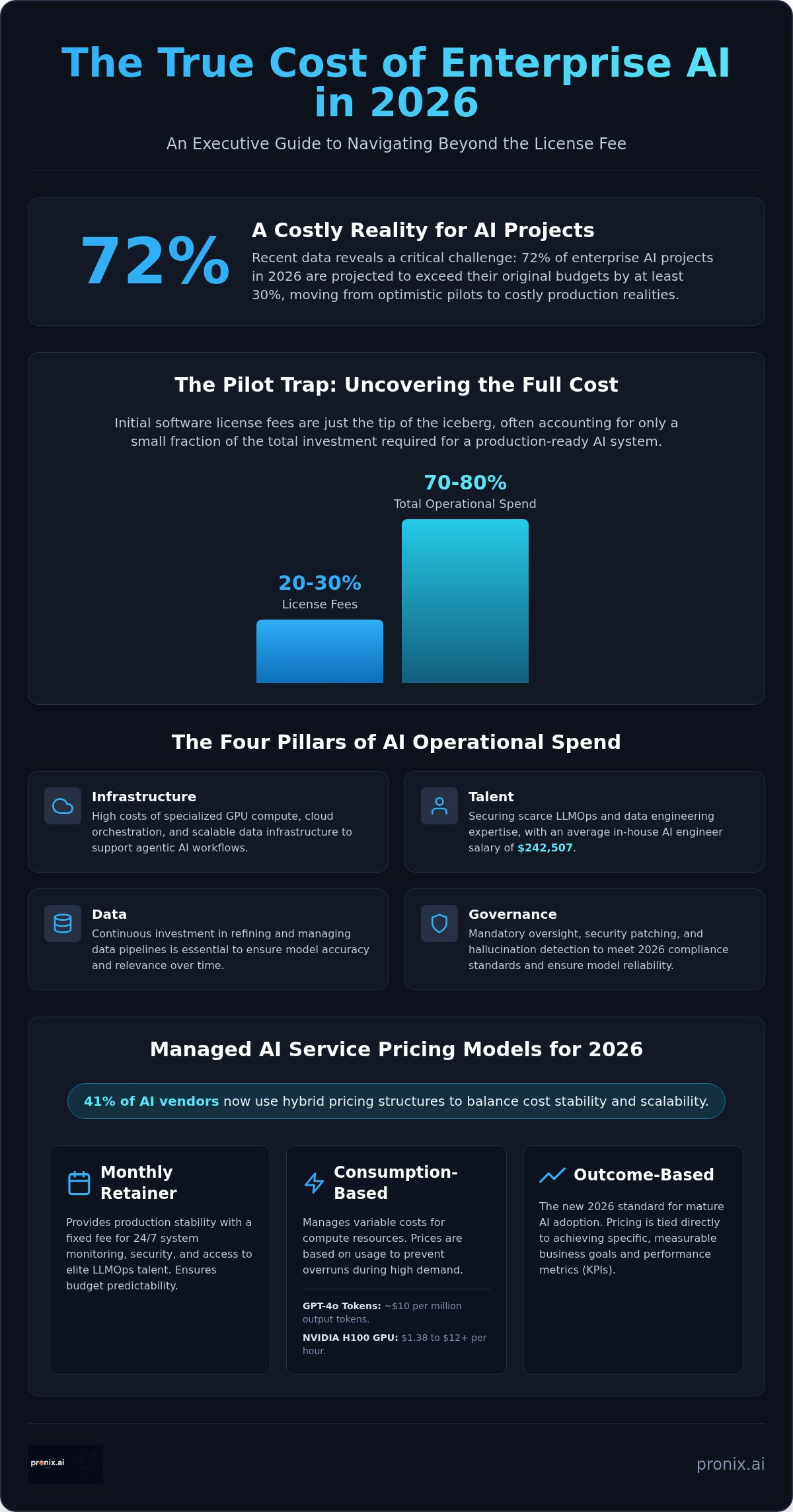
Recent data reveals that 72% of enterprise AI projects in 2026 exceed their original budgets by at least 30%. Most executive teams launch pilots with optimism, only to face the harsh reality of budget creep during the transition to full production. You likely recognize the friction. Unpredictable usage-based costs from LLM providers and the staggering $242,507 average salary for in-house AI engineers make internal scaling a high-risk gamble. Calculating the true cost of enterprise AI managed services requires moving past simple software estimates to account for governed orchestration and operational stability.
We understand that your goal is to scale rapidly without compromising your margins. This 2026 executive guide provides a rigorous budget framework to help you navigate the transition from monthly retainers to emerging outcome-based pricing models. You will learn to distinguish between baseline license fees and the strategic value of managed services. We provide the specific ROI metrics you need to justify these expenses to the CFO and ensure your AI investments translate into measurable business maturity. By the end of this guide, you will have a clear roadmap for maximizing your 2026 technology spend.
Key Takeaways
- Move beyond simple SaaS licensing to understand how hybrid pricing models combine base retainers with outcome-based triggers for better financial control.
- Identify the hidden operational expenses of scaling, ensuring the total cost of enterprise AI managed services covers essential LLMOps and data infrastructure.
- Learn to account for foundational investments in data strategy and governance to prevent budget overruns in highly regulated sectors.
- Utilize a professional ROI framework to baseline current workflows and justify managed service investments with clear, evidence-based performance metrics.
- Discover how a "pilot to production" methodology provides cost predictability across major ecosystems like AWS, Microsoft, and Salesforce.
The 2026 Enterprise AI Cost Landscape: Beyond the Per-Seat License
The 2026 landscape has evolved past the simplicity of per-user licensing. While many executives initially budget for $20 to $30 per-seat fees for tools like Microsoft 365 Copilot or Google Gemini, these figures represent a fraction of the actual operational requirement. Most organizations discover that license fees typically account for only 20% to 30% of the total cost of enterprise AI managed services. The remainder is consumed by the complex machinery required to move a project from a successful pilot into a stable, governed production environment.
Organizations often face the Pilot Trap. This occurs when a team successfully tests an AI application in a siloed environment but fails to account for the cost explosion that happens during scaling. To avoid this, budget planning must address the four pillars of AI operational spend:
- Infrastructure: The high cost of specialized GPU compute and cloud orchestration.
- Talent: The expense of securing scarce LLMOps and data engineering expertise.
- Data: The continuous refinement of data pipelines to ensure model accuracy.
- Governance: The mandatory oversight required to meet 2026 compliance standards.
The Distinction Between AI Software vs. AI Managed Services
It's vital to separate the tool from the expertise. Software costs cover the right to use an interface or an API. In contrast, Managed services provide the elite technical oversight needed to integrate these tools into legacy systems. As the demand for AI talent outpaces supply by five times in 2026, enterprises are moving toward a Talent-as-a-Service model. This allows leaders to bypass the $242,507 average salary for in-house AI engineers while gaining access to a team that specializes in stabilizing production systems.
The Impact of Agentic AI on Operational Budgets
The transition toward Agentic AI implementation services has fundamentally changed how CFOs view compute costs. Unlike simple chatbots that respond to a single prompt, autonomous agents operate with high concurrency. They execute multi-step workflows that require constant orchestration and monitoring. This shift increases the cost of enterprise AI managed services because the focus moves from maintaining a static tool to managing a dynamic, autonomous workforce. The Agentic Enterprise is the 2026 standard for operational efficiency, where autonomous agents handle complex business logic with minimal human intervention.
Managed AI Service Pricing Models: Retainers, Consumption, and Outcomes
By August 2026, the market has moved beyond speculative pricing toward models that prioritize operational transparency. Data shows that 41% of AI vendors now utilize hybrid structures to balance stability with scalability. Determining the cost of enterprise AI managed services requires analyzing how these models interact within your specific architecture. Most enterprises utilize a combination of monthly retainers for stability, consumption-based fees for compute, and outcome-based triggers for business value.
The consumption-based model remains the primary method for managing variable costs like LLM tokens and GPU cloud rental rates. For example, OpenAI GPT-4o usage is priced at $10 per million output tokens, while NVIDIA H100 rental rates range from $1.38 to over $12 per hour depending on the provider. These variable expenses are often managed under a service umbrella to prevent budget overruns during periods of high demand.
The Monthly Retainer: Managing Production Stability
The retainer model provides the specialized support necessary for production-grade AI. This fixed fee typically includes 24/7 system monitoring, security patching, and hallucination detection to ensure model reliability. A core element of this model is scalable AI infrastructure management, which prevents performance bottlenecks as your agentic workforce grows. Retainer fees scale based on the number of production agents and the complexity of the underlying data pipelines. This structure offers the budget predictability that CFOs demand while securing access to elite LLMOps talent.
Outcome-Based Pricing: The New 2026 Standard
Outcome-based pricing represents the most mature stage of AI adoption. It moves the focus from paying for tools to paying for results. In CX modernization, this translates to a per-resolution model where fees are only triggered when an agent successfully completes a task. Platforms like Salesforce and Genesys now facilitate this through flex-credit systems, allowing for a more equitable risk-sharing arrangement between the enterprise and the service provider. This model makes the cost of enterprise AI managed services highly justifiable by aligning every expenditure with a specific ROI metric. If you want to move from pilot to production with guaranteed cost-efficiency, evaluating Enterprise AI Managed Services is a critical step for your 2026 strategy.
The "Hidden" Costs of Scaling: Infrastructure, Governance, and Talent
Scaling AI reveals expenses that stay dormant during experimentation. Cloud egress fees and data movement costs frequently catch teams off guard. Transferring terabytes between legacy databases and LLM environments creates a recurring operational charge. These technical debts accumulate quickly. To maintain momentum, you must account for these infrastructure realities before they disrupt your 2026 margins. Calculating the cost of enterprise AI managed services requires looking beneath the surface of token usage to the underlying data transport layer.
The Governance and Auditability Tax
Regulated sectors face a unique financial burden. For these organizations, AI compliance for regulated industries is not just a checkbox; it's a significant portion of the total investment. Healthcare and finance agents require rigorous audit trails. You must account for "Human-in-the-loop" infrastructure to validate high-stakes decisions. Failing to do so risks penalties under the EU AI Act, where fines reach up to 7% of global annual turnover. Governed AI Production represents a non-negotiable budget line for 2026.
TCO Comparison: In-House Team vs. Managed Service Provider
Building an internal operations team is a massive capital commitment. A skeleton crew of four specialists, including a Data Engineer, LLMOps specialist, Security expert, and AI Architect, carries a heavy price tag. With the average AI engineer salary hitting $242,507 in 2026, your base payroll for this team exceeds $970,000 before factoring in benefits or overhead. Managed service providers offer a tiered alternative. They distribute these specialized costs across multiple clients, providing elite expertise at a fraction of the internal hiring cost. This approach stabilizes the cost of enterprise AI managed services while ensuring you aren't overpaying for idle capacity.
Integrating an enterprise AI risk management framework into daily operations requires constant vigilance. Internal IT teams often struggle with "Day 2 Operations," which involves the ongoing maintenance and monitoring after the initial launch. This leads to rapid burnout and high turnover. Using a managed partner stabilizes these workflows. It allows your core team to focus on strategic innovation rather than patching infrastructure. The service includes this peace of mind, ensuring your systems remain secure and audit-ready without draining your internal resources.
A Framework for Evaluating AI Managed Service ROI
Justifying the cost of enterprise AI managed services requires a shift from viewing AI as a tool to viewing it as a strategic asset. Executives often focus on immediate savings. Real value emerges through operational velocity. To build a persuasive case for the CFO, you must utilize a structured framework that quantifies both direct savings and long-term gains. This framework moves beyond software costs to measure the compounding impact of a stabilized production environment.
- Step 1: Baseline current costs. Map the manual overhead in CX, business automation, and data processing.
- Step 2: Factor in foundational strategy. Integrate the enterprise data strategy for AI as a necessary investment for accuracy.
- Step 3: Measure productivity acceleration. Focus on how much faster your team can execute complex tasks rather than simple headcount reduction.
- Step 4: Audit the cost of inaction. Account for the 30% budget overruns typical in unmanaged projects and the loss of market share to AI-first competitors.
- Step 5: Predict future spend. Apply the 2026 AI Maturity Model to forecast how costs will transition from implementation to optimization.
Measuring Value in CX Modernization
Implementing AI-driven CX modernization fundamentally changes your cost structure. In 2026, leading enterprises have moved past basic CSAT scores to measure "Revenue-per-Agent." This metric combines human empathy with AI speed. Managed services ensure these systems maintain peak performance at a lower total cost of ownership. By automating 24/7 production monitoring, you reduce the cost-per-interaction while increasing the quality of every resolution.
The Productivity Acceleration Metric
Productivity acceleration is the most critical KPI for manufacturing and finance sectors. Managed services reduce the typical "Time to Production" from 12 months down to 90 days. This speed is supported by a stable AI governance implementation plan. When your infrastructure is governed and automated, your team stops fighting fires and starts building new revenue streams. If you are ready to stabilize your budget and secure predictable outcomes, explore our Enterprise AI Managed Services to lead your industry in 2026.
Why pronix.ai is the Partner for Cost-Optimized AI Outcomes
Transitioning from a successful experiment to a scalable operation requires more than just technical skill. It demands a disciplined methodology that aligns technological capability with financial reality. Our "Pilot to Production" framework is designed specifically to address the budget volatility that often cripples internal AI initiatives. By standardizing the deployment lifecycle, we help organizations secure predictable outcomes while stabilizing the cost of enterprise AI managed services. We focus on removing the friction points that cause budget creep, ensuring your investment translates into operational maturity rather than technical debt.
Predictable Scaling for the Agentic Enterprise
Managing a multi-platform environment is a significant cost driver in 2026. Many enterprises struggle with fragmented ecosystems across AWS, Microsoft, Salesforce, and Genesys. This fragmentation leads to vendor lock-in and unforeseen cost spikes. We manage these diverse architectures as a unified ecosystem. Our 24/7 managed LLMOps ensures your production agents remain stable, secure, and efficient. Stability requires constant vigilance, and our team provides the oversight needed to prevent performance degradation. pronix.ai serves as the essential bridge between speculative AI experimentation and governed, high-yield ROI.
Bridging the Talent and Governance Gap
The talent shortage remains a primary barrier to AI adoption. As discussed, the expense of securing in-house specialists can quickly exceed a million dollars for a minimal team. Our talent-as-a-service model provides immediate access to elite AI practitioners without the long-term overhead of full-time hiring. This is particularly critical for regulated industries like healthcare and finance. We integrate auditability and security frameworks directly into your infrastructure, ensuring you meet the strict transparency rules of the EU AI Act and other global standards. This built-in compliance reduces the cost of enterprise AI managed services by eliminating the need for separate, expensive governance audits.
Every enterprise roadmap is unique. We invite leadership teams to engage in a strategic cost-benefit analysis to identify specific efficiency gains within their current architecture. This data-driven approach allows you to baseline your spend and project future savings with precision. If you are ready to move past the pilot phase and secure a production-ready future, schedule a 2026 AI Managed Services consultation with pronix.ai.
Securing Your 2026 AI Operational Maturity
Success in the 2026 AI landscape requires moving past the unpredictability of per-seat software licenses. You've seen how the true cost of enterprise AI managed services encompasses more than just tokens; it includes the vital infrastructure, elite talent, and rigorous governance required for production stability. By adopting a "Pilot to Production" framework, you can navigate these complexities with financial precision. Bridging the gap between experimentation and governed ROI is no longer an optional strategy; it's a competitive necessity for the agentic enterprise.
Our team provides deep expertise across the AWS, Microsoft, Salesforce, and Genesys ecosystems to ensure your workflows are both secure and scalable. We specialize in helping regulated sectors achieve governed outcomes without the overhead of massive internal hiring. It's time to transition your AI initiatives from high-risk pilots to stable, revenue-driving assets. Optimize your enterprise AI costs with pronix.ai managed services. We're ready to help you lead with confidence and operational excellence.
Frequently Asked Questions
How much do enterprise AI managed services cost on average in 2026?
In 2026, the market average for full enterprise solutions typically ranges from $5,000 to $50,000 per month. Initial setup costs for these systems often fall between $25,000 and $100,000 depending on the complexity of the data foundations. Small business subscriptions are lower, generally ranging from $2,000 to $5,000 monthly. These figures cover the continuous operational management of production environments rather than just the base software licenses.
What is the difference between AI consulting and AI managed services?
AI consulting focuses on high-level strategy, roadmap development, and initial system design. It's often a project-based engagement with a defined end date for delivery. In contrast, enterprise AI managed services provide the technical oversight required to stabilize and optimize production systems long-term. This includes ongoing 24/7 monitoring, security patching, and hallucination detection. Consulting builds the vision, while managed services ensure operational maturity and reliability.
How do managed services help control usage-based LLM costs?
Managed services implement rigorous guardrails and orchestration layers to prevent token waste and inefficient compute usage. Providers monitor API calls in real-time to identify runaway agents that could spike your usage-based fees. By optimizing prompt engineering and utilizing specialized models for routine tasks, they reduce the overall cost of enterprise AI managed services. This proactive management prevents the 30% budget overruns common in unmanaged environments.
Is outcome-based pricing better than a monthly retainer for AI?
Outcome-based pricing is often superior for mature CX modernization projects where value is tied to specific task resolutions. It allows for equitable risk-sharing between the enterprise and the service provider. However, a monthly retainer remains the standard for maintaining foundational infrastructure and production stability. Most 2026 leaders utilize a hybrid model. This combines the predictability of a base retainer with the performance incentives of outcome-based triggers.
What are the hidden costs of managing AI agents in-house?
Managing AI agents in-house involves several overlooked expenses that inflate the total cost of enterprise AI managed services. Beyond the $242,507 average salary for an AI engineer, you must account for cloud egress fees and data transport costs. Continuous model retraining and infrastructure maintenance also drain internal resources. These Day 2 operations often lead to IT burnout and high turnover, creating recruitment costs that exceed initial estimates.
How does pronix.ai handle AI managed services for regulated industries?
pronix.ai integrates secure, governed data foundations and auditability frameworks directly into the implementation lifecycle. For healthcare and finance, this includes maintaining strict compliance and ensuring every agent decision is traceable. Our focus on regulated sectors means we provide built-in compliance for the EU AI Act and other global standards. This approach reduces the burden on your internal legal teams while ensuring that high-stakes agents operate within safe guardrails.
Why is governance considered a cost driver in AI managed services?
Governance is a primary cost driver because it requires dedicated infrastructure for audit trails, bias monitoring, and human-in-the-loop validation. Enterprises now spend significantly on governance platforms to meet 2026 transparency rules. Implementing a framework like the NIST AI Risk Management Framework averages $15,000 with external consultancy. These measures are essential for risk mitigation, as they prevent catastrophic legal penalties that could reach 7% of global annual turnover.
Can I use an MSP if I already have a cloud provider like AWS or Azure?
Yes, an MSP acts as the expert orchestration layer sitting on top of your existing cloud infrastructure. While AWS and Azure provide the raw compute and storage, they don't offer the end-to-end management of specific agentic workflows or data foundations. pronix.ai specializes in managing ecosystems across AWS, Microsoft, and Salesforce. We ensure your cloud resources are used efficiently, preventing cost spikes while maintaining the production stability required for enterprise-grade AI.