

In 2026, the era of the experimental pilot is officially over. Most organizations have spent the last year distributing licenses only to find their teams using Copilot for nothing more than basic email drafting. Meanwhile, security leaders remain paralyzed by M365 data leakage concerns and the rigorous compliance mandates of the EU AI Act. You don't need more licenses. You need a professional framework for enterprise microsoft copilot implementation that converts expensive seats into measurable operational maturity.
We understand the friction of unpredictable ROI and the struggle to find internal talent capable of building custom agents. It's time to stop treating AI as a desktop utility and start treating it as a governed, agentic workforce. This article provides the 2026 production blueprint to move from passive assistance to autonomous execution at scale. You'll learn how to secure your data architecture, deploy "Copilot Cowork" agents for complex workflows, and finally close the gap between licensing costs and business value. We are moving from basic prompts to a fully orchestrated, production-ready AI ecosystem that prioritizes stability and auditability.
Key Takeaways
- Master the transition from experimental pilots to a governed enterprise microsoft copilot implementation that prioritizes operational maturity over simple license distribution.
- Establish a secure foundation using Zero Trust architecture and Microsoft Purview to ensure data hygiene and compliance with the 2026 EU AI Act.
- Move beyond basic assistance by leveraging Copilot Studio and "Copilot Cowork" to build autonomous, agentic systems that execute multi-step business workflows.
- Follow a structured 90-day deployment roadmap to bridge the gap between initial discovery and high-impact production outcomes.
- Solve the internal AI talent gap by utilizing managed services to maintain technical stability and ensure sustained ROI across the Microsoft 365 ecosystem.
Scaling Microsoft Copilot: Beyond the Pilot Phase in 2026
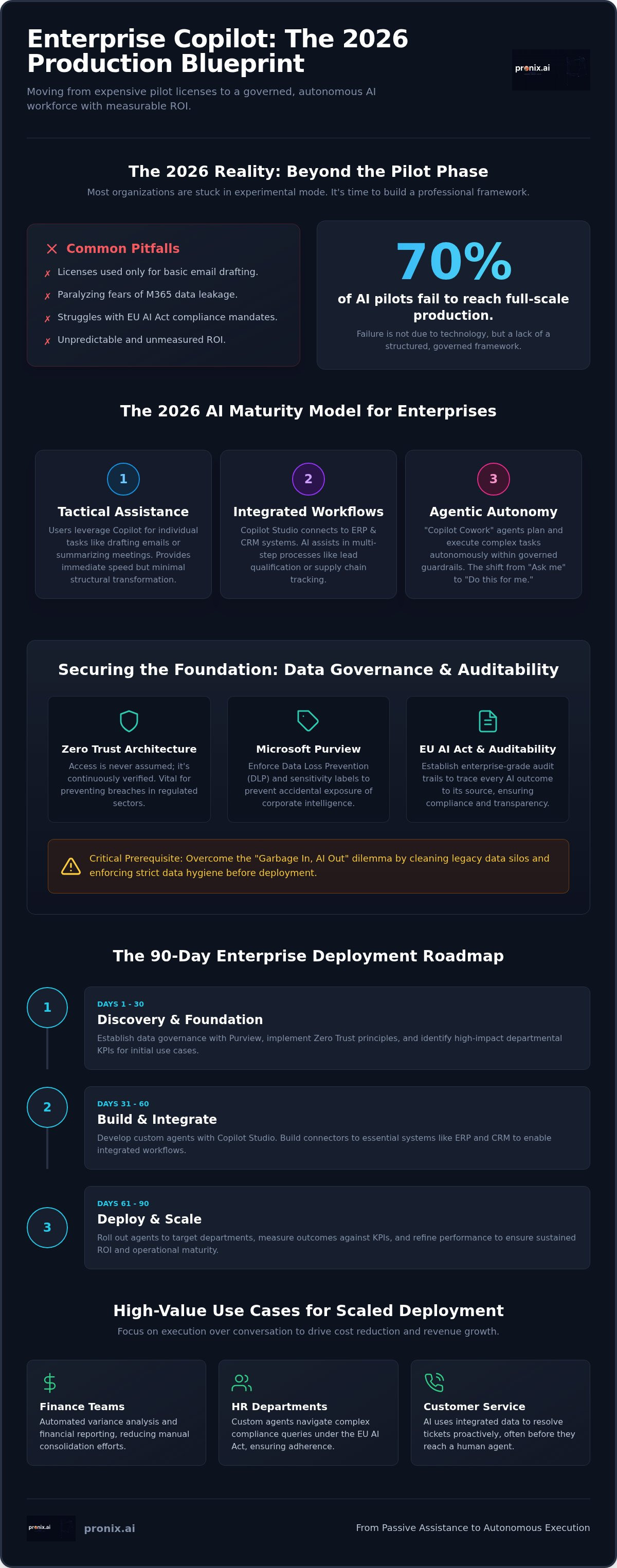
The 2026 enterprise landscape has moved beyond the novelty of AI prompts. Organizations that treated Microsoft Copilot as a simple M365 add-on are now facing a stark reality. Licensing is simple; achieving production-ready outcomes is a rigorous engineering challenge. Industry benchmarks indicate that 70% of AI pilots fail to reach full-scale production. These failures aren't caused by the technology itself, but by a lack of structured frameworks for governance and operational integration. Success requires a transition from experimental "playgrounds" to a disciplined enterprise microsoft copilot implementation that prioritizes stability, auditability, and measurable ROI.
Defining "Production-Ready" goes beyond technical uptime. It requires a secure data foundation where Microsoft Purview controls are strictly enforced to prevent sensitive data leakage. It demands a scalable architecture that can handle the increased token load of complex agents without degrading performance. Most importantly, it requires a clear path to business value. A systems integrator plays a critical role here, bridging the gap between Microsoft's broad licensing tiers and the specific, hardened configurations needed for a corporate environment. They provide the pragmatism required to turn a $30-per-month add-on into a strategic asset.
The 2026 AI Maturity Model for Enterprises
Maturity isn't measured by user seat count. It's measured by how deeply the AI integrates with core business logic. We categorize this evolution into three tiers:
- Level 1: Tactical Assistance. Users leverage Copilot for individual tasks like summarizing Teams meetings or drafting emails. This provides immediate speed but minimal structural transformation.
- Level 2: Integrated Workflows. Organizations use Copilot Studio to build custom connectors. The AI interacts with ERP and CRM systems, assisting in multi-step processes like lead qualification or supply chain tracking.
- Level 3: Agentic Autonomy. Following the general availability of Copilot Cowork in June 2026, systems have moved to agency. Agents plan and execute tasks autonomously within strictly governed guardrails, moving from "Ask me" to "Do this for me."
Identifying High-Value Use Cases for Scaled Deployment
Deployment must be driven by departmental KPIs. Finance teams use Copilot for automated variance analysis. HR departments deploy custom agents to navigate complex compliance queries under the EU AI Act. Customer service units use integrated data to resolve tickets before they reach a human agent. Avoid the "Chatbot Trap" where users spend more time conversing with the AI than completing work. High-impact enterprise microsoft copilot implementation focuses on execution over conversation, ensuring every deployment has a direct line to cost reduction or revenue growth.
Securing the Foundation: Data Governance and Auditability
A successful enterprise microsoft copilot implementation relies on the integrity of the underlying data. Without rigorous data hygiene, organizations face the "Garbage In, AI Out" dilemma. Low-quality or redundant data leads to unreliable outputs that erode user trust and operational stability. In 2026, data governance is no longer a passive IT function; it's a prerequisite for AI production. Organizations must deploy Microsoft Purview to enforce data loss prevention (DLP) and sensitivity labels across the M365 ecosystem. This ensures that Copilot only processes information it's authorized to access, preventing the accidental exposure of sensitive corporate intelligence.
Security requires a Zero Trust architecture. Access is never assumed. It's continuously verified. This approach is vital for regulated sectors where the stakes of a breach are catastrophic. In healthcare, implementations must strictly adhere to HIPAA standards to protect patient information. For financial services, compliance with SEC and FINRA mandates requires precise control over how AI interacts with transaction records and client communications. Establishing enterprise-grade auditability allows leadership to trace every AI-generated outcome back to its source data, providing the transparency required by the EU AI Act.
Data Engineering for Enterprise AI
Legacy data silos often contain conflicting information that confuses Retrieval-Augmented Generation (RAG) processes. Cleaning these silos is the first step in a mature enterprise data strategy for AI. A common hurdle is "over-sharing" within SharePoint and OneDrive. If a file is accessible to "everyone except external users," Copilot will find it and surface it. We recommend a comprehensive permission audit before rollout. Restructuring these permissions ensures that your AI implementation reflects your actual organizational hierarchy and security protocols.
AI Risk Mitigation and Compliance Frameworks
Guardrails are essential to prevent hallucinations in external-facing workflows. These technical boundaries stop the AI from making unauthorized commitments or providing inaccurate advice. Managed services provide the continuous monitoring necessary to detect risky AI behavior in real-time. Safety isn't a one-time setup; it's an ongoing operational commitment. To simplify adoption, every organization should adopt a clear stance. Our recommended 2026 policy: "AI must always operate as a transparent, auditable partner under human-led governance." For organizations struggling to align these technical requirements with business goals, our Agentic AI Strategy & Consulting provides a clear path to secure production.
From Assistance to Agency: Building Custom Copilot Agents
A standard enterprise microsoft copilot implementation often begins with out-of-the-box productivity features. However, true operational maturity requires a shift from passive assistance to proactive agency. In 2026, the competitive advantage lies in building custom agents that execute multi-step business logic without constant human prompting. This transition necessitates a strategic choice between development paths. Copilot Studio, starting at $200 per month per tenant, offers a low-code environment for orchestrating workflows within the M365 ecosystem. Conversely, Azure OpenAI provides the architecture for deeper, proprietary model development. For most production outcomes, building enterprise AI agents through Copilot Studio provides the fastest path to integrating with existing Salesforce and ServiceNow environments.
The move toward "Agentic AI" signifies a fundamental change in user interaction. We are moving away from simple "Ask me" prompts toward "Do this for me" commands. This shift is powered by the general availability of Copilot Cowork, which allows these systems to plan and execute tasks across disparate platforms. To succeed, leadership must prioritize the orchestration of complex business logic that spans both Microsoft 365 and third-party SaaS applications. Without this integration, your AI remains a siloed tool rather than a cross-functional asset.
Designing Intelligent Workflows with Copilot Studio
The power of a custom agent is its ability to access real-time enterprise data. By utilizing Microsoft Graph Connectors, agents pull context from across your digital estate. This ensures responses are grounded in current facts rather than static training data. Multi-turn agents represent the next evolution, capable of maintaining context through complex decision-making cycles. For example, in procurement, an autonomous agent can identify a low-stock alert, cross-reference preferred vendor lists in an external ERP, and draft a purchase order for approval. This moves the AI from a simple chatbot to a functional member of the operations team, ensuring that your enterprise microsoft copilot implementation delivers tangible labor savings.
Integrating Agentic AI into CX Modernization
Customer experience is the primary frontier for agentic systems. By integrating Copilot agents into the contact center, organizations can achieve a more sophisticated level of AI-driven CX modernization. These agents don't just provide scripts; they proactively orchestrate data from CRM platforms to resolve queries before they reach a human representative. When a human must intervene, the AI provides a comprehensive summary of the interaction and suggests immediate next steps. This orchestration significantly reduces average handle time and improves first-call resolution rates. In the 2026 contact center, the goal is not conversation for its own sake, but the rapid, autonomous execution of customer needs through disciplined AI architecture.
The 90-Day Enterprise Deployment Roadmap
A fragmented approach to enterprise microsoft copilot implementation leads to high licensing costs without offsetting productivity gains. Most organizations stall because they lack a time-bound execution plan. We utilize a 90-day roadmap to move from initial discovery to a hardened, production-ready environment. This structure ensures that technical readiness and business objectives align before the first license is assigned to a general user. Speed is a competitive advantage, but it's worthless without the stability provided by a methodical rollout.
Day 1-30: Establishing the AI Foundation
The first 30 days focus on technical readiness and governance. You must conduct a comprehensive data audit to identify over-shared files in SharePoint and OneDrive as discussed in our governance framework. Securing executive sponsorship is equally critical. Without top-down mandates, adoption remains elective and inconsistent. During this phase, define specific success metrics that go beyond simple usage statistics. For a deeper look at setting these benchmarks, consult our Enterprise Agentic AI: 2026 Production Guide.
Days 31 through 60 are dedicated to high-impact pilots and custom agent development. Rather than a broad rollout, focus on specific departments like finance or HR where the ROI is most visible. This is where you build the multi-turn agents that interact with your ERP and CRM systems. These 30 days allow you to refine agentic workflows in a controlled environment. Testing here prevents the "Chatbot Trap" by ensuring agents actually execute tasks rather than just generating text.
Day 61-90: Scaling for Production Outcomes
Scaling requires a Champion Network. These are power users who drive peer-to-peer adoption and provide real-time feedback on agent performance. By day 90, the focus shifts from internal testing to enterprise-wide production outcomes. You must automate your feedback loops to identify where agents are failing or where legacy data silos are still causing friction. This transition marks the move from "User Sentiment" to "Operational Savings," where success is measured by reduced handle times and automated task completion.
The final phase also involves moving from internal pilots to customer-facing AI agents where appropriate. This requires a final audit of your AI guardrails to ensure compliance with the 2026 EU AI Act. Scaling AI requires a partner who understands the friction points of legacy systems and modern automation. If you're ready to accelerate your journey, our Agentic AI Strategy & Consulting team can help you build a roadmap tailored to your specific infrastructure.
Managed Services: Ensuring Sustained Copilot ROI
A successful enterprise microsoft copilot implementation does not end after the initial 90-day rollout. The transition to production is merely the beginning of a continuous optimization cycle. In 2026, the primary challenge for leadership is the "AI Talent Gap." Finding and retaining experts who understand the intersection of M365 architecture, agentic orchestration, and enterprise security is increasingly difficult. Internal teams often struggle to maintain momentum while balancing day-to-day operations. Managed services solve this by providing a predictable, scalable alternative to the high costs and slow timelines of internal hiring.
Managed services provide the technical stability required to keep your AI ecosystem aligned with evolving business logic. While an internal hire might focus on a single department, a managed partner leverages cross-industry insights to refine your agents continuously. This ensures that your investment delivers a sustained return rather than stagnating after the first year. Success requires moving beyond basic adoption to a state of operational maturity where performance data drives every adjustment. For a detailed selection guide, see our framework for managed services for agentic AI.
Bridging the Gap with Specialized AI Talent
Accessing "Talent as a Service" allows your organization to scale rapidly without the friction of traditional recruiting cycles. Managed services ensure 24/7 governance and security monitoring, which is critical for maintaining compliance with the EU AI Act and industry-specific mandates like HIPAA. This proactive oversight prevents the performance "drift" that often occurs as enterprise data grows and changes. As a specialized systems integrator, pronix inc plays a vital role in this long-term strategy. We provide the elite expertise needed to manage complex architectures while ensuring your AI foundation remains auditable and secure.
Driving Long-Term Value and Innovation
Long-term value is built through quarterly AI maturity reviews and roadmap adjustments. These sessions allow leadership to assess agent performance against original KPIs and identify new high-value use cases across the enterprise. By staying ahead of AI trends, such as updates to Microsoft Agents or new Purview governance features, you ensure your enterprise microsoft copilot implementation remains a strategic asset. This iterative approach prioritizes evidence-based success over speculative hype. Moving from a pilot to a lasting production outcome starts with a strategic partner who understands the rigors of enterprise transformation.
Orchestrating Your AI Future: From Licensing to Operational Maturity
The transition from a basic pilot to a fully realized enterprise microsoft copilot implementation requires more than just seat assignments. Success in 2026 depends on shifting from tactical assistance to governed, agentic autonomy. You must prioritize a secure data foundation and deploy custom agents that execute multi-step business logic across your entire digital estate. By following a structured 90-day roadmap and leveraging managed services, you'll close the internal talent gap and ensure technical stability in a rapidly evolving market.
We provide the end-to-end strategy needed to move your organization from experimentation to production-ready outcomes. Our specialized expertise in regulated industries ensures that your automation is both powerful and compliant. It's time to stop treating AI as a utility and start treating it as a strategic workforce. Schedule your 2026 Copilot Production Readiness Assessment with pronix.ai to secure your competitive advantage. The path to measurable ROI is clear; let's build your production framework together.
Frequently Asked Questions
What is the primary difference between Microsoft 365 Copilot and custom Copilot agents?
Microsoft 365 Copilot is a broad productivity tool designed for standard applications; custom agents are purpose-built for specific business logic. Custom agents use Copilot Studio or Azure OpenAI to execute multi-step workflows by connecting to external databases and proprietary systems. Standard Copilot assists with content creation, while custom agents act on your data. This distinction is vital for a mature enterprise microsoft copilot implementation that targets specific operational outcomes.
How do we ensure our proprietary data isn't used to train public Microsoft models?
Microsoft does not use enterprise data from M365 tenants to train its public large language models. Your data remains within the M365 service boundary, protected by logical isolation and encryption at rest and in transit. This ensures that your proprietary corporate intelligence and customer data stay private. Organizations should use Microsoft Purview to audit and verify these data residency boundaries continuously to maintain total control over their digital estate.
What are the common hidden costs of an enterprise Microsoft Copilot implementation?
Hidden costs often include licensing upgrades to E3 or E5 prerequisites and the $200 monthly tenant fee for Copilot Studio. Organizations frequently underestimate the expense of data cleaning and engineering required for high-quality outputs. Technical debt from legacy SharePoint permissions can lead to unplanned remediation costs. The internal labor required for prompt engineering and agent maintenance often exceeds initial budget projections without a professional managed service partner.
Does Microsoft Copilot comply with HIPAA and GDPR in 2026?
Microsoft Copilot is compliant with HIPAA and GDPR as of 2026, provided the organization configures its tenant correctly. Compliance isn't automatic; it requires enabling specific Data Residency and Purview controls. The EU AI Act, enforced in August 2026, adds a layer of provable compliance. Organizations must maintain detailed audit logs and risk assessments to meet these evolving regulatory standards in healthcare and finance sectors across the country.
How many users do we need to justify the ROI of a managed implementation service?
ROI for managed implementation services is typically justified at 250 users or more. At this scale, the complexity of governance and the cost of licensing demand a professional framework to prevent waste. Smaller organizations may see ROI sooner if they deploy high-impact agentic workflows in specialized departments like finance or manufacturing. The focus should be on labor hours saved and task automation rather than simple seat counts.
Can Microsoft Copilot integrate with non-Microsoft platforms like Salesforce or AWS?
Yes, Microsoft Copilot integrates with non-Microsoft platforms through Graph Connectors and custom plugins. In 2026, these connectors allow agents to pull data directly from Salesforce CRM or AWS S3 buckets. This cross-platform orchestration is central to a successful enterprise microsoft copilot implementation. It allows the AI to act as a unified interface for disparate enterprise systems, breaking down traditional data silos to improve organizational efficiency.
What is the role of RAG (Retrieval-Augmented Generation) in Copilot implementation?
Retrieval-Augmented Generation (RAG) allows Copilot to ground its responses in your specific enterprise data instead of just public information. It acts as a bridge between the LLM and your private document libraries. RAG ensures that the AI provides accurate, context-aware answers based on current internal facts. Without RAG, the system is prone to hallucinations and lacks the specificity required for professional production environments where accuracy is the highest priority.
How do we handle user resistance during a large-scale AI rollout?
User resistance is best managed through a "Champion Network" and clear evidence of personal productivity gains. Instead of mandatory training, show employees how the tool automates their most tedious tasks, like drafting status reports or summarizing lengthy threads. Transparent communication about job evolution and AI guardrails helps build trust. Providing a safe sandbox for experimentation allows users to discover value at their own pace without fear of making errors.